Solana ETF Draws $39 Million Inflow in Single Week, Highest Since February, Futures Open Interest Surges 30%, Traders Target $120

marsbitPublished on 2026-05-12Last updated on 2026-05-12

Abstract

Solana ETF sees its strongest weekly inflow since February, attracting $39.23 million with Bitwise's BSOL ETF accounting for 92% of the total. This marks a potential reversal of a six-month downtrend in monthly inflows. Simultaneously, SOL futures open interest surged 29.5% in the first half of May, reaching $6.4 billion, indicating significant new capital entering the derivatives market. Spot buying pressure also increased, with the Cumulative Volume Difference (CVD) rising sharply. On the fundamental side, Solana's largest-ever consensus upgrade, Alpenglow, has launched on a community testnet, aiming to drastically reduce transaction finality times. Mainnet deployment could occur next quarter. Analysts note that after a four-month consolidation period, short-term traders have largely exited, leaving conviction holders in control of the supply. This shift in holder structure means any renewed trading volume is more likely to push prices upward. A technical Adam & Eve bottom pattern suggests a price target of $120. However, short-term momentum has shown signs of cooling near the $95-$96 resistance level. Risks remain, including potential pressure from exchange sell orders if ETF inflows weaken again and the threat of cascading liquidations from highly leveraged positions.

Author: Claude, Deep Tide TechFlow

Deep Tide Introduction: Solana spot ETFs recorded a net inflow of $39.23 million last week, their strongest weekly performance since February, with Bitwise's BSOL capturing 92% of the share. Futures open interest surged 29.5% in the first two weeks of May to $6.4 billion, with spot and derivatives buying activity amplifying simultaneously.

Technically, an Adam & Eve bottom pattern has emerged, pointing to a target of $120. Concurrently, Solana's largest-ever consensus upgrade, Alpenglow, went live on the community testnet on May 11, with co-founder Yakovenko indicating mainnet deployment could happen as early as next quarter. Capital flows, derivatives, and on-chain fundamentals are all emitting bullish signals simultaneously.

SOL is experiencing a multi-dimensional signal convergence.

According to a Cointelegraph report on May 11, Solana spot ETFs recorded a net inflow of $39.23 million last week, their strongest weekly performance since February. During the same period, the SOL price rose about 15% in seven days to around $97, while futures open interest grew by nearly $1.5 billion in half a month.

The on-chain holder structure is also quietly shifting: traders and hot money gradually exited during the four-month consolidation, and strong holders have regained control of the token supply. Any increase in volume after the sharp contraction will tend to push prices upward.

Signals from multiple independent data sources are lighting up simultaneously.

ETF Fund Flows Reverse Six-Month Downtrend, Bitwise BSOL Captures Over 80% Share

According to SoSoValue data, Solana spot ETFs saw a net inflow of $39.23 million last week, with Bitwise's staking ETF BSOL contributing $36 million, accounting for approximately 92%; Fidelity's FSOL saw an inflow of about $1.8 million. Since its launch, BSOL has accumulated approximately $861 million, representing 81% of the total cumulative inflow (approximately $1.06 billion) into all SOL spot ETFs.
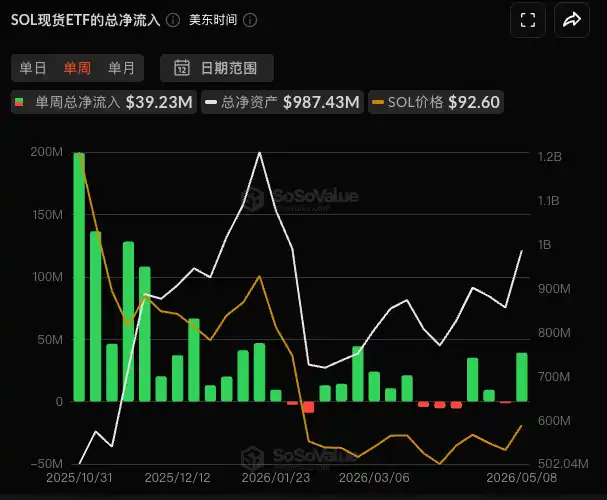
The significance of this figure needs to be understood within a longer timeline. Citing SoSoValue data, BeInCrypto reported that monthly inflows into Solana ETFs have declined for six consecutive months after hitting a peak of $419 million last November: $148 million in December, $105 million in January, $63 million in February, $45.44 million in March, and only $39.93 million in April, the lowest monthly performance since the products launched. The weekly inflow in the first two weeks of May has already approached April's full-month level. If the current pace continues, it will mark the first reversal of the six-month downtrend.

As of publication, the total net asset value of all SOL spot ETFs is approximately $938 million, with SOL accounting for about 1.82% of ETF net assets, and historical cumulative net inflows exceeding $1 billion.

Futures Open Interest Surges 30% in Half a Month to $6.4 Billion, Spot Buying Volume Also Expands

The signal from the derivatives market is equally clear.

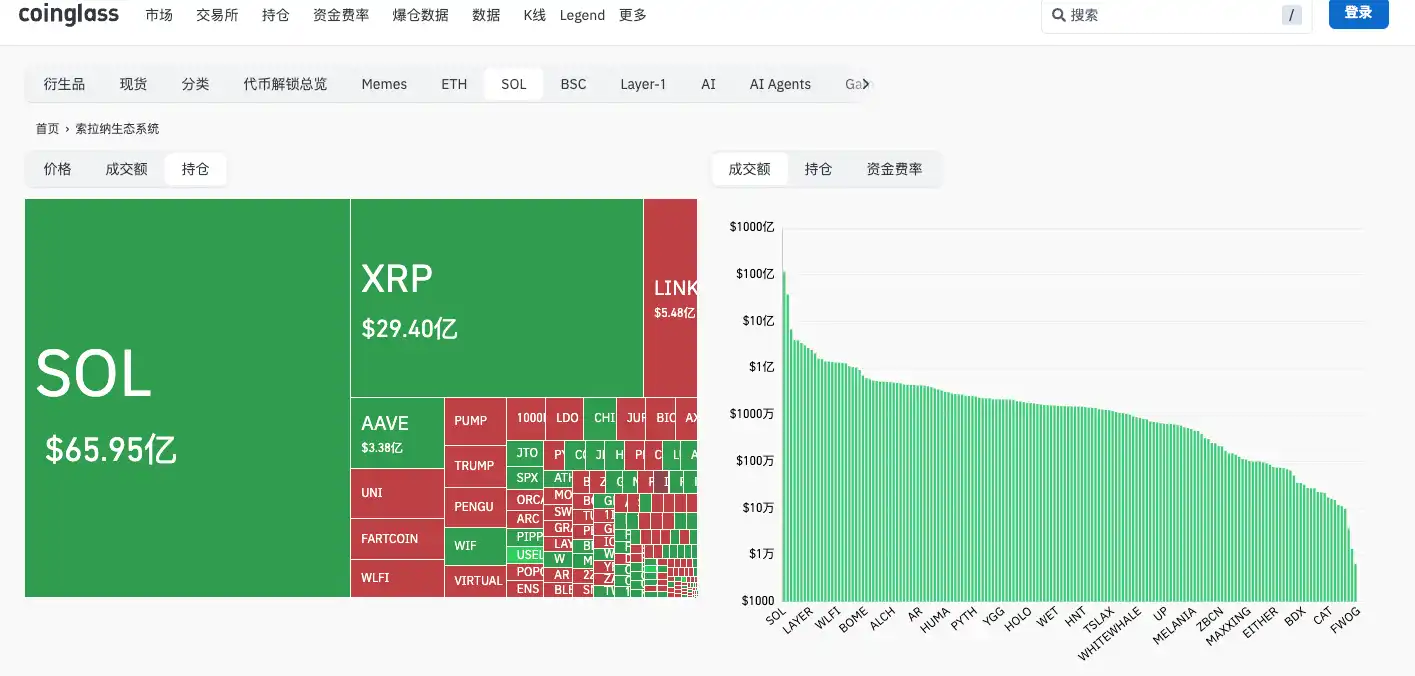
According to Coinglass data, SOL futures open interest climbed from $4.94 billion on May 1st to $6.4 billion, a 29.5% increase within half a month, representing an increment of approximately $1.5 billion. This is not merely increased leverage from existing players, but direct evidence of new capital entering the market.

Spot market buying activity is also cooperating. According to velo.chart data, the spot Cumulative Volume Delta (CVD, measuring the net difference between active buying and selling in the market) rose from $163 million to nearly $250 million over five days; futures CVD has been rising steadily since May 5th, expanding to approximately $594 million. Buyers are absorbing selling liquidity in both the spot and futures markets simultaneously.

The funding rate remains around 0.065%, indicating that longs are still paying to maintain their positions, but it hasn't reached overheated levels. However, after SOL reached the $95 to $96 range, the spot and futures CVD have started to flatten, suggesting short-term momentum has cooled somewhat.
Alpenglow Launches on Testnet, Solana's Largest-Ever Consensus Upgrade Enters Countdown

Beyond capital flows and technicals, fundamentals are also providing a catalyst.

According to a CoinDesk report on May 11, Solana's core development team Anza announced that the network's largest-ever consensus upgrade, Alpenglow, has gone live on a community test cluster. This upgrade will replace the current Proof-of-History and TowerBFT systems with the new Votor and Rotor protocols, aiming to compress transaction finality time from the current ~12.8 seconds to around 150 milliseconds—a speedup of nearly 100 times.

In a community vote last September, 98.27% of stakers voted in favor of the proposal, with a participation rate of 52%. Solana co-founder Anatoly Yakovenko stated at the Consensus conference in Miami last week that if testing goes smoothly, Alpenglow could launch on the mainnet as early as next quarter.

Silent Shift in Holder Structure, Healthier Token Distribution After 'Tourists Depart'

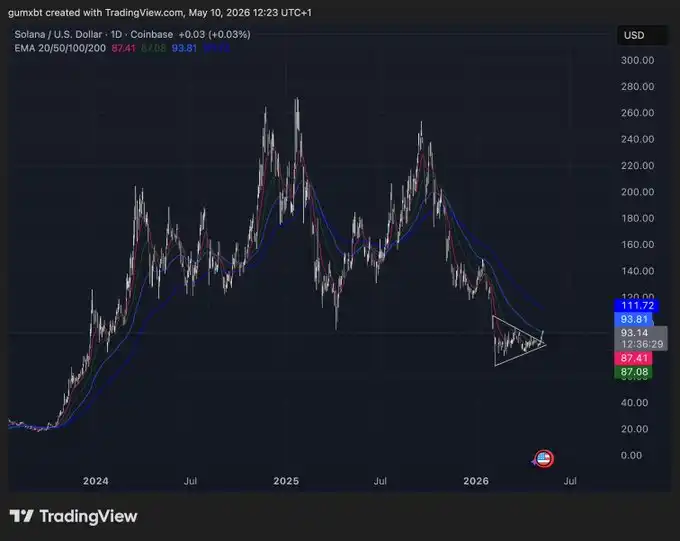
Crypto KOL gum pointed out on platform X that SOL is breaking out from a four-month consolidation period, but the underlying reason for this breakout is not just technical. He believes SOL is breaking out now, rather than a month ago, because it acts as a barometer for the entire crypto market's risk appetite, and its current price action is pricing in a 'return of risk'.

More crucially, it's about the token distribution structure. gum notes that during the four-month consolidation, short-term traders and hot money have abandoned SOL and exited, leading to a sharp decline in trading volume. Strong holders (conviction holders) have regained control of the token distribution. With this distribution structure, any reasonable recovery in trading volume will tend to push momentum in an upward direction.
Reference: KOL Perspective: Why SOL is Poised for a Rise at This Price Point?

Risk Warning: Short-term Momentum Shows Signs of Cooling

It's important to note that buying intensity for SOL in the $95 to $96 range has already begun to weaken, with spot and futures CVD flattening over the past 24 hours. The Adam & Eve pattern still requires daily close confirmation; failure to hold above $95 could lead to a pullback towards the $89 to $91 support zone.

Furthermore, a previous BeInCrypto analysis pointed out that if ETF inflows in May fail to stabilize or even continue to decline, SOL could face selling pressure from exchanges. The rapid buildup of high-leverage positions also means that any price retracement could amplify volatility through cascading liquidations. The liquidity vacuum left after meme-coin-driven retail frenzy subsides is another recurring risk pattern historically.

Multiple signals from capital flows, derivatives, and technicals are all pointing in the same direction, but the market is never short of precedents for moving in the opposite direction when 'signals align'. The $120 technical target is clearly visible, but every step from $95 to $120 will require real buying volume to materialize.


Related Questions

QWhat was the net inflow for Solana spot ETFs in the recent week, and why is this figure significant?

ASolana spot ETFs recorded a net inflow of $39.23 million in the recent week. This is significant because it represents the strongest weekly performance since February, potentially marking a reversal of a six-month consecutive decline in monthly inflows.

QAccording to the article, how much did Solana futures open interest increase in the first two weeks of May, and what does this signify?

ASolana futures open interest increased by 29.5% in the first two weeks of May, reaching $6.4 billion, with an increase of approximately $1.5 billion. This signifies that new capital, not just leverage from existing players, is entering the market.

QWhat is the Alpenglow upgrade for Solana, and what is its primary goal?

AAlpenglow is Solana's largest-ever consensus upgrade. It aims to replace the current Proof-of-History and TowerBFT systems with new Votor and Rotor protocols, with the primary goal of reducing transaction finality time from about 12.8 seconds to roughly 150 milliseconds.

QHow has the holder structure of SOL changed during its four-month consolidation, according to the KOL gum?

AAccording to KOL gum, during the four-month consolidation, short-term traders and 'tourist capital' gradually exited SOL. This led to a sharp decline in trading volume, allowing 'conviction holders' or strong holders to regain control of the token distribution.

QWhat are some of the key risk factors mentioned for SOL's price in the near term?

AKey near-term risk factors include: buying pressure weakening in the $95-$96 range; the need for the Adam & Eve technical pattern to be confirmed with a daily close above $95; potential for a pullback to the $89-$91 support zone if that fails; pressure from exchange sell-offs if ETF inflows don't stabilize; and the risk of cascading liquidations due to rapid high-leverage accumulation.

Related Reads

Seeking Alpha's Hot Article: Why Might the U.S. Stock Market Crash in June?

In a recent Seeking Alpha article, financial professor and analyst Damir Tokic argues that the US stock market may be poised for a significant crash in June 2026. The core thesis centers on a "mega-bubble" in equities, particularly within the technology sector, which has driven the S&P 500 to near-record valuations, with a Shiller P/E ratio exceeding 40—a level comparable to the 2000 dot-com bubble. Tokic identifies two primary catalysts for a potential collapse. First, he points to unsustainable market exuberance fueled by what he terms the "Trump Stimulus"—massive AI capital expenditure by tech giants, which he believes is politically driven and cannot last. Second, and more urgently, he highlights the escalating Iran war as a critical threat. The ongoing closure of the Strait of Hormuz has created a severe global energy supply crunch. Strategic petroleum reserves are projected to hit critically low operational levels by June, potentially causing oil prices to spike above $200 per barrel and triggering a severe, supply-driven inflationary shock. This scenario, Tokic warns, would force the Federal Reserve's hand. Despite currently maintaining a dovish bias, the Fed would likely be compelled to officially pivot to a hawkish stance at its June FOMC meeting to combat soaring inflation and bond yields. He contends that such a shift—or even a failure to act, which would destroy Fed credibility—could be the trigger that punctures the market bubble. The resulting downturn, he concludes, could rival the bear markets of 2000 and 2008, advising investors to prepare for a major correction.

marsbit16m ago

Seeking Alpha's Hot Article: Why Might the U.S. Stock Market Crash in June?

marsbit16m ago

AI PC Battle: Bet on the Toll Booth, Not the Camp

**Title:** The AI PC Battle: Don't Bet on Sides, Bet on the Tollbooth **Summary:** The AI PC competition is moving beyond simple "x86 vs. Arm" narratives. The core investment thesis should focus on identifying which players can sustain margins, cash flow, and pricing power throughout the upgrade cycle, rather than backing a particular architecture. The opportunity is analyzed in three layers: 1. **The Advanced Foundry Tollbooth:** TSMC is positioned to collect "tolls" regardless of which chip designer wins, due to its dominant ~70% share in advanced semiconductor manufacturing, which is essential for high-end AI PC chips. 2. **Compute & Platform Spillover:** AMD represents an offensive in the x86 CPU+GPU space, while NVIDIA leverages its GPU and CUDA software stack dominance. Both benefit from the demand for increased local AI compute. 3. **Architecture Diffusion & Turnaround Plays:** ARM and Intel offer potential for significant upside (elasticity), but investments here require stricter discipline due to higher execution risks and competitive challenges. The industry is transitioning from concept to shipment validation. While short-term forecasts for AI PC adoption have been revised down slightly due to tariffs and procurement delays, the long-term trend towards AI becoming a standard PC feature remains intact. The key driver for upgrade cycles will be whether compelling enterprise applications (e.g., privacy-sensitive computing, low-latency inference) emerge beyond consumer-focused features like meeting summarization. Investment strategy should prioritize companies with platform-level advantages and recurring revenue streams. TSMC offers high certainty as the foundational tollbooth. AMD presents a strong offensive play within the established ecosystem. ARM and Intel are higher-risk, higher-potential-reward turnaround bets. The report cautions against chasing short-term hype and emphasizes a disciplined, long-term approach focused on buying ecosystem strength and cash-flow certainty after market enthusiasm subsides. **Key Risks:** Underwhelming AI PC applications slowing upgrade cycles; slow improvement in Windows on Arm compatibility; macro/tariff impacts on PC demand; potential advanced node supply-demand mismatches affecting TSMC; high overall AI sector valuations making stocks vulnerable to a risk-off shift in markets.

marsbit30m ago

AI PC Battle: Bet on the Toll Booth, Not the Camp

marsbit30m ago

Ten-Thousand-Word Analysis: From $10 to $290, MRVL Wins the Entire AI Era by 'Not Making GPUs'

Marvell Technology's stock price surged from under $10 in 2016 to a record $290 in June 2026, fueled not by making GPUs, but by dominating AI infrastructure connectivity. This analysis argues the market misvalues MRVL as merely a smaller Broadcom in custom AI chips, overlooking its true, unique position. Marvell's core strength lies in enabling high-speed data flow for AI clusters through three interconnected businesses. First, it holds a commanding ~70% market share in high-speed optical DSPs (essential for data center light modules), a deep-moat business with accelerating growth. Second, its custom AI chip design business serves hyperscalers like AWS, Microsoft, and Google, with a significant revenue pipeline despite lower margins. Third, stable cash flows come from Ethernet switch chips and enterprise storage controllers. Together, they form a full-stack "AI data movement" platform. CEO Matt Murphy's transformative leadership since 2016, involving strategic divestments, key acquisitions (like Inphi for optical DSPs), and securing long-term agreements with major cloud providers, repositioned the company. A pivotal $2 billion strategic investment from NVIDIA in 2026 underscored Marvell's critical role in the AI ecosystem, particularly through collaborations like NVLink Fusion. While Marvell faces risks—including client concentration (losing the Amazon Trainium3 design), lower-margin business mix, competitive threats, insider selling, and complex supply chains—its fundamentals remain strong. The optical interconnect moat is widening with the acquisition of Celestial AI (photonics fabric), and financial metrics show accelerating revenue growth and operating leverage. With a PEG ratio suggesting undervaluation relative to its growth, the thesis is that the market undervalues Marvell's monopolistic position in AI "plumbing" while overemphasizing its competitive custom chip segment. The story transcends investing, symbolizing how in any complex system—from the internet to AI—the value of "connection" ultimately surpasses that of individual "nodes."

marsbit1h ago

Ten-Thousand-Word Analysis: From $10 to $290, MRVL Wins the Entire AI Era by 'Not Making GPUs'

marsbit1h ago

AI Relay Stations Spark Heated Debate on Zhihu: Behind Cheap Tokens, What Are Users Really Worried About?

A discussion on Zhihu about "AI relay stations" shifted the niche developer topic of "cheap tokens" into broader user awareness. Users moved beyond simply questioning the legitimacy of these services to focus on practical concerns: Where do cheap tokens truly come from? Is the model being accessed the real one? Can relay stations see prompts, code, and API keys? For occasional users, are the risks worth it? The core debate centered less on price and more on trust. A primary worry is model authenticity—the risk of "model swapping," where users paying for a premium model might be routed to a cheaper one, creating an information asymmetry. Others argued that cost comparisons matter; while cheaper than official pay-as-you-go APIs, relay stations may not be the lowest-cost option versus subscriptions, domestic models, or free tiers, making user needs assessment crucial. Speculation about token sources ranged from legitimate bulk discounts to gray-area methods like account sharing or exploiting regional pricing. This opacity makes risk assessment difficult for users. Data security emerged as a critical concern, especially for enterprise use. When processing sensitive information like code, contracts, or client data, the inability to verify a relay station's data handling, retention, or access policies poses significant compliance and confidentiality risks. The evolving consensus suggests relay stations can be used cautiously for low-sensitivity, disposable tasks (e.g., summarizing public info, simple translation). However, they should not be the default for sensitive, professional, or production workflows involving proprietary data, Agents, or automated systems. Recommendations include avoiding large prepayments, not relying on a single service, using test prompts to monitor quality, anonymizing data where possible, and keeping official channels as backups. Ultimately, the discussion framed tokens not just as a billing unit but as a measure of real cost encompassing price, model integrity, data security, and service stability. The popularity of relay stations highlights user demand for affordable access, but the debate underscores a key trade-off: the savings from cheap tokens may come at the price of trust, transparency, and control over one's data and AI experience.

marsbit1h ago

AI Relay Stations Spark Heated Debate on Zhihu: Behind Cheap Tokens, What Are Users Really Worried About?

marsbit1h ago

Trading

Spot
Futures

Hot Articles

Discussions

Welcome to the HTX Community. Here, you can stay informed about the latest platform developments and gain access to professional market insights. Users' opinions on the price of SOL (SOL) are presented below.

活动图片














