Solana ETF Defies Market Trend with Sustained Inflows: 7 Consecutive Days of Capital Inflow Highlight Institutional Long-Term Confidence

marsbitPublished on 2025-12-14Last updated on 2025-12-14

Abstract

Despite Solana (SOL) facing significant price pressure—down nearly 55% from its January peak—its spot ETF has demonstrated strong capital attraction, with seven consecutive days of net inflows totalling nearly $700 million, according to Farside Investors. The Bitwise BSOL ETF, which stakes 100% of assets for 5-7% annual yield, dominates with over 90% of inflows, offering dual exposure to price and staking returns. This contrasts with Grayscale’s lower staking ratio and higher fees. The divergence between sustained institutional inflows and SOL’s price decline reflects macro pressure, profit-taking, and large sell-offs. However, on-chain data shows accumulation by long-term holders. A key innovation is the compliant integration of staking rewards into traditional finance, allowing passive yield without direct token ownership—a regulatory shift that benefits PoS assets. While institutional views diverge, with some citing meme-driven speculation risks, developments like Western Union’s stablecoin issuance on Solana may strengthen its utility. Continued network growth and enterprise adoption could align ETF inflows with price performance over time.

Despite continued pressure on the price of Solana (SOL) tokens, its spot ETF has demonstrated strong capital attraction capabilities. According to data from Farside Investors, the Solana ETF has achieved net capital inflows for 7 consecutive days, with cumulative net inflows approaching $700 million. The highest single-day inflow occurred on December 12, reaching $16.6 million. This phenomenon contrasts sharply with SOL's weak performance, which has fallen nearly 55% from its January all-time high, reflecting that institutional investors may be positioning themselves in the Solana ecosystem with a long-term perspective.

I. Inflow Structure: Bitwise as the Dominant Force, Staking Mechanism as Key Attraction
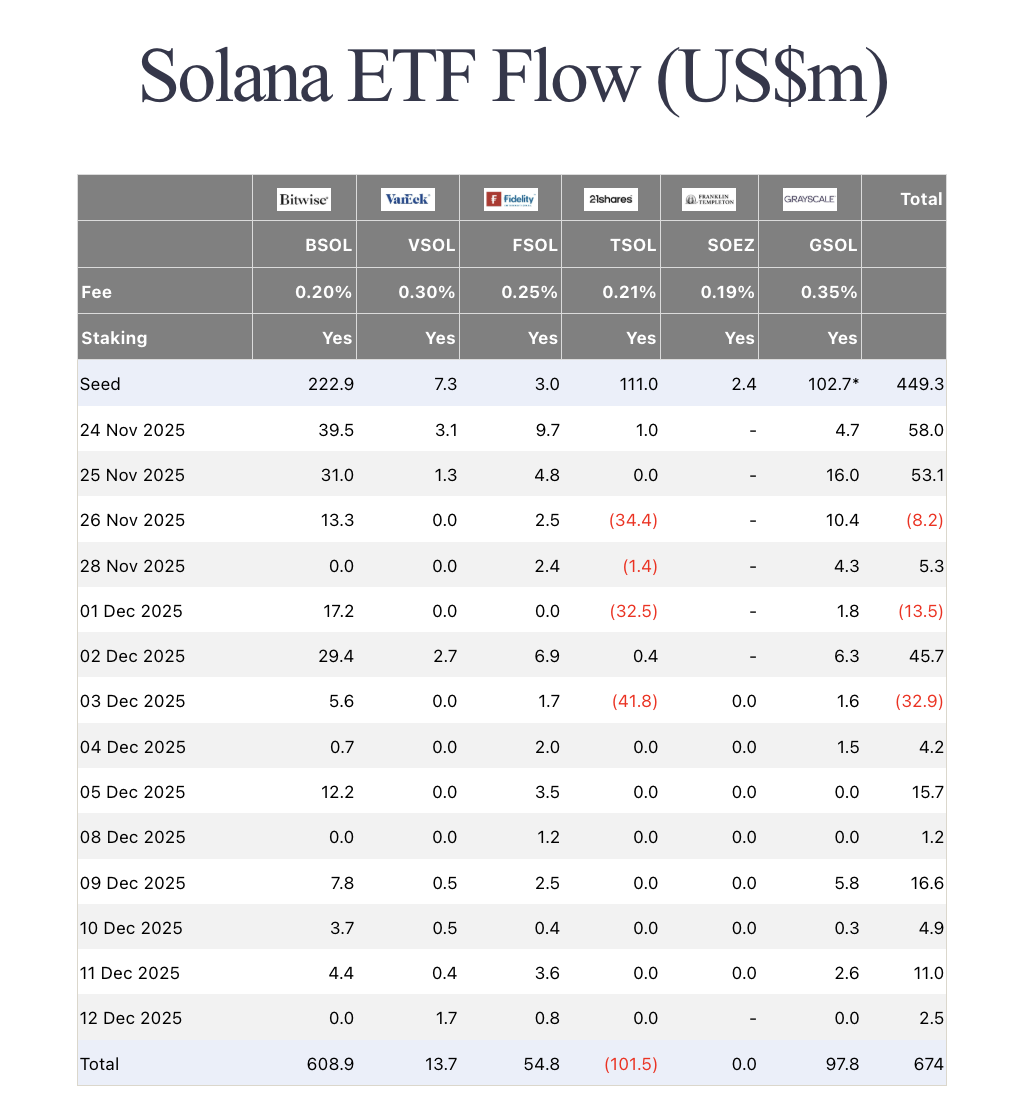
SOL ETF inflow situation. Source: Farside Investors

Solana ETF inflows are highly concentrated, with Bitwise's BSOL ETF being the primary contributor, accounting for over 90% of total inflows, and its assets under management have surpassed $6 billion. This advantage stems from its product design: BSOL utilizes 100% of its custodied assets for on-chain staking, offering an annualized yield of approximately 5%-7%, providing investors with dual returns from "price exposure + staking rewards." In contrast, Grayscale's GSOL stakes only 77% of its assets and has a higher management fee (0.35%), making it less attractive.

Furthermore, the entry of traditional asset management giants like Franklin Templeton has further enriched the product matrix. The staking rewards from these ETFs are directly compounded into the fund's net asset value rather than distributed as cash dividends, better aligning with long-term allocation needs.


II. Price and Flow Decoupling: Short-Term Selling Pressure vs. Long-Term Value Game
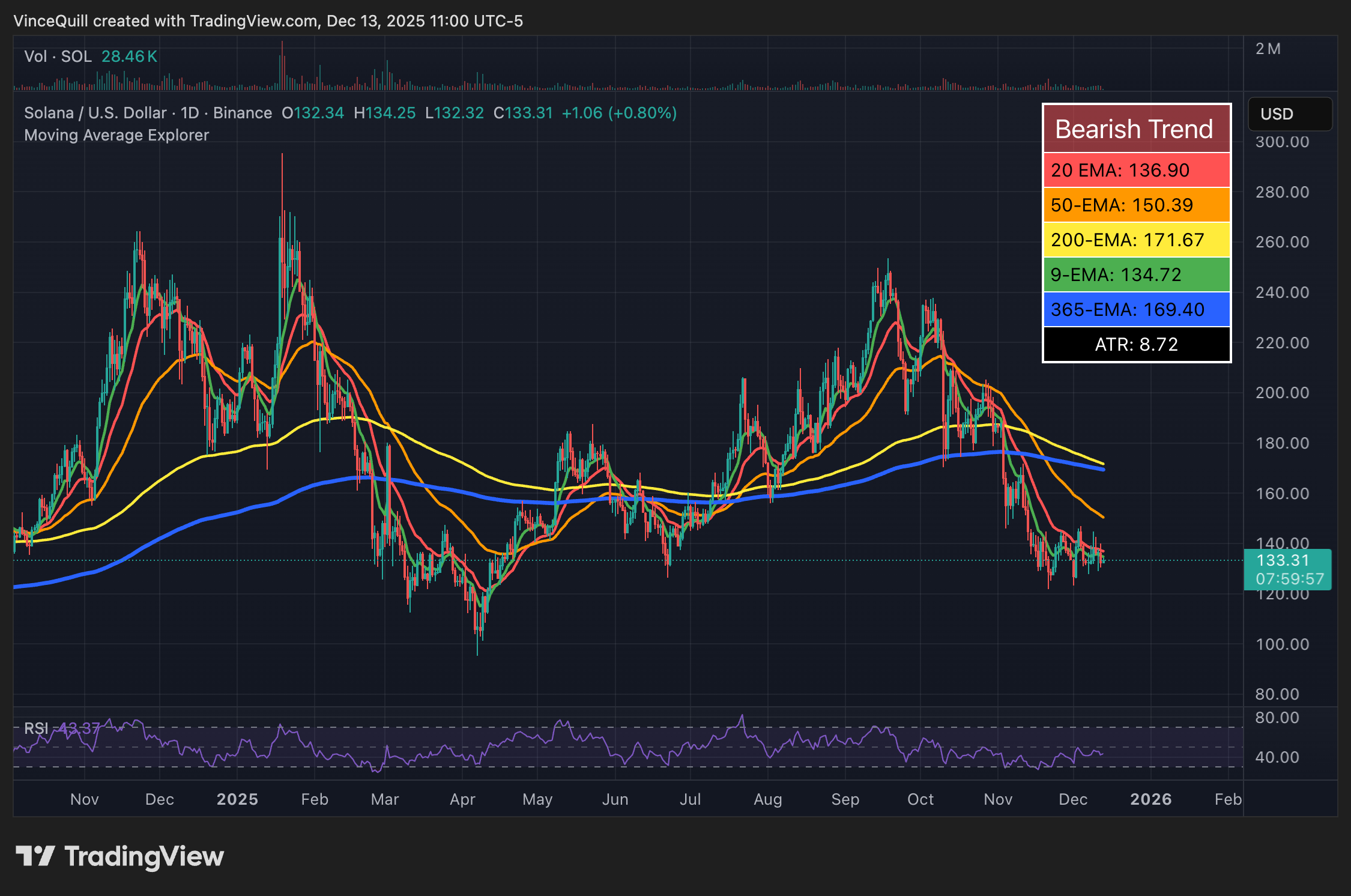
SOL price movement from November 2024 to December 2025. Source: TradingView

Despite continuous ETF inflows, the SOL price remains down roughly 47% from its September local high and has been trading below its 365-day moving average for an extended period. This decoupling is primarily due to three factors:

  1. Macro Market Pressure: Bitcoin and Ethereum ETFs experienced large-scale net outflows during the same period ($3.48 billion and $1.42 billion respectively), dragging down overall crypto market sentiment.
  2. Profit-Taking by Speculators: A concentrated outbreak of "buy the rumor, sell the news" behavior after ETF approval, with some early investors choosing to realize profits.
  3. Whale Selling Impact: For instance, Jump Crypto once sold 1.1 million SOL (approx. $205 million) in a single transaction in late October, creating significant selling pressure in the short term.


However, on-chain data shows that some institutional investors are quietly accumulating during the decline. For example, a mysterious whale cumulatively transferred 1.57 million SOL (approx. $329 million) from platforms like Coinbase to private wallets, hinting at long-term bullish confidence.

III. The Innovative Significance of ETFs: From Price Exposure to Yield Financialization

The core breakthrough of the Solana ETF lies in the compliance of its staking rewards.

By embedding an on-chain staking mechanism into traditional financial products, investors can participate in network governance and earn rewards without directly holding the tokens. This model, referred to as "yield-bearing assets" by Bitwise CIO Matt Hougan, is particularly attractive to traditional financial institutions in a low-interest-rate environment.

Furthermore, the SEC's tacit approval of the staking clauses signals a shift in regulatory attitude. Previously, Ethereum ETFs were forced to remove related clauses due to staking concerns, while the successful listing of Solana ETFs has paved a compliant path for more PoS assets.


IV. Future Outlook: Institutional Divergence and the Battle of Ecosystem Fundamentals

Despite strong inflows, institutional attitudes towards Solana are diverging:

  • Bullish Camp: Grayscale's Head of Research, Zach Pandl, predicts that Solana ETFs could absorb 5% of the total supply (approx. $5 billion).
  • Cautious Camp: Institutions like BlackRock believe the Solana ecosystem is overly reliant on Meme coin trading, posing speculative risks.


Ecosystem fundamentals remain key to long-term value. Western Union's announcement of issuing a stablecoin on Solana, along with improvements in network throughput and developer activity, is gradually strengthening its positioning as "financial infrastructure." If Solana can continue to optimize network stability and expand enterprise-level use cases, the long-term effects of ETF inflows are expected to gradually materialize in the price.



Related Questions

QWhat is the continuous trend of Solana ETF's fund inflows according to Farside Investors data?

ASolana ETF has achieved net capital inflows for 7 consecutive days, with cumulative net inflows approaching $700 million.

QWhich ETF product is the main contributor to Solana ETF inflows and what is its key feature?

ABitwise's BSOL ETF is the main contributor, accounting for over 90% of the total inflows. Its key feature is that it stakes 100% of its custodial assets on-chain, providing an annualized yield of approximately 5%-7%.

QWhat are the three main reasons for the decoupling between SOL's price decline and the ETF's continuous capital inflows?

AThe three main reasons are: 1. Macro market pressure, with Bitcoin and Ethereum ETFs experiencing large net outflows; 2. Profit-taking by speculative traders after the ETF approval; 3. Selling pressure from large holders, such as Jump Crypto's sale of 1.1 million SOL.

QWhat is the core innovation of the Solana ETF highlighted in the article?

AThe core innovation is the合规化 (compliant integration) of staking rewards, allowing investors to gain exposure to price and earn yield without directly holding the token, a model referred to as 'yield-bearing assets'.

QHow do institutional views on Solana's future differ according to the article?

AViews are divided. The bullish camp, like Grayscale's research head, predicts the ETF could attract 5% of the total supply. The cautious camp, including BlackRock, believes the ecosystem relies too heavily on meme coin trading and carries speculative risks.

Related Reads

Musk Posted a Recruitment Ad for SpaceX, and After Reading the Comments Section, I Understood

On May 20th, SpaceX filed for a landmark IPO with a $1.75 trillion valuation. Shortly after, Elon Musk posted a recruitment call on X, seeking "world-class engineers and physicists" for SpaceX. The application process was starkly simple: email with three bullet points proving "exceptional ability," with real, complex projects as a plus. Musk promised to review qualifying emails himself. The post garnered millions of views and thousands of replies, revealing a spectrum of responses. Most comments, including a highly-upvoted humorous one listing absurd "skills," merely listed credentials or experiences in a conventional, non-differentiating way. This highlighted a key insight: a traditional resume listing degrees and skills often fails to demonstrate true exceptionalism. Effective self-presentation requires "performance efficiency." A standout reply came from an OpenAI engineering lead, who simply stated "codex." This demonstrated that for those who have built significant, recognized products, the product itself becomes the ultimate resume. The article argues that in the AI era, any tangible, shareable output—a tool, research, or online project—serves as a living, self-evident credential more powerful than a list of attributes. However, a twist emerged when applicants found the provided email address non-functional, leading to speculation that the post might also serve as an IPO publicity stunt, projecting an image of aggressive talent acquisition to investors. Ultimately, the episode served as a microcosm: some participate through performance, others through proof of work, while some question the reality of the stage itself. It underscores the enduring challenge of defining and demonstrating value in an age of abundant, yet often superficial, content.

marsbit50m ago

Musk Posted a Recruitment Ad for SpaceX, and After Reading the Comments Section, I Understood

marsbit50m ago

Cutting Off OpenAI, Anthropic Acquires the Tool Provider Used by a Quarter of Global Developers

Anthropic has acquired Stainless, a developer tool company that automatically generated official SDKs (Software Development Kits) for AI giants including OpenAI, Anthropic, Meta, and Cloudflare. The deal, reportedly valued at around $300 million, marks a strategic shift for Anthropic as it builds its "AI agent" infrastructure. Stainless acted as a "translator," converting complex API specifications into ready-to-use code libraries for developers. Its tools indirectly reached about a quarter of professional software developers globally. Following the acquisition, Stainless will shut down its public products and its team will join Anthropic to focus on internal platform development, notably for the Claude Platform. Existing SDKs remain with their respective client companies but will no longer receive updates from Stainless. This move is part of Anthropic's broader 18-month strategy to assemble a complete "agent stack." The stack consists of the Claude model at its core, the newly acquired Stainless for standardized API interfaces, and the Model Context Protocol (MCP), an open standard for connecting agents to external tools and data. This contrasts with OpenAI's focus on model generations and consumer-scale compute. Anthropic believes an agent's ultimate utility depends on its ability to connect to external systems. By internalizing the SDK layer and promoting MCP as a connection standard, Anthropic aims to lock in long-term ecosystem advantages and create path dependency, moving beyond the transient lead provided by any single model generation.

marsbit51m ago

Cutting Off OpenAI, Anthropic Acquires the Tool Provider Used by a Quarter of Global Developers

marsbit51m ago

Bankless Founder Sells Off ETH, Collective Collapse of Ethereum Faith

Ethereum faces a "crisis of faith" as David Hoffman, co-founder of the prominent pro-Ethereum media outlet Bankless, announces he has sold all his ETH. This move, coupled with reports of major layoffs at Bankless, signals a potential retreat of Ethereum's staunchest supporters. Hoffman and co-founder Ryan Sean Adams confirm Bankless is entering a "second era," with Adams stepping back and Hoffman exploring new frontiers. Hoffman sharply criticizes the Ethereum Foundation, stating that ETH's poor price performance cannot be separated from its leadership. He has a history of public dissatisfaction, citing the Foundation's failure to drive market growth and its "endless manifestos." His frustration coincides with ETH/BTC hitting multi-month lows and a significant exodus of senior researchers and executives from the Ethereum Foundation, partly attributed to controversial "loyalty oaths." The article contrasts Ethereum's current predicament—with its Layer-2 narrative discredited and ecosystem stagnant—against what should have been a highlight year in 2026 amid tokenization trends. While a previous surge to near $5,000 was driven by corporate buybacks (DAT热潮), ETH has since fallen over 50%. The core question remains: with fading faith and intense competition, what is Ethereum's next solution? Hoffman's divestment symbolizes a growing disconnect between the community and the ecosystem's direction.

Odaily星球日报1h ago

Bankless Founder Sells Off ETH, Collective Collapse of Ethereum Faith

Odaily星球日报1h ago

Trading

Spot
Futures

Hot Articles

Discussions

Welcome to the HTX Community. Here, you can stay informed about the latest platform developments and gain access to professional market insights. Users' opinions on the price of SOL (SOL) are presented below.

活动图片