Solana 2025 Report Card: Annual Revenue of $1.5 Billion, Surpassing the Combined Total of 'Hyperliquid + Ethereum'

marsbitPublished on 2026-01-04Last updated on 2026-01-04

Abstract

Solana's 2025 Performance: $1.5B in Annual Revenue, Outpacing Ethereum and Hyperliquid Combined In 2025, Solana emerged as the top-performing blockchain by key financial and usage metrics. According to Nansen, Solana's on-chain fee revenue reached $603 million, surpassing Tron ($581M) and Ethereum ($514M). The network also recorded over 10.5 billion active addresses and 230.1 billion transactions. Blockworks Research data shows Solana's total annual revenue exceeded $1.5 billion, outperforming Hyperliquid ($780M) and Ethereum ($690M) combined, while maintaining a median transaction cost below $0.01. Solana co-founder Anatoly Yakovenko attributed this success to capacity growth and cost efficiency. Additionally, Solana's spot trading volume hit $1.6 trillion, exceeding all centralized exchanges except Binance. JupiterExchange data indicates Solana's share of total crypto trading volume grew from 1% in 2022 to 12% in 2025. Solana's revenue structure includes base fees (burned for deflation), priority fees (for validators), MEV income, and minor sources like storage fees. Approximately 50% of fees are burned, benefiting all SOL holders through deflation, while the rest rewards validators. The report highlights that public blockchains, perpetual DEXs (like Hyperliquid with $908M revenue), and launchpads (like Pump.fun with $549M revenue) remain among crypto's most profitable sectors, second only to stablecoins.

Original|Odaily Planet Daily(@OdailyChina)

Author|Wenser(@wenser 2010 )

The year 2025, which was significant for cryptocurrency, has passed. This year, in addition to a series of favorable policies, the regulatory layer, the development of on-chain ecosystems was even more rapid.

From the Meme coin issuance wave sparked by Pump.fun, to the on-chain Perp DEX trend led by Hyperliquid, and then to the stablecoin and PayFi financial wave driven by Circle (CRCL)'s listing, the on-chain ecosystems of numerous public chains have also entered a period of explosion. Among them, Solana, with its ecological vitality, underlying infrastructure construction, and its "application-first" internet-style capital network positioning, surpassed Ethereum to become the "New King of Annual On-Chain Networks".

Odaily Planet Daily will梳理 (sort out) the Solana on-chain ecosystem in this article, attempting to explore the "best business model" in the current crypto market (Odaily Note: Data sources vary, statistical calibers differ, for reference only).

Solana On-Chain Revenue Exceeds $600 Million, Outperforms Ethereum and TRON to Become the "Strongest Public Chain"

Solana's "year-end report card" starts with public chain revenue. Although the price of SOL fell all the way after rising to a new high of nearly $300 last year, and the highest rebound did not reach $270, from the perspective of public chain operation, its ability to generate revenue is already "fractured first".

Solana's On-Chain Fee Revenue Surpassed $600 Million in 2025

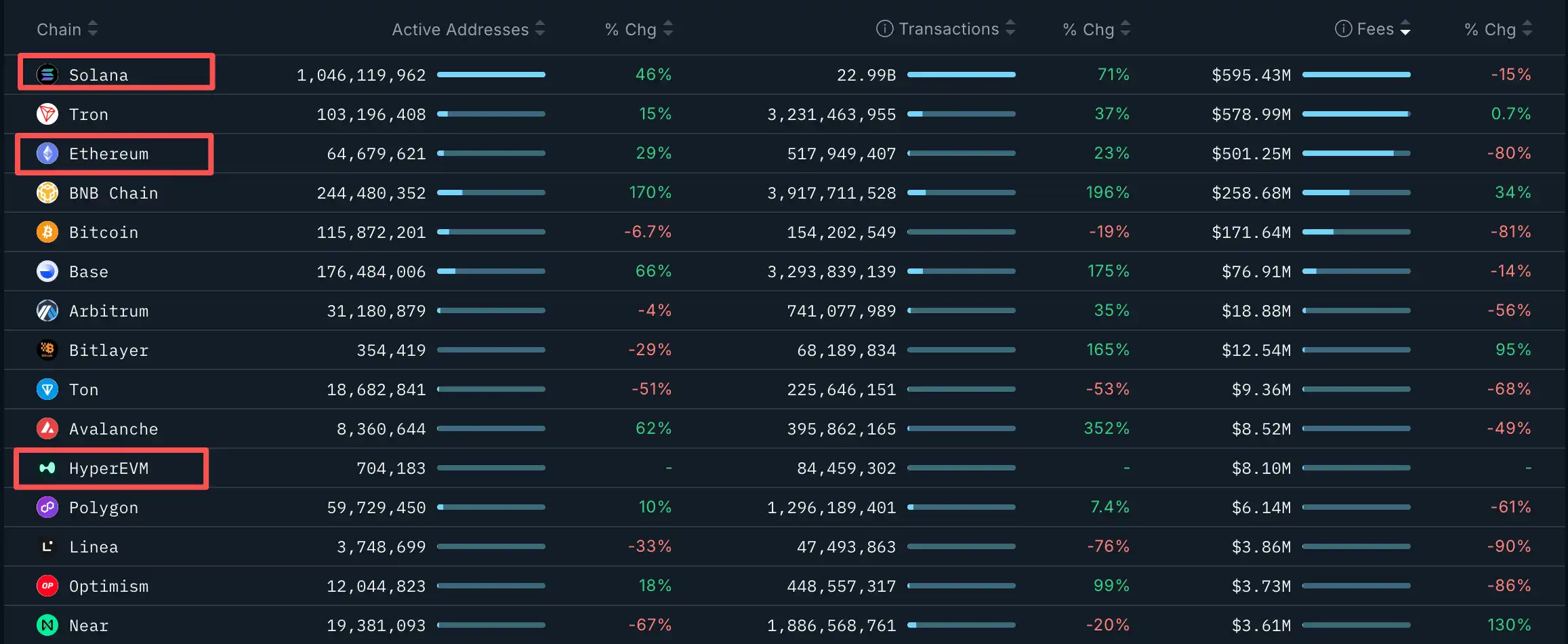
On January 2nd, Nansen data showed that Solana's on-chain fee revenue exceeded $600 million in 2025, surpassing TRON and Ethereum to rank first. The top five blockchains by on-chain fees last year were:

  • Solana ($603 million);
  • TRON ($581 million);
  • Ethereum ($514 million);
  • BNB Chain ($259 million);
  • Bitcoin ($172 million).

In addition, the number of active addresses on the Solana chain exceeded 1.05 billion, and the number of on-chain transactions was about 23.01 billion, both higher than public chains such as Ethereum, Bitcoin, and Tron.

Latest data shows that,as of the time of writing, Solana has maintained its first position in terms of the number of active addresses, number of transactions, and fee revenue over the past year.
Solana's Annual Revenue in 2025 Exceeded $1.5 Billion, Surpassing the Combined Revenue of "Hyperliquid + Ethereum"

According to data from Blockworks Research, Solana's full-year revenue in 2025 exceeded $1.5 billion, leading all public chain networks. Hyperliquid followed closely with revenue of $780 million; Ethereum generated $690 million in the same period, both lagging behind Solana. At the same time, and even more commendable, Solana achieved this revenue while its median transaction fee remained below 1 cent.

In this regard, Solana co-founder Anatoly Yakovenko affirmed this achievement and pointed out that capacity growth and cost-effectiveness are the core driving forces. He believes that network scale, not high fees, supports sustainable revenue expansion.

Solana's On-Chain Spot Trading Volume Reached $1.6 Trillion in 2025, Surpassing All CEXs Except Binance

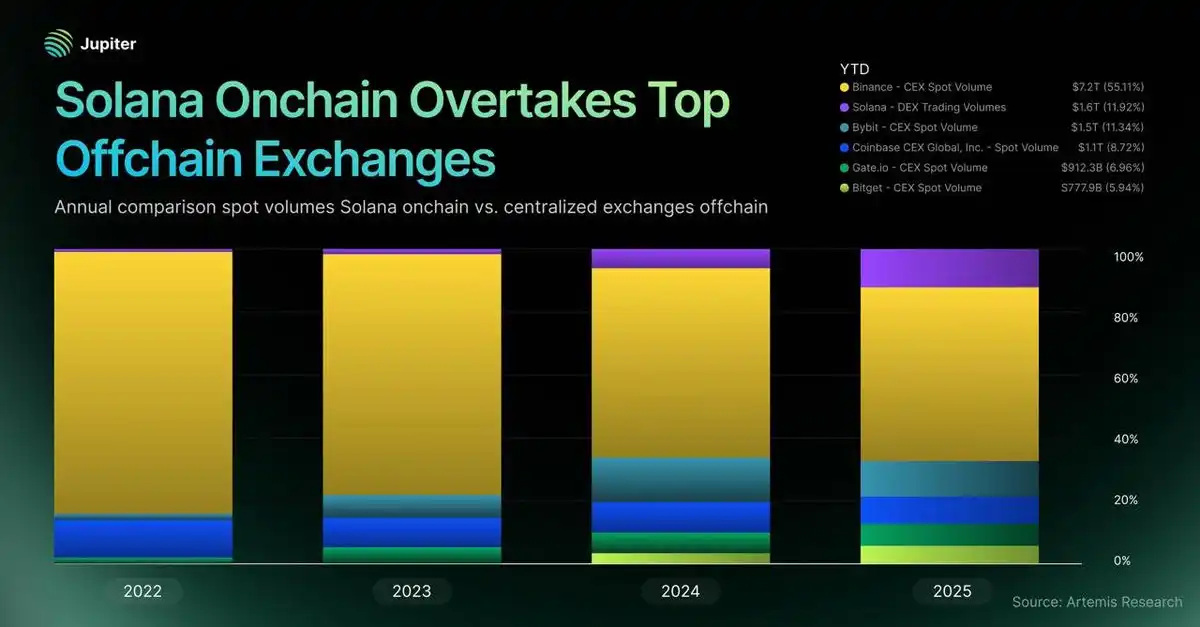
Recently, The Kobeissi Letter stated that Solana's on-chain spot trading volume officially reached $1.6 trillion in 2025, surpassing all centralized exchanges except Binance.

According to data from JupiterExchange, the proportion of Solana's on-chain trading volume to the total trading volume has grown from 1% to 12% since 2022. In 2025, Solana's total trading volume officially exceeded that of Bybit, Coinbase Global, and Bitget, second only to Binance.

At the same time, Binance's market share has dropped from 80% to 55% since 2022. This also means that industry activity in cryptocurrency is rapidly shifting on-chain.
Revealing the Composition of Solana's Ecological On-Chain Revenue: 4 Components Support Over $600 Million

Based on available information, Solana's network revenue mainly comes from on-chain transaction fees. Unlike Ethereum and others, its fee mechanism design focuses more on deflation and validator incentives. The composition of the total fee revenue of $603 million in 2025 is as follows:

First Revenue: Base Fee

  • A very low fixed base fee is charged per transaction (about 5000 lamports).
  • This portion of the fee is entirely burned, not distributed to validators, directly reducing the total supply of SOL, creating deflationary pressure.
  • Accounts for a large proportion of total fee revenue, especially in 2025 with explosive transaction growth, the burning mechanism significantly enhanced SOL's scarcity.

Second Revenue: Priority Fee

  • An additional fee that users can choose to pay to speed up transaction confirmation.
  • During periods of high congestion (such as meme coin booms, large DEX trades), priority fees increase significantly, becoming the main source of revenue increment.
  • This portion of the fee is distributed to block producers (Leaders) and stakers, and is the main reward source for validators.

Third Revenue: MEV (Maximal Extractable Value) Related Revenue

  • Tips paid by searchers through MEV clients like Jito further supplement income.
  • The proportion of MEV revenue increased in 2025, closely related to complex arbitrage opportunities in DEX and meme coin trading.

Fourth Revenue: Other Minor Sources

Such as account rent (storage fees), voting fees, etc., accounting for a small proportion.

In the overall distribution mechanism, about 50% of the fees indirectly benefit all SOL holders through the burning mechanism (deflation); about 50% is directly distributed to validators and stakers, incentivizing network security. Unlike Ethereum, where ecological protocol fee revenue mainly goes to validators, Solana's burning mechanism gives its network revenue greater long-term value capture capability, which is also the key to maintaining low fees under high transaction volume.

Overview of Crypto Money-Making Machine Business Models: Public Chains, Perp DEXs, Launchpads Remain the Most Profitable Tracks, Second Only to Stablecoins

Finally, based on existing market information, public chains (Solana, Ethereum, TRON), on-chain perp DEXs (such as Hyperliquid, Aster, etc.), and on-chain Launchpads (such as Pump.fun) are still the most profitable tracks in the crypto industry, second only to stablecoin projects that collect interest and have stable issuance.

Although we previously analyzed the awkward survival state of current public chain projects in the article "Only 10 Public Chains Have Weekly Revenue Over $100,000: Naked After the Tide Recedes", the existence of public chains like Solana, Ethereum, TRON, and Base tells us: public chains are still the most profitable crypto track, perhaps even without one.

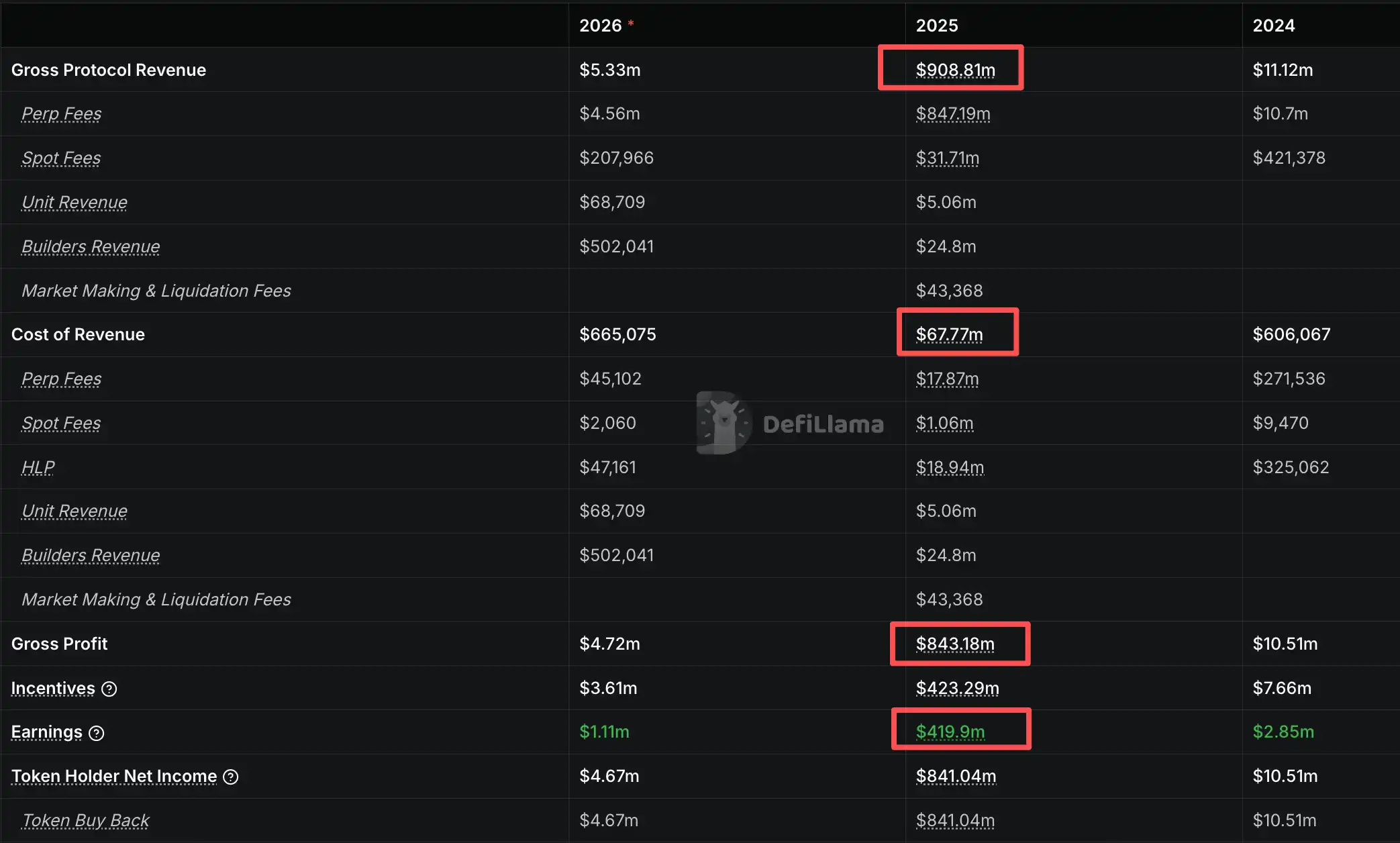
According to DefiLlama data, Hyperliquid's revenue in 2025 was $908 million; its cost of revenue was approximately $67.77 million, and its annual net profit was approximately $843 million. Excluding incentive-based expenses, the net profit attributed to the platform in 2025 was as high as approximately $420 million.
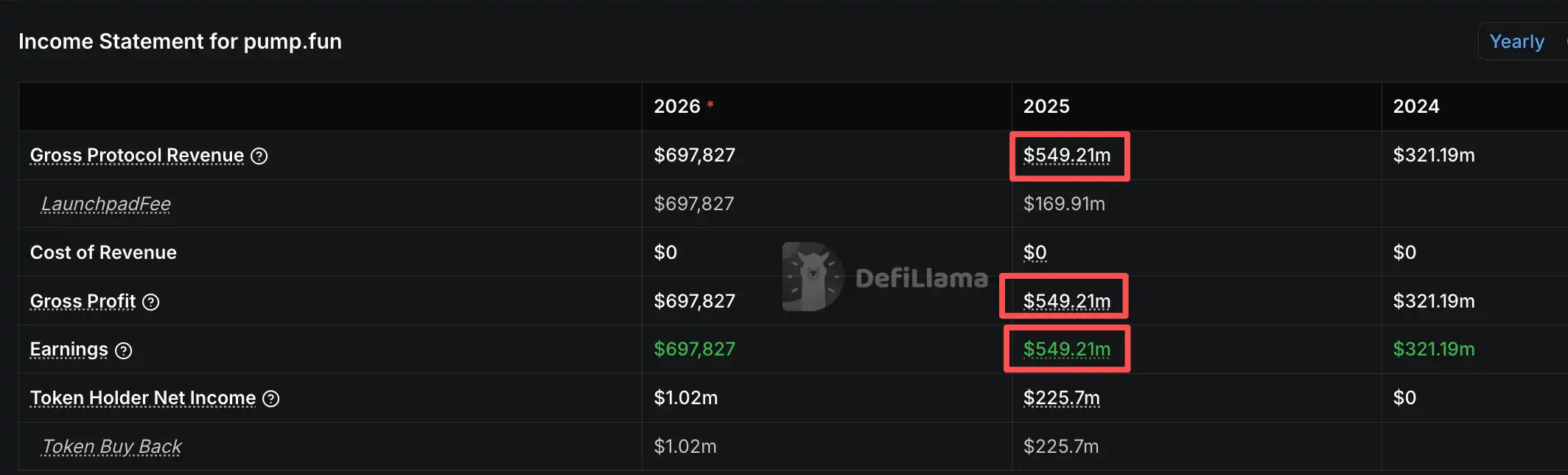
According to DefiLlama data, Pump.fun's annual revenue in 2025 was approximately $550 million. Unlike on-chain perp DEX platforms like Hyperliquid, as a "one-click coin issuance platform", Pump.fun does not need to incur incentive expenses, so its platform's annual net profit is approximately equal to its annual revenue, i.e., $549 million.
Based on the above information, the industry's mainstream revenue generators are still top applications like public chains, on-chain Perp DEXs, and Launchpad coin issuance platforms, second only to stablecoins (e.g., Tether's net profit related to the stablecoin sector alone was as high as $7.43 billion in 2025).


Trending Cryptos

Related Questions

QAccording to the article, which blockchain had the highest on-chain fee revenue in 2025?

ASolana had the highest on-chain fee revenue in 2025, reaching $603 million.

QWhat was Solana's total annual revenue for 2025, and how did it compare to the combined revenue of Hyperliquid and Ethereum?

ASolana's total annual revenue for 2025 was over $1.5 billion, which was more than the combined revenue of Hyperliquid ($780 million) and Ethereum ($690 million).

QWhat were the four main components that made up Solana's on-chain fee revenue?

AThe four main components were: 1. Base fees (burned), 2. Priority fees (paid to validators and stakers), 3. MEV (Maximal Extractable Value) related income, and 4. Other minor sources like account rent and voting fees.

QHow much on-chain spot trading volume did Solana achieve in 2025, and what did it surpass?

ASolana achieved $1.6 trillion in on-chain spot trading volume in 2025, surpassing all centralized exchanges except for Binance.

QBesides public chains, what other types of crypto projects are mentioned as the most profitable business models, second only to stablecoins?

AThe other most profitable business models mentioned are on-chain Perpetual DEXs (like Hyperliquid) and on-chain Launchpads (like Pump.fun).

Related Reads

From South Korea to the United States: Blue-Collar Jobs Are Becoming Increasingly Popular, Thanks to AI

AI is reshaping the labor market's value proposition. The traditional four-year college degree is losing its appeal as a guaranteed career path, while skilled blue-collar trades like electricians, welders, and plumbers are experiencing historic demand and wage premiums. This shift is driven by dual pressures: AI's displacement of certain white-collar roles and a booming need for physical infrastructure and data center construction. Data confirms the trend. In the U.S., vocational school revenue surged, and a significant portion of recent layoffs are AI-related. Surveys show a majority of Gen Z adults plan to pursue blue-collar work, citing better job security against AI automation. Vocational education interest has exploded recently. Experts cite a psychological shift as younger generations seek tangible, AI-resistant careers and avoid high student debt. In many cases, salaries for skilled trades now match or exceed those requiring a bachelor's degree. In South Korea, semiconductor vocational high schools boast near-total employment, with graduates securing high-paying roles at companies like Samsung. The shortage is structural, exacerbated by a retiring baby boomer workforce and massive infrastructure projects. Companies like JPMorgan Chase, Meta, and Lowe's are investing heavily in training programs. However, overcoming historical stigma and a "perception gap" around trade careers remains a key challenge to closing the talent gap.

marsbit30m ago

From South Korea to the United States: Blue-Collar Jobs Are Becoming Increasingly Popular, Thanks to AI

marsbit30m ago

Qualcomm: AI Hype Subsides, When Will Smartphones Emerge from the Gloom?

Qualcomm reported its Q3 FY2026 results (ending June 2026), with revenue of $9.95B, down 4% YoY but above expectations. Gross margin declined to 53.1%, pressured by rising costs across manufacturing and memory. Key business segments showed mixed performance: Handset revenue fell 19.6% YoY to $5.09B, dragged by an 11% decline in non-Apple Android shipments and weaker high-end mix. Conversely, Automotive revenue surged 61% to $1.59B, and IoT grew 9% to $1.83B. Core operating profit dropped 41% YoY due to margin compression and higher expenses. Management's Q4 FY2026 guidance projects revenue of $9.7B-$10.5B, in line with consensus, but Non-GAAP EPS guidance of $2.05-$2.25 fell short of expectations. Amidst persistent weakness in its core handset market, Qualcomm is pursuing growth in AI, focusing on Edge AI (smartphones, PCs, automotive) and Data Center AI. Its data center strategy includes four pillars: AI accelerators (e.g., AI200), commercial CPUs (Dragonfly C1000), custom silicon, and connectivity solutions. While these initiatives initially boosted its stock, concerns over AI capital expenditure sustainability have since erased those gains. The company targets $5B in data center revenue for FY2027 and $15B for FY2029. The report concludes that with the traditional handset business still under pressure, the data center opportunity is currently viewed as a longer-term option, and a more conservative valuation based on core operations may be warranted until AI contributions materialize.

marsbit34m ago

Qualcomm: AI Hype Subsides, When Will Smartphones Emerge from the Gloom?

marsbit34m ago

From TPU to Self-Evolving Agents: How Jeff Dean Predicts the Next Step in AI

At the 2026 YC Startup School, Jeff Dean outlined his vision for AI's next phase, shifting focus from simply scaling models to building intelligent, autonomous systems. He believes AI's progress is no longer just about creating smarter models, but about integrating them into systems capable of long-term, iterative work, automated experimentation, and continuous learning. This evolution moves the competition from "who has the bigger model" to "who can best organize intelligence." Dean suggests AI capabilities are now comparable to a junior engineer, enabling the automation of complex workflows. However, the true challenge and opportunity lie in managing these AI "workers" at scale. He emphasizes the importance of **context engineering**—structuring tools, memory, and feedback loops—over raw model power. For startups, this means building deep expertise in niche domains where general models currently fail (near 0-1% success rates), leveraging proprietary data, specialized tools, and domain-specific evaluators. A recurring theme is re-examining fundamental constraints. Dean's past work, like moving Google's search index to memory or creating the TPU, stemmed from questioning outdated assumptions about hardware and cost. He sees similar inflection points today, particularly in **specialized inference hardware** to drastically reduce latency and energy consumption for real-time Agent operation. Notably, he points out that in modern AI systems, the dominant cost is often not computation but **data movement**. Reliable, long-running Agents require robust system design, borrowing concepts from distributed computing like checkpointing, state management, and parallel exploration to handle failures and maintain progress over days or weeks. As AI automates execution, the scarcest human skills will shift to **defining clear specifications**, **judging what problems are worth solving** (taste), and designing effective feedback loops. Ultimately, Dean's framework prioritizes understanding the problem deeply, identifying the true bottlenecks, and systematically building closed-loop systems where AI can not only perform tasks but also improve AI itself.

marsbit34m ago

From TPU to Self-Evolving Agents: How Jeff Dean Predicts the Next Step in AI

marsbit34m ago

Trading

Spot

Hot Articles

Discussions

Welcome to the HTX Community. Here, you can stay informed about the latest platform developments and gain access to professional market insights. Users' opinions on the price of ETH (ETH) are presented below.

活动图片














