Solana 2025 Report Card: Annual Revenue of $1.5 Billion, Surpassing the Combined Total of 'Hyperliquid + Ethereum'

Odaily星球日报Published on 2026-01-04Last updated on 2026-01-04

Abstract

Solana's 2025 Performance: A Record-Breaking Year with $1.5B in Revenue In 2025, Solana emerged as the top-performing blockchain network, generating a total revenue of $1.5 billion, surpassing the combined revenue of Hyperliquid and Ethereum. According to Nansen, its on-chain fee income alone reached $603 million, exceeding that of Tron and Ethereum and securing its position as the leader in public blockchain earnings. Key metrics underscored Solana's dominance: it recorded over 10.5 billion active addresses and approximately 23.01 billion transactions, both figures leading all major blockchains. Its on-chain spot trading volume hit $1.6 trillion, surpassing all centralized exchanges except Binance, indicating a significant shift of crypto activity to on-chain platforms. Solana's revenue structure is composed of four main components: base fees (burned for deflation), priority fees (paid to validators), MEV-related income, and minor sources like storage fees. This efficient model supports high transaction volumes while maintaining a median fee below $0.01. The report highlights that public chains, Perp DEXs (like Hyperliquid with $908M revenue), and launchpads (like Pump.fun with $549M revenue) remain the most profitable crypto sectors, second only to stablecoins. Solana's growth is attributed to its scalability, low costs, and vibrant ecosystem, including meme coin trends and DeFi innovations.

Original|Odaily Planet Daily(@OdailyChina)

Author|Wenser(@wenser 2010 )
The year 2025, which belonged to cryptocurrency, has passed. This year, in addition to a series of favorable policies, the regulatory layer development was even more rapid.

From the Meme coin issuance wave sparked by Pump.fun, to the on-chain Perp DEX trend led by Hyperliquid, and then to the stablecoin and PayFi financial wave driven by Circle (CRCL) going public, the on-chain ecosystems of numerous public chains have also entered a period of explosion. Among them, Solana, with its ecological vitality, underlying infrastructure construction, and its "application-first" internet-style capital network positioning, surpassed Ethereum to become the "New King of Annual On-Chain Networks".

Odaily Planet Daily will梳理 (sort out) the Solana on-chain ecosystem in this article, attempting to explore the "best business model" in the current crypto market (Odaily Note: Data sources vary, statistical calibers differ, for reference only).

Solana On-Chain Revenue Exceeds $600 Million, Outperforms Ethereum and TRON to Become the "Strongest Public Chain"

Solana's "year-end report card" starts with public chain revenue. Although the price of SOL has been falling since it rose to a new high of nearly $300 last year, and the highest rebound did not reach $270, from the perspective of public chain operation, its ability to generate revenue is already "fragmented and first".

2025 Solana On-Chain Fee Revenue Breaks Through $600 Million

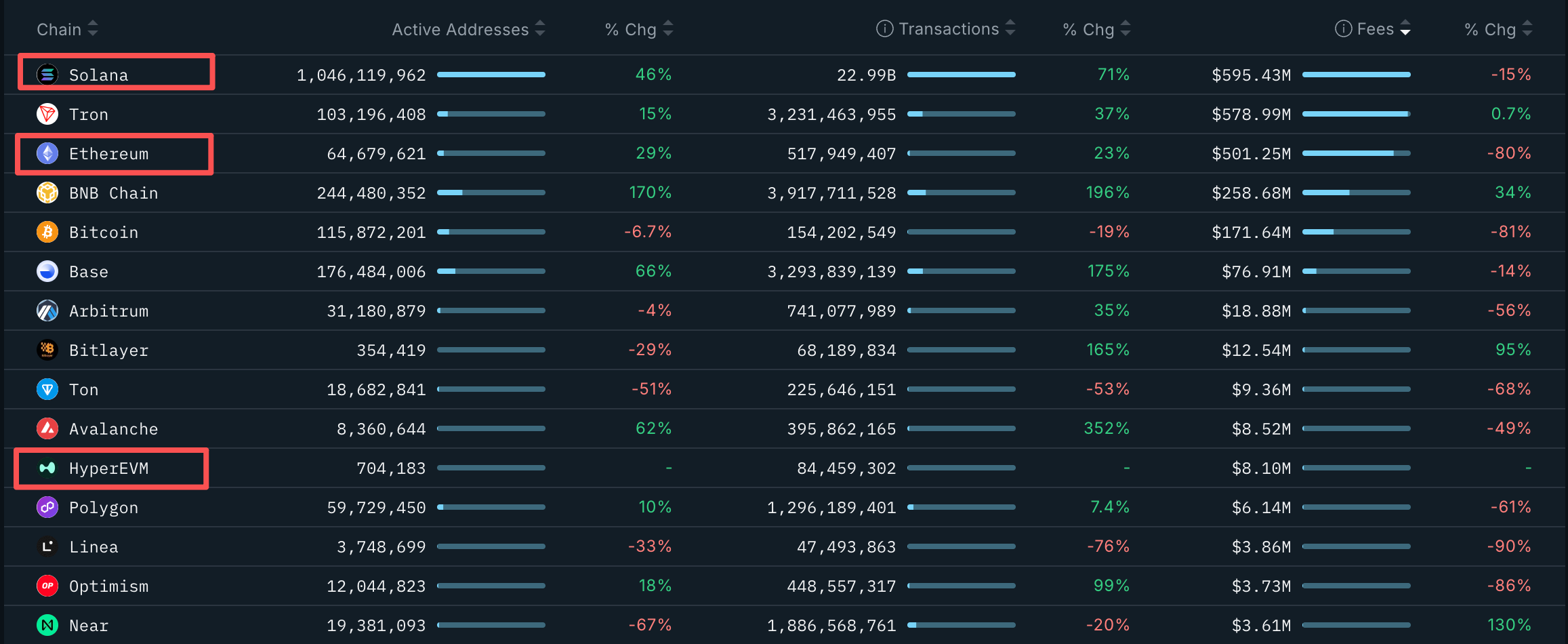
On January 2nd, Nansen data showed that Solana's on-chain fee revenue in 2025 broke through $600 million, surpassing TRON and Ethereum to rank first. The top five blockchains by on-chain fees last year were:

  • Solana ($603 million);
  • TRON ($581 million);
  • Ethereum ($514 million);
  • BNB Chain ($259 million);
  • Bitcoin ($172 million).

In addition, the number of active addresses on the Solana chain exceeded 1.05 billion, and the number of on-chain transactions was about 23.01 billion, both higher than public chains such as Ethereum, Bitcoin, and Tron.

Latest data shows that,as of the time of writing, Solana has maintained its first position in terms of number of active addresses, number of transactions, and revenue fees within the past year.
2025 Solana Annual Revenue Exceeds $1.5 Billion, Surpassing the Combined Revenue of "Hyperliquid + Ethereum"

According to Blockworks Research data, Solana's full-year revenue in 2025 exceeded $1.5 billion, leading all public chain networks. Hyperliquid followed closely with revenue of $780 million; Ethereum generated $690 million in the same period, both lagging behind Solana. At the same time, and even more commendable, Solana achieved this revenue achievement while its median transaction fee remained below 1 cent.

In this regard, Solana co-founder Anatoly Yakovenko affirmed this achievement and pointed out that capacity growth and cost-effectiveness are the core driving forces. He believes that network scale, not high fees, supports sustainable revenue expansion.

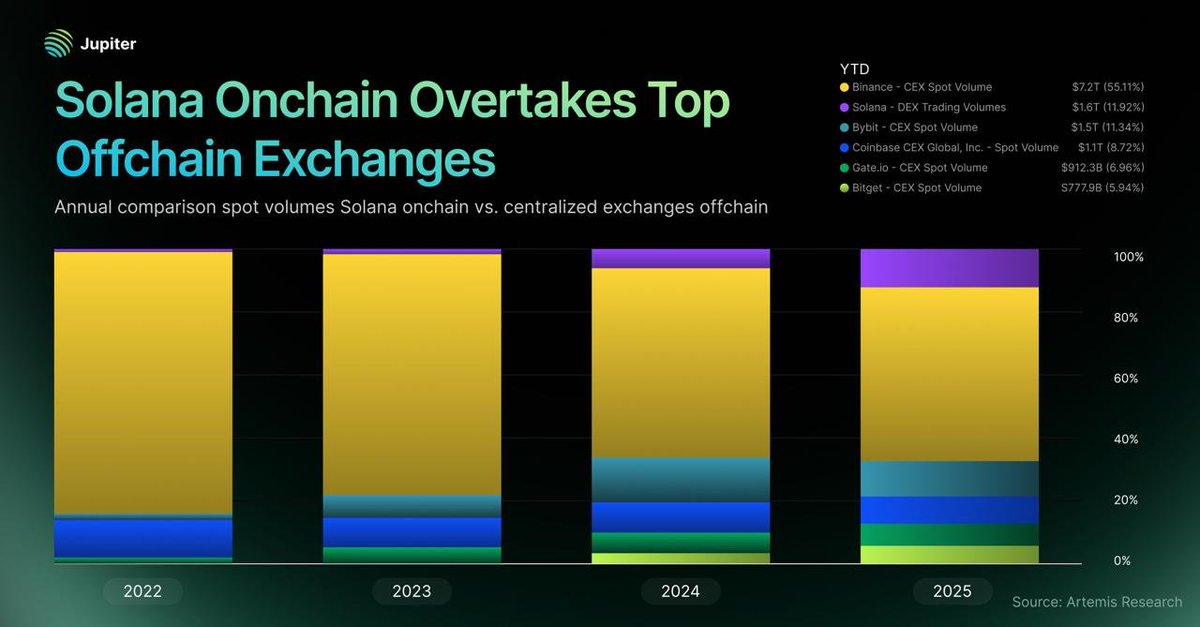
2025 Solana On-Chain Spot Trading Volume Reaches $1.6 Trillion, Surpassing All CEXs Except Binance

Recently, The Kobeissi Letter stated that the on-chain spot trading volume on Solana in 2025 officially reached $1.6 trillion, surpassing all centralized exchanges except Binance.

According to data from JupiterExchange, the proportion of Solana's on-chain trading volume to total trading volume has grown from 1% to 12% since 2022. In 2025, Solana's total trading volume officially exceeded that of Bybit, Coinbase Global, and Bitget, second only to Binance.

At the same time, Binance's market share has dropped from 80% to 55% since 2022. This also means that industry activity in cryptocurrency is rapidly shifting on-chain.
Revealing the Composition of Solana Ecosystem On-Chain Revenue: 4 Components Support Over $600 Million

Based on available information, Solana's network revenue mainly comes from on-chain transaction fees. Unlike Ethereum and others, its fee mechanism design focuses more on deflation and validator incentives. The composition of the total fee revenue of $603 million in 2025 is as follows:

First Revenue: Base Fee

  • A very low fixed base fee is charged per transaction (about 5000 lamports).
  • This portion of the fee is entirely burned, not distributed to validators, directly reducing the total supply of SOL, creating deflationary pressure.
  • Accounts for a large proportion of total fee revenue, especially in 2025 with explosive transaction growth, the burning mechanism significantly enhanced SOL's scarcity.

Second Revenue: Priority Fee

  • An additional fee that users can optionally pay to speed up transaction confirmation.
  • During periods of high congestion (e.g., meme coin craze, large DEX trades), priority fees increase significantly, becoming a major source of revenue increment.
  • This portion of the fee is distributed to block producers (Leaders) and stakers, and is the main reward source for validators.

Third Revenue: MEV (Maximal Extractable Value) Related Revenue

  • Tips paid by searchers through MEV clients like Jito further supplement income.
  • The proportion of MEV revenue increased in 2025, closely related to complex arbitrage opportunities in DEX and meme coin trading.

Fourth Revenue: Other Minor Sources

Such as account rent (storage fees), voting fees, etc., accounting for a small proportion.

In the overall distribution mechanism, about 50% of the fees indirectly benefit all SOL holders through the burning mechanism (deflation); about 50% is directly distributed to validators and stakers, incentivizing network security. Unlike Ethereum, where protocol revenue fees mainly go to validators, Solana's burning mechanism gives its network revenue greater long-term value capture capability, which is also the key to maintaining low fees under high transaction volume.

Overview of Crypto Money-Making Machine Business Models: Public Chains, Perp DEXs, Launchpads Remain the Most Profitable Tracks, Second Only to Stablecoins

Finally, synthesizing existing market information, public chains (Solana, Ethereum, TRON), on-chain perp DEXs (like Hyperliquid, Aster, etc.), and on-chain Launchpads (like Pump.fun) are still the most profitable tracks in the crypto industry, second only to stablecoin projects that collect interest and have stable issuance.

Although we previously analyzed the awkward survival state of current public chain projects in the article "Only 10 Public Chains Have Weekly Revenue Over $100,000: Swimming Naked After the Tide Recedes", the existence of public chains like Solana, Ethereum, TRON, and Base tells us: public chains are still the most profitable crypto track today, perhaps even without exception.

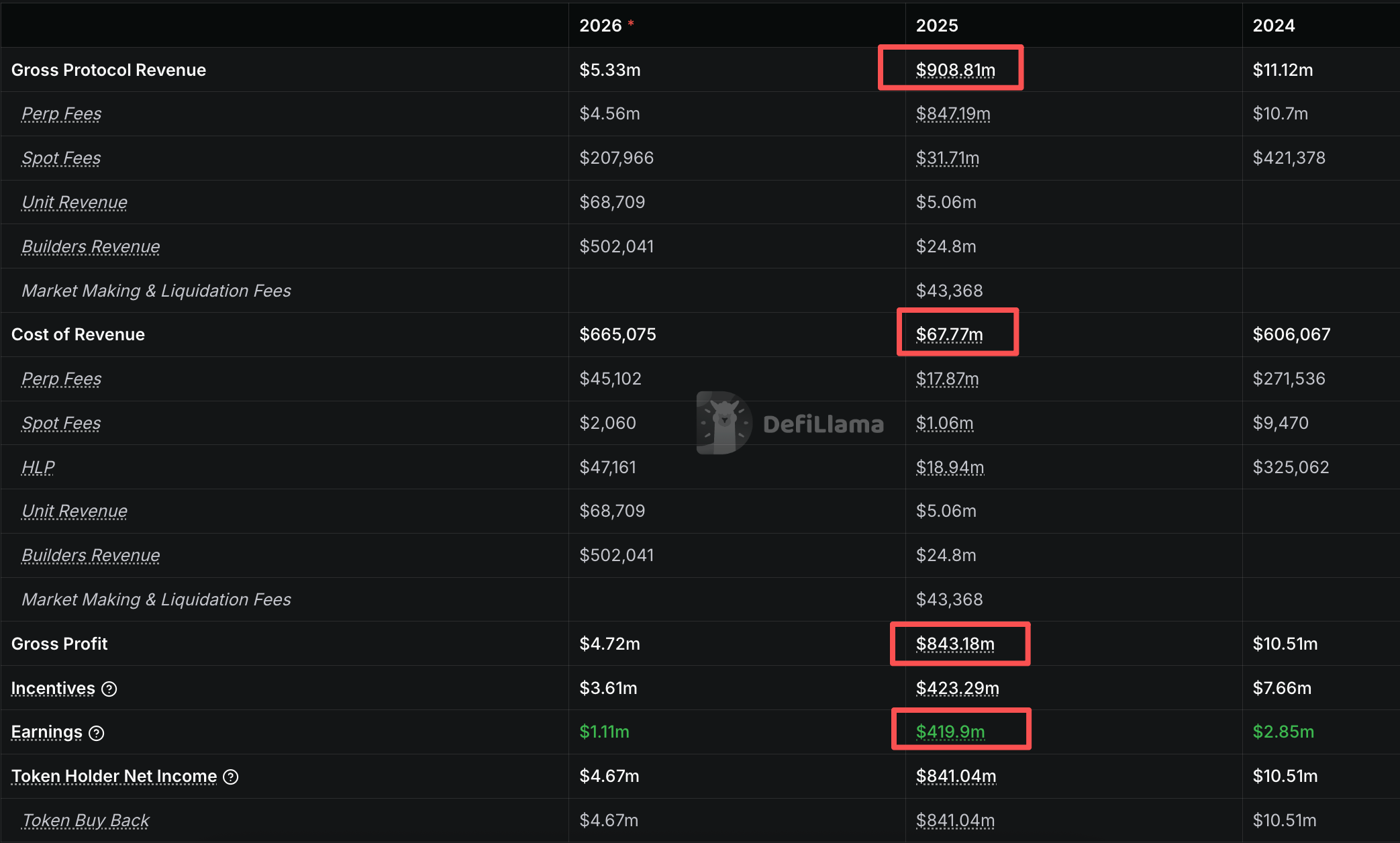
According to DefiLlama data, Hyperliquid's revenue in 2025 was $908 million; its cost of revenue was approximately $67.77 million, and its annual net profit was approximately $843 million. Excluding incentive-based expenses, the net profit attributed to the platform in 2025 was as high as approximately $420 million.
According to DefiLlama data, Pump.fun's annual revenue in 2025 was approximately $550 million. Unlike on-chain perp DEX platforms like Hyperliquid, as a "one-click coin issuance platform", Pump.fun does not need to incur incentive expenses, so its platform's annual net profit is approximately equal to its annual revenue, i.e., $549 million.
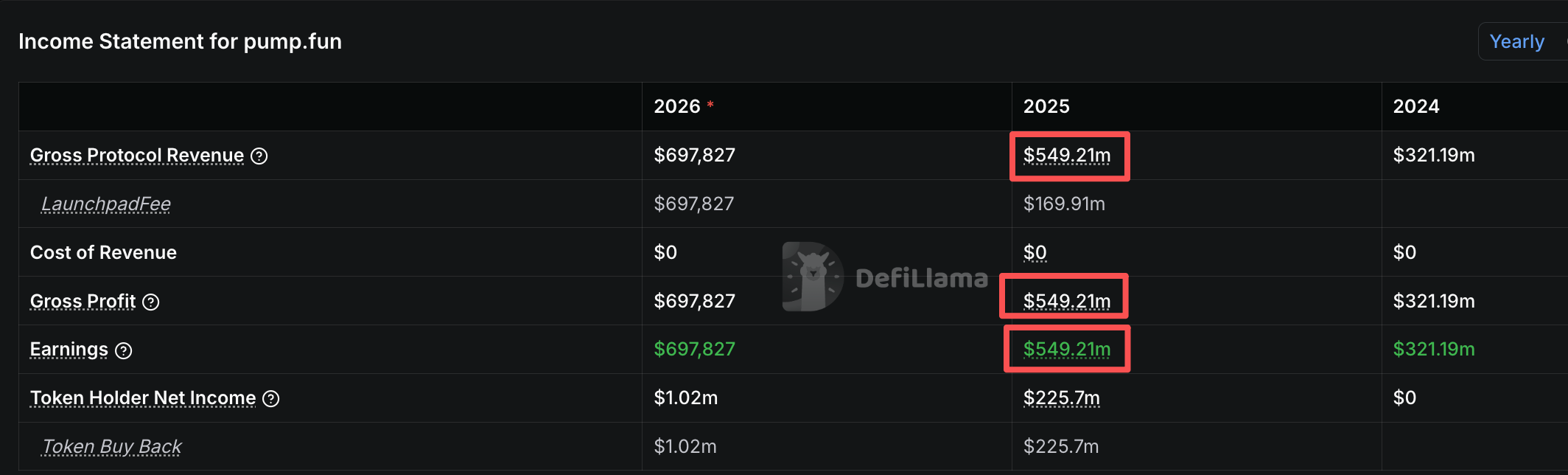
Based on the above information, the industry's mainstream revenue-generating machines are still top applications like public chains, on-chain Perp DEXs, and Launchpad coin issuance platforms, second only to stablecoins (e.g., Tether's net profit related to the stablecoin sector alone reached $7.43 billion in 2025).


Trending Cryptos

Related Questions

QWhat was Solana's on-chain fee revenue in 2025, and how did it rank compared to other major blockchains?

ASolana's on-chain fee revenue in 2025 was $603 million, ranking it number one among all major blockchains, surpassing Tron ($581 million) and Ethereum ($514 million).

QWhat was Solana's total annual revenue for 2025, and how does it compare to the combined revenue of Hyperliquid and Ethereum?

ASolana's total annual revenue for 2025 was over $1.5 billion, which is more than the combined revenue of Hyperliquid ($780 million) and Ethereum ($690 million).

QWhat were the four main components that made up Solana's $603 million in on-chain fee revenue?

AThe four main components were: 1. Base fees (burned, creating deflationary pressure), 2. Priority fees (paid to validators and stakers), 3. MEV (Maximal Extractable Value) related income, and 4. Other minor sources like account rent and voting fees.

QHow much on-chain spot trading volume did Solana process in 2025, and what does this volume surpass?

ASolana processed $1.6 trillion in on-chain spot trading volume in 2025, surpassing the volume of all centralized exchanges except for Binance.

QAccording to the article, what are the most profitable business models in the crypto industry,仅次于稳定币?

AThe most profitable business models,仅次于稳定币, are public chains (like Solana, Ethereum, Tron), on-chain Perp DEXs (like Hyperliquid), and on-chain Launchpads (like Pump.fun).

Related Reads

7 Months After the Collapse of Huiwang, Southeast Asia's Escrow Platforms Undergo a Major Reshuffle

Following the collapse of Huione Pay—dubbed the "Alipay of Southeast Asia"—seven months ago, the region's underground financial guarantee platform sector is undergoing a significant reshuffle. This power vacuum has been swiftly filled by emerging platforms such as XinBi, Tiger/Navigator, JinBei (renamed JinBo), Dali/Tiancheng, and FullyLight. These platforms, operating largely via Telegram and offering services like escrow for illicit transactions, have absorbed the vast user base and markets left behind by Huione. While positioning themselves as "trust intermediaries," their primary clientele consists of networks involved in online scams, money laundering, illegal gambling, and even human trafficking. For instance, the Tiger/Navigator platform explicitly provides "escrow" services for kidnapping-for-ransom operations ("强押车交易"). Data underscores the immense scale: Huione alone processed over $103 billion in cryptocurrency payments and facilitated over $31 billion through its escrow market before its downfall, linking it to Cambodia's notorious Prince Group. Since its collapse, competitors have seen explosive growth. For example, the XinBi platform has accumulated over $1.6 billion in total USDT revenue, while platforms like NewPay, OkPay (under Dali), and FullyLight Wallet collectively processed over $4.8 billion in USDT in a single year. This ecosystem thrives in regions like Cambodia and Myanmar, where regulatory gaps allow these platforms to act as critical financial infrastructure for sprawling cybercrime industries, from scam compounds to online casinos. The article concludes that the moniker "Southeast Asian Alipay" is a misnomer, obscuring the platforms' fundamental role in enabling serious criminal enterprises rather than representing legitimate financial innovation.

Odaily星球日报44m ago

7 Months After the Collapse of Huiwang, Southeast Asia's Escrow Platforms Undergo a Major Reshuffle

Odaily星球日报44m ago

The Changing Landscape: What Are Crypto VCs Experiencing?

Title: The Shifting Landscape of Crypto Venture Capital The era of dedicated crypto venture capital funds is undergoing a significant transformation. Once essential for navigating the sector's complexity and high risk, these specialized funds are now facing an identity crisis as the market matures. This shift mirrors historical patterns in other specialized investment classes like cleantech and SPACs, where initial information advantages dissipate as technologies become mainstream and integrated into existing industry frameworks. The article argues that crypto is reaching a critical inflection point, transitioning from a "building phase" to an "integration phase." Major players like Stripe, BlackRock, and Visa now engage with crypto not for its novel mechanics but as a foundational financial infrastructure. Their needs—regulatory compliance, banking partnerships, distribution channels—align with traditional fintech, a domain easily understood by large, generalist funds like Sequoia and Founders Fund. This evolution creates a "barbell effect" within the VC landscape. On one end are massive, diversified platforms that can incorporate crypto as one vertical among many. On the other are small, nimble funds focused on niche, experimental projects. The middle ground—medium-sized dedicated crypto funds—is being squeezed out. Their typical fund size makes it impossible to generate sufficient returns solely from early-stage crypto bets, yet they cannot compete with giants for later-stage deals. Consequently, leading crypto-native firms like Paradigm and Framework Ventures are expanding into AI, robotics, and other sectors, driven partly by LP pressure for better returns amid a broader VC DPI crisis. Others, like Dragonfly and a16z, have narrowed their crypto focus predominantly to financial infrastructure like stablecoins, reframing the sector's core narrative. For crypto entrepreneurs, this consolidation presents challenges. While generalist funds offer larger checks and broader resources, crypto projects now compete fiercely with AI for attention and capital within these firms. Furthermore, the long-term, non-commercial foundational work that built the ecosystem—funded by dedicated crypto VCs—is less likely to attract generalist capital focused on direct returns. The conclusion is that "crypto investor" as a standalone category is becoming obsolete, akin to "internet investor." Crypto is becoming a baseline infrastructure layer. The future will see a barbell structure: large-scale growth financing handled by generalist funds, while pioneering, speculative projects are funded by small, specialized vehicles. The dedicated crypto funds of the 2017-2021 boom, which incubated core infrastructure, are giving way to this new, bifurcated reality.

Foresight News1h ago

The Changing Landscape: What Are Crypto VCs Experiencing?

Foresight News1h ago

As Consensus Accelerates, What Are Young Investors Betting On?

Title: As Consensus Forms Faster, What Are Young Investors Betting On? In the rapid evolution of tech investment, a new generation of young investors is navigating a landscape where AI, robotics, commercial aerospace, and quantum computing are advancing simultaneously. Traditional investment logic based on financial models is giving way to a need for deep technical understanding and the ability to act before industry consensus forms. An analysis of trends from the "WAIC FUTURE TECH" list of young investment leaders reveals key shifts in focus. The first major trend is the movement of AI from the digital screen into the physical world. Investment is shifting from large language models and chatbots towards embodied AI, robotics, AI hardware, and edge computing. While demonstrations generate excitement, the real challenge lies in achieving scalable, reliable, and cost-effective delivery in complex real-world environments like factories and logistics. Success depends not just on algorithms but on the integration of sensors, actuators, and control systems. Second, the competitive focus for large models is moving beyond raw capability toward building an "intelligence flywheel." The goal is to create self-reinforcing systems where user interaction generates data, improving the model, which in turn enhances the user experience and attracts more engagement. Companies that successfully embed AI into workflows to create these closed-loop systems can build lasting value that isn't easily erased by the next model upgrade. Third, facing a potential bottleneck in high-quality human-generated data, investors are looking at new underlying technologies. Reinforcement learning and self-play, as demonstrated by AlphaGo Zero, offer paths for AI to generate its own experience. Scientific foundation models, which aim to build general AI capabilities for fields like life sciences and materials discovery, represent a non-consensus direction that could unlock new frontiers of knowledge and data. Finally, in deep-tech areas like quantum computing, commercial aerospace, and space-based infrastructure, patient capital is essential. These fields have long, uncertain development and validation cycles involving complex engineering, supply chains, and regulations. Investment here requires a long-term view, focusing on foundational team capabilities and the eventual emergence of market demand, even if commercial returns are distant. Collectively, these trends illustrate how young investors are adapting to a new era. They are learning to make earlier, technically-informed judgments, balance hype with real-world viability, and provide the patient capital needed to build the deep-tech foundations of the future.

marsbit1h ago

As Consensus Accelerates, What Are Young Investors Betting On?

marsbit1h ago

Trading

Spot

Hot Articles

Discussions

Welcome to the HTX Community. Here, you can stay informed about the latest platform developments and gain access to professional market insights. Users' opinions on the price of ETH (ETH) are presented below.

活动图片














