"Six Walnuts" Diversifies into AI Investment, Stock Price Triples in One Year

marsbitPublished on 2026-06-24Last updated on 2026-06-24

Abstract

"Six Walnuts," a popular Chinese beverage brand under Yangyuan Food and Beverage, has pivoted aggressively into AI and semiconductor investments. Despite its core walnut milk drink business facing sustained decline—with revenues shrinking 41% over a decade—the parent company has channeled nearly all its annual profits for three consecutive years into a 40 billion yuan investment fund targeting AI hardware, chips, and storage. This bold move has transformed the firm into an AI-themed stock, propelling its share price up nearly 300% in one year, even as consumer stocks broadly struggled. A key bet is a 1.6 billion yuan investment in memory chipmaker Yangtze Memory, whose potential IPO could deliver substantial returns. Other investments span AI vision, edge AI chips, and GPUs, though many remain unrealized or at a paper loss. While maintaining its beverage base, Yangyuan is pursuing a dual-track strategy: steady income from its traditional business and high-risk, high-reward exposure to hard tech. Its future valuation now heavily depends on the success of these tech investments, particularly Yangtze Memory's listing. Failure could lead to significant market correction as AI expectations unwind.

Author: Think AI, Aaron

"Use your brain often, drink more Six Walnuts" is a well-known advertising slogan.

As the blockbuster beverage of Yangyuan Beverage Company, Six Walnuts once swept across the country. Few would have imagined that this beverage company would be linked to AI chips.

In fact, the parent company of Six Walnuts is almost all-in on AI, having invested nearly its entire annual net profit into AI-related industries for three consecutive years.

Although it hasn't yet made actual money from the AI industry, its stock price soared from around 17.7 yuan at the beginning of last year to a high of 52 yuan in May, a 293% increase, nearly tripling.

The market already views Yangyuan Beverage as an AI concept stock.

In contrast, similar consumer stocks have had a terrible year over the same period. Across the A-share market, 1653 individual stocks hit new lows for the year, with consumer sector stocks accounting for a very high proportion. "Six Walnuts" has become a bright spot in the market.

Why has the parent company of Six Walnuts continued to ramp up investments in hard-tech sectors like AI since 2021? If these investments fail, what will the future hold?

Main Business Shrinking, Founding Team Needs Imagination

There was a time when Yangyuan Beverage was a dominant force. In 2015, its revenue reached a historical peak of 9.1 billion yuan, making founder Yao Kuizhang the richest person in Hebei province that year.

From 2015 to 2018, Yangyuan maintained rapid development, with net profit reaching a historical maximum of 2.8 billion yuan in 2018.

At that time, Yangyuan held a 90% market share in the walnut milk industry, almost monopolizing the entire sector.

Annual net profits exceeding 2 billion yuan also made the company a cash cow.

But by the present, in 2025, Yangyuan's revenue is only around 5.3 billion yuan, a 41% decline over 10 years, and profits have halved to just 1.2 billion yuan compared to the peak.

More troubling is that the decline is not isolated. Yangyuan is under pressure in its main sales regions like East China, Central China, and North China, with declines in regions like Northeast and Northwest China even exceeding 30%. Traditional peak seasons have also failed to reverse the downturn.

Yangyuan heavily relies on core products like Six Walnuts, with walnut milk accounting for over 80% of all product sales.

New products have remained lukewarm, while walnut milk itself is losing market share to alternatives like nut milks and oat milk. The gifting attribute of Six Walnuts has also gradually weakened, placing the main business in a long-term shrinking track.

Faced with weak products, the company did not choose to increase R&D efforts, innovate with new products, or compete on the product front.

Instead, it chose a more imaginative route of AI investment. Yangyuan's overall investment philosophy is relatively simple: invest in whatever is hot.

Setting aside the question of right or wrong, let's first look at which sectors Yangyuan has heavily entered, what results it has achieved, and then we will predict Yangyuan's possible endgame.

Cross-Border Gambling Spree

Since 2021, Yangyuan Beverage has focused on laying out the upstream and downstream of AI hardware. It launched a 3-billion-yuan fund, later expanding it by another 1 billion yuan in October last year, continuously increasing bets on AI, semiconductors, and new energy.

So far, 2.95 billion yuan has been spent, with 1.05 billion yuan still idle, awaiting new projects to invest in.
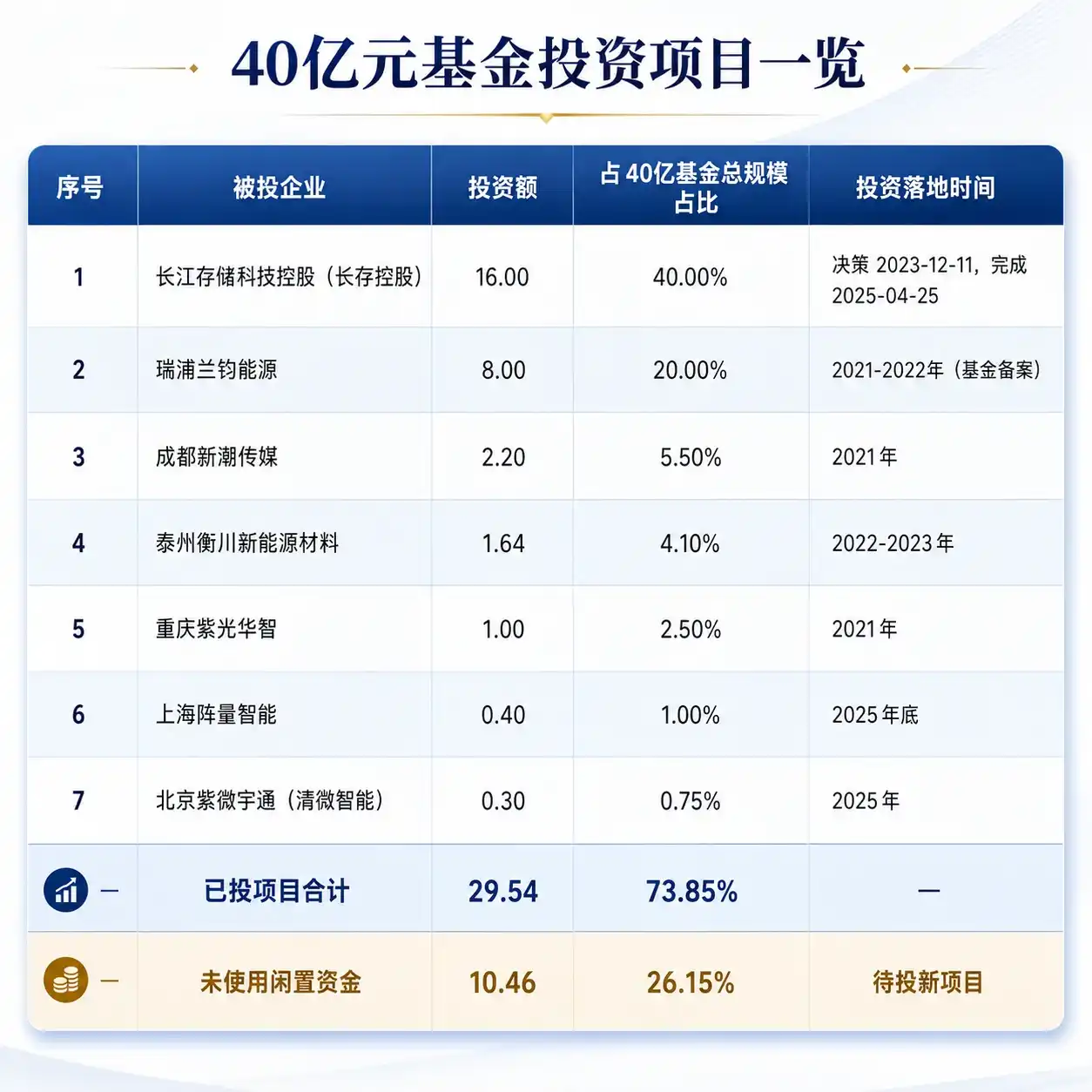
Among its 4-billion-yuan fund, one major investment drew attention: a 1.6-billion-yuan investment completed in April last year into Yangtze Memory Technologies Co., Ltd. (YMTC), acquiring a 0.99% equity stake.

1.6 billion yuan is equivalent to Yangyuan's entire annual profit. Investing the whole amount into a long-cycle industry like memory storage shows the company's boldness.

And YMTC has become hot this year, with reports of a potential domestic IPO and valuations ranging from 500 billion to 1 trillion yuan. Compared to last year's investment valuation, this represents a tripling in value.

If YMTC can successfully list, this single investment will mark the success of Yangyuan's industrial investments.

Because most of the other investments are currently at a floating loss, but Yangyuan has not exited, opting to continue holding long-term.

Among them, an 800-million-yuan investment in REPT Battero, a new energy power battery company, was fully cashed out after its 2023 Hong Kong IPO, realizing a book gain of approximately 241 million HKD.

The acquisition of Xinchao Media by Focus Media was valued at only 8.3 billion yuan, far below the 16.1 billion yuan valuation at the time of investment. Exit has not been executed yet, the fund still holds the equity, and it is currently at a floating loss.

The other AI-related companies are concentrated in areas like AI vision, edge-side AI chips, and GPUs for large model training, forming a relatively complete AI industry chain layout.

What's Next for Yangyuan?

In the coming years, Yangyuan Beverage is unlikely to completely transform into a VC company. Instead, it will likely maintain a dual-wheel model of "consumer main business as the foundation, equity investments for elasticity."

Six Walnuts will still be the company's basic business, but the walnut milk category has passed its high-growth period and will find it difficult to return to its past peak of 10 billion yuan annual revenue.

The 4-billion-yuan Quanhong Fund will remain an industrial fund worth watching.

Yangyuan's future capital will likely continue to flow into the upstream of AI computing power, including hard-tech directions like memory storage, edge-side AI chips, and industrial vision. Non-core tracks like new energy and media will gradually be marginalized.

If YMTC successfully lists, the investment gains could rewrite the income statement in one go, transforming the company's valuation from a traditional beverage stock to a dual pricing of "consumer + hard-tech shadow stock."

Conversely, if YMTC's listing is delayed or the semiconductor cycle turns cold, the stock price could also sharply retreat due to unmet tech expectations.


Trending Cryptos

Related Questions

QWhat is the main reason behind Yangyuan Beverage's (parent company of 'Six Walnuts') heavy investment in AI and related industries since 2021?

AThe primary reason is the continuous decline of its core beverage business, 'Six Walnuts.' The company faces shrinking revenues and profits in its main product line, with market share being eroded by alternatives like nut milk and oat milk. Instead of intensifying product R&D, the company has chosen to invest in high-growth, high-imagination sectors like AI to seek new growth drivers and boost its market valuation.

QWhat was the most significant AI/hard tech investment made by Yangyuan Beverage's fund, and what is its current status?

AThe most significant investment was a 1.6 billion RMB injection into Yangtze Memory Technologies Co., Ltd. (YMTC) in April of last year, acquiring a 0.99% stake. YMTC is reportedly planning a domestic IPO with a valuation estimated between 500 billion and 1 trillion RMB. If successful, this investment could triple in value and be a major success for Yangyuan's industrial investment strategy.

QHow has Yangyuan Beverage's stock price performed following its shift towards AI investments, and how does this contrast with the broader market?

AYangyuan Beverage's stock price surged from a low of around 17.7 RMB in early last year to a high of 52 RMB in May, representing a gain of approximately 293% (nearly tripling). This performance starkly contrasts with the broader A-share consumer sector, where many stocks hit yearly lows, making 'Six Walnuts' a standout performer in the market.

QAccording to the article, what is the likely future business model for Yangyuan Beverage?

AThe article suggests Yangyuan Beverage will likely maintain a dual-wheel business model: its traditional consumer beverage business (primarily 'Six Walnuts') as a stable foundation, combined with equity investments (particularly in AI and hard tech via its Quanhong Fund) to seek higher growth and valuation elasticity. It is not expected to transform completely into a venture capital firm.

QWhat are the potential risks for Yangyuan Beverage if its major AI/hard tech investments, like in YMTC, do not meet expectations?

AIf key investments like YMTC face delays in their IPO or if the semiconductor industry cycle turns downward, Yangyuan Beverage could experience a significant drop in its stock price as market expectations for tech-driven growth fail to materialize. This would lead to a sharp valuation correction. The company's financial performance would also be impacted without the anticipated large investment returns to offset the decline in its core beverage business.

Related Reads

Base Under Pressure

**Title: The Pressure Mounts for Base** Base, the Ethereum Layer 2 scaling solution backed by Coinbase, is facing significant pressure and public scrutiny from its leadership following the launch of Robinhood Chain. Base co-founder Jesse Pollak recently acknowledged strategic missteps, admitting that the chain's past focus on social and creator tokens (e.g., through Farcaster, Zora) failed to deliver sustainable adoption. He has refocused on core infrastructure, handing leadership of the Base App back to Coinbase's Cobie. While Base remains a top L2 contender alongside OP Mainnet and Arbitrum, and boasts the highest TVL (nearly $12B), its weaknesses are being highlighted by the new competitor. Key criticisms include its slow progress on decentralization. Base has faced issues with its single sequencer causing block production halts, and L2BEAT is reportedly considering downgrading its decentralization rating from Stage 1 to Stage 0. This contrasts sharply with the rapid initial success of Robinhood Chain, whose DEX quickly entered the top five by volume. The leadership styles of the parent companies are also being compared: Robinhood's CEO actively engages with new projects, while a recent incident where Coinbase's Brian Armstrong briefly changed his profile picture—sparking and then crashing a related meme token—drew community ire and mockery. Pollak stated Base is working with Coinbase on tokenized stocks backed 1:1 by real equity, differentiating it from Robinhood's derivatives model. However, the article argues that Base's most urgent task is to address its long-standing technical and trust issues. With more traditional finance players likely to emulate Robinhood's path, Base must use this competitive pressure to solidify its position as long-term financial infrastructure.

Foresight News9m ago

Base Under Pressure

Foresight News9m ago

White House Concession Removes Ethical Hurdle, Clarity Act Races Against Final Window Before Recess?

On July 21st, industry sources reported that the Trump administration has agreed to include an ethics provision in the "Clarity Act" (Digital Asset Market Clarity Act of 2025). This concession addresses the long-standing conflict-of-interest concerns regarding government officials and the crypto industry, potentially removing the final major obstacle to the bill's progress. Additionally, Patrick Witt, the executive director of the White House's Digital Asset Advisory Committee, confirmed he will remain in his role to help finalize the bill, alleviating previous concerns about his potential departure. The Clarity Act aims to establish a unified federal regulatory framework for the U.S. digital asset market. Its core objective is to resolve regulatory ambiguity by defining different types of digital assets (digital commodities, investment contract assets, and permitted payment stablecoins) and clarifying the respective oversight roles of the SEC and CFTC. This would end the long-running jurisdictional dispute between the two agencies and provide clearer compliance paths for the industry. With the ethics issue moving toward resolution, the most urgent challenge now is time. The U.S. Congress is set to begin its August recess in mid-August, leaving only a few working weeks to finalize the text and advance the bill through the Senate. Industry advocates, like the Blockchain Association's Kristin Smith, stress that this is a critical moment. If negotiations conclude successfully in the coming weeks, the Clarity Act could pass a key hurdle before the recess; otherwise, it may face significant delays. If enacted, the Clarity Act could mark a historic turning point in crypto regulation. By providing a clearer and more predictable legal framework, it aims to reduce uncertainty for businesses, developers, and traditional financial institutions looking to enter the digital asset space, potentially setting a global benchmark for market structure regulation.

Odaily星球日报14m ago

White House Concession Removes Ethical Hurdle, Clarity Act Races Against Final Window Before Recess?

Odaily星球日报14m ago

AI Era, Industrial Revolution, and Future Civilization Interview — Zhang Dingwen: The Future Does Not Belong to Chasers

"AI Era, Industrial Revolution and Future Civilization: An Interview with Zhang Dingwen – The Future Does Not Belong to Those Who Chase" In this interview, entrepreneur Zhang Dingwen reflects on his entrepreneurial journey and philosophy, moving beyond discussions of financing or success to emphasize understanding the "era" itself. He argues that true entrepreneurs should not chase short-term trends ("winds"), but position themselves in the direction of long-term technological and societal evolution. Zhang shares key lessons from his early days, including the realization that user value does not automatically translate to commercial value. For him, the core of entrepreneurship is not building a company but constantly upgrading one's own "cognition" – the ability to interpret information, ask the right questions, and understand the underlying "causes" behind business outcomes, not just the effects. His thinking has evolved from a focus on creating good products to a strategic focus on building "entrances" – platforms that naturally connect users to digital services. He sees smart wearables, like watches, not merely as hardware but as potential future gateways combining technological, financial, social, and even fashion attributes to create sustained user relationships and ecosystems. Ultimately, Zhang's vision transcends individual products or companies. He discusses business competition in three stages: product, platform, and finally, "civilization" – where the greatest companies influence how society operates by defining new rules and ways of life. He believes the mission of a truly great enterprise is to solve problems of its time, build enduring trust, and contribute lasting value, leaving behind not just wealth but a positive impact on how the world works. The future, he concludes, belongs not to the fastest, but to those with the correct long-term direction and a commitment to continuous learning and evolution.

marsbit25m ago

AI Era, Industrial Revolution, and Future Civilization Interview — Zhang Dingwen: The Future Does Not Belong to Chasers

marsbit25m ago

Cryptocurrency & Stock Market Barometer丨Strategy Cash Reserves Increase to $3.23 Billion, Halting BTC Purchases; Vanguard and Other Asset Managers Increase Holdings in Strategy Stock (July 21)

Market Overview & Warnings: The article warns of high volatility in South Korean stocks and continued dependence on U.S. stocks on geopolitics. Chinese A-shares remain under pressure. It advises against using leverage in current equity markets. For crypto-linked stocks, most have limited growth except Robinhood, with caution advised. U.S. Stock Market: Bearish bets on U.S. stocks, particularly targeting AI-related companies, have reached record highs since 2010, signaling deep skepticism about the sustainability of the AI-driven rally. Tech and chip stocks led a market decline, with the Philadelphia Semiconductor Index potentially entering a bear market. Increased expectations for Federal Reserve interest rate hikes and geopolitical tensions contributed to the negative sentiment. Bitcoin Treasury Company Updates: * Strategy: Increased its cash reserves to $3.23 billion and paused Bitcoin purchases. Several major asset managers, including Vanguard Group and Capital Group, increased their holdings of Strategy (MSTR) stock. * Global corporate Bitcoin buying slowed significantly to just $1.33 million last week. * Other notable activity: Strive purchased 21 BTC; ORANGE JUICE raised $40 million for Bitcoin acquisitions; Bitcoin Japan Corp. raised $60 million, allocating $4.08 million for its first BTC purchase. Other Crypto Treasury Holdings: * Ethereum: BitMine increased its ETH holdings to 5.78 million, nearing its 5% of supply goal. Its total crypto assets, cash, and securities are valued at $11.5 billion. * Solana: No significant corporate treasury activity reported. * Altcoins: HypeStrat made no adjustments to its treasury; its mNAV ratio fell to a long-term low. (Note: This summary is for informational purposes only and does not constitute investment advice.)

marsbit26m ago

Cryptocurrency & Stock Market Barometer丨Strategy Cash Reserves Increase to $3.23 Billion, Halting BTC Purchases; Vanguard and Other Asset Managers Increase Holdings in Strategy Stock (July 21)

marsbit26m ago

Trading

Spot

Hot Articles

How to Buy ONE

Welcome to HTX.com! We've made purchasing Harmony (ONE) simple and convenient. Follow our step-by-step guide to embark on your crypto journey.Step 1: Create Your HTX AccountUse your email or phone number to sign up for a free account on HTX. Experience a hassle-free registration journey and unlock all features.Get My AccountStep 2: Go to Buy Crypto and Choose Your Payment MethodCredit/Debit Card: Use your Visa or Mastercard to buy Harmony (ONE) instantly.Balance: Use funds from your HTX account balance to trade seamlessly.Third Parties: We've added popular payment methods such as Google Pay and Apple Pay to enhance convenience.P2P: Trade directly with other users on HTX.Over-the-Counter (OTC): We offer tailor-made services and competitive exchange rates for traders.Step 3: Store Your Harmony (ONE)After purchasing your Harmony (ONE), store it in your HTX account. Alternatively, you can send it elsewhere via blockchain transfer or use it to trade other cryptocurrencies.Step 4: Trade Harmony (ONE)Easily trade Harmony (ONE) on HTX's spot market. Simply access your account, select your trading pair, execute your trades, and monitor in real-time. We offer a user-friendly experience for both beginners and seasoned traders.

4.4k Total ViewsPublished 2024.03.29Updated 2026.06.02

How to Buy ONE

Discussions

Welcome to the HTX Community. Here, you can stay informed about the latest platform developments and gain access to professional market insights. Users' opinions on the price of ONE (ONE) are presented below.

活动图片