Silver Faces a 'Delivery Failure' Crisis? March May Be a 'Critical Moment' for Precious Metals

marsbitPublished on 2026-01-29Last updated on 2026-01-29

Abstract

A potential delivery crisis is looming in the silver market, with veteran analyst Bill Holter warning that COMEX could face a physical silver default as early as March 2026. Such an event would destroy the credibility of the current pricing mechanism and trigger a chain reaction spreading to gold and credit markets, potentially causing a systemic financial collapse. Unusually high delivery demand has already emerged, with over 40 million ounces of silver requested for delivery in January—a traditionally non-delivery month—compared to the usual 1-2 million ounces. As the key March delivery month approaches, demand could reach 70-80 million ounces, potentially exhausting COMEX's registered inventory of 110-120 million ounces. This warning comes amid an unprecedented rally, with silver prices surging 154% year-to-date and 40% in January alone. If COMEX fails to deliver, contract values could collapse, undermining trust in paper contracts and triggering a liquidity crisis reminiscent of the 1980 Silver Thursday event. Despite prices exceeding $100/ounce, analysts believe the market remains in early stages, with predictions of $300/ounce or even extreme valuations based on monetary recalibration. Strong industrial demand from solar, EV, and electronics sectors, combined with investment demand as an inflation hedge, contrasts with constrained supply, setting the stage for continued volatility and potential long-term price appreciation.

Author:Bu Shuqing, Wall Street News

The precious metals market is facing a potential delivery crisis.

Veteran precious metals analyst Bill Holter recently warned that the New York Commodity Exchange (COMEX) could see a physical silver delivery default as early as March 2026. This would completely destroy the credibility of the existing pricing mechanism and trigger a chain reaction spreading to the gold and credit markets, potentially leading to the collapse of the entire financial system.

Abnormal delivery demand has already emerged. According to Holter, in January, traditionally a non-delivery month, COMEX has already seen over 40 million ounces of silver requested for delivery, whereas this figure is typically only 1 to 2 million ounces in previous years during the same period. As the main delivery month of March approaches, delivery demand could reach 70 to 80 million ounces, potentially depleting COMEX's current registered inventory of 110 to 120 million ounces.

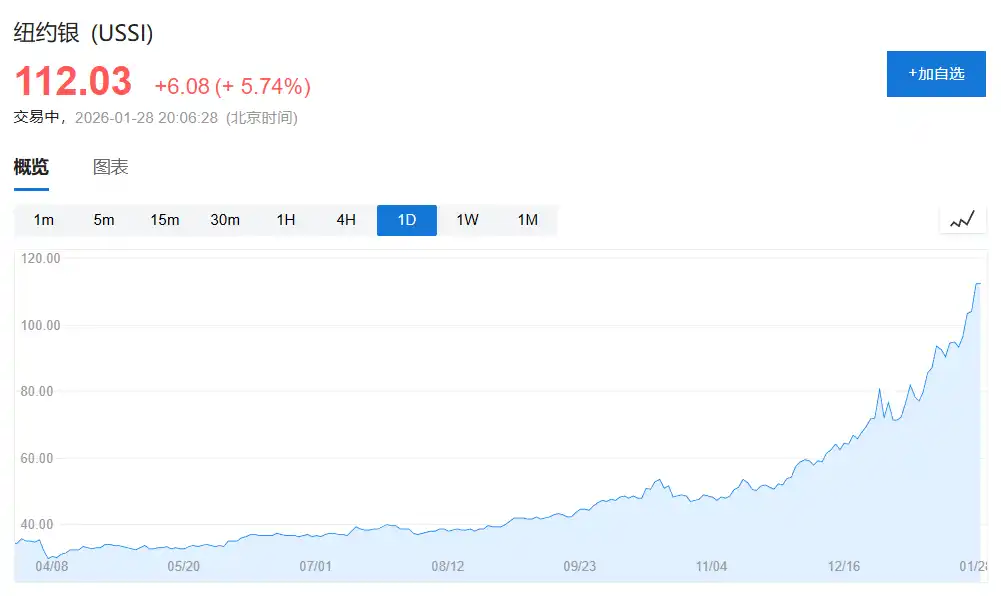
This warning comes as the silver market is experiencing an unprecedented rally. Silver prices have surged 154% year-to-date in 2025, rising about 40% in January alone, far outpacing the stock market's performance over the same period. UBS strategists have already alerted clients this week, stating that the gains in precious and industrial metals have been "out of control" recently.
If Delivery Fails, Is the Financial System at Risk of Collapse?

The COMEX silver market is facing unprecedented physical delivery pressure. Holter pointed out that the appearance of 40 million ounces of delivery requests in January, a non-delivery month, is an extremely abnormal phenomenon, signaling the potential for a larger-scale run in the main delivery month of March.

"If COMEX cannot fulfill its delivery obligations, the contract value will go to zero," Holter stated. He emphasized that a delivery default would completely negate COMEX's pricing authority, as contracts that cannot be honored hold no value.

More seriously, a silver delivery failure would immediately transmit to the gold market. Holter warned that since gold is essentially an "anti-dollar" or "anti-U.S. Treasury" asset, a default in the gold market would directly impact the credit market, thereby threatening the stability of the entire financial system.

Currently, COMEX's registered deliverable silver inventory is approximately 110 to 120 million ounces, but the market questions whether this inventory might be subject to re-hypothecation or other encumbrances. If March delivery demand exceeds available inventory, the market will face the most severe liquidity crisis since the Silver Thursday event of 1980.

Holter painted a grim picture of the consequences of a delivery default. He predicted that if a delivery failure occurs in March 2026, it would trigger currency devaluation and the collapse of the entire financial system.

"The real economy runs on credit. Everything you touch, everything you do, involves the participation of credit," Holter said. If credit becomes unavailable, the real economy would completely stall.

This warning is not alarmist. The pricing mechanism of the precious metals market has long relied on paper contracts, with physical delivery being extremely low. Once trust in paper contracts collapses, investors will flock to demand physical delivery, and exchange inventories are far from sufficient to meet the delivery demands of all contracts.

Considering the U.S.'s total debt and commitment scale of $200 trillion, the financial system's reliance on credit has reached a historical extreme. A crisis of confidence in any key market could trigger a chain reaction, and the precious metals market is precisely the final anchor of trust for the entire monetary system.

Price Predictions "Ridiculously Underestimated"

Although the silver price has broken through $100 per ounce, Holter believes the market is still in the early stages of the rally. He stated that all current price predictions—including the $600 per ounce target proposed years ago—will ultimately prove to be "ridiculously underestimated."

Well-known silver analyst Peter Krauth is also optimistic, expecting silver prices to potentially hit $300 per ounce in the upcoming "mania phase." Krauth believes that $50 per ounce has become the new price floor, and a sharp adjustment in the gold-to-silver ratio will be the core driver pushing silver prices higher.

Holter provided an even more extreme valuation framework from a monetary perspective. He pointed out that if calculated based on the U.S. federal government's $38 trillion debt, supported by 8,000 tons of gold reserves, the gold price should reach $200,000 per ounce. This logic also applies to the repricing of silver.

Some large traders and banks that are short precious metals have already fallen into financial difficulties. Holter indicated that the persistently rising metal prices—especially silver prices—are putting severe pressure on these institutions, which could exacerbate market instability.

Silver's strong performance is rooted in a deep fundamental imbalance. As a metal with both monetary and industrial properties, silver is being squeezed by multiple sources of demand.

Industrial demand remains strong, particularly in areas such as solar energy, electric vehicles, and electronics. At the same time, investment demand is also surging, with investors viewing silver as a hedge against inflation and currency devaluation.

The supply side faces structural constraints. Silver is primarily a by-product of base metal mining like copper, lead, and zinc, making its production difficult to quickly respond to price signals. This supply rigidity can easily trigger sharp price fluctuations when demand surges.

Krauth emphasized that all the elements needed to sustain the rally for "quite some time" are already in place. Although there is a risk of a short-term pullback, the medium to long-term trend is already established.


Related Questions

QWhat potential crisis is the COMEX silver market facing according to analyst Bill Holter?

ABill Holter warns that the COMEX may face a physical silver delivery default as early as March 2026, which could destroy the credibility of the existing pricing mechanism and trigger a chain reaction leading to the collapse of the entire financial system.

QWhat unusual demand pattern has been observed in the COMEX silver market recently?

AIn January, a traditionally non-delivery month, there were over 40 million ounces of silver requested for delivery, compared to the usual 1-2 million ounces in previous years.

QWhat is the estimated size of the COMEX's registered silver inventory, and why is it a concern?

AThe COMEX's registered deliverable silver inventory is approximately 110-120 million ounces. There is concern that this may be insufficient if delivery demands reach 70-80 million ounces in the key March delivery month, potentially leading to a liquidity crisis.

QWhat are some of the extreme price targets mentioned for silver by the analysts in the article?

AAnalyst Peter Krauth expects silver could reach $300 per ounce in an upcoming 'mania phase,' while Bill Holter suggests that even a target of $600 per ounce would be a 'laughable underestimate' from a monetary valuation perspective.

QBeyond investment demand, what other factors are contributing to the strong fundamentals for silver?

ASilver is experiencing strong industrial demand from sectors like solar energy, electric vehicles, and electronics. Additionally, its supply is structurally constrained as it is largely a byproduct of base metal mining (like copper, lead, zinc), making it difficult to quickly increase production in response to price signals.

Related Reads

Within Strategy's Framework, STRC's Dividend Yield Remains at 12% as Share Price Stays Below Par Value

Michael Saylor, Executive Chairman of Strategy (MSTR), confirmed that the dividend rate for its STRC perpetual preferred shares will remain at 12.00% through August 2026. The rate has increased from 9% at its July 2025 launch to the current high via a "ratchet" mechanism, which permanently raises the rate by 0.5% whenever the share price falls below $95. This mechanism is intended to push the price back toward its $100 par value and support Strategy's "at-the-market" (ATM) program for issuing new shares to fund Bitcoin purchases. However, the mechanism has not worked as intended. STRC shares closed at $89.46 on July 31, remaining about 10-11% below par value despite the record-high dividend. Competition from rival Strive's higher-yielding SATA securities has pressured demand. The persistent discount has forced Strategy to suspend new STRC issuances via its ATM program, limiting this funding channel for Bitcoin acquisitions. STRC's struggles reflect Bitcoin's own volatility, as the preferred shares historically move in tandem. Analysts have warned the ratchet structure carries long-term, one-way risk. A law firm is investigating Strategy's ability to maintain dividend payments if Bitcoin's price stays low. Retail investors own roughly 83% of outstanding STRC shares, a group seen as prone to panic selling during downturns. In response, Strategy has established financial reserves, including a liquidity cushion covering about 26 months of dividend/interest obligations, and a $2 billion share buyback program alongside a Bitcoin monetization framework, though the company emphasized it is not obligated to sell any Bitcoin.

cryptonews.ru23m ago

Within Strategy's Framework, STRC's Dividend Yield Remains at 12% as Share Price Stays Below Par Value

cryptonews.ru23m ago

Analyst: Bitcoin's Price Will Drop to $60k in August, Then Rebound to $70k

Financial analyst Andrey Poroshin has provided a new forecast for Bitcoin's price dynamics in August. Poroshin, an analyst at the Bitbanker exchange, expects the cryptocurrency market to experience a downturn this month, with prices retesting the $60,000 level due to a lack of supportive macroeconomic catalysts. He noted that the recent US Federal Reserve decision to hold interest rates did not significantly impact the market, while inflation remains above the 2% target. Poroshin stated that Bitcoin is ending July under pressure from moderate volatility and a lack of new macroeconomic stimuli, leading to continued market caution. According to his base scenario, Bitcoin will drop to a range of $60,000 to $62,000 before recovering to $70,000. He pointed out that even $70,000 remains below the cost of mining in the US, which has prompted some miners to shift towards AI data center operations. Poroshin cited the winding down of BitMEX's operations as a potential catalyst for a price rebound, suggesting the exit of weaker players often coincides with market reversals and reduced short-term selling pressure. He believes Bitcoin is currently less susceptible to geopolitical shocks, such as the Iran-US conflict, and does not expect significant market changes in August related to the pending CLARITY Act. Looking ahead, Poroshin forecasts that September will bring more active price fluctuations driven by potential Fed rate decisions and possible discussions or approval of the CLARITY Act.

cryptonews.ru23m ago

Analyst: Bitcoin's Price Will Drop to $60k in August, Then Rebound to $70k

cryptonews.ru23m ago

Trading

Spot
活动图片




