SharpLink CEO: How to Interpret Ethereum Developers Surpassing 1 Million?

marsbitPublished on 2026-06-16Last updated on 2026-06-16

Abstract

SharpLink CEO reflects on the milestone of Ethereum surpassing one million historical developers, a figure unmatched in crypto. Based on Electric Capital data and observations from Asian developer hubs, the article argues that Ethereum’s true strength isn't raw speed, but where top builders choose to build long-term. The core advantage is a decade-deep ecosystem of standards, tools, liquidity, and culture. Of the over one million developers, about 232,000 were active in the past year, working on hard problems: protocol scalability (e.g., the upcoming Glamsterdam upgrade), synchronous composability across rollups, and post-quantum security preparedness. Ethereum’s defensibility stems from network effects beyond numbers: deep composability (the "financial Lego" of DeFi), the universal EVM/Solidity stack, credible neutrality (secured by ~900k validators), and its role as the trusted settlement layer for major institutions. The convergence of top researchers, a modular rollup ecosystem, and a culture of long-term thinking create a compounding advantage that is difficult to replicate. The conclusion is that Ethereum has consolidated its position as the default operating system for programmable finance and internet-native capital, attracting the builders who are architecting the next generation of financial infrastructure.

Author: Joseph Chalom

Compiled by: Jiahuan, ChainCatcher

I just returned from Asia, where I spent time with Ethereum developers and ecosystem leaders. Special thanks to Nonce Classic, Four Pillars, and DSRV in Seoul, our friends at SNZ, and the newly opened Ethereum Community Hub in Hong Kong. This hub is the first long-term, physically operational Ethereum community space in Asia, supported by the Ethereum Foundation.

What impressed me most was not just the vibrancy, but the rigor and ambition of the builders. The high-caliber projects, the spirit of experimentation, and the long-term thinking emerging from the global Ethereum ecosystem were truly inspiring.

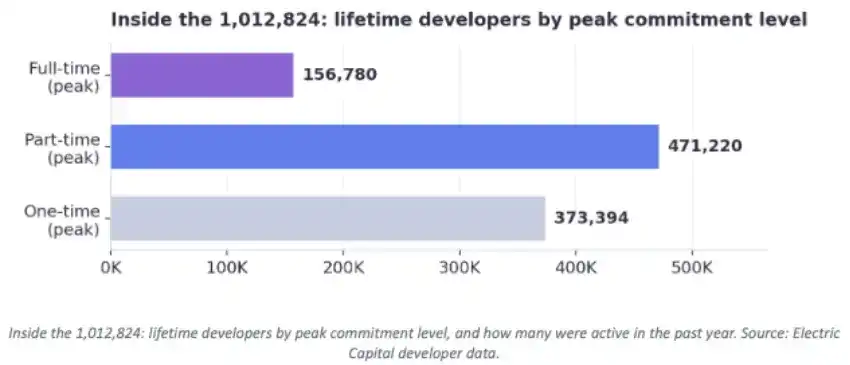
This also gave life to a statistic: According to Electric Capital's data, the total number of historical Ethereum developers has now surpassed one million, with 1,012,824 individuals having contributed to the ecosystem. No other ecosystem in the crypto space comes close.

A Milestone Worth Noting

One million is a round number, and round numbers can sometimes feel hollow. But this one is not. It represents the largest pool of technical talent ever assembled around an open, permissionless blockchain network. More importantly, this pool continues to deepen and broaden.

Of these one million developers, approximately 232,000 have remained active in the past twelve months.
Why Ethereum: The Truly Important Question

For years, discussions in the crypto industry have revolved around speed, fees, and throughput. Every new chain claims to be "faster than Ethereum." But the core question in crypto has never been which chain is the fastest, but rather another:

"Where will the most talented builders choose to build long-term?"

On this question, Ethereum still holds a significant advantage. This advantage isn't merely technical; it's institutional, cultural, economic, and ecological—a complex of a decade's accumulation of developers, infrastructure, standards, tools, liquidity, research, applications, and social coordination that no other ecosystem can replicate.

Ethereum has become the default operating system for programmable finance and internet-native capital formation.

What These Million Builders Are Building, and Why It Strengthens the Moat

The importance of the million builders lies crucially in what they are doing now. The current focus is on the hardest, riskiest problems in the industry: core protocol scalability, privacy, quantum resistance, and the autonomous agent systems that will run on top of it.

The Glamsterdam Upgrade: Innovating Without Compromising Core Principles. The Glamsterdam upgrade, expected in 2026, exemplifies how Ethereum progresses while holding fast to its core values. Core changes include enshrined Proposer-Builder Separation (ePBS) and Block-Level Access Lists (BALs), unlocking parallel execution and higher throughput, potentially raising the Gas limit and significantly increasing Layer 1 capacity.

Scaling for future demand while defending credible neutrality, security, and MEV fairness is a moat that evolves.

Synchronous Composability: Making Many Rollups Act Like One Chain. Composability has always been Ethereum's superpower; the next leap is extending it to Layer 2. Native Rollups and Based Rollups, combined with synchronous composability, solve this. A contract on one rollup can call a contract on the mainnet or another rollup in a single atomic transaction—no bridges, no waiting.

Linea, the Ethereum Economic Zone, Gnosis, Zisk, and the Ethereum Foundation are collaborating to couple this design with live proofs. The result is that dozens of rollups no longer function as isolated networks but begin to operate like a unified chain. This is a direct response to fragmentation criticism.

Quantum Resistance: Ethereum's Most Obvious Lead. No mainstream ecosystem is better prepared for the post-quantum era. The "Lean Ethereum" roadmap, the Ethereum Foundation's Post-Quantum Security team established in early 2026, pq.ethereum.org, and over a dozen client teams already running weekly post-quantum interoperability devnets constitute a coordinated open-source migration targeting readiness by 2029.

When quantum risk materializes, institutions holding trillions in assets will care about one thing above all: which chain prepared the earliest and most thoroughly.

The Moat Beyond Developers: Composability, Standards, and Trust

The aggregation of developer talent creates compound interest, thanks to how Ethereum is built. Its deepest network effect isn't liquidity; it's the depth of composability: applications interact like interoperable financial LEGO bricks.

Lending, stablecoins, exchanges, wallets, tokenized assets, oracles, and Layer 2 rollups all interact through shared standards, and developers never need to start from scratch. The EVM is the application layer of crypto; Solidity skills are transferable across Base, Arbitrum, Optimism, Polygon, zkSync, Scroll, Linea, and hundreds of other networks.

Learning the Ethereum tech stack maximizes optionality, which in turn spins the flywheel: more developers, more tools, more liquidity, more institutions, attracting even more developers to build composable protocols and assets. Liquidity begets liquidity, and composability begets composability.
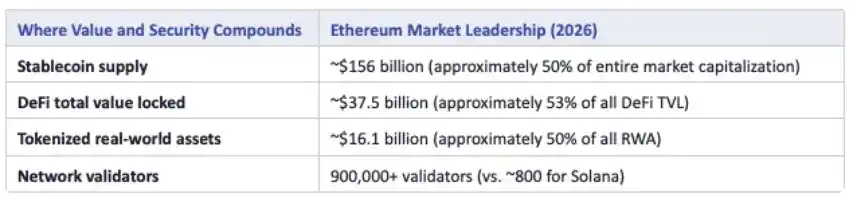
Moreover, Ethereum dominates where true value settles, not just where the most noise is made:

Three forces reinforce this lead.

Credible Neutrality: Ethereum is secured by over 900,000 validators, compared to roughly 800 for Solana. Major institutions place immense value on this degree of decentralization and platform neutrality.

Modularity: Rollups like Base, Arbitrum, and Optimism don't fragment Ethereum; they extend it into an increasingly connected modular internet economy that inherits the security of the mainnet.

Culture: Ethereum attracts top researchers, cryptographers, and EIP standards drafters far beyond any other ecosystem, setting the direction for the entire industry. This is also the advantage most difficult for others to copy.

There's Only One Ethereum

There's a fundamental difference between generating on-chain activity and being the long-term coordination layer for internet-native finance. The latter means being the layer trusted by the world's largest financial institutions.

Ethereum firmly holds the mindshare of large asset holders, institutions that value trust, security, and liquidity above all. I witnessed this firsthand from the front row during my tenure at BlackRock.

In technology markets, ecosystems consolidate over time around standards, liquidity, and developer mindshare. This is Ethereum's moat.

After meeting these developers, builders, and ecosystem leaders in Seoul and Hong Kong, I am more convinced than ever of Ethereum's competitive edge. I met the talent building the next generation of financial infrastructure—the future founders of our industry and the architects of agentic finance. It is these individuals and teams who will change the world.

The future of Ethereum is happening now.

Trending Cryptos

Related Questions

QAccording to the article, what is the significance of Ethereum surpassing 1 million total developers?

AIt represents the largest and most skilled technical talent pool ever assembled around an open, permissionless blockchain network. It signifies deep, broad, and sustainable developer engagement that forms a critical competitive moat for Ethereum.

QBeyond just technical speed, what does the author argue is the most important question in the crypto space?

AThe most important question is not which chain is the fastest, but: 'Where will the very best builders choose to build for the long term?'

QWhat are three key technical areas the article highlights where Ethereum's large developer base is focusing to build its moat?

A1) Core protocol scalability through upgrades like Glamsterdam (ePBS, BALs). 2) Synchronous composability across rollups to unify the ecosystem. 3) Post-quantum resistance via coordinated research and migration efforts.

QWhat three reinforcing forces does the article identify as strengthening Ethereum's leading position?

A1) Credible neutrality, secured by extensive decentralization (e.g., ~900k+ validators). 2) A modular architecture where rollups extend rather than fragment the network. 3) A deeply rooted culture that attracts top-tier researchers and sets industry standards.

QHow does the article describe the difference between generating on-chain activity and being a long-term coordination layer for internet-native finance?

AThe latter means becoming the trusted layer for the world's largest financial institutions. It involves capturing the 'mindshare' of large asset holders who prioritize trust, security, and liquidity over mere transaction speed or volume.

Related Reads

My Coding Betting Dashboard is Profiting, but Polymarket is Truly Not a Good Place for 'Arbitrage'

The author built a custom monitoring dashboard for Polymarket, a prediction market platform, and tested it with $1,600, achieving over 30% returns. However, the core argument is that Polymarket is not a good venue for traditional arbitrage. The dashboard has two main sections: a "Portfolio Dashboard" for tracking active positions with key metrics like total capital, P&L, and a risk-control module using a tier system (T1, T2, T3), and an "Opportunity Watchlist" for monitoring markets. The article details a critical structural trap in binary markets: a bet with a high perceived probability of success still carries a 100% loss risk if wrong. The author's T1/T2/T3 system is designed to manage this by limiting position sizes based on conviction and time horizon, emphasizing that high confidence should not equal high concentration. A key insight is the danger of "pseudo-diversification"—betting on different markets driven by the same underlying variable. The author concludes that Polymarket offers few true low-risk, arbitrage opportunities. It is instead a high-risk environment where wins can create a false sense of mastery, leading to large losses. The platform is better viewed as a training ground for honing judgment through disciplined, framework-driven betting rather than a reliable income source. The tools help transform intuition into structured, rule-based decisions to mitigate the risk of catastrophic errors.

marsbit2h ago

My Coding Betting Dashboard is Profiting, but Polymarket is Truly Not a Good Place for 'Arbitrage'

marsbit2h ago

WeChat AI Card Hands-On Guide: Has the AI Shopping Era Arrived?

**"WeChat AI Card" Practical Test Guide: Has the Era of AI Shopping Arrived?** WeChat has officially launched the "AI Exclusive Card," a feature integrated into its Workbuddy AI assistant. This card is designed to handle payments for AI-initiated purchases. Our hands-on test reveals it's not yet a tool for fully autonomous AI shopping, but rather a controlled payment layer for AI agents. The AI Card functions as an isolated sub-wallet within WeChat Pay. Users must bind the card and transfer funds into it from their main wallet. Crucially, every transaction requires explicit user confirmation via smartphone scan; AI cannot spend autonomously. Currently accessible through the Workbuddy agent, the card targets specific digital consumption scenarios: purchasing paid content (reports, data), calling paid APIs/tools, and subscribing to services. Its design prioritizes security and control by separating funds and mandating approval for each payment. We tested a real-world scenario: ordering bubble tea via Workbuddy using a "Meituan Life Assistant" skill. The process encountered multiple hurdles: high "skill" usage costs (exceeding daily free credits), and most importantly, while a payment was successfully initiated, the AI purchased an incorrect product (a mismatched group-buy coupon instead of the desired drink). This highlights the current limitation: the **AI Card only solves the payment step**. The broader challenge lies in the **AI agent's execution chain**—accurately understanding intent, navigating third-party platforms, selecting the right product, and ensuring proper fulfillment. The payment succeeded, but the purchase failed to meet the user's need. In conclusion, the WeChat AI Exclusive Card is a cautious, early-step experiment in AI commerce. It provides a secure, user-controlled payment method for agent interactions but is not yet capable of reliable, end-to-end complex purchases. For now, it's best used for low-value, low-risk digital services with careful user verification at each step. The vision of AI handling complete shopping tasks remains a work in progress.

marsbit4h ago

WeChat AI Card Hands-On Guide: Has the AI Shopping Era Arrived?

marsbit4h ago

Deconstructing Notion's Growth: From a Note-taking Tool to 100 Million Users—How Notion Built a Triple Growth Flywheel Through Product, Templates, and Community

Notion's growth from a niche note-taking tool to a platform with 100 million users is powered by three interconnected flywheels: Product-Led Growth (PLG), a Template Economy, and Community-Driven Growth. First, Notion's PLG strategy relies on a highly flexible, "plastic" product that users can adapt to countless personal and team workflows. Its freemium model lowers the barrier to entry, while features like page sharing and collaboration drive organic, usage-based viral growth as users naturally invite others. Second, the Template Economy solves the "blank page" problem. Templates, created by both Notion and its community, transform abstract product capabilities into concrete, copyable solutions for specific scenarios (e.g., project management, content calendars). This dramatically lowers activation costs for new users and fuels SEO-driven discovery. Third, a vibrant Community acts as a distributed growth engine. Users and official Ambassadors create tutorials, share use cases, and host local events. This community not only educates users but also fosters a sense of identity around pursuing "better ways of working," strengthening loyalty and enabling global, low-cost expansion. Together, these flywheels create a self-reinforcing ecosystem: a great product attracts users who create templates and community content, which in turn attracts more users and deepens engagement. This system allowed Notion to scale from individuals to teams and enterprises through a bottom-up adoption path. Looking ahead, AI integration promises to accelerate these flywheels further by making templates smarter and the platform a potential AI-native work operating system. Ultimately, Notion's defensible advantage is not just its features, but this deeply entrenched network of user assets, creators, and community trust.

marsbit4h ago

Deconstructing Notion's Growth: From a Note-taking Tool to 100 Million Users—How Notion Built a Triple Growth Flywheel Through Product, Templates, and Community

marsbit4h ago

$10 Billion, Qualcomm to Acquire Chip Legend Jim Keller's Company

Global mobile chip giant Qualcomm is in advanced talks to acquire AI chip startup Tenstorrent in a deal valued between $8-10 billion, according to media reports. This potential acquisition would be one of the largest in the AI chip sector in recent years. Tenstorrent, led by legendary chip architect Jim Keller, has gained prominence for its RISC-V architecture and AI accelerator designs. The move highlights Qualcomm's strategic push to diversify beyond its core smartphone chip business. As the smartphone market matures, Qualcomm is aggressively targeting growth in automotive, data center, and cloud AI. Acquiring Tenstorrent would allow Qualcomm to rapidly enter the high-end AI computing market, bypassing lengthy in-house development cycles. Tenstorrent's cost-effective system architecture, which avoids expensive HBM memory and relies on standard Ethernet for clustering, offers a potential alternative to Nvidia's costly solutions. Furthermore, Tenstorrent's high-performance RISC-V CPU technology and its focus on the automotive and edge computing segments align with Qualcomm's strategic goals, including its "Snapdragon Digital Chassis" platform. Despite the strategic rationale, the high valuation has sparked some investor caution. The successful integration of Tenstorrent's open-source culture and independent team into Qualcomm's organization, along with the commercialization of its technology, remains a key challenge.

marsbit5h ago

$10 Billion, Qualcomm to Acquire Chip Legend Jim Keller's Company

marsbit5h ago

Trading

Spot
Futures

Hot Articles

Discussions

Welcome to the HTX Community. Here, you can stay informed about the latest platform developments and gain access to professional market insights. Users' opinions on the price of ETH (ETH) are presented below.

活动图片















