Second Largest Whale Cuts Losses and Liquidates, Can AAVE Still Be Bought Amid Deepening Conflict?

Odaily星球日报Published on 2025-12-22Last updated on 2025-12-22

Abstract

The second-largest AAVE whale, excluding the project team, protocol contracts, and exchanges, has sold off 230,000 AAVE tokens (worth approximately $38 million) at a loss, causing a 12% price drop. The sale occurred amid growing tensions between the Aave team and its community over governance and financial control. The conflict began when the community discovered that Aave Labs, without prior communication, redirected front-end exchange fees—previously directed to the Aave DAO treasury—to its own address after switching the default trading path to Cow Swap. This change could divert an estimated $10 million annually from the community to the team. Aave Labs defended the move, arguing that front-end products are separate from the protocol and that the team has the right to monetize its own infrastructure. In response, a proposal was made to transfer control of Aave’s brand assets—including domains and social accounts—to AAVE token holders. Founder Stani Kulechov opposed the proposal, calling it oversimplified and poorly structured, further escalating community backlash. The situation highlights deeper structural tensions in DeFi between team-controlled products and community-governed protocols. The outcome of the ongoing snapshot vote on the proposal may significantly influence AAVE’s price and long-term community trust.

Original | Odaily Planet Daily (@OdailyChina)

Author | Azuma (@azuma_eth)
The leading lending protocol Aave is embroiled in a public opinion storm, with the conflict between the team and the community intensifying, which has objectively shaken the confidence of token holders in the AAVE token itself.

In the early hours of today, the second-largest AAVE holding whale, excluding the project team, protocol contracts, and CEXs, cut losses and liquidated 230,000 AAVE (worth approximately $38 million), causing AAVE to drop 12% short-term. It is reported that this "number two big brother" purchased the AAVE holdings from late last year to early this year at an average price of $223.4. The average selling price today was about $165, resulting in a final loss of $13.45 million.

  • Odaily Note: The whale address is https://debank.com/profile/0xa923b13270f8622b5d5960634200dc4302b7611e.

Origin of the Incident: Fee Flow Dispute

To understand the current community crisis at Aave, we need to start with a recent change to the Aave frontend.

On December 4th, Aave announced a partnership with Cow Swap, adopting the latter as the default trading path for the swap function on the Aave frontend (Odaily Note: previously it was ParaSwap), utilizing its anti-MEV features for better quotes.
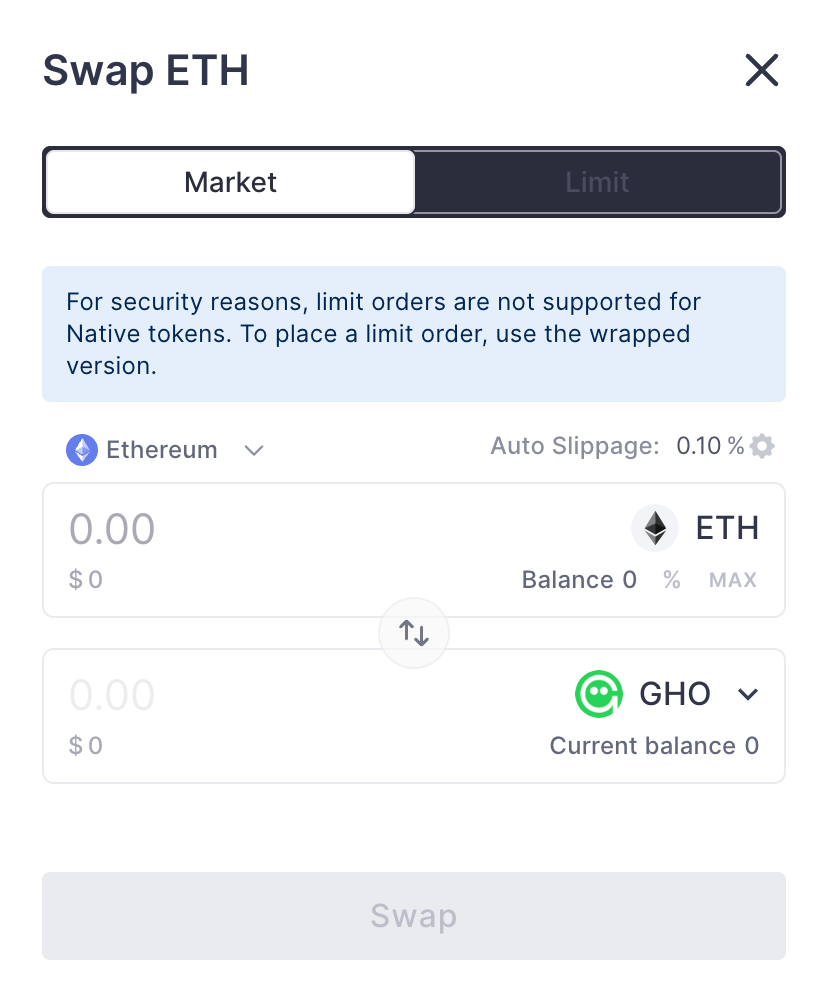
This seemed like a normal functional upgrade, but the community soon discovered that the additional fees generated by this function (including referral fees or positive slippage surplus fees), which previously flowed to the Aave DAO treasury address when using ParaSwap, were now being directed to the Aave Labs address after switching to Cow Swap.

Community representative EzR3aL was the first to notice this change, which Aave had not actively mentioned. They questioned the Aave team in the governance forum and estimated that, just tracking the income flow on Ethereum and Arbitrum, this fee change could generate around $200,000 in weekly revenue, corresponding to an annualized income of over $10 million — this meant Aave had redirected at least tens of millions of dollars in revenue from the community address to the team address, seemingly without anyone knowing.

Core Controversy: Who Really Owns the Aave Brand?

As EzR3aL's post gained traction, a large number of AAVE holders felt betrayed, especially considering that Aave made this change without communicating with the community or making any disclosure, somewhat hinting at an intention to conceal this alteration.

In response to community质疑 (queries/doubts), Aave Labs replied directly under EzR3aL's post, stating that there should be a clear distinction between the protocol layer and the product layer. The swap function interface on the Aave frontend is entirely operated by Aave Labs, which is responsible for capital investment, construction, and maintenance. This function is completely independent of the DAO-managed protocol. Therefore, Aave Labs has the right to independently decide how to operate and profit from it... The income previously flowing to the Aave DAO address was a donation from Aave Labs, but it was not an obligation.

In short, Aave Labs' stance is that the frontend interface and its ancillary functions essentially belong to the team's product, and the revenue generated should also be regarded as company property, not to be confused with the protocol and related income controlled by the DAO.

This statement quickly sparked heated discussion within the community regarding the ownership of the Aave protocol versus its products. A well-known DeFi analyst wrote an article titled "Who Really Owns 'Aave'?: Aave Labs vs Aave DAO". Odaily Planet Daily also published a Chinese translation, which can be read for further context.

On December 16th, the矛盾 (contradiction/conflict) was further intensified. Former Aave CTO Ernesto Boado initiated a proposal in the governance forum requesting the control of Aave brand assets (including domain names, social media accounts, naming rights, etc.) be transferred to AAVE token holders. The relevant assets would be managed through a DAO-controlled entity (the specific form to be determined later) with strict anti-encroachment protection mechanisms.

The proposal received nearly ten thousand views and hundreds of high-quality replies within the Aave governance forum. Various participants in the Aave ecosystem expressed their positions in the comments below the proposal. Although some voices believed the proposal's execution plan was insufficient and risked exacerbating the conflict, most replies expressed support.

Founder's Statement, But Community Unconvinced

As community sentiment heated up, Aave founder Stani responded in the forum: "...This proposal leads us in a direction unfavorable to the Aave ecosystem. It attempts to force a complex legal and operational issue into a simple 'yes/no' vote without providing a clear execution path. Handling such a complex issue should involve a specially designed structured process, achieving consensus through multiple interim checks accompanied by specific solutions. For the reasons above, I will vote against this proposal..."
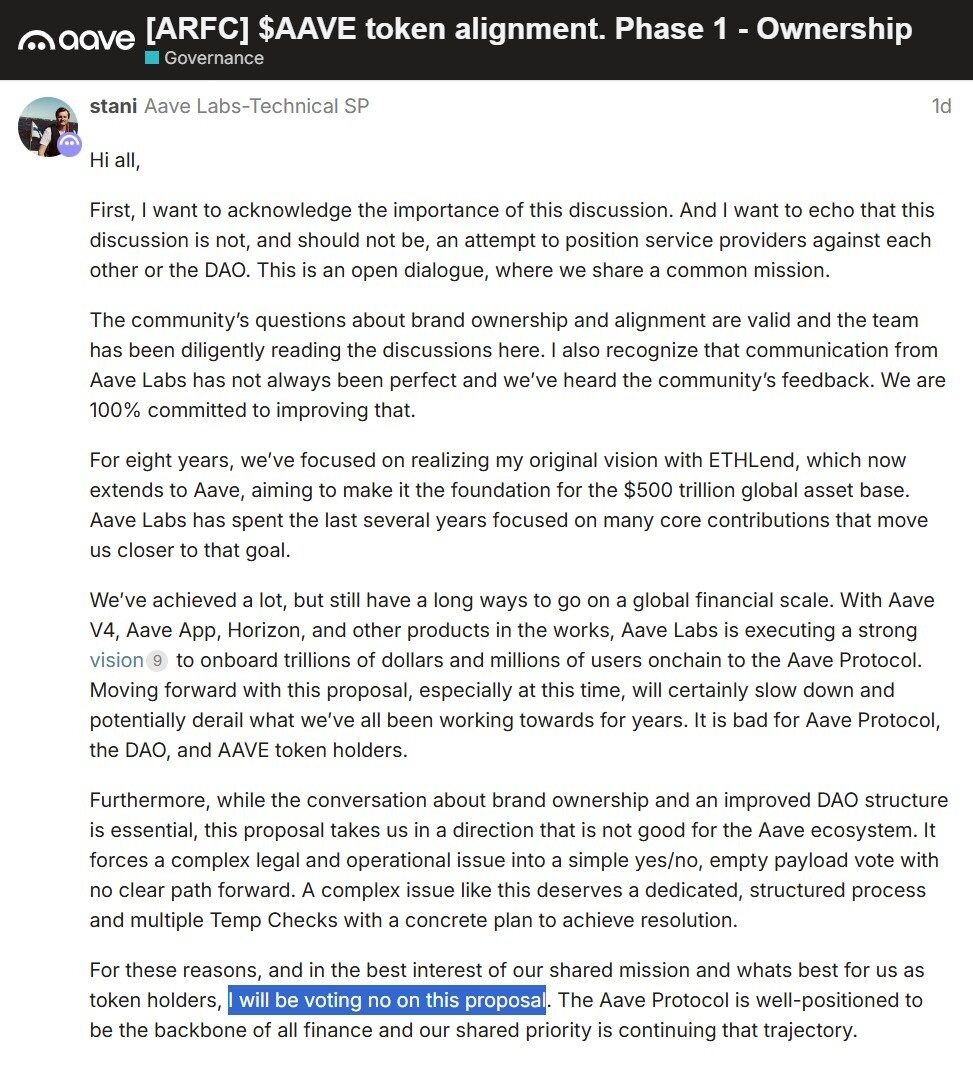
From a business operations perspective, Stani's claim that the proposal is too rash might not be wrong. However, in the current discussion atmosphere, this statement can easily be interpreted as 'the Aave founder disagrees with transferring brand assets to token holders,' which obviously further intensified the conflict between the community and the team.

After Stani's statement, even some attacking remarks against Stani appeared in the original post's comments. More users expressed their dissatisfaction via the forum or social media. An OG user mentioned it was the first time he considered liquidating his AAVE holdings. A loyal AAVE believer stated: "AAVE holders should realize this is just another DeFi shitcoin. It's neither better nor worse than the others."

The latest community development is the one mentioned at the beginning of this article: the number two big brother cutting losses and exiting with a loss exceeding ten million dollars.

Can AAVE Still Be Bought?

Just two weeks ago, Odaily Planet Daily wrote an article titled "What Did the Smart Money Aggressively Buying AAVE at Lows See?". At that time, AAVE was still a favorite of top institutions like Multicoin Capital. Its优质 (high-quality) brand reputation, substantial locked funds, clear expansion path, and strong revenue and buyback flow all proved that AAVE was a 'true value token' different from other altcoins.

But in just two weeks, a舆论危机 (public opinion crisis) spanning from fee ownership to brand control and then to team-community relations has rapidly plunged AAVE from a "representative of value tokens" into the center of controversy, even landing it on the short-term top decliners list due to emotional impact.

As of writing, Aave Labs has stated below Ernesto's proposal that they have initiated an ARFC snapshot vote on the proposal, allowing AAVE token holders to formally express their stance and clarify the future direction. The outcome of this vote and the subsequent handling attitude of the Aave Labs team will undoubtedly significantly impact Aave community faith and the short-term price performance of AAVE.

It is important to emphasize that this incident is not merely "negative news" or "performance change," but a集中拷问 (concentrated interrogation) of Aave's existing governance structure and boundaries of rights.

If you believe that Aave Labs will still maintain high alignment with Aave DAO's long-term interests, and the current friction is more of a communication and process失误 (mistake), then the price pullback led by emotions might be a good entry window; but if you think this controversy exposes not an occasional problem, but a structural contradiction of long-term unclear rights between the team and the protocol, lacking institutional constraints, then this storm might just be the beginning.

From a broader perspective, Aave's controversy is not an isolated case. As DeFi matures, protocol revenue becomes genuinely considerable, and brands and frontends begin to possess commercial value, some inherent structural contradictions between protocols and products, teams and communities will surface. Aave is pushed into the spotlight this time not because it erred more, but because it has gone further.

This debate over fees, brand, and control rights poses a question that needs answering not just by AAVE, but is an inevitable question the entire DeFi industry must eventually face.


Related Questions

QWhat was the main reason behind the community crisis and whale selling AAVE tokens?

AThe crisis stemmed from a dispute over fee redirection from Aave's front-end swap function. After switching to Cow Swap, fees that previously flowed to the Aave DAO treasury were redirected to Aave Labs, causing community backlash over undisclosed changes and raising questions about revenue ownership.

QHow did Aave Labs justify redirecting the swap fees to their own address instead of the DAO treasury?

AAave Labs argued that the front-end interface and its swap functionality are separate from the protocol managed by the DAO. They claimed ownership of the product layer, stating that the fees generated were company property, not DAO revenue, and previous donations to the DAO were voluntary, not obligatory.

QWhat proposal did former Aave CTO Ernesto Boado make to address the community's concerns?

AErnesto Boado proposed transferring control of Aave's brand assets—including domains, social media accounts, and naming rights—to AAVE token holders through a DAO-controlled entity, aiming to ensure community governance and anti-encroachment protections.

QHow did Aave founder Stani Kulechov respond to the proposal, and what was the community's reaction?

AStani opposed the proposal, calling it overly simplistic for a complex legal and operational issue and advocating for a structured process with multiple checks. The community perceived this as resistance to decentralizing control, intensifying opposition and leading to negative sentiment, including whale sell-offs.

QWhat broader DeFi industry issue does the Aave controversy highlight?

AThe controversy underscores structural tensions in DeFi between teams and communities over revenue sharing, brand ownership, and governance control. It reflects a industry-wide challenge as protocols mature and front-end products gain commercial value, forcing debates on equitable distribution of power and profits.

Related Reads

Ten-Thousand-Word Analysis: From $10 to $290, MRVL Wins the Entire AI Era by 'Not Making GPUs'

Marvell Technology's stock price surged from under $10 in 2016 to a record $290 in June 2026, fueled not by making GPUs, but by dominating AI infrastructure connectivity. This analysis argues the market misvalues MRVL as merely a smaller Broadcom in custom AI chips, overlooking its true, unique position. Marvell's core strength lies in enabling high-speed data flow for AI clusters through three interconnected businesses. First, it holds a commanding ~70% market share in high-speed optical DSPs (essential for data center light modules), a deep-moat business with accelerating growth. Second, its custom AI chip design business serves hyperscalers like AWS, Microsoft, and Google, with a significant revenue pipeline despite lower margins. Third, stable cash flows come from Ethernet switch chips and enterprise storage controllers. Together, they form a full-stack "AI data movement" platform. CEO Matt Murphy's transformative leadership since 2016, involving strategic divestments, key acquisitions (like Inphi for optical DSPs), and securing long-term agreements with major cloud providers, repositioned the company. A pivotal $2 billion strategic investment from NVIDIA in 2026 underscored Marvell's critical role in the AI ecosystem, particularly through collaborations like NVLink Fusion. While Marvell faces risks—including client concentration (losing the Amazon Trainium3 design), lower-margin business mix, competitive threats, insider selling, and complex supply chains—its fundamentals remain strong. The optical interconnect moat is widening with the acquisition of Celestial AI (photonics fabric), and financial metrics show accelerating revenue growth and operating leverage. With a PEG ratio suggesting undervaluation relative to its growth, the thesis is that the market undervalues Marvell's monopolistic position in AI "plumbing" while overemphasizing its competitive custom chip segment. The story transcends investing, symbolizing how in any complex system—from the internet to AI—the value of "connection" ultimately surpasses that of individual "nodes."

marsbit16m ago

Ten-Thousand-Word Analysis: From $10 to $290, MRVL Wins the Entire AI Era by 'Not Making GPUs'

marsbit16m ago

AI Relay Stations Spark Heated Debate on Zhihu: Behind Cheap Tokens, What Are Users Really Worried About?

A discussion on Zhihu about "AI relay stations" shifted the niche developer topic of "cheap tokens" into broader user awareness. Users moved beyond simply questioning the legitimacy of these services to focus on practical concerns: Where do cheap tokens truly come from? Is the model being accessed the real one? Can relay stations see prompts, code, and API keys? For occasional users, are the risks worth it? The core debate centered less on price and more on trust. A primary worry is model authenticity—the risk of "model swapping," where users paying for a premium model might be routed to a cheaper one, creating an information asymmetry. Others argued that cost comparisons matter; while cheaper than official pay-as-you-go APIs, relay stations may not be the lowest-cost option versus subscriptions, domestic models, or free tiers, making user needs assessment crucial. Speculation about token sources ranged from legitimate bulk discounts to gray-area methods like account sharing or exploiting regional pricing. This opacity makes risk assessment difficult for users. Data security emerged as a critical concern, especially for enterprise use. When processing sensitive information like code, contracts, or client data, the inability to verify a relay station's data handling, retention, or access policies poses significant compliance and confidentiality risks. The evolving consensus suggests relay stations can be used cautiously for low-sensitivity, disposable tasks (e.g., summarizing public info, simple translation). However, they should not be the default for sensitive, professional, or production workflows involving proprietary data, Agents, or automated systems. Recommendations include avoiding large prepayments, not relying on a single service, using test prompts to monitor quality, anonymizing data where possible, and keeping official channels as backups. Ultimately, the discussion framed tokens not just as a billing unit but as a measure of real cost encompassing price, model integrity, data security, and service stability. The popularity of relay stations highlights user demand for affordable access, but the debate underscores a key trade-off: the savings from cheap tokens may come at the price of trust, transparency, and control over one's data and AI experience.

marsbit46m ago

AI Relay Stations Spark Heated Debate on Zhihu: Behind Cheap Tokens, What Are Users Really Worried About?

marsbit46m ago

In-Depth Research Report on TradFi: The Convergence Wave of Crypto and Traditional Finance

In 2026, the crypto industry is undergoing a profound infrastructure-level transformation—TradFi assets are migrating on-chain at an unprecedented pace. According to CoinGecko's Q1 2026 report, the total value locked (TVL) of tokenized real-world assets (RWA) has surpassed $31 billion, a nearly 4x increase from $7.8 billion at the beginning of 2025, with the sector’s aggregate market capitalization reaching $19.3 billion. Among these, the market cap of tokenized stocks surged from $2 million to $486 million, with Q1 spot trading volume reaching $15.1 billion—a single quarter already surpassing the entire second half of 2025. RWA perpetual contract Q1 trading volume reached a staggering $524.8 billion, far exceeding the $313 billion for all of 2025. Meanwhile, BlackRock's BUIDL fund has reached $2.3 billion in scale and has filed for two new tokenized funds, signaling that the world's largest asset manager's tokenization strategy is evolving from pilot to product suite expansion. HTX, as a core participant in the crypto exchange sector, officially launched TradFi perpetual futures products including NVDA, AAPL, MSFT, META, and SPY in 2026, enabling crypto users to gain 24/7 trading access to core U.S. equities. Boston Consulting Group predicts that global tokenized asset scale could reach $16 trillion by 2030, while McKinsey offers a conservative estimate of approximately $2 trillion. The on-chain migration of TradFi assets is no longer a "future narrative" but a structural transformation unfolding in real time, as crypto exchanges evolve from single crypto asset trading platforms toward "multi-asset-class trading infrastructure."

HTX Learn49m ago

In-Depth Research Report on TradFi: The Convergence Wave of Crypto and Traditional Finance

HTX Learn49m ago

Trading

Spot
Futures

Hot Articles

How to Buy AAVE

Welcome to HTX.com! We've made purchasing Aave Protocol (AAVE) simple and convenient. Follow our step-by-step guide to embark on your crypto journey.Step 1: Create Your HTX AccountUse your email or phone number to sign up for a free account on HTX. Experience a hassle-free registration journey and unlock all features.Get My AccountStep 2: Go to Buy Crypto and Choose Your Payment MethodCredit/Debit Card: Use your Visa or Mastercard to buy Aave Protocol (AAVE) instantly.Balance: Use funds from your HTX account balance to trade seamlessly.Third Parties: We've added popular payment methods such as Google Pay and Apple Pay to enhance convenience.P2P: Trade directly with other users on HTX.Over-the-Counter (OTC): We offer tailor-made services and competitive exchange rates for traders.Step 3: Store Your Aave Protocol (AAVE)After purchasing your Aave Protocol (AAVE), store it in your HTX account. Alternatively, you can send it elsewhere via blockchain transfer or use it to trade other cryptocurrencies.Step 4: Trade Aave Protocol (AAVE)Easily trade Aave Protocol (AAVE) on HTX's spot market. Simply access your account, select your trading pair, execute your trades, and monitor in real-time. We offer a user-friendly experience for both beginners and seasoned traders.

5.3k Total ViewsPublished 2024.03.29Updated 2026.06.02

How to Buy AAVE

Discussions

Welcome to the HTX Community. Here, you can stay informed about the latest platform developments and gain access to professional market insights. Users' opinions on the price of AAVE (AAVE) are presented below.

活动图片