SEC Chairman Explains Why NFTs Are Not Securities: 'Like Buying Trading Cards'

marsbitPublished on 2026-03-19Last updated on 2026-03-19

Abstract

SEC Chairman Paul Atkins explained in a CNBC interview why NFTs are generally not considered securities, comparing them to collectibles like baseball cards. The SEC recently issued guidance identifying four categories of digital assets not classified as securities: digital commodities, digital tools, digital collectibles (including NFTs), and stablecoins. Atkins emphasized that NFTs are typically "bought and held" assets rather than investment contracts, which are central to the definition of a security. He noted that each asset is evaluated based on its specific facts and circumstances, but digital collectibles are generally viewed as immutable purchases not intended for trading like traditional securities. This reflects a broader shift in the SEC’s approach under Atkins’ leadership, moving away from enforcement-driven regulation toward clearer guidance and a more predictable framework. The change aligns with the Trump administration's crypto-friendly stance, with Atkins criticizing past regulatory missteps that he believes set the U.S. back in crypto innovation.

Author: Sam Bourgi

Compiled by: Deep Tide TechFlow

Deep Tide Introduction: SEC Chairman Paul Atkins further explained in a CNBC interview why NFTs generally do not constitute securities. The SEC recently released an interpretive document listing four categories of digital assets that are not securities: digital commodities, digital instruments, digital collectibles (including NFTs), and stablecoins.

Atkins compared NFTs to baseball cards, emphasizing that such assets are "bought and held" and do not involve investment contracts. This is the latest move by the SEC under Atkins' leadership to shift from "enforcement-driven" to "guidance-driven" regulation.

Full text as follows:

After the U.S. Securities and Exchange Commission (SEC) listed four major categories of digital assets not subject to securities laws, Chairman Paul Atkins further explained why non-fungible tokens (NFTs) generally do not meet the definition of securities.

In a CNBC interview on Wednesday, Atkins reiterated the four categories of digital assets identified in the SEC's recent interpretive document that are typically not considered securities: digital commodities, digital instruments, digital collectibles like NFTs, and stablecoins.

During the interview, host Andrew Ross Sorkin pressed the issue of digital collectibles, noting that depending on their structure, they could more easily be classified as securities.

Atkins responded, "That's true of anything." He emphasized that the SEC's analysis still depends on the specific facts and circumstances of each asset, particularly whether it involves an investment contract under long-standing legal precedent.

Atkins stated that digital collectibles are generally viewed as items to be bought and held, similar to physical collectibles, rather than investment contracts. Investment contracts are a core defining feature of securities.

He said, "These collectibles, like baseball cards, memes, memecoins, NFTs, are things someone buys. It's an immutable purchase...unlike other assets that people trade."
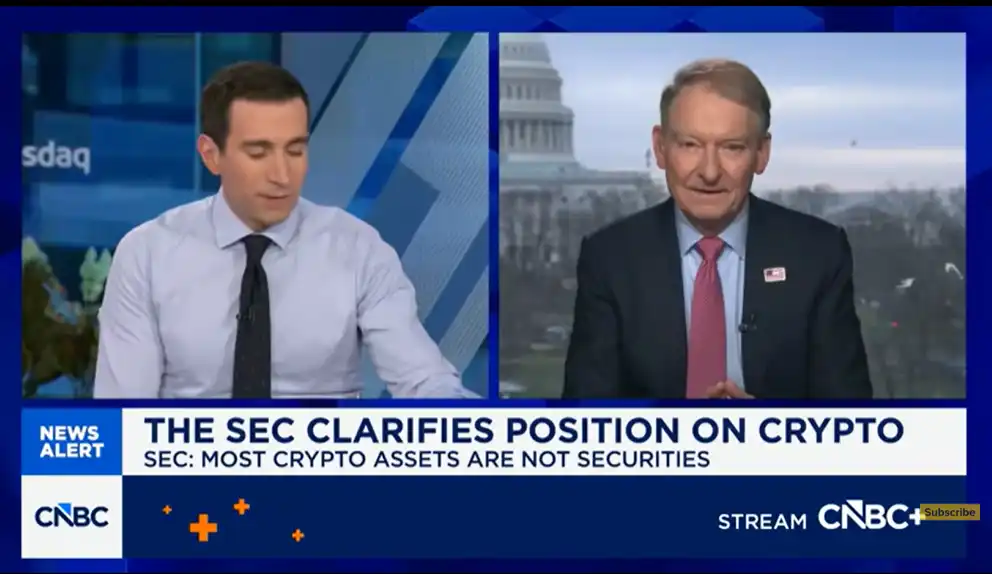
Caption: Paul Atkins interviewed on CNBC. Source: CNBC

SEC Continues to Move Away from "Enforcement-Driven" Crypto Policy

Under Atkins' leadership, the SEC's approach to regulating digital assets has undergone a noticeable adjustment. This shift coincides with the Trump administration, which is more crypto-friendly and took office in early 2025.

Atkins said in the CNBC interview, "We are breaking with the past." He described the SEC's efforts to promote clearer guidance and a more predictable regulatory framework.

Last year, Atkins criticized the SEC's previous reliance on "regulation by enforcement" and promised to move away from this approach. He also noted that tokenization is a key innovation that regulators should support rather than restrict.

Since then, he has repeatedly stated that past regulatory missteps have set the U.S. back by as much as a decade in crypto development and vowed to reverse this situation.


Related Questions

QWhat are the four categories of digital assets that the SEC recently identified as typically not being considered securities?

AThe four categories are digital commodities, digital tools, digital collectibles (including NFTs), and stablecoins.

QHow did SEC Chairman Paul Atkins compare NFTs to explain why they are not securities?

AHe compared NFTs to baseball cards, stating they are 'bought and held' items, similar to physical collectibles, and do not involve investment contracts.

QWhat shift in regulatory approach has the SEC undergone under Chairman Paul Atkins' leadership?

AThe SEC has shifted from an 'enforcement-driven' approach to a 'guidance-driven' one, focusing on clearer guidance and a more predictable regulatory framework.

QAccording to the article, what did Paul Atkins say about the impact of past regulatory mistakes on the U.S. crypto industry?

AHe stated that past regulatory missteps set the U.S. back by as much as a decade in crypto development and vowed to reverse this situation.

QWhat key feature did Atkins emphasize as central to the definition of a security in the context of digital assets?

AHe emphasized that the key feature is whether the asset involves an investment contract under long-standing legal precedent.

Related Reads

Market Adjusts Following Google's $84.7 Billion Fundraising, AI Valuations Now Focus on Payback Speed

After Alphabet's announcement of an $84.75 billion equity financing round, market focus for AI investment is shifting from pure growth narratives to capital efficiency and payback periods. The core argument is that AI is being re-priced from a software-like growth story into a heavy-asset infrastructure cycle, requiring massive capital expenditure (CapEx) on chips, data centers, and power grids. While Alphabet's financing itself is not a distress signal—part of it is for administrative purposes like tax obligations on stock compensation—it highlights the enormous capital demands of AI infrastructure. This demand extends beyond tech giants to pure-play AI model companies (like OpenAI, Anthropic), data center REITs, and utilities. Major tech firms are projected to spend heavily on AI data centers in 2026, signaling a broad-based capital cycle the market must absorb. Consequently, valuation logic is changing. Investors are moving away from questions about who has the strongest AI narrative and are now prioritizing clear visibility into orders, stable cash flows, and the cost of capital. This has led to recent pressure on high-multiple AI software and semiconductor stocks, while "picks-and-shovels" hardware, data center, and power assets with firmer near-term demand may see relative support. The key going forward will be monitoring whether rising CapEx guidance across companies is matched by a timely monetization of AI investments into revenue and cash flow. The market's tolerance for high spending depends on demonstrable returns. While the long-term AI thesis remains intact, the valuation framework has fundamentally shifted to emphasize capital discipline and payback speed.

marsbit7m ago

Market Adjusts Following Google's $84.7 Billion Fundraising, AI Valuations Now Focus on Payback Speed

marsbit7m ago

Trading

Spot
Futures
活动图片



