Screwed by Polymarket, This Time the Bug Was a 'Time Warp'

marsbitPublished on 2026-03-09Last updated on 2026-03-09

Abstract

Polymarket, a prediction market platform, encountered a technical issue related to the transition from Eastern Standard Time (EST) to Eastern Daylight Time (EDT) on March 8. The switch, which involves moving the clock forward by one hour, caused a disruption in the platform’s hourly cryptocurrency price prediction markets for assets like BTC, ETH, SOL, and XRP. Due to the time change, the 2:00 AM hour effectively did not exist, leading Polymarket’s system to display an illogical time range of "March 8, 1-1 AM ET" for these events, instead of the expected one-hour duration. This anomaly affected both the front-end display and API data, causing confusion among users. One automated trading user reported significant losses exceeding $100,000, as their system relied on accurate end-time data to execute trades. The incident highlights a design flaw in using local time (ET) without accounting for daylight saving transitions, unlike mainstream financial systems that typically use UTC time to avoid such inconsistencies. Users have called for Polymarket to switch to UTC and compensate affected traders. The platform has not yet issued an official response.

Original | Odaily Planet Daily (@OdailyChina)

Author | Azuma (@azuma_eth)

In conventional understanding, time is linear, but the crypto world has its "exceptions".

Yesterday, Eastern Time (ET) completed the switch from standard time to daylight saving time as per convention (generally on the second Sunday of March at 2:00 AM), moving the clock forward by one hour, jumping directly from 2:00 AM on March 8 to 3:00 AM. The time didn't vanish into thin air; it's just that the Eastern Time zone switches between Eastern Standard Time (EST) and Eastern Daylight Time (EDT) based on custom, aiming to artificially adjust the time scale to make fuller use of daylight hours (and save electricity in the process).

For daily life, this switch doesn't cause much impact, but on the prediction market Polymarket, yesterday's time zone switch directly sparked an unexpected controversy.

Polymarket Runs Into Timing Controversy

The controversy occurred around the "Crypto Up or Down" prediction events on Polymarket.

Polymarket offers cryptocurrency price movement prediction events with timeframes of year, month, week, day, 4 hours, 1 hour, 15 minutes, and 5 minutes, supporting major tokens like BTC, ETH, SOL, and XRP. These events are automatically created and settled based on Eastern Time and have become a significant source of trading volume on Polymarket.

At 1:00 AM on March 8 (still Eastern Standard Time at that moment), Polymarket launched new 1-hour up/down prediction events for BTC, ETH, SOL, and XRP. Links to the relevant events are below.

  • BTC (Final Result: Up): https://polymarket.com/event/bitcoin-up-or-down-march-8-1am-et
  • ETH (Final Result: Down): https://polymarket.com/event/ethereum-up-or-down-march-8-1am-et
  • SOL (Final Result: Down): https://polymarket.com/event/solana-up-or-down-march-8-1am-et
  • XRP (Final Result: Down): https://polymarket.com/event/xrp-up-or-down-march-8-1am-et

According to the event settlement rules — comparing the opening and closing prices of the 1-hour candle on Binance's USDT trading pairs starting from the event's beginning — the above four events have all been settled.

However, because the end time of this batch of events coincided with the daylight saving time switch, the moment Eastern Time reached 2:00 AM, it immediately jumped to 3:00 AM (meaning the period from 2:00 AM to 3:00 AM was skipped), causing some timing confusion for this batch of events on the Polymarket platform itself.


As shown on Polymarket's frontend interface, perhaps because 2:00 AM did not exist in yesterday's Eastern Time reckoning, the time period currently displayed for this batch of events is "March 8, 1-1 AM ET" (i.e., March 8, 1:00 AM - 1:00 AM). Under normal timing conditions, such events should display a 1-hour time period (for example, the previous day's similar event was "March 7, 1-2 AM ET", i.e., 1:00 AM - 2:00 AM). If accounting for the daylight saving time switch, a more reasonable time period for this batch would be "March 8, 1-3 AM ET" (i.e., 1:00 AM - 3:00 AM, still effectively 1 hour).

So no matter how you look at it, the currently displayed "March 8, 1-1 AM ET" is very strange.

Chinese user "Xiao Z" (@richrichardoz) posted on X regarding this, stating that besides the frontend, Polymarket's API also returned the "1-1 AM ET" time period, causing automated programs relying on the API data to "all crash", estimating losses exceeding $100,000 as a result.
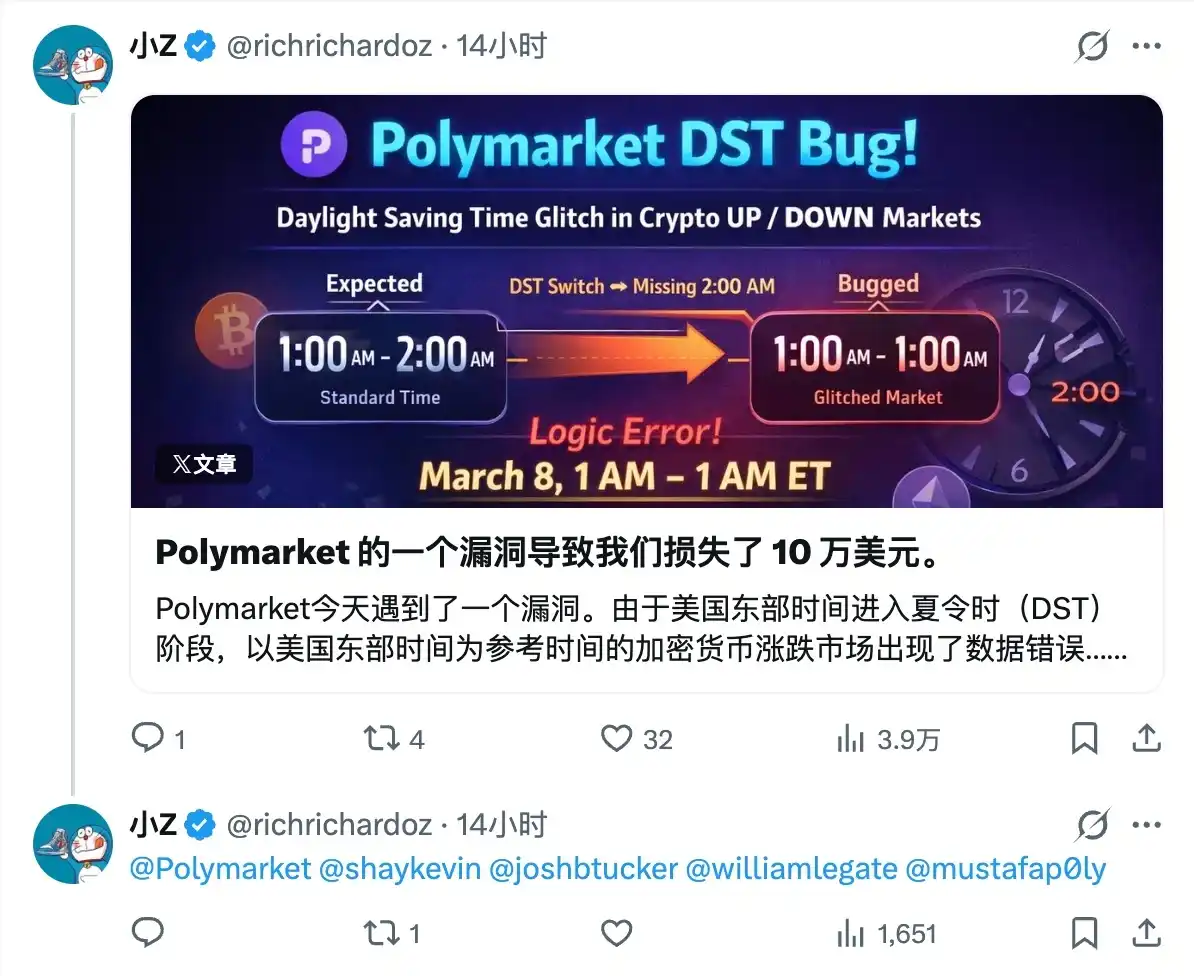
"Xiao Z" further explained that the start time and end time being exactly the same is a market state that is logically impossible. Many automated trading systems rely on the end time to determine the trading window; this error directly caused their program to lose a large sum of money. Therefore, they suggested Polymarket change the time standard for relevant events to UTC time and compensate users affected by the data issue.
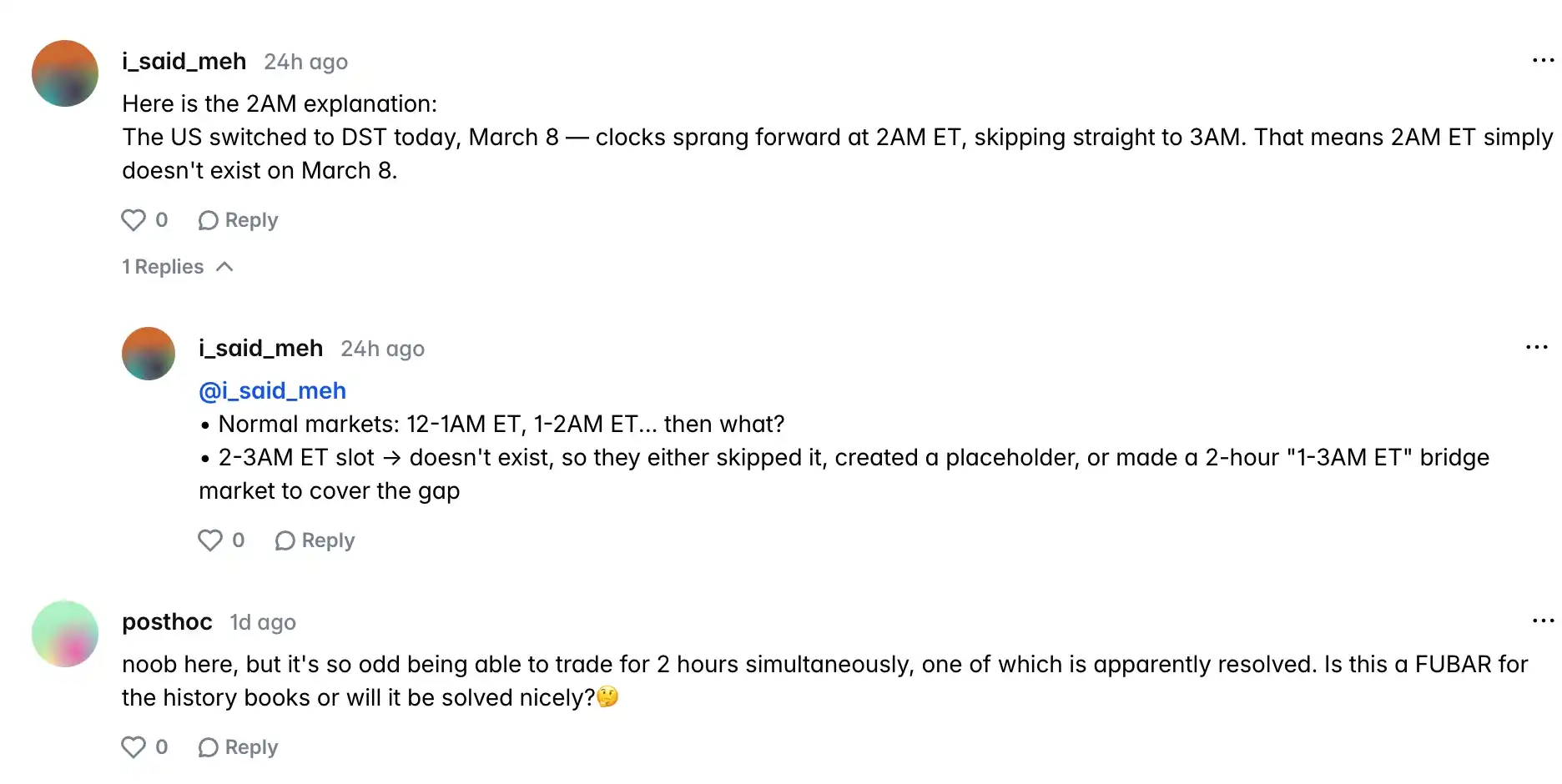
Besides this user, many other users have also commented under the relevant events expressing confusion, but as of writing, Polymarket has not responded through official channels.

Time Standards in Traditional Financial Markets

Looking back at this controversy, while the scale of impact isn't huge, it exposed a fundamental design flaw in Polymarket's "Crypto Up or Down" market events.

Influenced by historical customs, economic status, and industry practices, Eastern Time is still widely used across various industries. However, this is not particularly friendly to financial systems because Eastern Time switches between daylight saving time and standard time every year — artificially moving the clock forward or backward by one hour at specific times, creating "jumps" and "overlaps" in time respectively.

In modern financial systems, UTC time has long become the de facto universal standard. In the vast majority of financial infrastructure, internal systems typically use UTC timestamps as the sole standard time. Local times like Eastern Time are still used, but in system logic, they often only exist in the presentation layer面向用户. This design is precisely to avoid the uncertainty of time systems, ensuring that time remains monotonic, unique, and globally consistent in financial transactions, settlement, and automated systems.

The key矛盾 (contradiction) in this Polymarket controversy lies in the fact that the relevant events used Eastern Time as the timing standard but failed to fully consider the potential variable of the daylight saving time switch, ultimately causing confusion in the frontend and API data. Among the current user base of prediction markets, more and more participants are trading via APIs and automated programs. Some issues that originally only affected frontend display can easily be amplified into real financial losses in automated systems.

Judging by the outcome, this controversy might not be considered a serious incident, and theoretically it can only happen at most twice a year, but what it reveals is a more serious design problem — as prediction markets gradually move towards becoming financial infrastructure, they must also adhere to the engineering standards used by financial infrastructure.

Related Questions

QWhat was the main issue that occurred on Polymarket due to the daylight saving time switch?

AThe main issue was a timing confusion caused by the switch from EST to EDT, where the clock jumped from 2:00 to 3:00, causing the 1-hour prediction events to display an illogical '1-1 AM ET' time period in both the frontend and API, disrupting automated trading systems.

QWhich cryptocurrencies were affected by the timing error in Polymarket's prediction events?

AThe affected prediction events were for BTC, ETH, SOL, and XRP, specifically the 1-hour up or down markets that started at 1:00 AM ET on March 8.

QHow did the timing error impact users, particularly automated trading systems?

AThe error caused automated trading programs to malfunction because the API returned an identical start and end time ('1-1 AM ET'), which is logically impossible. This led to significant losses, with one user estimating over $100,000 in losses due to the disrupted trading windows.

QWhat time standard do traditional financial markets typically use to avoid issues like daylight saving time changes?

ATraditional financial markets predominantly use UTC (Coordinated Universal Time) as the internal standard for timestamps to ensure consistency, avoid ambiguities from local time changes, and maintain global synchronization in trading and settlement systems.

QWhat suggestion did users make to Polymarket to prevent similar issues in the future?

AUsers suggested that Polymarket should change the time standard for its events to UTC instead of Eastern Time (ET) to eliminate confusion from daylight saving transitions, and also compensate users who suffered losses due to the data error.

Related Reads

Interview with Robinhood Executive: Meme + Tokenized US Stocks as "Barbell" Customer Acquisition Strategy, All Business Lines Achieve Hundreds of Millions in Revenue

Interview with Robinhood executive Johann Kerbrat reveals the company's "barbell" customer acquisition strategy for its new Robinhood Chain, combining meme tokens with tokenized stocks. Three weeks after mainnet launch, the chain has seen over $3B in weekly DEX volume and 105M transactions. Kerbrat explains the logic behind the permissionless chain: meme tokens attract DeFi users, while tokenized real-world assets (RWA), currently over 90 US stocks and ETFs accessible in 120+ countries, serve global users. The goal is to bring Robinhood's 27 million funded accounts on-chain by simplifying DeFi with a user-friendly interface, exemplified by features like Robinhood Earn which offers yield without requiring wallet management. Built on Arbitrum's technology stack for its speed, low cost, and Ethereum's security, the chain focuses on financial products like Earn, spot trading, and perpetuals. Kerbrat downplays direct competition with platforms like Base, emphasizing the goal of expanding the overall market for on-chain assets. He details selective partnerships (e.g., Morpho, Lighter) based on compliance, unique UX, and differentiation. While regulatory clarity is pending for US perpetuals, the expansion continues via Bitstamp in Europe. Finally, Kerbrat positions Robinhood as a "super app" integrating stocks, options, crypto, banking, and AI trading, with all major business lines generating hundreds of millions in revenue. For the chain, current priority is driving adoption over maximizing gas fee revenue.

marsbit1h ago

Interview with Robinhood Executive: Meme + Tokenized US Stocks as "Barbell" Customer Acquisition Strategy, All Business Lines Achieve Hundreds of Millions in Revenue

marsbit1h ago

Fidelity Q3 Report: BTC, ETH, and SOL Continue to Build Bottoms; How Much Further Will This Crypto Bear Market Go?

Fidelity's Q3 Crypto Signal Report analyzes the current bear market, noting Bitcoin (BTC), Ethereum (ETH), and Solana (SOL) are in a prolonged bottoming phase. Key indicators like the weighted Net Unrealized Profit/Loss (NUPL) have turned negative (-0.01), signaling the market is slightly below its aggregate cost basis, with BTC acting as the primary stabilizing asset. BTC's dominance has risen to 68%, indicating a lack of capital rotation to other digital assets. Performance has been weak across the board, with BTC, ETH, and SOL down significantly year-to-date. Market sentiment is depressed, exacerbated by substantial outflows from spot ETPs and a challenging macro environment. The report compares the current ~203-day downtrend to historical ~300-day bottoming cycles, suggesting the process may be two-thirds complete, with late 2026 as a potential timeframe to monitor. For Bitcoin, NUPL at 0.09 indicates cautious sentiment, while momentum signals remain negative. The Yardstick metric points to potential undervaluation relative to network security (hashrate). Ethereum's NUPL is deep in the "capitulation" zone at -0.43, a historically positive signal for future returns, though its momentum and network fee revenue are negative. Solana shows the deepest NUPL at -0.72 but demonstrates relative resilience in on-chain activity and stablecoin transfer volume. The report concludes that while several metrics are near historical capitulation levels, a definitive market bottom has not yet been established. The path forward likely involves continued consolidation, with BTC's relative strength and fundamental on-chain usage for ETH and SOL providing key areas for investor observation.

marsbit1h ago

Fidelity Q3 Report: BTC, ETH, and SOL Continue to Build Bottoms; How Much Further Will This Crypto Bear Market Go?

marsbit1h ago

Trading

Spot
活动图片