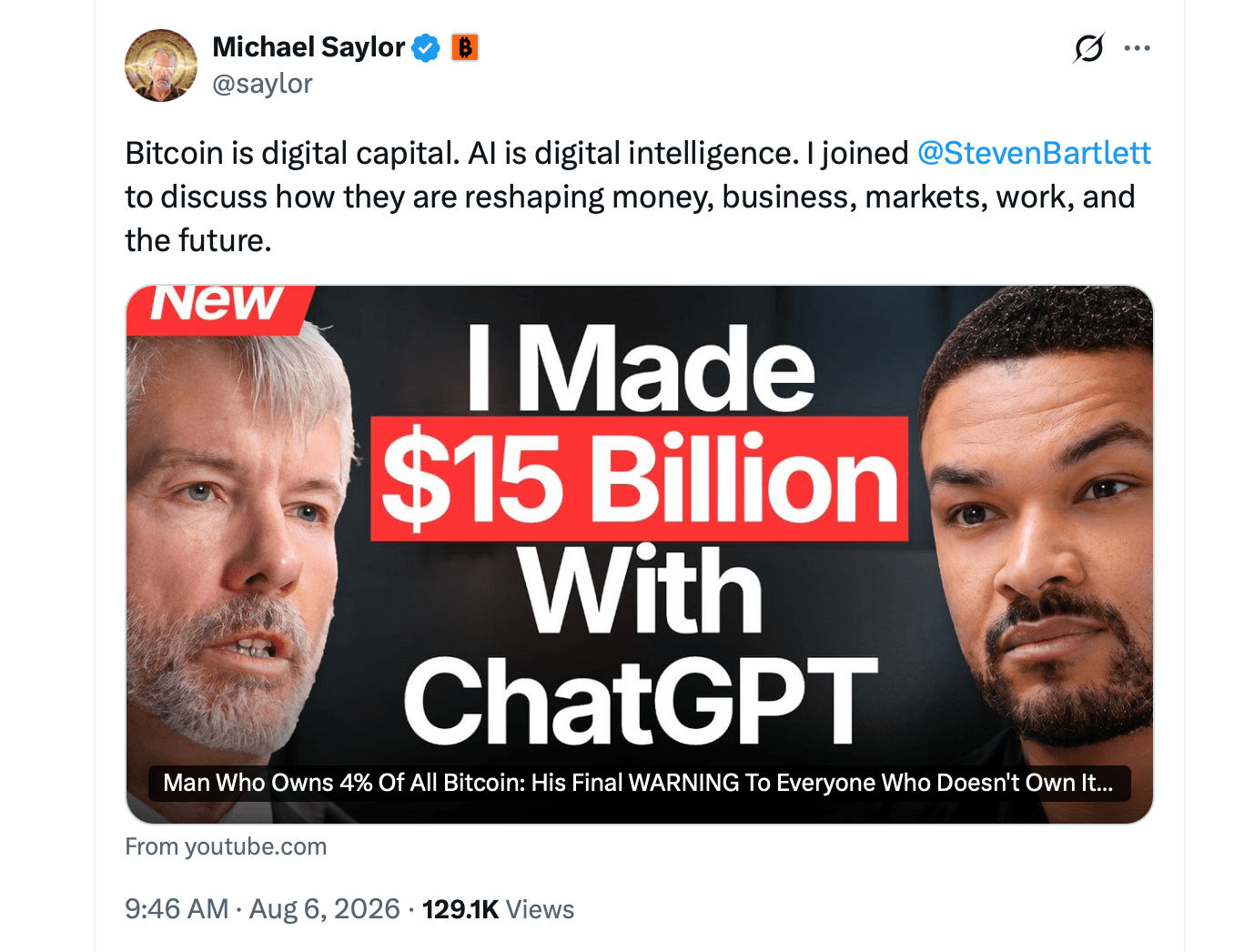
In a conversation with Stephen Bartlett on the "The Diary of a CEO" podcast, the Executive Chairman of Strategy described AI as a tool for solving problems that the traditional financial system has never encountered. He began the discussion with a simple statement: "Bitcoin is digital capital. AI is digital intelligence." He emphasized that together, these technologies are transforming the face of business, markets, labor, and long-term prosperity.
Sailor Claims AI Solved a Problem That Humans Could Not
Sailor's main point concerned Strategy's and Digital Asset Treasury's (DAT) efforts to continue raising capital after exhausting more traditional financing options. According to him, the company had already become one of the world's largest issuers of convertible bonds to finance additional bitcoin purchases. Ultimately, this approach reached its practical limits.
Instead of abandoning its strategy, the company, according to Sailor, turned to the generative AI model ChatGPT to explore a completely new type of financial security. The result was STRK—a preferred equity structure designed to combine debt and equity instruments while enabling additional bitcoin purchases. Sailor noted that no such instrument had existed before.
"Last year, we made $15 billion using AI," Sailor explained to Bartlett. The founder of Strategy added:
"AI gave us a solution to a problem that no one in the history of the world had ever faced before."
He explained that lawyers and investment bankers initially resisted the idea because they had never encountered such a structure before. Instead, AI proposed alternative approaches that ultimately helped the company create a product capable of attracting billions of dollars from investors.
Bitcoin and AI Are Central to His Thesis
Throughout the interview, Sailor repeatedly linked bitcoin and artificial intelligence. He characterized bitcoin as the world's first form of digital capital and called AI the next major leap in digital intelligence.
According to Sailor, both technologies solve different problems. Bitcoin allows individuals and companies to own assets that can be transferred worldwide without involving numerous financial intermediaries, while AI significantly boosts labor productivity by helping people solve increasingly complex tasks.
He argued that entrepreneurs should stop directly competing with AI and instead use it to create products and services that previously seemed impossible.
Sailor told the host of "The Diary of a CEO" podcast:
"Don't try to work harder than robots. You need to ask AI to do something no one has done before."
Why He Still Prefers Bitcoin to Traditional Financial System (TradFi) Assets
The conversation also revisited one of Sailor's long-standing areas of focus: preserving purchasing power.
He argued that inflation steadily erodes the value of fiat currencies over long periods, citing historical examples that, in his view, demonstrate the loss of purchasing power of the U.S. dollar over several generations. He contrasted this with the world's scarcest assets, such as stocks, commercial real estate, gold, and bitcoin, which he characterized as more reliable long-term stores of value than holding cash.
Sailor also questioned traditional recommendations regarding homeownership. While acknowledging that residential real estate can appreciate in price, he argued that ongoing property taxes, insurance, and maintenance costs reduce long-term returns in many jurisdictions. According to him, commercial real estate often yields better returns because these costs can often be offset by rental income.
For Sailor, bitcoin has another advantage. Unlike physical assets, he explained, bitcoin can be transferred across borders in seconds without needing approval from numerous banks or governments, making it particularly valuable during periods of economic or political uncertainty.
AI Will Change Professions Faster Than Many Expect
A significant portion of the discussion shifted from investing to the broader economic impact of artificial intelligence.
Sailor predicted that AI will automate many forms of intellectual labor, including accounting, legal research, and document preparation. He emphasized that this does not mean people will stop creating value. On the contrary, future professions will increasingly focus on managing AI rather than performing repetitive work on their own.
He urged young people to study technologies that are still ascending the "S-curve" of innovation, rather than industries that have largely already reached maturity. According to him, the ability to work with AI is likely to be more valuable than mastering tasks that software will soon perform automatically.
He also refuted the idea that AI will eliminate the need for money. Responding to comments by Elon Musk about a future of material abundance, Sailor stated that while technology may make everyday goods cheaper, scarce assets will still exist, ensuring that wealth and capital remain important.
What's Next
Sailor characterized both bitcoin and artificial intelligence as technologies still in the early stages of adoption. He believes that companies combining digital capital with digital intelligence will create entirely new financial products and business models in the coming years.
Whether these predictions come true remains to be seen. What is already clear is that Strategy continues to expand and alter its bitcoin-focused corporate strategy, while Sailor increasingly presents AI as a tool capable of accelerating the company's next growth phase. The interview suggests he views the combination of bitcoin and AI not as separate trends, but as two technologies likely to define the next generation of finance and entrepreneurship.
end-content