RWA Weekly Report|Data: Approximately 50% of Euro Stablecoins Deployed on Ethereum; Potential Policy Adjustments as Trump Prepares for Next November's Midterm Elections May Again Impact Digital Assets (12.18-12.23)

marsbitPublished on 2025-12-23Last updated on 2025-12-23

Abstract

RWA Market Weekly Summary (Dec 18–23) The total on-chain value of Real World Assets (RWA) grew 1.65% this week to $19.05 billion, while the broader RWA market saw a slight contraction. U.S. Treasuries remained the core asset at $8.7 billion. Commodities and private equity saw notable increases. The number of RWA asset holders and stablecoin users continued to rise. Key developments include: - Data shows ~50% of euro-denominated stablecoins are deployed on Ethereum. - Former U.S. President Trump’s policy adjustments ahead of the midterm elections may impact digital assets. - The SEC issued new guidance on crypto asset custody and ATS operations. - Hong Kong proposed new rules for insurance investments in crypto assets. - U.S. lawmakers proposed tax exemptions for small stablecoin payments and staking rewards. - Ghana legalized crypto trading and plans to explore gold-backed stablecoins. Highlighted RWA projects: - Ondo Finance (ONDO) will launch tokenized stocks and ETFs on Solana in early 2026. - MSX (STONKS) is preparing for the potential launch of official Nasdaq tokenized stocks. Stablecoin sector growth continues, with Grayscale reporting a $300B supply and $1.1T in monthly trading volume.

Author | Ethan(@ethanzhang_web3)
RWA Sector Market Performance

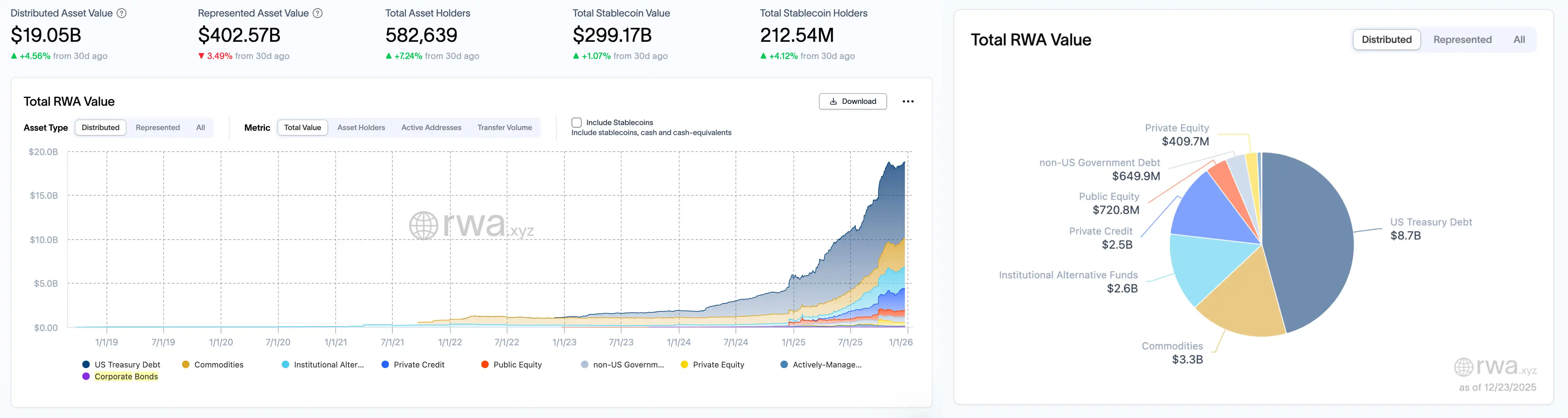
According to the rwa.xyz data dashboard, as of December 23, 2025, the total on-chain value (Distributed Asset Value) of RWA continued its moderate growth trend this week. The total increased from $187.4 billion on December 17 to $190.5 billion, a rise of approximately $3.1 billion, representing a weekly gain of 1.65%. The broader RWA market size contracted slightly, falling from $410.38 billion to $402.57 billion, a decrease of $7.81 billion, or 1.9%. The total number of asset holders on the user side increased from 575,752 to 582,639, adding 6,887 new users in a single week, a sequential growth of 1.2%. Meanwhile, the stablecoin user base continued to expand, with the number of holders climbing from 210.72 million to 212.54 million, an increase of about 1.82 million people, or 0.86%. The total market capitalization of stablecoins saw a slight pullback, decreasing from $300.18 billion to $299.17 billion. Although it declined slightly (by approximately $101 million), the overall level remained relatively steady.

In terms of asset structure, US Treasury bonds remain the core anchor of the RWA sector, with their on-chain scale holding steady at $8.7 billion. Commodity assets saw an uptick, rising from $3.22 billion to $3.33 billion, a gain of $110 million, contributing the most incremental growth this week. The institutional alternative fund sector also experienced a slight increase, moving from $2.5 billion to $2.6 billion, indicating a trend of capital reallocation into steady, non-traditional assets. Private equity recorded significant growth, jumping from $381 million to $410 million, an increase of $29 million. Non-US government debt saw a slight correction, decreasing modestly from $664.3 million to $649.9 million, a drop of 2.2%. However, public equity quietly grew, increasing from $689.1 million to $720.8 million. Private credit remained stable, edging up $10 million to $2.5 billion, continuing its sideways trend after stabilizing previously.

Trend Analysis (Compared to Last Week)

Overall, the total volume of on-chain RWA assets saw steady growth this week, while the broader traditional representative assets experienced some fluctuations. User numbers continued to grow, indicating a gradual strengthening of real activity in the on-chain RWA market. Assets with moderate risk appetites, such as commodities, private equity, and institutional alternative funds, began to attract more capital allocation, suggesting that some market participants are releasing liquidity from low-risk instruments like US Treasuries and转而 pursuing higher marginal returns. Furthermore, the continued climb in stablecoin holders remains a key variable driving potential capital inflows in the future.

Market Keywords: Steady growth with slight increases, structural shift, user activity.
Key Event Review

Potential Policy Adjustments as Trump Prepares for Next November's Midterm Elections May Again Impact Digital Assets

Caixin published its "2026 New Year Special Review and Outlook," which noted that the "Trump Trade" took effect in 2025, with gold and virtual currencies shining. In March, an executive order was signed to include approximately 210,000 Bitcoin held by the federal government into the national strategic reserve. Various transactions based on stablecoins and digital currencies saw significant implementation in 2025. Public companies transformed into treasury companies specifically hoarding digital currencies, sparking speculation. However, the seizure of $15 billion in Bitcoin from the Chen Zhi telecom fraud group by the US brought transaction security issues into sharp focus, and Bitcoin fell from its historical high by year-end. Moving into 2026, as Trump begins preparing for the November midterm elections, which areas his policies will adjust in response to feedback, and how this will impact the performance of various major asset classes, becomes a theme requiring持续关注 in 2026.

US SEC Issues Guidance on Broker Crypto Asset Custody and Crypto ATS Operations

The U.S. Securities and Exchange Commission (SEC) this week, through its Division of Trading and Markets, issued a new staff statement providing operational guidance for regulated broker-dealers custodying client crypto assets. It simultaneously released a set of Frequently Asked Questions (FAQ) regarding crypto alternative trading systems (ATS).

Regarding custody, the SEC stated that as long as broker-dealers follow the informal standards outlined in the statement, including properly safeguarding client private keys and预先 considering scenarios like blockchain failures, 51% attacks, hard forks, or airdrops, the regulatory层面 will not take enforcement action. This guidance applies to crypto securities, including tokenized stocks and debt securities, though related definitions still await further clarification.

Additionally, the SEC highlighted key focuses for regulatory attention concerning the trading and settlement activities of crypto ATSs. SEC Crypto Assets and Cyber Unit Head, Commissioner Hester Peirce, stated that trading platforms and market participants need to operate under clear market structure rules to promote a fair and orderly market environment without adding unnecessary burdens.

Bloomberg: Hong Kong Plans to Introduce New Rules for Insurer Investments in Crypto Assets and Infrastructure

The Hong Kong Insurance Authority (IA) has proposed new rules aimed at guiding insurance funds into crypto assets and infrastructure sectors. According to a presentation document dated December 4th, the regulator plans to impose a 100% risk capital requirement on crypto assets, while the risk capital requirement for stablecoin investments will be determined based on the fiat currency to which the Hong Kong-regulated stablecoin is pegged.

The Hong Kong IA stated that it initiated a review of the risk-based capital制度 this year, with the primary goal of supporting the insurance industry and broader economic development. The proposal is expected to undergo public consultation from February to April next year, before being submitted to the legislature. Furthermore, the new rules involve incentives for infrastructure investment, proposing capital benefits for investments in infrastructure projects in Hong Kong, mainland China, or those linked to Hong Kong (such as the development of new towns like the Northern Metropolis), to support the SAR government's local infrastructure construction plans. As of 2024, the total premium income of Hong Kong's insurance industry was approximately HK$635 billion.

US Lawmakers Propose Tax Breaks for Small Stablecoin Payments and Staking Rewards

US lawmakers have introduced a discussion draft that would ease the tax burden on ordinary cryptocurrency users by exempting small stablecoin transactions from capital gains tax, including a $200 tax exemption for stablecoin payments, and providing new deferral options for staking and mining rewards. According to the draft, if a stablecoin is issued by an issuer approved under the GENIUS Act, is pegged to the US dollar, and its trading price remains within a narrow range around $1, users would not need to recognize gains or losses on transactions not exceeding $200.

Data: Approximately 50% of Euro Stablecoins Deployed on Ethereum

According to Token Terminal data, approximately 50% of the market capitalization of Tokenized Euro (Euro stablecoins) is deployed on the Ethereum chain, with the remainder distributed across multiple chains including Arbitrum, Polygon, Base, and Solana.

Grayscale: Stablecoin Supply Reached $300 Billion in 2025, Monthly Trading Volume Averaged $1.1 Trillion, Multiple Token Subjects to Benefit

Grayscale posted on X platform, stating that stablecoins experienced explosive growth in 2025, with supply reaching $300 billion and monthly trading volume averaging $1.1 trillion. With the passage of the GENIUS Act (Stablecoin Genius Act) and increasing stablecoin adoption, blockchain projects like ETH, TRX, BNB, and SOL will benefit from the growing transaction flow. Infrastructure such as Chainlink (LINK) and emerging networks like XPL will also benefit.

Gemini: Urges US Congress to Maintain the Genius Act As Is

Gemini posted on X platform, stating that Gemini, along with over 125 companies and organizations, has co-signed a letter urging the US Congress to maintain the Genius Act as is. Gemini stated that legitimate stablecoin rewards benefit consumers and competition and are already legally permitted. Modifying the Genius Act at this time would harm certainty and innovation.

Stablecoin U Officially Launches: Lands on BNB Chain and Ethereum, Integrates with Mainstream DeFi Protocols like PancakeSwap and ListaDAO, Lists on Centralized Exchange HTX

United Stables announced the official launch of the USD stablecoin U, currently deployed on both BNB Smart Chain (BSC) and Ethereum (ETH), with multiple ecological integrations completed. It is reported that the U stablecoin is 1:1 fully reserved (USD + major stablecoins), features real-time on-chain proof-of-reserve (PoR), monthly audits, etc., and will support enterprise-grade privacy protection and AI-native payments (EIP-3009/x402) in the future. U is the first "unified stablecoin" stablecoin on BNB Chain, integrating mainstream stablecoins as usable collateral assets to form a unified liquidity base.

Ecological Integration: U has integrated support for mainstream DeFi protocols including PancakeSwap, Aster, Four.meme, and ListaDAO. Users can directly trade, stake, lend, and provide liquidity on-chain. Wallet Support: Binance Wallet, Trust Wallet, and SafePal have simultaneously listed U. Beyond the on-chain world, U is also listed on the centralized exchange HTX.

United Stables stated that U will focus on empowering scenarios such as trading, DeFi, institutional settlement, cross-border payments, and the AI autonomous economy, and plans to expand to more public chains, DeFi protocols, and trading platforms in the future.

WLFI Releases Governance Proposal: Proposes Using Part of Unlocked Treasury Funds to Incentivize USD1 Adoption

WLFI released a governance update announcement stating that a new community governance proposal is open for voting, proposing the use of part of the unlocked WLFI treasury funds as incentives to drive the adoption and growth of the stablecoin USD1.

The announcement showed that in the past three weeks, WLFI has used USD1 to repurchase approximately $10 million worth of WLFI tokens and successfully obtained multiple spot trading pair supports on Binance. Meanwhile, the usage scale of USD1 in CeFi and DeFi scenarios has grown significantly, and the WLFI token unlock schedule is also steadily progressing and nearing finalization.

The proposal aims to continue the current growth momentum, using incentive mechanisms to further expand the integration, use cases, and number of partners for USD1, thereby enhancing the overall level of economic activity within the WLFI ecosystem. The announcement pointed out that the growth of USD1 will directly drive the expansion of the WLFI ecosystem and benefit the entire community.

Ghana Passes New Bill Legalizing Cryptocurrency Trading, Plans to Explore Gold-Backed Stablecoins

The Ghanaian parliament has voted to pass the Virtual Asset Service Provider Bill, formally legalizing cryptocurrency trading and related digital asset activities. The bill stipulates that individuals and entities engaged in digital asset activities must register with the Bank of Ghana or the Securities and Exchange Commission, depending on the nature of their business.

Bank of Ghana Governor Johnson Asiama stated in a speech that the bill lays the foundation for the licensing and supervision of industry participants, ensuring that emerging activities are brought into a transparent and regulated framework. Johnson Asiama explicitly stated that after the bill is passed, no one will be arrested for trading cryptocurrencies. Additionally, Ghana plans to conduct special explorations in 2026 focused on payments, trade finance, and market infrastructure, including researching asset-backed digital settlement instruments like gold-backed stablecoins. According to estimates by Web3 Africa Group, Ghana processed approximately $3 billion in cryptocurrency transactions between July 2023 and June 2024.

Bankless Founder's 2026 Predictions: Focus on Tokenization, ICO Return, and Quantum Challenges

Bankless founder David Hoffman released his predictions for the 2026 market, stating: He believes 2026 will be the first year of asset tokenization, with traditional financial giants like BlackRock fully embracing blockchain technology; as the regulatory environment improves, ICOs will return to the market in a more mature form; the DeFi ecosystem will accelerate its expansion, with new stablecoin banks有望 developing into financial super-apps; robot-related tokens may see speculative price frenzies; meanwhile, the potential threat of quantum computing to cryptocurrency security will gradually attract industry attention.

Hot Project Dynamics

Ondo Finance (ONDO)

One-Sentence Introduction:

Ondo Finance is a decentralized finance protocol focused on structured financial products and the tokenization of real-world assets. Its goal is to provide users with fixed-income products, such as tokenized US Treasury bonds or other financial instruments, through blockchain technology. Ondo Finance allows users to invest in low-risk, highly liquid assets while maintaining decentralized transparency and security. Its token, ONDO, is used for protocol governance and incentive mechanisms. The platform also supports cross-chain operations to expand its application within the DeFi ecosystem.

Latest Developments:

On December 15, Ondo Finance announced on platform X that its tokenized stock and ETF platform will launch on the Solana blockchain in early 2026, aiming to bring Wall Street liquidity into the internet capital market.

Previously, it was reported that the U.S. Securities and Exchange Commission (SEC) has concluded its investigation into tokenized asset company Ondo Finance without recommending any charges.

This investigation began in October 2023, initiated by former SEC Chairman Gary Gensler, primarily reviewing whether Ondo complied with US securities laws in its tokenized US Treasury product offerings and whether the ONDO token should be classified as a security. An Ondo spokesperson stated that the company received formal notice in late November that this two-year SEC investigation had concluded. Since the pro-cryptocurrency SEC Chairman Paul Atkins took office, the agency has closed most cryptocurrency-related investigations. Ondo stated that the resolution of the investigation clears obstacles for its expansion in the US. The company had previously registered as an investment adviser and acquired SEC-registered broker-dealer, ATS operator, and transfer agent Oasis Pro Markets. Ondo is scheduled to host its annual Ondo Summit in New York on February 3, where new tools and products for tokenizing real-world assets are expected to be announced.

MSX(STONKS)
One-Sentence Introduction:

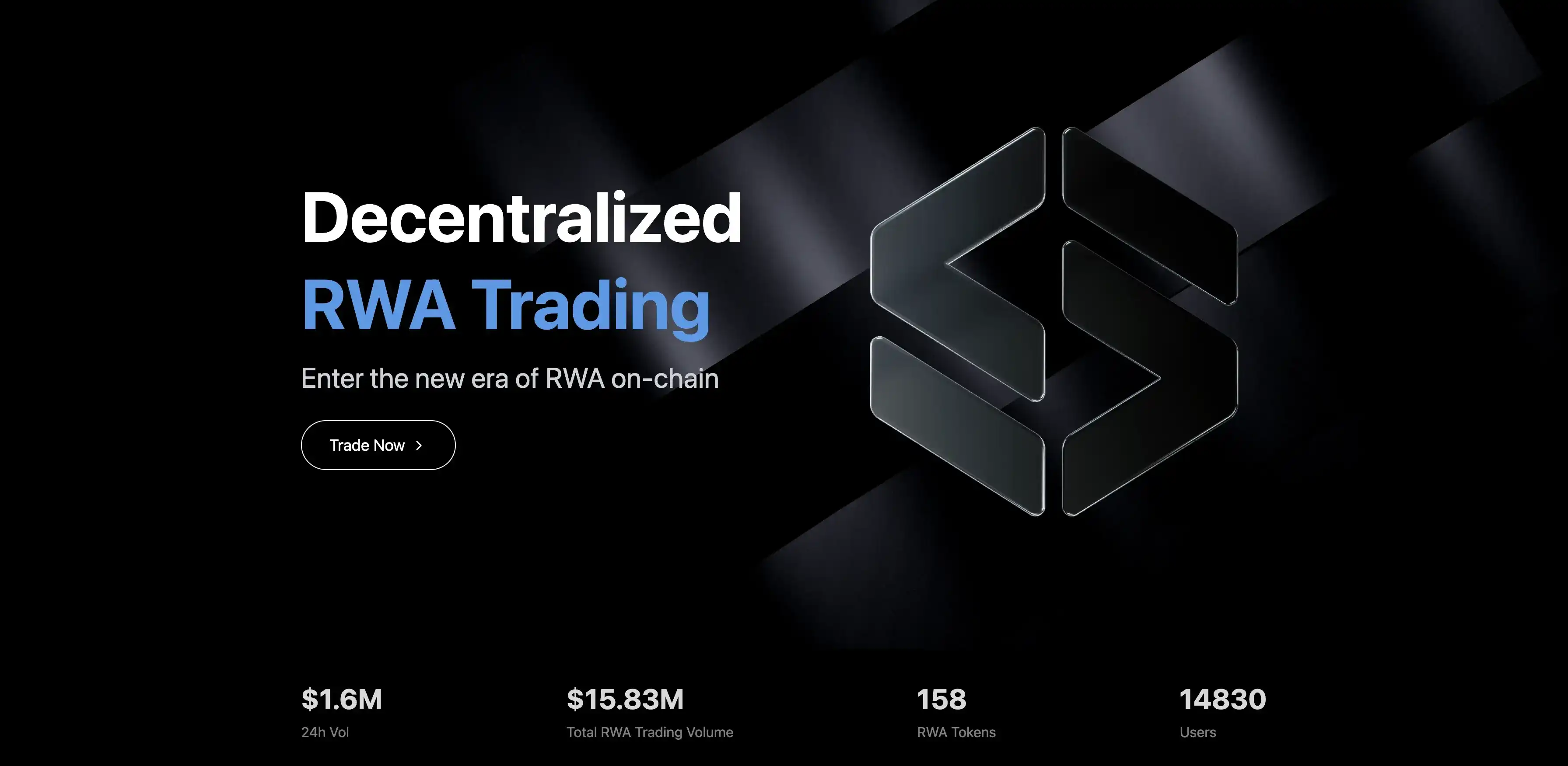
MSX is a community-driven DeFi platform focused on tokenizing US stocks and other RWAs for on-chain trading. Through a partnership with Fidelity, the platform achieves 1:1 physical custody and token issuance. Users can use stablecoins like USDC, USDT, and USD1 to mint stock tokens such as AAPL.M and MSFT.M, and trade them 24/7 on the Base blockchain. All trading, minting, and redemption processes are executed by smart contracts, ensuring transparency, security, and auditability. MyStonks is committed to bridging the gap between TradFi and DeFi, providing users with a high-liquidity, low-barrier entry point for US stock investments on-chain, building the "Nasdaq of the crypto world".

Latest Developments:

On December 22, MSX founder Bruce posted, stating that recent BTC selling pressure has encountered resistance, marginal selling has dried up, and there is actual capital absorbing筹码 below, not emotional buying, and he holds a bullish attitude towards this.

Previously, Bruce posted on X that Nasdaq has submitted a stock token application, and MSX is prepared to convert into "official" tokens. He said: "Nasdaq already submitted its stock token application to the SEC in September this year. If progress is fast, it will officially launch in Q1 next year. The launch of Nasdaq's stock tokens will impact all 'non-official stock tokens.' MSX is prepared to convert into 'official' tokens at any time."

Related Links

《RWA Weekly Report Series》

Curates the latest insights and market data for the RWA sector.

《5 Major L1 Public Chains Most Worth Watching in 2026: The Mainline Evolution from DeFi to RWA》

For investors, developers, and traders, helping to see which public chains are continuously gathering real activity, users, and long-term value.

《After 13 Ministries and 7 Associations Issued a Document to Prevent Virtual Currency Risks, Where is the Path for RWA?》

Article: Our advice is: If you want to engage in RWA, please first sever all connections with domestic RMB, ordinary retail investors, and promotional channels. In front of red lines, living long is more important than running fast. Legal red lines are never meant for playing jump rope.


Related Questions

QWhat percentage of Euro stablecoins are deployed on the Ethereum blockchain, according to the article?

AApproximately 50% of Euro stablecoins are deployed on the Ethereum blockchain.

QHow did the RWA on-chain total value (Distributed Asset Value) change from December 17th to December 23rd?

AThe RWA on-chain total value increased from $187.4 billion to $190.5 billion, a weekly gain of 1.65%.

QWhat potential impact could former President Trump's policy adjustments have, as mentioned in the article?

AAs Trump prepares for the midterm elections in November, his policy adjustments could once again affect digital currencies and other major asset classes.

QWhich asset class contributed the most to the weekly growth in the RWA sector?

ACommodity assets contributed the most to the weekly growth, increasing by $110 million from $3.22 billion to $3.33 billion.

QWhat new guidance did the U.S. SEC issue for broker-dealers regarding crypto assets?

AThe U.S. SEC issued guidance stating that broker-dealers will not face enforcement action for custodying customer crypto assets if they follow specified standards, such as safeguarding private keys and preparing for events like 51% attacks or hard forks.

Related Reads

Trading

Spot
Futures

Hot Articles

What is SONIC

Sonic: Pioneering the Future of Gaming in Web3 Introduction to Sonic In the ever-evolving landscape of Web3, the gaming industry stands out as one of the most dynamic and promising sectors. At the forefront of this revolution is Sonic, a project designed to amplify the gaming ecosystem on the Solana blockchain. Leveraging cutting-edge technology, Sonic aims to deliver an unparalleled gaming experience by efficiently processing millions of requests per second, ensuring that players enjoy seamless gameplay while maintaining low transaction costs. This article delves into the intricate details of Sonic, exploring its creators, funding sources, operational mechanics, and the timeline of significant events that have shaped its journey. What is Sonic? Sonic is an innovative layer-2 network that operates atop the Solana blockchain, specifically tailored to enhance the existing Solana gaming ecosystem. It accomplishes this through a customised, VM-agnostic game engine paired with a HyperGrid interpreter, facilitating sovereign game economies that roll up back to the Solana platform. The primary goals of Sonic include: Enhanced Gaming Experiences: Sonic is committed to offering lightning-fast on-chain gameplay, allowing players and developers to engage with games at previously unattainable speeds. Atomic Interoperability: This feature enables transactions to be executed within Sonic without the need to redeploy Solana programmes and accounts. This makes the process more efficient and directly benefits from Solana Layer1 services and liquidity. Seamless Deployment: Sonic allows developers to write for Ethereum Virtual Machine (EVM) based systems and execute them on Solana’s SVM infrastructure. This interoperability is crucial for attracting a broader range of dApps and decentralised applications to the platform. Support for Developers: By offering native composable gaming primitives and extensible data types - dining within the Entity-Component-System (ECS) framework - game creators can craft intricate business logic with ease. Overall, Sonic's unique approach not only caters to players but also provides an accessible and low-cost environment for developers to innovate and thrive. Creator of Sonic The information regarding the creator of Sonic is somewhat ambiguous. However, it is known that Sonic's SVM is owned by the company Mirror World. The absence of detailed information about the individuals behind Sonic reflects a common trend in several Web3 projects, where collective efforts and partnerships often overshadow individual contributions. Investors of Sonic Sonic has garnered considerable attention and support from various investors within the crypto and gaming sectors. Notably, the project raised an impressive $12 million during its Series A funding round. The round was led by BITKRAFT Ventures, with other notable investors including Galaxy, Okx Ventures, Interactive, Big Brain Holdings, and Mirana. This financial backing signifies the confidence that investment foundations have in Sonic’s potential to revolutionise the Web3 gaming landscape, further validating its innovative approaches and technologies. How Does Sonic Work? Sonic utilises the HyperGrid framework, a sophisticated parallel processing mechanism that enhances its scalability and customisability. Here are the core features that set Sonic apart: Lightning Speed at Low Costs: Sonic offers one of the fastest on-chain gaming experiences compared to other Layer-1 solutions, powered by the scalability of Solana’s virtual machine (SVM). Atomic Interoperability: Sonic enables transaction execution without redeployment of Solana programmes and accounts, effectively streamlining the interaction between users and the blockchain. EVM Compatibility: Developers can effortlessly migrate decentralised applications from EVM chains to the Solana environment using Sonic’s HyperGrid interpreter, increasing the accessibility and integration of various dApps. Ecosystem Support for Developers: By exposing native composable gaming primitives, Sonic facilitates a sandbox-like environment where developers can experiment and implement business logic, greatly enhancing the overall development experience. Monetisation Infrastructure: Sonic natively supports growth and monetisation efforts, providing frameworks for traffic generation, payments, and settlements, thereby ensuring that gaming projects are not only viable but also sustainable financially. Timeline of Sonic The evolution of Sonic has been marked by several key milestones. Below is a brief timeline highlighting critical events in the project's history: 2022: The Sonic cryptocurrency was officially launched, marking the beginning of its journey in the Web3 gaming arena. 2024: June: Sonic SVM successfully raised $12 million in a Series A funding round. This investment allowed Sonic to further develop its platform and expand its offerings. August: The launch of the Sonic Odyssey testnet provided users with the first opportunity to engage with the platform, offering interactive activities such as collecting rings—a nod to gaming nostalgia. October: SonicX, an innovative crypto game integrated with Solana, made its debut on TikTok, capturing the attention of over 120,000 users within a short span. This integration illustrated Sonic’s commitment to reaching a broader, global audience and showcased the potential of blockchain gaming. Key Points Sonic SVM is a revolutionary layer-2 network on Solana explicitly designed to enhance the GameFi landscape, demonstrating great potential for future development. HyperGrid Framework empowers Sonic by introducing horizontal scaling capabilities, ensuring that the network can handle the demands of Web3 gaming. Integration with Social Platforms: The successful launch of SonicX on TikTok displays Sonic’s strategy to leverage social media platforms to engage users, exponentially increasing the exposure and reach of its projects. Investment Confidence: The substantial funding from BITKRAFT Ventures, among others, emphasizes the robust backing Sonic has, paving the way for its ambitious future. In conclusion, Sonic encapsulates the essence of Web3 gaming innovation, striking a balance between cutting-edge technology, developer-centric tools, and community engagement. As the project continues to evolve, it is poised to redefine the gaming landscape, making it a notable entity for gamers and developers alike. As Sonic moves forward, it will undoubtedly attract greater interest and participation, solidifying its place within the broader narrative of blockchain gaming.

1.3k Total ViewsPublished 2024.04.04Updated 2024.12.03

What is SONIC

What is $S$

Understanding SPERO: A Comprehensive Overview Introduction to SPERO As the landscape of innovation continues to evolve, the emergence of web3 technologies and cryptocurrency projects plays a pivotal role in shaping the digital future. One project that has garnered attention in this dynamic field is SPERO, denoted as SPERO,$$s$. This article aims to gather and present detailed information about SPERO, to help enthusiasts and investors understand its foundations, objectives, and innovations within the web3 and crypto domains. What is SPERO,$$s$? SPERO,$$s$ is a unique project within the crypto space that seeks to leverage the principles of decentralisation and blockchain technology to create an ecosystem that promotes engagement, utility, and financial inclusion. The project is tailored to facilitate peer-to-peer interactions in new ways, providing users with innovative financial solutions and services. At its core, SPERO,$$s$ aims to empower individuals by providing tools and platforms that enhance user experience in the cryptocurrency space. This includes enabling more flexible transaction methods, fostering community-driven initiatives, and creating pathways for financial opportunities through decentralised applications (dApps). The underlying vision of SPERO,$$s$ revolves around inclusiveness, aiming to bridge gaps within traditional finance while harnessing the benefits of blockchain technology. Who is the Creator of SPERO,$$s$? The identity of the creator of SPERO,$$s$ remains somewhat obscure, as there are limited publicly available resources providing detailed background information on its founder(s). This lack of transparency can stem from the project's commitment to decentralisation—an ethos that many web3 projects share, prioritising collective contributions over individual recognition. By centring discussions around the community and its collective goals, SPERO,$$s$ embodies the essence of empowerment without singling out specific individuals. As such, understanding the ethos and mission of SPERO remains more important than identifying a singular creator. Who are the Investors of SPERO,$$s$? SPERO,$$s$ is supported by a diverse array of investors ranging from venture capitalists to angel investors dedicated to fostering innovation in the crypto sector. The focus of these investors generally aligns with SPERO's mission—prioritising projects that promise societal technological advancement, financial inclusivity, and decentralised governance. These investor foundations are typically interested in projects that not only offer innovative products but also contribute positively to the blockchain community and its ecosystems. The backing from these investors reinforces SPERO,$$s$ as a noteworthy contender in the rapidly evolving domain of crypto projects. How Does SPERO,$$s$ Work? SPERO,$$s$ employs a multi-faceted framework that distinguishes it from conventional cryptocurrency projects. Here are some of the key features that underline its uniqueness and innovation: Decentralised Governance: SPERO,$$s$ integrates decentralised governance models, empowering users to participate actively in decision-making processes regarding the project’s future. This approach fosters a sense of ownership and accountability among community members. Token Utility: SPERO,$$s$ utilises its own cryptocurrency token, designed to serve various functions within the ecosystem. These tokens enable transactions, rewards, and the facilitation of services offered on the platform, enhancing overall engagement and utility. Layered Architecture: The technical architecture of SPERO,$$s$ supports modularity and scalability, allowing for seamless integration of additional features and applications as the project evolves. This adaptability is paramount for sustaining relevance in the ever-changing crypto landscape. Community Engagement: The project emphasises community-driven initiatives, employing mechanisms that incentivise collaboration and feedback. By nurturing a strong community, SPERO,$$s$ can better address user needs and adapt to market trends. Focus on Inclusion: By offering low transaction fees and user-friendly interfaces, SPERO,$$s$ aims to attract a diverse user base, including individuals who may not previously have engaged in the crypto space. This commitment to inclusion aligns with its overarching mission of empowerment through accessibility. Timeline of SPERO,$$s$ Understanding a project's history provides crucial insights into its development trajectory and milestones. Below is a suggested timeline mapping significant events in the evolution of SPERO,$$s$: Conceptualisation and Ideation Phase: The initial ideas forming the basis of SPERO,$$s$ were conceived, aligning closely with the principles of decentralisation and community focus within the blockchain industry. Launch of Project Whitepaper: Following the conceptual phase, a comprehensive whitepaper detailing the vision, goals, and technological infrastructure of SPERO,$$s$ was released to garner community interest and feedback. Community Building and Early Engagements: Active outreach efforts were made to build a community of early adopters and potential investors, facilitating discussions around the project’s goals and garnering support. Token Generation Event: SPERO,$$s$ conducted a token generation event (TGE) to distribute its native tokens to early supporters and establish initial liquidity within the ecosystem. Launch of Initial dApp: The first decentralised application (dApp) associated with SPERO,$$s$ went live, allowing users to engage with the platform's core functionalities. Ongoing Development and Partnerships: Continuous updates and enhancements to the project's offerings, including strategic partnerships with other players in the blockchain space, have shaped SPERO,$$s$ into a competitive and evolving player in the crypto market. Conclusion SPERO,$$s$ stands as a testament to the potential of web3 and cryptocurrency to revolutionise financial systems and empower individuals. With a commitment to decentralised governance, community engagement, and innovatively designed functionalities, it paves the way toward a more inclusive financial landscape. As with any investment in the rapidly evolving crypto space, potential investors and users are encouraged to research thoroughly and engage thoughtfully with the ongoing developments within SPERO,$$s$. The project showcases the innovative spirit of the crypto industry, inviting further exploration into its myriad possibilities. While the journey of SPERO,$$s$ is still unfolding, its foundational principles may indeed influence the future of how we interact with technology, finance, and each other in interconnected digital ecosystems.

54 Total ViewsPublished 2024.12.17Updated 2024.12.17

What is $S$

What is AGENT S

Agent S: The Future of Autonomous Interaction in Web3 Introduction In the ever-evolving landscape of Web3 and cryptocurrency, innovations are constantly redefining how individuals interact with digital platforms. One such pioneering project, Agent S, promises to revolutionise human-computer interaction through its open agentic framework. By paving the way for autonomous interactions, Agent S aims to simplify complex tasks, offering transformative applications in artificial intelligence (AI). This detailed exploration will delve into the project's intricacies, its unique features, and the implications for the cryptocurrency domain. What is Agent S? Agent S stands as a groundbreaking open agentic framework, specifically designed to tackle three fundamental challenges in the automation of computer tasks: Acquiring Domain-Specific Knowledge: The framework intelligently learns from various external knowledge sources and internal experiences. This dual approach empowers it to build a rich repository of domain-specific knowledge, enhancing its performance in task execution. Planning Over Long Task Horizons: Agent S employs experience-augmented hierarchical planning, a strategic approach that facilitates efficient breakdown and execution of intricate tasks. This feature significantly enhances its ability to manage multiple subtasks efficiently and effectively. Handling Dynamic, Non-Uniform Interfaces: The project introduces the Agent-Computer Interface (ACI), an innovative solution that enhances the interaction between agents and users. Utilizing Multimodal Large Language Models (MLLMs), Agent S can navigate and manipulate diverse graphical user interfaces seamlessly. Through these pioneering features, Agent S provides a robust framework that addresses the complexities involved in automating human interaction with machines, setting the stage for myriad applications in AI and beyond. Who is the Creator of Agent S? While the concept of Agent S is fundamentally innovative, specific information about its creator remains elusive. The creator is currently unknown, which highlights either the nascent stage of the project or the strategic choice to keep founding members under wraps. Regardless of anonymity, the focus remains on the framework's capabilities and potential. Who are the Investors of Agent S? As Agent S is relatively new in the cryptographic ecosystem, detailed information regarding its investors and financial backers is not explicitly documented. The lack of publicly available insights into the investment foundations or organisations supporting the project raises questions about its funding structure and development roadmap. Understanding the backing is crucial for gauging the project's sustainability and potential market impact. How Does Agent S Work? At the core of Agent S lies cutting-edge technology that enables it to function effectively in diverse settings. Its operational model is built around several key features: Human-like Computer Interaction: The framework offers advanced AI planning, striving to make interactions with computers more intuitive. By mimicking human behaviour in tasks execution, it promises to elevate user experiences. Narrative Memory: Employed to leverage high-level experiences, Agent S utilises narrative memory to keep track of task histories, thereby enhancing its decision-making processes. Episodic Memory: This feature provides users with step-by-step guidance, allowing the framework to offer contextual support as tasks unfold. Support for OpenACI: With the ability to run locally, Agent S allows users to maintain control over their interactions and workflows, aligning with the decentralised ethos of Web3. Easy Integration with External APIs: Its versatility and compatibility with various AI platforms ensure that Agent S can fit seamlessly into existing technological ecosystems, making it an appealing choice for developers and organisations. These functionalities collectively contribute to Agent S's unique position within the crypto space, as it automates complex, multi-step tasks with minimal human intervention. As the project evolves, its potential applications in Web3 could redefine how digital interactions unfold. Timeline of Agent S The development and milestones of Agent S can be encapsulated in a timeline that highlights its significant events: September 27, 2024: The concept of Agent S was launched in a comprehensive research paper titled “An Open Agentic Framework that Uses Computers Like a Human,” showcasing the groundwork for the project. October 10, 2024: The research paper was made publicly available on arXiv, offering an in-depth exploration of the framework and its performance evaluation based on the OSWorld benchmark. October 12, 2024: A video presentation was released, providing a visual insight into the capabilities and features of Agent S, further engaging potential users and investors. These markers in the timeline not only illustrate the progress of Agent S but also indicate its commitment to transparency and community engagement. Key Points About Agent S As the Agent S framework continues to evolve, several key attributes stand out, underscoring its innovative nature and potential: Innovative Framework: Designed to provide an intuitive use of computers akin to human interaction, Agent S brings a novel approach to task automation. Autonomous Interaction: The ability to interact autonomously with computers through GUI signifies a leap towards more intelligent and efficient computing solutions. Complex Task Automation: With its robust methodology, it can automate complex, multi-step tasks, making processes faster and less error-prone. Continuous Improvement: The learning mechanisms enable Agent S to improve from past experiences, continually enhancing its performance and efficacy. Versatility: Its adaptability across different operating environments like OSWorld and WindowsAgentArena ensures that it can serve a broad range of applications. As Agent S positions itself in the Web3 and crypto landscape, its potential to enhance interaction capabilities and automate processes signifies a significant advancement in AI technologies. Through its innovative framework, Agent S exemplifies the future of digital interactions, promising a more seamless and efficient experience for users across various industries. Conclusion Agent S represents a bold leap forward in the marriage of AI and Web3, with the capacity to redefine how we interact with technology. While still in its early stages, the possibilities for its application are vast and compelling. Through its comprehensive framework addressing critical challenges, Agent S aims to bring autonomous interactions to the forefront of the digital experience. As we move deeper into the realms of cryptocurrency and decentralisation, projects like Agent S will undoubtedly play a crucial role in shaping the future of technology and human-computer collaboration.

598 Total ViewsPublished 2025.01.14Updated 2025.01.14

What is AGENT S

Discussions

Welcome to the HTX Community. Here, you can stay informed about the latest platform developments and gain access to professional market insights. Users' opinions on the price of S (S) are presented below.

活动图片












