Ripple Unveils ‘Institutional DeFi’ Roadmap For The XRP Ledger

bitcoinistPublished on 2026-02-07Last updated on 2026-02-07

Abstract

Ripple has released an "Institutional DeFi" roadmap for the XRP Ledger (XRPL), positioning XRP as a core settlement and liquidity asset for payments, foreign exchange, collateral, and on-ledger credit. The plan aims to transform XRPL into a compliant financial operating system for institutions, with features like permissioned markets, privacy tools, and lending protocols. Key components already live include Token Escrow, Batch Transactions, and Credentials for KYC/AML. Upcoming 2026 releases include a Permissioned DEX, confidential transfers using zero-knowledge proofs, and the XLS-66 Lending Protocol for on-ledger credit markets. The roadmap is designed to drive both direct and indirect demand for XRP through increased transaction activity and protocol-level usage.

Ripple on Thursday published an “Institutional DeFi” roadmap for the XRP Ledger (XRPL), positioning XRP as a protocol-level settlement and liquidity primitive across payments, FX, collateral workflows, and on-ledger credit. The company’s pitch is straightforward: compliance tooling and asset-layer primitives are already live on mainnet, with lending, privacy, and permissioned market infrastructure slated to round out a more institution-friendly stack over the coming quarters.

The Institutional DeFi Roadmap For The XRP Ledger

In its post, Ripple framed the roadmap as an evolution from a fast settlement network into something closer to a full financial operating environment for regulated workflows. The blog argues that with “native onchain privacy, permissioned markets, and institutional lending” expected “in the coming months,” XRPL is aiming to become “an end-to-end operating system for real-world finance,” with institutions able to run compliant processes without pushing additional complexity onto end users.

RippleX summarized the roadmap in a companion post, saying XRP sits “at the center of settlement, FX, collateral, and onchain credit,” and that 2026 focus areas include lending, privacy, and permissioned on-chain markets.

The roadmap leans heavily on the idea that XRP demand can be driven both directly and indirectly. Directly, Ripple points to new functionality that could increase transaction volume and asset issuance, raising demand for network resources. Indirectly, it highlights XRP’s role in base-layer mechanics such as reserve requirements, transaction fees (which burn XRP), and bridging in FX and lending flows.

Ripple organizes this into three institutional pillars: payments/FX, collateral/liquidity, and credit/financing. On payments and FX, it emphasizes “Permissioned Domains,” where access is gated via “Credentials” (e.g., KYC/AML attestations), and a planned Permissioned DEX that would extend XRPL’s existing exchange rails into controlled, regulated contexts for secondary markets in FX, stablecoins, and tokenized assets. In those permissioned market flows, Ripple says XRP functions as an auto-bridge asset between tokens and stablecoins, while each transaction consumes fees paid in XRP.

On collateral and liquidity, Ripple spotlights Token Escrow and Batch Transactions as building blocks for conditional settlement and atomic delivery-versus-payment workflows, alongside the Multi-Purpose Token (MPT) standard, which it describes as a way to embed metadata and restrictions for complex instruments without custom contracts. The thesis here is that tokenized collateral issuance, escrowed settlement, and DvP-style flows expand on-ledger activity that still depends on XRP reserves and fees at the protocol layer.

The most explicit “institutional DeFi” expansion comes in credit. Ripple says XRPL v3.1.0 will introduce native on-ledger credit markets via a lending stack built around Single-Asset Vaults and the XLS-66 Lending Protocol, designed for fixed-term, underwritten loans with repayment automation. Underwriting and risk management remain off-chain, while the loan contracts and mechanics live on-ledger.

What Ripple Says Is Next

Ripple’s post distinguishes between primitives already available and a near-term pipeline. Live today, it lists MPT, Credentials, Permissioned Domains, transaction “Simulate” tooling for preflight-style risk reduction, “Deep Freeze” controls for issuers, Token Escrow and Batch Transactions, plus an XRPL EVM sidechain bridged via Axelar for Solidity-based deployments that tap XRPL liquidity and identity features.

On the roadmap, Ripple highlights a Permissioned DEX targeted for Q2, the XLS-65/66 lending protocol for later in 2026, “Confidential Transfers” for MPTs using zero-knowledge proofs in Q1, and “Smart Escrows” and MPT DEX integration in Q2—alongside an “Institutional DeFi Portal” intended to bundle tokenization, lending, and payments exploration in one place.

At press time, XRP traded at $1.35.
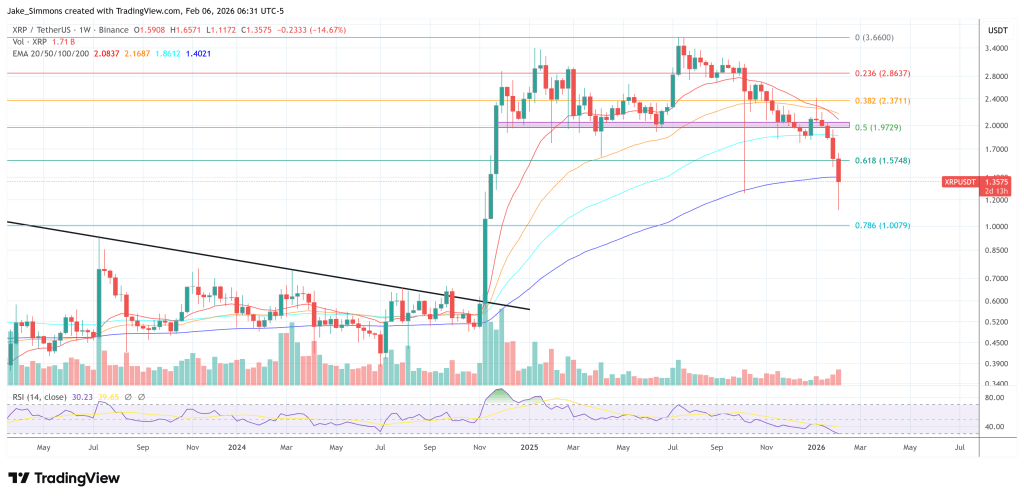
XRP needs a weekly close above the 200-week EMA, 1-week chart | Source: XRPUSDT on TradingView.com

Trending Cryptos

Related Reads

Agent Race Ends, Super Workbench Takes Over

The era of fragmented AI agents is ending. Over the past month, China's tech giants—Tencent, Alibaba, and ByteDance—have simultaneously shifted strategy: instead of launching new, standalone AI agents, they are consolidating their various agent projects into unified "super workbenches." Tencent integrated its QClaw teams into WorkBuddy, a strategic product hailed as a potential third flagship after QQ and WeChat. Alibaba is merging its QoderWork, Wukong, and MuleRun agents into a new "Qianwen Office" platform under DingTalk's leadership. ByteDance rebranded its TRAE SOLO coding agent to TRAE Work, signaling a broader focus on workflow collaboration. This convergence marks a pivotal industry consensus. The initial exploration phase, where companies rapidly built numerous overlapping agents for different scenarios, proved costly and inefficient. With open-source tools eroding technical barriers, competition has shifted from agent creation to resource consolidation and cost control. Historically, platform wars are won not by creating more products, but by simplifying them—as seen with browsers unifying web access and super-apps consolidating services. Now, the "super workbench" aims to become the unified AI entry point for work. This reflects a deeper market realization: the primary audience for AI is no longer just programmers (a market in the tens of millions) but all knowledge workers (a market of billions). The real opportunity lies in augmenting everyday tasks—managing emails, documents, data, and meetings—across the entire workday. The core battleground is becoming control over the primary AI entry point that employees use daily. Tencent's WorkBuddy leverages WeChat and Tencent Docs; Alibaba's Qianwen Office taps into DingTalk's organizational data; ByteDance's TRAE Work integrates with Feishu's workflows. Whoever owns this "super workbench" gains strategic control over orchestrating enterprise data and APIs. This shift is redefining enterprise software. Traditional SaaS applications, valued for their user interfaces, will recede into the background. Their core functionalities will be exposed as standardized "Skills" or APIs for the super workbench's agents to invoke. Software value will shift from selling user seats to charging based on API calls and outcomes delivered. The evolution of agents is moving through clear stages: first as novel standalone products, then as consolidated primary work entry points, and finally as pervasive, invisible capabilities embedded into the digital fabric. The recent moves by major tech firms signal the transition from the first stage into the second, accelerating toward the third. In the end, the most successful agent technology may become invisible—like electricity or the HTTP protocol—a fundamental, unnamed infrastructure powering work itself.

marsbit4m ago

Agent Race Ends, Super Workbench Takes Over

marsbit4m ago

Michael Saylor: 110 Reasons to Oppose BIP-110

Michael Saylor presents 110 arguments against Bitcoin Improvement Proposal (BIP) 110, a soft fork aimed at restricting certain non-monetary data storage uses (like inscriptions) on the Bitcoin blockchain. He acknowledges the proponents' valid concerns—such as node costs, fee pressure, and preserving Bitcoin's monetary focus—but fundamentally disagrees with the proposed solution. Saylor argues that BIP 110 represents a dangerous precedent of using consensus rules to enforce value judgments on transaction validity, moving away from Bitcoin's core principles of neutrality and permissionless innovation. His key objections are organized into eleven categories: 1) It violates neutrality and hard consensus by banning currently valid transactions. 2) It fails to meet the high burden of proof required for a consensus change, lacking concrete data on the alleged crisis. 3) Its seven bundled technical restrictions are overly broad, targeting generic script functionalities and blocking future upgrade paths. 4) It sacrifices compatibility and future optionality by closing off designed upgrade hooks. 5) Its temporary rules add significant complexity (grandfathering, expiry states) without sufficient justification. 6) The economic and security impacts, particularly on miner revenue and fee markets, are uncertain and unmodeled. 7) Superior, market-based tools (fee markets, relay/mining policies) already exist to manage blockchain load. 8) It stifles innovation by creating a chilling effect for developers. 9) Its modified activation mechanism (55% threshold, forced signaling) is aggressive and risks network splits. 10) The precedent it sets—using consensus to suppress disliked but legal uses—is more dangerous than the problem it aims to solve. 11) A better path exists: improving measurements, refining resource-based policies, and allowing market forces to work. Saylor concludes that Bitcoin's strength lies in its neutral rules, open markets, and hard consensus. Changing these foundational elements to target specific use cases is an unnecessary and risky "iatrogenic" intervention. He advocates for guarding Bitcoin's neutrality rather than acting as its redeemer.

marsbit20m ago

Michael Saylor: 110 Reasons to Oppose BIP-110

marsbit20m ago

Trading

Spot

Hot Articles

What is XRP 2.0

XRP 2.0: A New Frontier in the Cryptocurrency Landscape Introduction to XRP 2.0 In the ever-evolving realm of cryptocurrency, new projects continuously emerge, vying for attention and adoption. One such promising initiative is XRP 2.0, a novel cryptocurrency project designed to leverage advanced blockchain technology and robust encryption methodologies. While the name draws parallels with Ripple’s XRP, it’s crucial to note that XRP 2.0 operates independently, focusing on enhancing transaction security, privacy, and scalability. As the digital financial landscape increasingly embraces decentralized solutions, XRP 2.0 aims to contribute meaningfully to web3 and the overall expansion of crypto projects. What is XRP 2.0? At its core, XRP 2.0 is a cryptocurrency project that aims to create a secure and decentralized digital currency ecosystem. Its foundational technology integrates sophisticated blockchain principles with cutting-edge encryption techniques. The overarching goal of XRP 2.0 is to establish itself as a reliable and efficient platform enabling swift transaction execution while prioritizing enhanced privacy protections for its users. The project is promoted as a solution to many limitations faced by existing cryptocurrencies, proposing a system that can handle a higher volume of transactions with improved speed and privacy. This versatility positions XRP 2.0 as a significant contender in a marketplace riddled with various digital currencies. Who is the Creator of XRP 2.0? The identity of the creator behind XRP 2.0 has been flagged as ‘Wilbur.’ However, comprehensive details regarding Wilbur or their associated entity remain elusive. The anonymity of many cryptocurrency creators is not an uncommon phenomenon in the industry, often designed to maintain a degree of privacy and security. Who are the Investors of XRP 2.0? As of now, specific information related to the investment foundations or organizations supporting XRP 2.0 is not publicly available. In the cryptocurrency sector, the backing by reputed investors can significantly influence a project's credibility and success, yet the transparency regarding the financial supporters of XRP 2.0 has not been established. How Does XRP 2.0 Work? XRP 2.0 stands out by employing a combination of blockchain technology and advanced encryption algorithms that ensures secure and decentralized transactions. Its innovative structure includes unique features designed to foster user engagement and broaden functionalities beyond conventional cryptocurrency transactions. Among these features, XRP 2.0 incorporates AI-powered capabilities, such as text-to-image and text-to-speech functionalities. These additions are designed to enhance the interactive experience for users, promoting broader applicability across various sectors. By bridging technological advancements with user-centered design, XRP 2.0 aims to capture the attention of a diverse range of individuals and enterprises looking to integrate cryptocurrency solutions into their operational frameworks. Timeline of XRP 2.0 Understanding XRP 2.0 requires examining the milestones that have defined its journey thus far: July 23, 2023: XRP 2.0 is introduced as a novel cryptocurrency project, aiming to revolutionize secure and decentralized transaction capabilities in the blockchain domain. September 8, 2023: The launching of another project, XRP20, occurs, marking the emergence of an ERC-20 token on the Ethereum blockchain that remains unrelated to XRP 2.0. November 13, 2023: The XRP Ledger undergoes a significant update with the release of rippled server software version 2.0.0. It is essential to note that this development is disconnected from the XRP 2.0 cryptocurrency project. Key Points About XRP 2.0 To distill the essence of XRP 2.0, several critical factors emerge: Unique Features: The inclusion of features like AI-powered text-to-image and text-to-speech further diversifies the potential applications of XRP 2.0. Blockchain Technology: The framework utilizes advanced blockchain mechanisms and encryption protocols, ensuring a secure and decentralized environment for transactions. Scalability and Privacy: XRP 2.0 prioritizes enhanced privacy protections in transaction processes and the scalability necessary to accommodate a growing user base. No Affiliation with Ripple: Importantly, despite its name, XRP 2.0 does not have any allegiance or collaboration with Ripple’s XRP, distinguishing its operational framework and objectives within the cryptocurrency ecosystem. Conclusion XRP 2.0 represents an ambitious venture into the cryptocurrency sphere, aiming to offer a combination of security, privacy, and efficiency in digital transactions. By integrating sophisticated technologies and user-friendly features, the project sets out to broaden the horizons of what cryptocurrency can achieve in today's digital economy. While the anonymity of its creator and lack of disclosed investors might raise questions for some, XRP 2.0's focus on advanced functionalities and decentralisation enhances its appeal amidst an increasingly crowded crypto market. As the cryptocurrency landscape continues to evolve, XRP 2.0 may yet emerge as a pivotal player in the expansion of secure and scalable blockchain solutions.

1.2k Total ViewsPublished 2024.04.01Updated 2024.12.03

What is XRP 2.0

Discussions

Welcome to the HTX Community. Here, you can stay informed about the latest platform developments and gain access to professional market insights. Users' opinions on the price of XRP (XRP) are presented below.

活动图片












