Ripple Outlines Next Steps After Critical XRP Ledger Batch Amendment Bug

bitcoinistPublished on 2026-03-04Last updated on 2026-03-04

Abstract

Ripple is implementing stricter security measures for the XRP Ledger amendment process after a critical bug was discovered in the proposed Batch amendment (XLS-56). The flaw, identified by Cantina AI, was caught before activation, preventing any mainnet impact. RippleX Head of Engineering J. Ayo Akinyele acknowledged the amendment "progressed further than it should have" and emphasized the need for higher review standards. While the network's safeguards worked as a final defense, Ripple is taking steps to make them a primary one. Proposed changes include mandatory multiple independent audits for high-risk features, an expanded bug bounty program, and formal adversarial testing. The company is also incorporating AI-assisted code review and aims to make formal verification standard for critical ledger components.

Ripple says it is tightening the XRP Ledger amendment process after a critical flaw was found in the proposed Batch amendment (XLS-56), an incident that exposed gaps in review even as the network’s last-resort safeguards prevented any mainnet impact.

In a post on X, RippleX Head of Engineering J. Ayo Akinyele said the bug was identified last week by Cantina AI, reported responsibly, and quickly validated as critical. The issue never became exploitable on mainnet because the amendment had not yet been activated, and a hotfix was issued to disable both Batch and the related fix amendment while a broader remediation is reviewed.

Ripple Responds To The Critical Bug

Akinyele did not try to soften the significance of the lapse. “The Batch amendment progressed further than it should have,” he wrote. “As active participants in the amendment lifecycle, we share responsibility for ensuring that review, signaling, and activation safeguards meet the highest standard. In this case, we must do better.”

At the same time, Ripple is framing the episode as a failure of early-stage review rather than of the XRPL governance model itself. Akinyele said “the amendment process functioned as designed,” noting that activation gating prevented harm to mainnet and the bug bounty disclosure route worked as intended. But he added a sharper warning: “Those safeguards matter, but they should serve as a final line of defense, not the primary one.”

That distinction runs through the rest of Ripple’s response. Rather than suggesting tighter centralized control, Akinyele argued that amendment security on XRPL must remain distributed across core contributors, validators, the XRPL Foundation and outside researchers. “No single entity controls activation. No single entity owns risk in isolation,” he wrote, describing that structure as both a consequence of decentralization and a strength, provided it is matched by layered defenses and better coordination.

Ripple’s proposed fixes are broad. Akinyele said future releases that introduce features carrying “theoretical risk of disruption” will go through multiple independent audits with reputable security firms in coordination with the XRPL Foundation. The idea is straightforward: different teams catch different classes of issues, and redundancy reduces blind spots when code touches consensus-critical behavior.

The company also plans to expand the bug bounty program and formalize adversarial testing campaigns before activation. Akinyele pointed to initiatives such as the Lending attackathon and a UBRI-sponsored hackathon as models for that approach, arguing that incentivizing white-hat attackers before launch is far cheaper than reacting after the fact. He added that lessons from the Batch incident have already affected other roadmap items, saying Ripple “deliberately held lending back” to allow for more review, testing and scrutiny before moving toward activation.

Part of that next phase will rely more heavily on AI. Akinyele said Ripple is incorporating AI-assisted code review, automated invariant discovery, agentic fuzzing and simulated attack scenarios into its software development lifecycle. “AI does not replace expert C++ engineers, but rather augments them,” he wrote, especially when “subtle logic interactions at critical points can create outsized risk.”

Longer term, Ripple says it wants formal verification to become standard for high-risk ledger components. That includes modeling amendment behavior before activation, proving safety properties for critical components and integrating formal methods from XLS specification through implementation and testing. The broader aim, Akinyele said, is end-to-end assurance that amendment code is not only functionally correct but aligned with defined security and safety properties.

At press time, XRP traded at $1.3698.
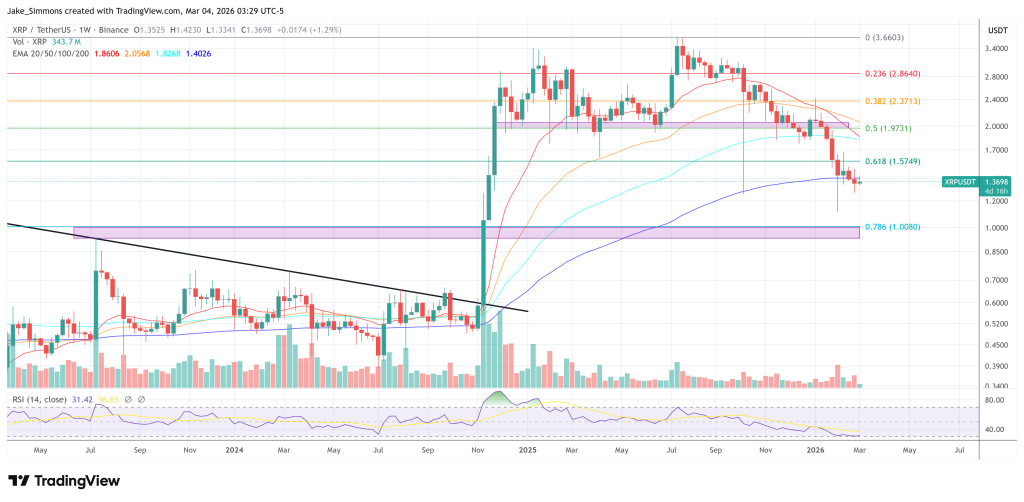
XRP falls below the 200-week EMA agan, 1-week chart | Source: XRPUSDT on TradingView.com

Trending Cryptos

Related Questions

QWhat was the critical flaw discovered in the XRP Ledger and how was it identified?

AA critical flaw was found in the proposed Batch amendment (XLS-56). It was identified by Cantina AI, who reported it responsibly, and it was quickly validated as critical.

QAccording to RippleX Head of Engineering, what was the primary failure that allowed the Batch amendment to progress too far?

AJ. Ayo Akinyele stated that the primary failure was in the early-stage review process, not the XRPL governance model itself. He said, 'The Batch amendment progressed further than it should have,' and that the review, signaling, and activation safeguards did not meet the highest standard.

QWhat specific new measures is Ripple implementing to prevent similar incidents in the future?

ARipple is implementing multiple independent audits for high-risk features, expanding the bug bounty program, formalizing adversarial testing campaigns, incorporating AI-assisted code review and automated testing into its development lifecycle, and aiming to make formal verification standard for high-risk ledger components.

QHow did the XRP Ledger's existing safeguards prevent the bug from causing harm on the mainnet?

AThe network's activation gating safeguards prevented any harm because the flawed amendment had not yet been activated on the mainnet. A hotfix was then issued to disable the amendment while a broader remediation was reviewed.

QWhat is Ripple's long-term goal regarding the security of amendment code on the XRP Ledger?

ARipple's long-term goal is to achieve end-to-end assurance that amendment code is not only functionally correct but also aligned with defined security and safety properties. This involves using formal verification to model behavior, prove safety properties for critical components, and integrate formal methods from specification through implementation and testing.

Related Reads

Bitcoin Mining Farms Are Becoming AI Factories

Bitcoin mines are transforming into AI factories. This shift is driven by the convergence of three key assets from the previous crypto cycle: infrastructure, talent, and capital. Crypto mining companies like Crusoe, CoreWeave, and Bitdeer are repurposing their core competency—securing power, land, and grid connections in remote locations—to build data centers for AI clients. These firms are signing multi-billion dollar, long-term contracts with companies like Anthropic, AWS, and Microsoft, as AI's demand for reliable, high-capacity compute surpasses the profitability of Bitcoin mining. Simultaneously, crypto entrepreneurs and engineers are applying their skills to new AI ventures. Examples include OpenSea's co-founder launching OpenRouter (an AI model aggregator), and former Coinbase engineers building Fal.ai (a generative media infrastructure platform). Their experience in building scalable, global software networks translates effectively to the AI space. Furthermore, capital accumulated during the crypto boom is now fueling AI. Figures like Jed McCaleb (co-founder of Ripple) funded Voltage Park, a large-scale GPU cloud provider. Notably, some crypto investments, like FTX's early bets on Anthropic and Cursor, have generated astronomical paper returns, demonstrating how high-risk crypto capital flowed into AI before it became mainstream. The transition is not just about repurposing hardware, but about redirecting critical resources—power infrastructure, distributed systems expertise, and venture funding—to the next technological frontier: artificial intelligence.

链捕手19m ago

Bitcoin Mining Farms Are Becoming AI Factories

链捕手19m ago

Morpho Launches Fixed-Rate Product Midnight: Lenders and Borrowers Set Their Own Rates, Ending the Era of Interest Rate Models

Morpho Launches Fixed-Rate Product Midnight: Lenders and Borrowers Set Their Own Rates, Ending the Era of Algorithmic Interest Models On-chain lending has grown to $60 billion but remains minuscule compared to traditional finance's $200 trillion annual credit volume. Morpho identifies the lack of fixed rates and maturity dates as key bottlenecks. Institutions need predictability, not the passive floating rates set by algorithmic models. Midnight allows lenders and borrowers to directly quote rates, set terms, and become price makers, not takers. Fixed-rate lending is now viable due to cheaper, faster blockchains and the entry of institutions demanding control and certainty over returns, costs, and duration. Morpho Blue previously gave users control over risk; Midnight adds control over interest rates. Past attempts at on-chain fixed-rate lending failed primarily because they were built on top of floating-rate pools (creating unpredictability) or lacked sufficient active participants. Midnight avoids these pitfalls as a standalone primitive with fixed rates at its core, built upon Morpho Blue's existing large and active user base. Midnight offers distinct value: institutions gain predictable term structures and full control; fintech companies can offer tailored fixed-rate products; lenders/borrowers achieve predictability and efficiency; and curators can now differentiate by configuring both risk and interest rates. Morpho Midnight is not a replacement for Morpho Blue. The Morpho network will now feature two complementary market structures: floating-rate/open-term (Blue) for flexibility and fixed-rate/fixed-term (Midnight) for predictability. Liquidity can flow between them. The launch will be gradual, prioritizing security. Initially, it will support direct lending on Base network with one trading pair (cbBTC/USDC) and limited maturity dates. Advanced features like auto-rollovers will be introduced later.

marsbit20m ago

Morpho Launches Fixed-Rate Product Midnight: Lenders and Borrowers Set Their Own Rates, Ending the Era of Interest Rate Models

marsbit20m ago

Trading

Spot

Hot Articles

What is XRP 2.0

XRP 2.0: A New Frontier in the Cryptocurrency Landscape Introduction to XRP 2.0 In the ever-evolving realm of cryptocurrency, new projects continuously emerge, vying for attention and adoption. One such promising initiative is XRP 2.0, a novel cryptocurrency project designed to leverage advanced blockchain technology and robust encryption methodologies. While the name draws parallels with Ripple’s XRP, it’s crucial to note that XRP 2.0 operates independently, focusing on enhancing transaction security, privacy, and scalability. As the digital financial landscape increasingly embraces decentralized solutions, XRP 2.0 aims to contribute meaningfully to web3 and the overall expansion of crypto projects. What is XRP 2.0? At its core, XRP 2.0 is a cryptocurrency project that aims to create a secure and decentralized digital currency ecosystem. Its foundational technology integrates sophisticated blockchain principles with cutting-edge encryption techniques. The overarching goal of XRP 2.0 is to establish itself as a reliable and efficient platform enabling swift transaction execution while prioritizing enhanced privacy protections for its users. The project is promoted as a solution to many limitations faced by existing cryptocurrencies, proposing a system that can handle a higher volume of transactions with improved speed and privacy. This versatility positions XRP 2.0 as a significant contender in a marketplace riddled with various digital currencies. Who is the Creator of XRP 2.0? The identity of the creator behind XRP 2.0 has been flagged as ‘Wilbur.’ However, comprehensive details regarding Wilbur or their associated entity remain elusive. The anonymity of many cryptocurrency creators is not an uncommon phenomenon in the industry, often designed to maintain a degree of privacy and security. Who are the Investors of XRP 2.0? As of now, specific information related to the investment foundations or organizations supporting XRP 2.0 is not publicly available. In the cryptocurrency sector, the backing by reputed investors can significantly influence a project's credibility and success, yet the transparency regarding the financial supporters of XRP 2.0 has not been established. How Does XRP 2.0 Work? XRP 2.0 stands out by employing a combination of blockchain technology and advanced encryption algorithms that ensures secure and decentralized transactions. Its innovative structure includes unique features designed to foster user engagement and broaden functionalities beyond conventional cryptocurrency transactions. Among these features, XRP 2.0 incorporates AI-powered capabilities, such as text-to-image and text-to-speech functionalities. These additions are designed to enhance the interactive experience for users, promoting broader applicability across various sectors. By bridging technological advancements with user-centered design, XRP 2.0 aims to capture the attention of a diverse range of individuals and enterprises looking to integrate cryptocurrency solutions into their operational frameworks. Timeline of XRP 2.0 Understanding XRP 2.0 requires examining the milestones that have defined its journey thus far: July 23, 2023: XRP 2.0 is introduced as a novel cryptocurrency project, aiming to revolutionize secure and decentralized transaction capabilities in the blockchain domain. September 8, 2023: The launching of another project, XRP20, occurs, marking the emergence of an ERC-20 token on the Ethereum blockchain that remains unrelated to XRP 2.0. November 13, 2023: The XRP Ledger undergoes a significant update with the release of rippled server software version 2.0.0. It is essential to note that this development is disconnected from the XRP 2.0 cryptocurrency project. Key Points About XRP 2.0 To distill the essence of XRP 2.0, several critical factors emerge: Unique Features: The inclusion of features like AI-powered text-to-image and text-to-speech further diversifies the potential applications of XRP 2.0. Blockchain Technology: The framework utilizes advanced blockchain mechanisms and encryption protocols, ensuring a secure and decentralized environment for transactions. Scalability and Privacy: XRP 2.0 prioritizes enhanced privacy protections in transaction processes and the scalability necessary to accommodate a growing user base. No Affiliation with Ripple: Importantly, despite its name, XRP 2.0 does not have any allegiance or collaboration with Ripple’s XRP, distinguishing its operational framework and objectives within the cryptocurrency ecosystem. Conclusion XRP 2.0 represents an ambitious venture into the cryptocurrency sphere, aiming to offer a combination of security, privacy, and efficiency in digital transactions. By integrating sophisticated technologies and user-friendly features, the project sets out to broaden the horizons of what cryptocurrency can achieve in today's digital economy. While the anonymity of its creator and lack of disclosed investors might raise questions for some, XRP 2.0's focus on advanced functionalities and decentralisation enhances its appeal amidst an increasingly crowded crypto market. As the cryptocurrency landscape continues to evolve, XRP 2.0 may yet emerge as a pivotal player in the expansion of secure and scalable blockchain solutions.

1.2k Total ViewsPublished 2024.04.01Updated 2024.12.03

What is XRP 2.0

Discussions

Welcome to the HTX Community. Here, you can stay informed about the latest platform developments and gain access to professional market insights. Users' opinions on the price of XRP (XRP) are presented below.

活动图片