Red Alert: Bank of Japan's 25bp Rate Hike Imminent, Are US Stocks and Crypto Set for a Repeat of the 2024 Flash Crash?

marsbitPublished on 2026-06-11Last updated on 2026-06-11

Abstract

Japanese central bank likely to raise interest rates by 25 basis points to 1.0% in June, its highest level since 1995, with market probability at 98%. This move, driven by persistent inflation risks from energy costs and a weak yen, risks triggering a "carry trade" unwind. Investors who borrowed cheap yen to invest in higher-yield assets like US stocks and crypto may be forced to sell, potentially causing significant volatility. An estimated $500 billion in yen-funded positions remains vulnerable. This could mirror the August 2024 flash crash, where a yen surge triggered a global stock sell-off and a sharp Bitcoin drop. High-valuation AI and tech stocks are particularly sensitive to tighter global liquidity and rising energy costs. Cryptocurrencies, as high-beta assets, face amplified risk from higher leverage costs and competing for scarcer market liquidity. Analysts warn of short-term pressure on risk assets, advising caution regarding leverage amid heightened volatility.

Original | Odaily Planet Daily (@OdailyChina)

Author | Qin Xiaofeng (@QinXiaofeng 888 )

According to Nikkei News, the Bank of Japan (BoJ) is expected to raise its short-term policy rate from 0.75% to 1.0% during the monetary policy meeting on June 15-16, which would be the highest policy rate level since 1995. Currently, market pricing for a rate hike is extremely high, with the probability of a "25bp (basis point) hike" on PolyMarket surging from 25% in early April to 98%.
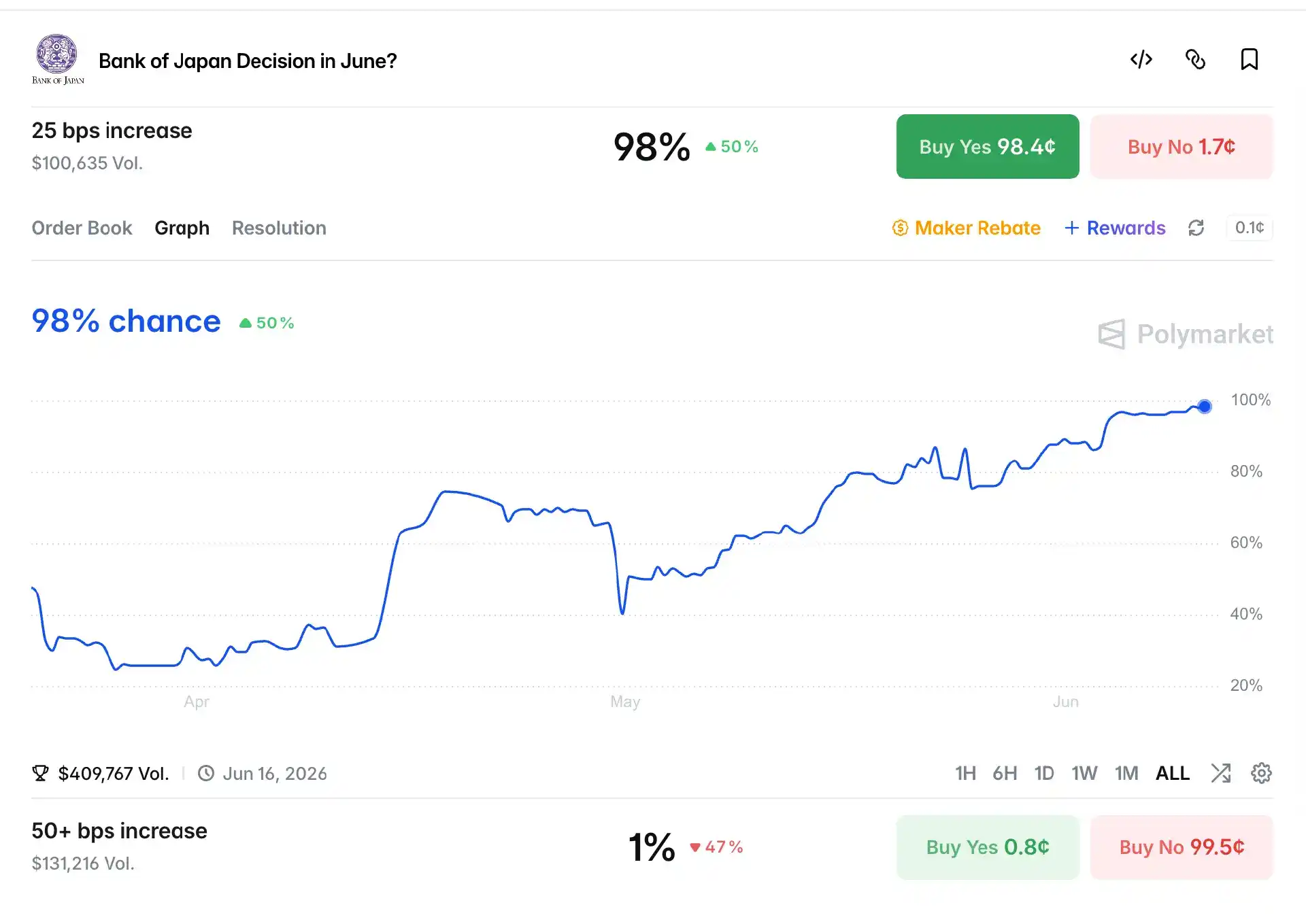
With a BoJ rate hike imminent, a large number of investors engaged in yen carry trades may be forced to sell overseas assets, convert back to yen, and repay loans, triggering a chain reaction and amplifying volatility in global risk assets—the flash crash in August 2024 serves as a classic example, where a sharp yen appreciation led to a short-term plunge in global stock markets, with Bitcoin plummeting nearly $20,000 in a single day, a maximum drop of 15%.

Odaily Planet Daily will analyze the macro backdrop and transmission mechanism of the BoJ rate hike, and focus on assessing the risk impact on AI tech stocks and cryptocurrencies for readers' reference.

1. Inflation Risks Drive BoJ Rate Hike

Over the past two years, hawkish voices within the BoJ have grown increasingly strong, culminating in the end of a 17-year negative interest rate policy in March 2024, raising the policy rate from -0.1% to a range of 0% to 0.1%, marking the first rate hike in this cycle. In July 2024, the BoJ hiked rates again by 15bp to 0.25% and announced a gradual balance sheet reduction; in January and December 2025, it raised rates by 25bp each, bringing the rate to 0.75%; rates remained unchanged in the first three meetings of 2026. The following outlines the BoJ's rate hikes in several meetings:
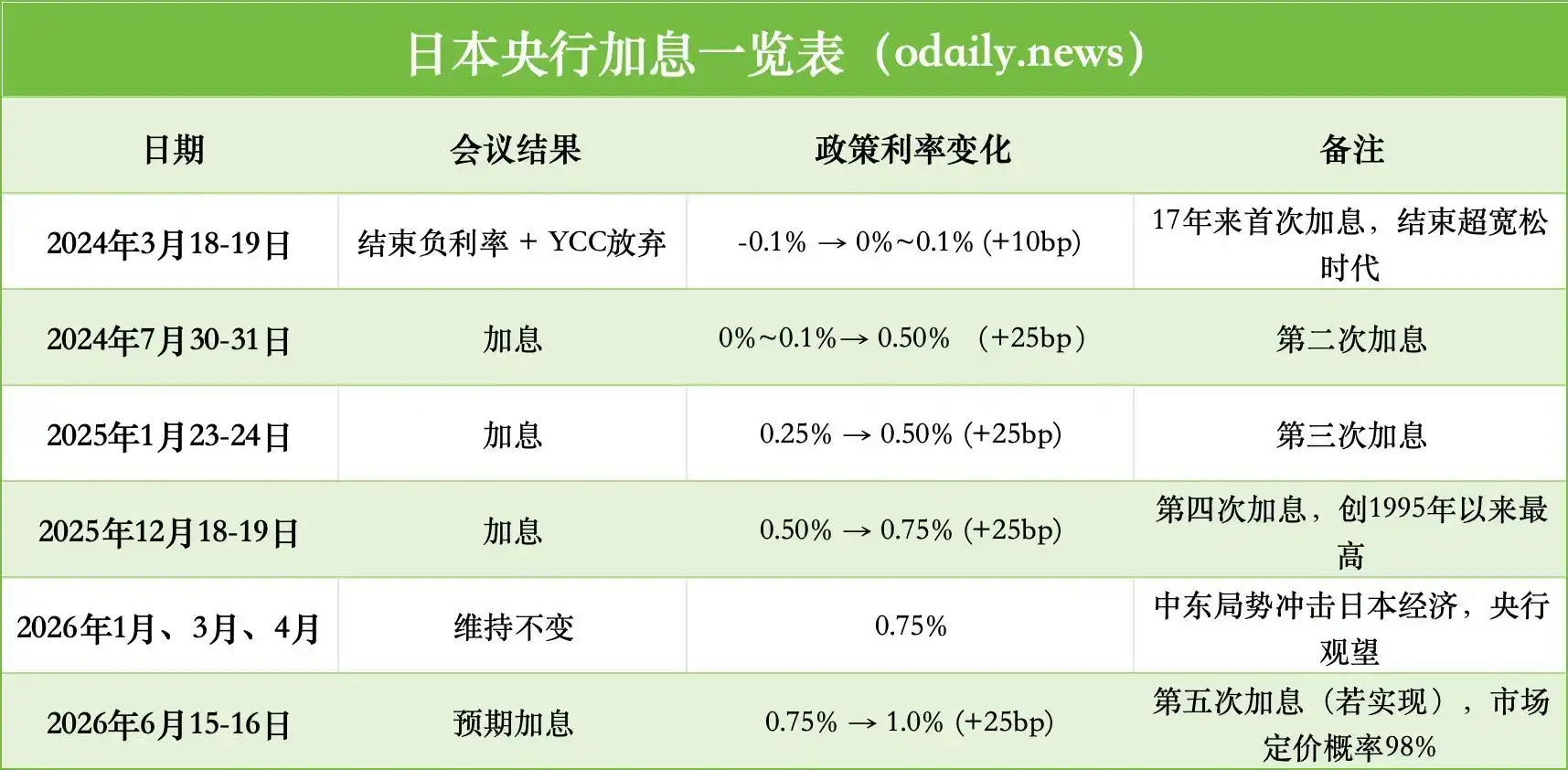
After keeping rates unchanged for half a year, why is the BoJ now eager to embark on a new round of rate hikes? This hike primarily stems from two aspects.

First, energy shocks and imported inflation pressure. As oil price volatility occurred due to Middle East conflicts in the first half of the year, Japan, highly dependent on imported energy, saw a significant rise in import costs. The Corporate Goods Price Index (CGPI) rose 6.3% year-on-year in May, the fastest pace since 2023, with petroleum products up 9.6% and utilities up 8.5%. The BoJ expects core CPI for fiscal 2026 to rise to 2.5-3.0%, far above the established 2% target.

Second, a weak yen exacerbates imported inflation. The current USD/JPY exchange rate continues to hover around the 158-160 high, nearing historically extreme weakness. The sharp depreciation of the yen directly weakens the import purchasing power of Japanese companies, leading to a significant increase in import costs for commodities such as energy and raw materials, further pushing up domestic prices. Although Japan's Ministry of Finance has repeatedly intervened in the foreign exchange market, the effects have been limited and unsustainable. This situation is forcing the BoJ to tighten monetary policy (i.e., raise rates) at the June meeting to avoid runaway inflation expectations.

In a speech on June 3, BoJ Governor Kazuo Ueda explicitly shifted the narrative towards fighting inflation, emphasizing that if upside risks to prices outweigh downside risks to the economy, the pros and cons of a rate hike must be discussed.

Reuters, citing three informed sources, reported that unless the Middle East conflict escalates sharply, the BoJ will raise rates in June and may slow the pace of bond portfolio reduction to maintain market stability. Bloomberg and institutions like ING maintain similar judgments and expect the BoJ to hike a total of 50bp in 2026.

This series of changes marks Japan's shift from the "world's last lender" to a normalizing central bank, posing a direct challenge to global assets reliant on cheap yen financing.

2. Unwinding Yen Carry Trades, Sustained Liquidity Tightening

The Bank of Japan's prolonged maintenance of ultra-loose monetary policy has made yen carry trades a key component of global liquidity over the past decade. Investors borrow yen at near-zero interest rates and invest in high-yielding assets like US stocks, tech stocks, emerging markets, and cryptocurrencies to earn interest differentials and capital gains.

The BoJ's upcoming rate hike will directly increase yen financing costs and could trigger yen appreciation (USD/JPY decline), forcing leveraged investors to unwind positions, creating a positive feedback loop: yen appreciation leads to expanding exchange rate losses → rising financing costs → forced investor deleveraging → large-scale selling of risk assets → further decline in asset prices → triggering more stop-losses → intensifying unwinding pressure.

Historically, every BoJ policy tightening signal has triggered severe market volatility.

On July 31, 2024, the BoJ hiked rates by 15bp to 0.25% and announced gradual balance sheet reduction, coupled with weak US employment data, triggering severe global market turbulence. At that time, South Korea's two major stock indices (KOSPI and KOSDAQ) plunged simultaneously, triggering circuit breakers; Japanese stocks crashed, with the Nikkei 225 plummeting 12.4% in a single day, accumulating a weekly loss of over 20%, the worst performance since 1987; global stock markets fell in tandem, with US stocks and tech stocks adjusting synchronously, and the VIX fear index soaring. Crypto also suffered heavy losses, with Bitcoin and ETH plunging over 30% in just a week, and leveraged liquidations surging.

According to Morgan Stanley estimates, although a significant number of positions have been gradually unwound since 2024, there are still approximately $500 billion in outstanding yen-funded positions in the market. Although the market has priced in some risks in advance, these positions still pose a significant hidden danger. Morgan Stanley warns that a rapid yen appreciation could trigger chain unwinding during periods of thin liquidity, especially impacting high-leverage assets severely.

J.P. Morgan's Global Head of Market Strategy, Dubravko Lakos-Bujas, and FX strategist Meera Chandan both pointed out that the policy divergence between the BoJ and the Federal Reserve will increase the instability of carry trade unwinding, potentially leading to a valuation reassessment of global risk assets.

3. Global Risk Assets Take a Hit, US Stocks and Crypto Not Spared

The AI-driven tech frenzy was the main theme for US stocks in the first half of 2026, with chip stocks like Nvidia and Broadcom and hyperscale cloud service providers leading the Nasdaq to repeatedly hit new highs.

However, entering June, significant rotation and pullbacks emerged in the market, particularly on June 5, when US stocks experienced their most severe single-day pullback of 2026 so far. The Nasdaq plunged 4.18%, marking its largest single-day drop since April 2025; the S&P 500 fell 2.64%, ending a nine-week winning streak; the Dow fell 1.35%, the Philadelphia Semiconductor Index plummeted over 10%, with core AI stocks like Nvidia, Broadcom, Micron, and Marvell leading the declines. (Recommended reading: "Nasdaq Drops 4.2% in a Day, Did 'Black Friday' Puncture the US Stock Bubble?")

The US stock market pullback is due to macro factors like geopolitical tensions and Fed policy uncertainty, but an undeniable factor is also the potential impact of the BoJ's impending rate hike.

First, liquidity tightening will directly hit high-valuation growth stocks. AI companies have massive capital expenditure scales and are highly dependent on cheap financing. Unwinding yen carry trades will reduce inflows of global risk-seeking capital, with high-beta tech stocks bearing the brunt. Semiconductor leaders like Nvidia and Broadcom, as well as hyperscalers like Meta and Microsoft, have extremely high valuation sensitivity and are highly susceptible to selling. Investing.com analysis points out that high-valuation growth sectors are most sensitive to changes in global liquidity; once carry trade unwinding begins, rapid deleveraging often occurs.

Second, rising energy costs will significantly compress AI profit margins. Middle East conflicts pushing up oil prices lead to a sharp increase in data center power and cooling costs, forming a "stagflationary" macro environment alongside BoJ rate hikes, severely testing the sustainability of the AI business model.

BitMex founder Arthur Hayes explicitly warned in his latest article "Reality Test": "The energy reality is testing the market's current 'dreaming' state." High oil prices not only raise operating costs but may also slow the growth of corporate token usage, further dampening AI-related revenue expectations.

Lastly, mega IPO supply shocks and political regulatory risks. Giants like SpaceX, Anthropic, and OpenAI plan to list intensively in the second half of 2026, with valuations often at hundreds of times sales; lock-up expirations will bring massive supply pressure. Meanwhile, Trump may shift to an anti-AI stance for midterm elections, increasing regulatory uncertainty.

As the highest-beta global risk asset, cryptocurrencies are even more precarious. On one hand, the BoJ rate hike brings rising global financing costs, directly increasing the cost of leveraged crypto trading, forcing large-scale liquidation of crypto leveraged positions; on the other hand, in competing for liquidity with AI, AI capital expenditure has already absorbed substantial market funds, leaving crypto lagging behind, and BoJ action will further tighten marginal liquidity.

Yahoo Finance analyst Lockridge Okoth stated that the 98% probability of a rate hike could trigger the next liquidity shock for Bitcoin. Investing.com analysis points out that yen appreciation and BTC weakness often move in high synchrony, a typical signal of rising global risk aversion.

Arthur Hayes has also emphasized in multiple analyses that the dynamics of yen carry trades remain one of the key variables affecting Bitcoin liquidity, reminding investors to pay attention to short-term liquidity shocks triggered by policy signals. In recent articles, Arthur Hayes emphasized the need to be wary of the combined impact of short-term energy costs and monetary policy risks; BTC/ETH may adjust alongside risk assets in the short term, with the long-term outlook depending on liquidity restarting.

Conclusion:

The rekindled concerns over a BoJ rate hike are not an isolated event but a signal of marginal tightening in global liquidity. Particularly with the current Middle East geopolitical conflict pushing oil prices higher, AI capital expenditure consuming liquidity, and multiple factors like Fed policy uncertainty superimposed, the buffer space is further compressed.

For investors, global risk assets—especially high-leverage, high-valuation sectors (AI tech stocks and cryptocurrencies)—may face significant downward pressure in the short term, with volatility set to rise noticeably. It is crucial to remain highly vigilant and mindful of leverage risks.


Trending Cryptos

Related Questions

QWhat is the main reason the Bank of Japan (BOJ) is expected to raise interest rates by 25 basis points in June 2026?

AThe main reason is to combat inflation. Two key factors are driving this: energy price shocks and input inflation due to rising oil prices from Middle East conflicts, and a persistently weak Yen (USD/JPY near 158-160), which increases import costs for energy and raw materials, further pushing up domestic prices. The BOJ's inflation forecast for fiscal 2026 has risen above its 2% target.

QHow does the Bank of Japan's potential interest rate hike pose a risk to global risk assets, particularly AI tech stocks and cryptocurrencies?

AThe rate hike increases the cost of Yen funding, potentially triggering the unwinding of the massive Yen carry trade. Investors who borrowed cheap Yen to invest in higher-yielding assets like US tech stocks and crypto may be forced to sell those assets to repay loans, especially if the Yen appreciates. This creates a vicious cycle of selling pressure, reduced global liquidity, and heightened volatility, directly impacting high-valuation, high-beta assets like AI stocks and cryptocurrencies.

QWhat historical event from 2024 is mentioned as a precedent for the market impact of BOJ policy tightening?

AThe article references the market flash crash in August 2024. Following a sharp appreciation of the Yen, global stock markets experienced a short but severe downturn. Bitcoin, as a prime example, plummeted by nearly $20,000 in a single day, recording a maximum intraday drop of 15%.

QAccording to the article, what are the estimated size of the remaining Yen carry trade positions and which financial institution provided this estimate?

AAccording to estimates from Morgan Stanley, there are still approximately $500 billion in outstanding Yen-funded positions in the market. The article warns that a rapid appreciation of the Yen could trigger chain-liquidations of these positions, especially in thin liquidity periods.

QBesides the BOJ rate hike, what other factors are mentioned as contributing to the potential pressure on AI tech stocks?

AThree additional factors are cited: 1) Rising energy costs from Middle East conflicts increasing data center power and cooling expenses, squeezing AI profit margins. 2) A looming supply shock from massive IPOs of companies like SpaceX, Anthropic, and OpenAI in H2 2026. 3) Increased political and regulatory uncertainty, with the possibility of the Trump administration adopting anti-AI rhetoric ahead of midterm elections.

Related Reads

After Three Consecutive Quarters of Decline, Can the Crypto Market Find a Window for Stabilization in Q3?

The cryptocurrency market has just concluded its worst-performing quarter since 2022, with total capitalization dropping 12.6% to $2.1 trillion. All core metrics indicate capital is leaving the sector, not just rotating within it. Bitcoin fell 14.2% and Ethereum dropped 25.4% in Q2, breaking their previous correlation with US tech stocks. A key driver is the reversal in US spot Bitcoin ETF flows, which saw a net outflow of approximately $4.67 billion in Q2, including a record monthly outflow near $4.5 billion in June. While recent data suggests long-term holders are accumulating again, sustained ETF outflows mean continued selling pressure. Market focus is now singularly on the Federal Reserve. The upcoming July FOMC meeting is seen as the most critical event for Q3. A dovish signal could support Bitcoin reclaiming a $68,000-$84,000 range, while a hawkish stance might establish a new trading band around $50,000-$56,000. Additionally, regulatory uncertainty persists, with the progress of the crucial *CLARITY Act* stalling in the Senate, reducing its perceived 2026 passage probability to 40-45%. Despite the broad downturn, a few sectors showed growth. Prediction markets saw nominal volume surge 48.7% year-over-year to $113.8 billion, and tokenized collectibles transaction volume rose 143% quarterly to $1.4 billion. The Real-World Asset (RWA) tokenization sector also continued steady growth, now representing ~$28.1 billion in on-chain value. The market's foundation for an extreme crash appears limited, with Bitcoin price hovering near its 200-week moving average. However, the trading paradigm has shifted from narrative-driven speculation to decisions based on price action, policy developments, and interest rate expectations, making a broad sentiment-driven rally unlikely in the near term.

marsbit2h ago

After Three Consecutive Quarters of Decline, Can the Crypto Market Find a Window for Stabilization in Q3?

marsbit2h ago

BIT Trading Moment: BTC Still Suppressed by Weekly 200 EMA, Rejection May Restart Decline; Storage and Semiconductors that Surged Last Night Begin Falling in Evening Trading

**Crypto & Stock Market Wrap: Bitcoin Tests Resistance, Stocks Retreat After AI Surge** Bitcoin consolidates around $66,000, facing key resistance near $68,000—an area seen as a major psychological and technical hurdle where previous rallies have failed. Analysts note the cryptocurrency is caught between its 200-week moving average (~$63,333) and 200-week EMA (~$68,328). A clear break above $68k is needed to signal a stronger bullish trend, while a rejection could lead to a retest of $63k support. Market sentiment remains cautious, with low futures open interest pointing to a low-liquidity rebound rather than a full bull market. Bitcoin spot ETFs saw another $203 million inflow. US stock futures pointed lower after a strong Tuesday session led by a massive rebound in semiconductors and memory stocks. The rally was fueled by renewed optimism about AI-driven hardware demand, with Micron, SanDisk, and SK Hynix surging. However, those gains reversed in pre-market trading. Super Micro Computer (SMCI) soared over 20% after hours on strong guidance and a record backlog. Other standouts included Rocket Lab and nuclear energy plays Oklo and X-Energy. Rising oil prices (Brent above $91) and climbing Treasury yields (10-year near 4.64%), however, are reigniting inflation concerns and acting as a headwind for equities. In Asia, markets were mixed. South Korea's KOSPI pared early gains to close slightly higher as semiconductor stocks like SK Hynix gave back initial surges. Japan's Nikkei edged lower as the yen hit a fresh 38-year low against the dollar, raising fears of potential market intervention. Key events to watch include the Samsung Galaxy launch, AMD's AI event, and a slew of major tech earnings from Alphabet, Tesla, and IBM after the close on Wednesday, followed by the ECB meeting and Intel's earnings on Thursday.

marsbit3h ago

BIT Trading Moment: BTC Still Suppressed by Weekly 200 EMA, Rejection May Restart Decline; Storage and Semiconductors that Surged Last Night Begin Falling in Evening Trading

marsbit3h ago

Former CFTC Chairman, Circle President Tarbert: Preaching Long-Termism While Cashing Out $30 Million Himself

Former CFTC Chairman and Circle President Heath Tarbert has consistently advocated for a long-term vision in public, urging patience from investors as Circle’s stock price has fallen significantly from its peak. However, it has been revealed that since Circle’s IPO, Tarbert has continuously sold his CRCL shares through pre-arranged trading plans, cashing out approximately $30 million, without making any public market purchases. This contrast between his public messaging and personal actions has drawn criticism. Tarbert joined Circle in July 2023 as Chief Legal Officer, leveraging his regulatory experience to help guide the company through its IPO and expansion. Despite promoting stablecoins as long-term infrastructure, he established a 10b5-1 trading plan just before Circle went public, leading to substantial stock sales over the following year. In March 2026, he initiated another plan to sell more shares. His career trajectory highlights a pattern of moving between high-level regulatory roles and influential positions in the financial sector. After resigning as CFTC Chairman in early 2021, he joined Citadel Securities as Chief Legal Officer just 27 days later, during a period of intense regulatory scrutiny for the firm. He later joined Circle, aiding its efforts to navigate regulatory challenges for its public listing. While Tarbert's expertise in policy and compliance is valuable to companies like Circle, his actions—advocating long-term confidence while personally divesting—raise questions about the alignment between his public statements and his private financial decisions, leaving investors who followed his advice to bear the market risks.

marsbit3h ago

Former CFTC Chairman, Circle President Tarbert: Preaching Long-Termism While Cashing Out $30 Million Himself

marsbit3h ago

Gate Research Institute: The 'Wall Street-ization' Wave of Crypto Financial Products – Competition or Integration?

The article titled "Gate Research Institute: Are Crypto Financial Products Sparking a 'Wall Street' Wave—Competition or Convergence?" explores the evolving relationship between the crypto ecosystem and traditional finance (TradFi). The piece begins by reflecting on Bitcoin's original 2009 vision of decentralization, disintermediation, and moving away from banks. It then contrasts this with the 2024 landscape, where key crypto assets like Bitcoin are increasingly held through Wall Street products like ETFs issued by giants like BlackRock. The article questions whether this signifies that TradFi is systematically taking over the rights to issue, price, custody, and distribute crypto financial assets. The core argument is that this is not a zero-sum takeover but rather a bidirectional convergence where each side addresses the other's weaknesses. Crypto offers 24/7 global markets, programmable settlement, and open access but lacks compliant channels, institutional-grade custody, deep fiat liquidity, and mainstream distribution. TradFi possesses these but is constrained by legacy systems, limited operating hours, and slow settlement. Two primary convergence paths are highlighted: * **Path A (CEX to TradFi):** Exemplified by Gate, which has progressed from offering tokenized stocks and CFDs to providing direct, real stock trading (US, Hong Kong, South Korea) within its platform, using USDT. * **Path B (TradFi to Crypto):** Exemplified by Robinhood, which has integrated crypto trading, acquired exchanges like Bitstamp, and is moving traditional assets like stocks onto the blockchain via tokenization and its own Layer 2. Both paths are ultimately competing to become the next-generation, unified financial account—a "super account" where users can seamlessly trade cryptocurrencies, stocks, ETFs, RWA (Real World Assets), and tokenized treasury products in one interface. The growth of RWA and tokenized treasuries (e.g., BlackRock's BUIDL) is presented as the asset-layer fusion, providing stable, yield-bearing assets on-chain and acting as a bridge between the two worlds. In conclusion, the "Wall Street-ization" of crypto is framed as a mutual transformation. Decentralized ideals persist in the protocol layer, while at the application layer, a more efficient, global, and accessible unified capital market is emerging from this convergence. The future competition lies not between crypto exchanges and stockbrokers, but between platforms vying to offer the most comprehensive asset coverage, liquidity, and user experience within a single account.

marsbit3h ago

Gate Research Institute: The 'Wall Street-ization' Wave of Crypto Financial Products – Competition or Integration?

marsbit3h ago

Trading

Spot

Hot Articles

What is $BANK

Bank AI: A Revolutionary Step in the Future of Banking Introduction In an era marked by rapid advancements in technology, Bank AI stands at the intersection of artificial intelligence (AI) and banking services. This innovative project seeks to redefine the financial landscape, enhancing operational efficiency, security measures, and customer experiences through the power of AI. As we embark on this exploration of Bank AI, we will delve into what the project entails, its operational dynamics, its historical context, and significant milestones. What is Bank AI? At its core, Bank AI represents a transformative initiative aimed at integrating artificial intelligence into various banking operations. This project harnesses the capabilities of AI to automate processes, improve risk management protocols, and enhance customer interaction through personalised services. The primary objectives of Bank AI include: Automation of Banking Functions: By leveraging AI technologies, Bank AI aims to automate routine tasks, reducing the burden on human resources and enhancing efficiency. Enhanced Risk Management: The project utilises AI algorithms to predict and identify risks, thereby fortifying security measures against fraud and other threats. Personalisation of Banking Services: Bank AI focuses on offering tailored financial products and services by analysing customer data and behaviours. Improving Customer Experience: The implementation of AI-driven solutions, such as chatbots and virtual assistants, aims to provide users with more human-like interactions, revolutionising the way customers engage with banks. With these goals, Bank AI positions itself as a crucial player in rendering banking more efficient, secure, and user-centric. Who is the Creator of Bank AI? Details regarding the creator of Bank AI remain unknown. As such, no specific individual or organisation has been identified in the available information. The anonymity surrounding the project's inception raises questions but does not detract from its ambitious vision and objectives. Who are the Investors of Bank AI? Similar to the project's creator, specific information regarding the investors or supporting organisations of Bank AI has not been disclosed. Without this information, it is challenging to outline the financial backing and institutional support that might be propelling the project forward. Nevertheless, the importance of having a robust investment foundation is pivotal for sustaining development in such an innovative field. How Does Bank AI Work? Bank AI operates on several innovative fronts, focusing on unique factors that differentiate it from traditional banking frameworks. Below are key operational features: Automation: By applying machine learning algorithms, Bank AI automates various manual processes within banks. This results in reduced operational costs and allows human workers to redirect their efforts towards more strategic activities. Advanced Risk Management: The integration of AI into risk management practices equips banks with tools to accurately predict potential threats such as fraud, ensuring that customer information and assets remain secure. Tailored Financial Recommendations: Through continuous learning from customer interactions, the AI systems develop a nuanced understanding of user needs, enabling them to offer tailored advice on financial decisions. Enhanced Customer Interactions: Utilizing chatbots and virtual assistants powered by AI, Bank AI enables a more engaging customer experience, allowing users to have their queries resolved quickly, thus reducing wait times and improving satisfaction levels. Together, these operational features position Bank AI as a pioneer in the banking sector, establishing new benchmarks for service delivery and operational excellence. Timeline of Bank AI Understanding the trajectory of Bank AI requires a look at its historical context. Below is a timeline highlighting important milestones and developments: Early 2010s: The conceptualisation of AI integration into banking services began to gain attention as banking institutions recognised the potential benefits. 2018: A marked increase in the implementation of AI technologies occurred when banks started using AI tools like chatbots for basic customer service and risk management systems for improved security handling. 2023: The sophistication of AI continued to advance, with generative AI being introduced for more complex tasks such as document processing and real-time investment analysis. This year marked a significant leap in the capabilities afforded to banks by AI technology. 2024-Current Status: As of this year, Bank AI is on an upward trajectory, with ongoing research and developments poised to further enhance capabilities in banking operations. Continued exploration of AI applications hints at exciting developments yet to come. Key Points About Bank AI Integration of AI in Banking: Bank AI focuses on adopting artificial intelligence to streamline banking processes and improve user experiences. Automation and Risk Management Focus: The project strongly emphasises these areas, aiming to shift the burden of routine tasks while enhancing security frameworks through predictive analytics. Personalised Banking Solutions: By harnessing customer data, Bank AI enables tailored banking services that cater to individual user needs. Commitment to Development: Bank AI remains committed to ongoing research and development efforts, ensuring its adaptability and ongoing relevance as technology continues to evolve. Conclusion In summary, Bank AI exemplifies a crucial step forward in the banking industry, leveraging artificial intelligence to reshape operational paradigms, enhance security, and promote customer satisfaction. Despite gaps in information surrounding the creator and investors, the clear objectives and functional mechanisms of Bank AI provide a strong foundation for its ongoing evolution. As AI technology continues to advance and merge with the banking sector, Bank AI is well-positioned to significantly impact the future of financial services, enhancing the way we understand and interact with banking.

208 Total ViewsPublished 2024.04.06Updated 2024.12.03

What is $BANK

Discussions

Welcome to the HTX Community. Here, you can stay informed about the latest platform developments and gain access to professional market insights. Users' opinions on the price of BANK (BANK) are presented below.

活动图片












