Read 500 Pages of Reports from Five Institutions for You, This One Article is Enough for the Crypto Annual Outlook

深潮Published on 2025-12-25Last updated on 2025-12-25

Abstract

In their 2026 crypto outlooks, leading research firms (Delphi Digital, Messari, Four Pillars, Coinbase, a16z) converge on a key theme: the era of pure speculative cycles is ending, replaced by structural maturation. Key trends include: - **Death of the 4-Year Cycle:** Value will shift to "Ownership Coins" with revenue-sharing models and real-world utility over short-term narratives. - **Rise of Agentic Finance:** AI agents will become major economic actors, driving demand for "Know Your Agent" (KYA) protocols and machine-native crypto payment rails. - **Super-App Consolidation:** User-friendly super-apps will integrate complex crypto functions, hiding technical complexity for mass adoption. - **Regulatory Clarity:** US legislation (e.g., GENIUS/CLARITY acts) will formalize the market, boosting institutional adoption and asset tokenization. - **Privacy & Infrastructure:** Privacy-focused chains (e.g., Zcash) and Zero-Knowledge proofs will become critical competitive advantages and scaling solutions. The future will be defined by infrastructure scalability, regulatory formalization, and the convergence of AI and crypto, moving beyond speculation to sustainable, utility-driven growth.

Author:Eli5DeFi

Compiled by: Deep Chao TechFlow

As the crypto industry moves towards 2026, leading research institutions are gradually reaching a consensus:

"The era of purely speculative cycles is fading away."

It is being replaced by structural maturity driven by liquidity convergence, infrastructure development, and industry consolidation, rather than short-term narratives.

Here are the core views of major crypto research institutions on the 2026 outlook (saving you the time of reading hundreds of pages of reports):

Core Summary:

  • "Death of the Cycle": Research institutions unanimously agree that the traditional 4-year halving speculative cycle is gradually fading. The future will be dominated by structural maturity, with value increasingly focused on "Ownership Coins" with revenue-sharing models and projects with real-world applications, rather than short-term speculative narratives.

  • The Rise of "Agentic Finance": Major institutions (such as Delphi Digital, a16z, Coinbase) predict that AI Agents will become major economic participants. This will drive the development of "Know Your Agent" (KYA) identity protocols and machine-native settlement layers, technologies that go beyond human manual capabilities.

  • Super-App Consolidation: As US regulations gradually become clearer (research from Four Pillars, Messari, etc.), complex crypto experiences will be integrated into user-friendly "Super-Apps" and privacy-supporting blockchains. These technologies will hide technical details, driving mass adoption.

Delphi Digital's View: Infrastructure, Applications, and Markets

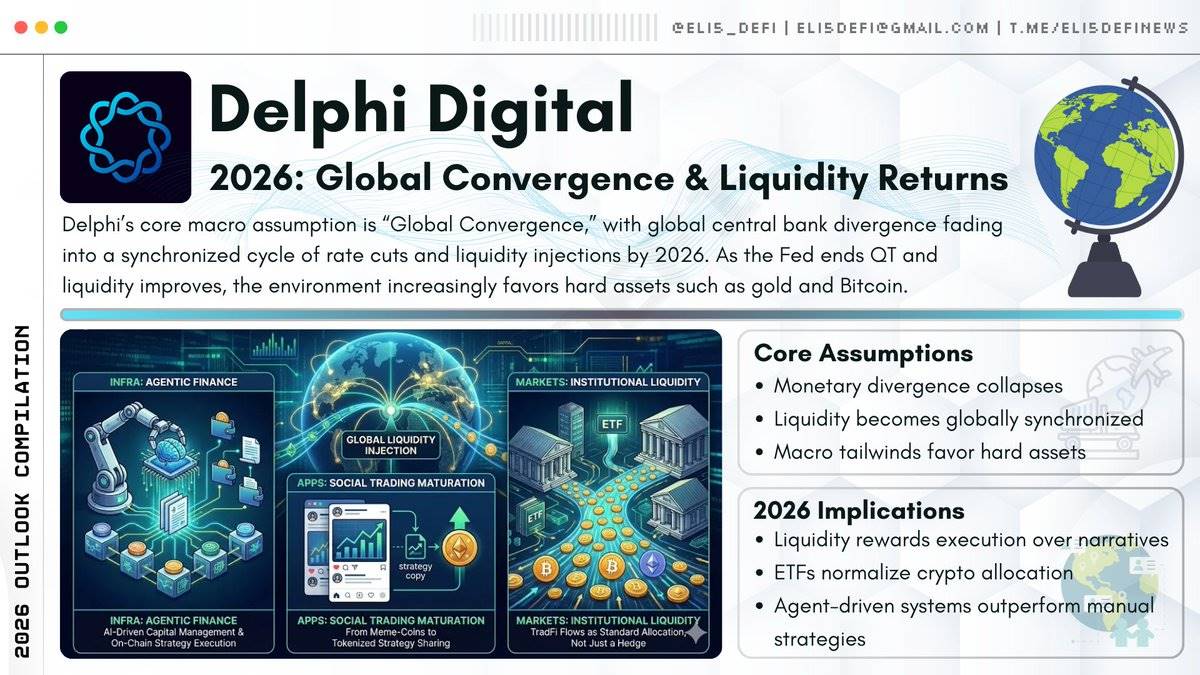
Delphi Digital's macro hypothesis is based on "Global Convergence." They predict that by 2026, the divergence in global central bank monetary policies will end, shifting towards a unified cycle of interest rate cuts and liquidity injection. After the Federal Reserve ends quantitative tightening (QT), improved global liquidity will benefit hard assets like gold and Bitcoin.
2026 Outlook:

  1. Agentic Finance

A significant expansion of infrastructure is reflected in the rise of "Agentic Finance." AI agents will no longer be just chatbots but will actively manage capital, execute complex decentralized finance (DeFi) strategies, and optimize yields on-chain without human intervention.

  1. Social Trading and the "Pump" Economy

On the consumer application side, Delphi highlighted the stickiness of platforms like @Pumpfun and predicted the maturation of "Social Trading." The trend will shift from simple meme coin speculation to more complex copy-trading hierarchies, with strategy sharing becoming a tokenized product.

  1. Institutional Liquidity

Market structure will change with the further adoption of Exchange-Traded Funds (ETFs). Traditional finance (TradFi) liquidity will enter the crypto market, not just as a hedging tool but as a standard portfolio allocation driven by macro liquidity easing.

Click to view the full report:

  • Infrastructure 2026 Outlook

  • Applications 2026 Outlook

  • Markets 2026 Outlook

Messari: 2026 Crypto Industry Outlook - Market Structure and the Rise of Utility

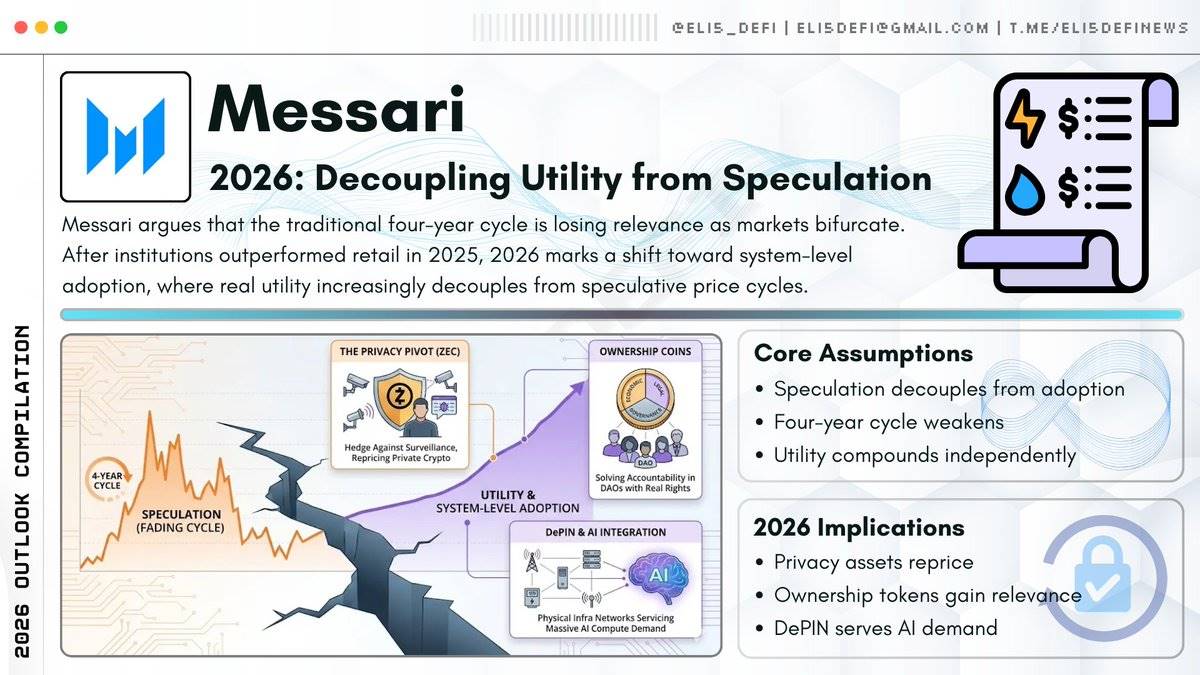
Messari's core argument is "The Separation of Utility and Speculation." They believe the traditional "four-year cycle" model is gradually losing relevance, and the market is moving towards divergence. They hypothesize that 2025 was a year where institutional investors prevailed and retail investors were frustrated, while 2026 will be the era of "system-level applications," not just speculative asset price games.
2026 Outlook:

  1. Privacy Shift ($ZEC)

Messari presents a contrarian growth view: the revival of the privacy sector. They specifically mention assets like @Zcash (ZEC), not just as "privacy coins" but as necessary hedges against increasing surveillance and corporate control, predicting a repricing opportunity for "privacy cryptocurrencies."

  1. Ownership Coins

2026 will see the emergence of a new token classification—"Ownership Coins." These tokens combine economic, legal, and governance rights. Messari believes these tokens have the potential to solve the accountability crisis in Decentralized Autonomous Organizations (DAOs) and may spawn the first projects with market capitalizations reaching billions of dollars.

  1. DePIN and AI Integration

The research also delves into the potential of DePIN (Decentralized Physical Infrastructure Networks), expecting these protocols to find market fit in the real world by meeting the massive demand for computing and data in the AI field.

Read the full report: 2026 Crypto Industry Report

Four Pillars: Regulatory Refactoring and Super-Apps

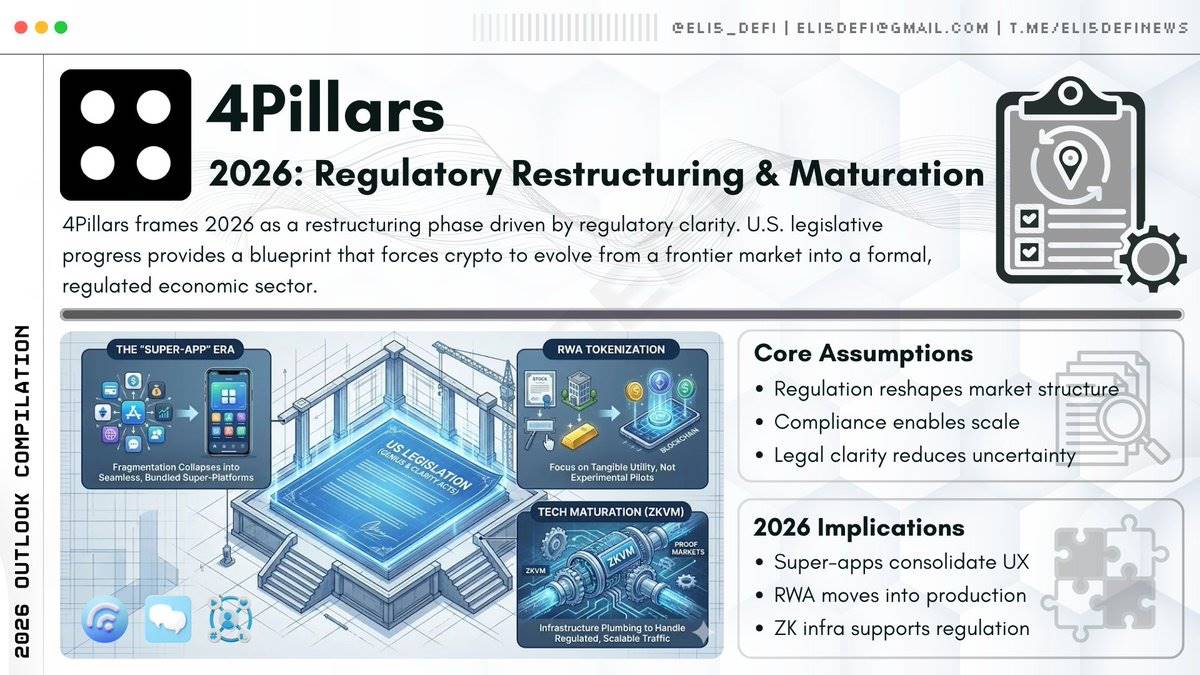
Four Pillars' 2026 outlook revolves around "Regulatory Refactoring." Their core assumption is that US legislative actions (specifically mentioning the GENIUS and CLARITY acts) will become the blueprint for driving comprehensive market reform.

This regulatory clarity will act as a catalyst, transforming the market from a "wild west" state into a formal economic sector.
Four Pillars' 2026 Outlook

  1. The Era of Super-Apps

Four Pillars predict that the current fragmented crypto application ecosystem will gradually consolidate into "Super-Apps." These platforms, driven by stablecoins, will integrate payment, investment, and lending functions, completely simplifying blockchain complexity and enhancing user experience.

  1. RWA Tokenization

As the market restructures, the tokenization of stocks and traditional assets will become a trend, but the focus will be on actual utility rather than experimental projects.

  1. Technological Maturation

On the technical side, the report emphasizes the importance of Zero-Knowledge Virtual Machines (ZKVM) and Proof Markets on Ethereum. They are seen as key technological infrastructure to handle the traffic scale of emerging regulatory bodies.

Read the full report: 2026 Outlook: Refactoring and a Century-Long Perspective

Coinbase: 2026 Crypto Market Outlook - Markets, Regulation, and Adoption

Coinbase's report presents the view of "Death of the Cycle." They explicitly state that 2026 will mark the end of the traditional Bitcoin halving cycle theory. Future markets will be driven by structural factors: including macro demand for alternative stores of value, and the formalization of the crypto industry as a medium-sized alternative asset class.

2026 Outlook:

  1. Tokenomics 2.0

A shift from "governance-only" tokens to "revenue-linked" models. Protocols will gradually introduce token buyback-and-burn or fee-sharing mechanisms (complying with new regulations) to better align token holder interests with platform success.

  1. Digital Asset Trading 2.0 (DAT 2.0)

The crypto market will move towards more professionalized trading models, particularly the procurement and trading of "sovereign block space." Block space will be seen as a critical resource in the digital economy.

  1. Intersection of AI and Crypto

Coinbase predicts that AI agents will heavily utilize crypto payment channels, driving demand for "crypto-native settlement layers." These layers can support continuous micro-transactions between machines, a need that traditional payment systems cannot meet.

Read the full report: 2026 Crypto Market Outlook

a16z Crypto: 2026 Outlook - The Future of Internet-Native Finance and AI

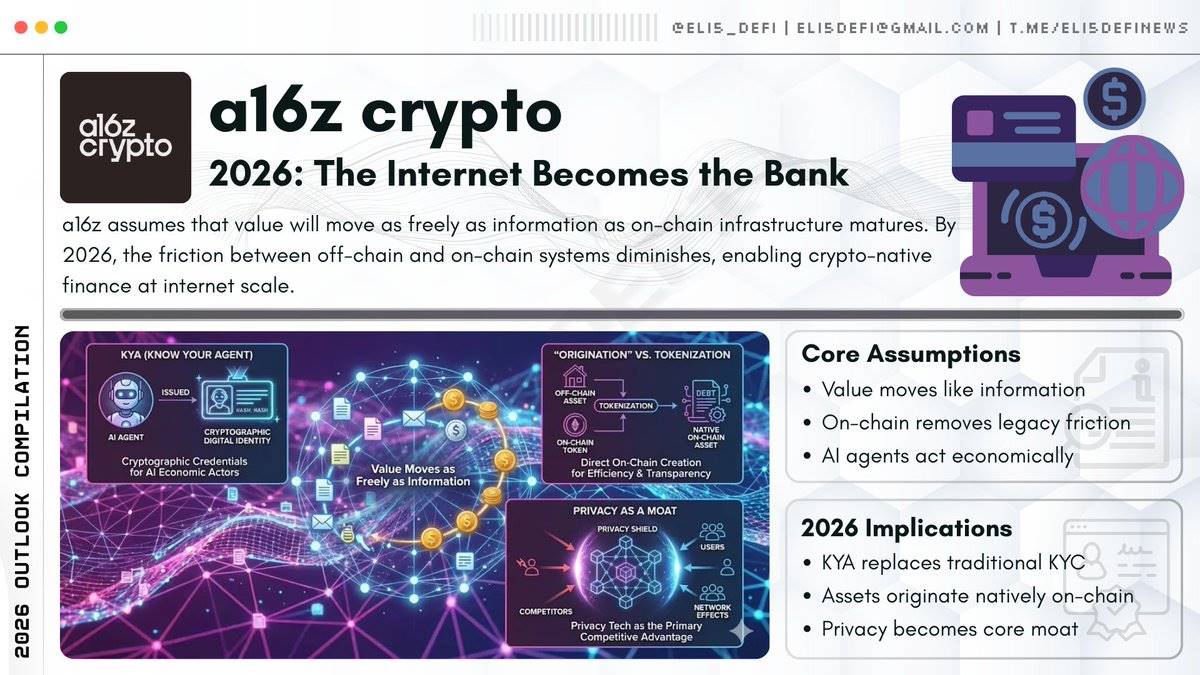
a16z Crypto's outlook is based on a core hypothesis: "The internet becomes the bank." They believe that the flow of value will become as free as information. The current friction between the on-chain and off-chain worlds is the main bottleneck, and 2026 will be the year this barrier is removed through better infrastructure.
a16z Crypto's 2026 Outlook

  1. KYA (Know Your Agent)

As AI Agents become major economic participants, identity verification will shift from traditional KYC (Know Your Customer) to KYA (Know Your Agent). AI agents will require cryptographically signed credentials to transact, giving rise to a whole new layer of identity infrastructure.

  1. "Asset Origination" VS "Asset Tokenization"

a16z predicts the market will gradually shift from tokenizing off-chain assets (e.g., buying treasury bonds and putting them on-chain) to originating debt and assets directly on-chain. This shift can not only reduce service costs but also greatly enhance transparency.

  1. Privacy as a Moat

In a world of prevalent open-source code, a16z emphasizes that privacy technology (especially the ability to maintain state privacy) will become the most important competitive advantage for blockchains. This will create strong network effects for privacy-supporting blockchains.

  1. Wealth Management for All

The combination of AI and crypto payment channels will democratize complex wealth management (such as asset rebalancing, tax-loss harvesting), making services previously limited to high-net-worth individuals accessible to ordinary users.

Read the full report: Major Trends in Crypto for 2026

Summary

The 2026 crypto industry outlook shows that structural maturity will replace speculative cycles, driven by liquidity convergence, regulatory clarity, and infrastructure.

Major research institutions agree that value will concentrate in settlement layers, aggregation platforms, and systems that can attract real users and capital.

Future opportunities will shift from chasing cycles to understanding capital flows. 2026 will reward projects that quietly build infrastructure, distribution capabilities, and trust at scale.


Trending Cryptos

Related Questions

QWhat is the consensus among leading research institutions regarding the future of the cryptocurrency industry by 2026?

ALeading research institutions agree that the era of purely speculative cycles is fading. It will be replaced by structural maturity driven by liquidity convergence, infrastructure development, and industry consolidation, rather than short-term narratives dictating market volatility.

QWhat is 'Agentic Finance' and why is it considered a major trend for 2026?

A'Agentic Finance' refers to the rise of AI Agents as primary economic actors. These agents will autonomously manage capital, execute complex DeFi strategies, and optimize yields on-chain without human intervention. This trend necessitates the development of 'Know Your Agent' (KYA) identity protocols and machine-native settlement layers.

QAccording to the reports, what is an 'Ownership Coin' and how does it differ from previous token models?

AAn 'Ownership Coin' is a new token classification that combines economic, legal, and governance rights. It is predicted to solve the accountability crisis in DAOs and move beyond 'governance-only' models by incorporating features like revenue-sharing or fee-sharing mechanisms, better aligning token holder interests with platform success.

QHow is the role of privacy expected to change in the crypto space by 2026?

APrivacy is expected to undergo a significant shift, moving from a niche feature to a core competitive advantage and necessary hedge against increased surveillance. Technologies like zero-knowledge proofs and privacy-focused blockchains will be crucial for enabling state privacy and fostering powerful network effects.

QWhat major shift in market structure is predicted due to increased regulatory clarity, particularly in the U.S.?

AIncreased U.S. regulatory clarity, driven by potential legislation like the GENIUS and CLARITY acts, is predicted to catalyze a market transformation from a 'wild west' state to a formal economic sector. This will lead to the integration of fragmented crypto experiences into user-friendly 'Super-Apps' and drive the tokenization of real-world assets (RWA) with a focus on actual utility.

Related Reads

After Aave's Exit and TVL's Sharp Fluctuation, Where Does MegaETH's Valuation Anchor Lie?

Following the withdrawal of Aave and a sharp drop in its Total Value Locked (TVL), the valuation of the high-performance DeFi blockchain MegaETH faces scrutiny. Once a highly anticipated project with a fully diluted valuation (FDV) reaching around $2 billion, MegaETH saw its TVL plummet from a May peak of $245 million to just over $30 million in July, a roughly 70% decline. Its native token, MEGA, currently trades around $0.048 with a market cap of approximately $54 million and an FDV of about $480 million. The report identifies a core vulnerability: MegaETH's TVL was heavily dependent on a single protocol, Aave V3, which at its peak contributed around 90% of the chain's TVL. A significant portion of this capital is attributed to leveraged yield-farming strategies involving stablecoins like USDe. When the profitability of these strategies diminished, capital rapidly exited, exposing the lack of diversified, sustainable activity. Three key mismatches between MegaETH's valuation and its fundamentals are highlighted: 1. **Valuation vs. Real Usage:** With an FDV of ~$4.8B but only ~$1M in annualized protocol revenue and ~2,600 daily active addresses, the valuation appears disconnected from current economic activity. 2. **Token Narrative vs. Ecosystem Reality:** Despite its DeFi narrative, nearly 80% of the chain's recent protocol revenue comes from a trading card game, Monster, not from core DeFi applications like Aave. The chain's native stablecoin, USDM, also shows low trading volume and a declining market cap. 3. **Short-Term Hype vs. Long-Term Delivery:** Initial hype from token generation, blue-chip integrations, and influencer support has faded. Major protocols like Uniswap now hold minimal TVL on the chain, indicating that early capital was largely transient and driven by incentives rather than organic demand. The situation reflects a broader market trend where investors are becoming less tolerant of valuations based on inflated TVL and narrative, demanding clearer evidence of sustainable transactions, revenue, and ecosystem development. While MEGA's price may experience short-term rebounds from market sentiment, a fundamental re-rating likely depends on the team's ability to convert its remaining resources into tangible, user-retaining applications and genuine ecosystem growth.

链捕手3h ago

After Aave's Exit and TVL's Sharp Fluctuation, Where Does MegaETH's Valuation Anchor Lie?

链捕手3h ago

Goldman Sachs In-Depth Report: Who Will Be the Long-Term Winners in China's AI Large Model Industry?

Goldman Sachs Report: China's AI Models at an Inflection Point China's open-source/open-weight large language models (LLMs) have reached performance parity with top global proprietary models, according to a Goldman Sachs report. This is driven by architectural innovations and higher parameter efficiency, allowing Chinese models to achieve comparable capabilities at 2%-10% the parameter size and significantly lower cost. The market is evolving into a two-tiered structure: a high-end segment (e.g., GLM5.2, Qwen3.7 Max) with premium pricing and a low-end, price-sensitive segment for global SMEs and individual users. Key points: * **Cost & Performance:** Innovations like Mixture of Experts (MoE) enable high performance with smaller models. Projects like Meituan's LongCat 2.0, trained on domestic hardware, highlight progress in tech self-sufficiency. * **Open-Source Strategy:** Most Chinese players use open-source/open-weight models for flexibility and ecosystem growth. However, Goldman notes this may underreport actual deployment and revenue. A shift toward "open-weight + community license" models with revenue sharing (e.g., MiniMax) could improve monetization. * **Market Shift & Global Expansion:** Enterprise AI adoption is shifting from "token maximization" to "ROI-first." International expansion, especially in non-US markets, is a major growth driver. Chinese models are increasingly available on global platforms like AWS Bedrock and Microsoft Copilot. * **Competitive Landscape:** Using a framework based on pricing power, cost advantage, and financial strength, Goldman identifies **Zhipu AI and DeepSeek** as the strongest in foundational text models, and **ByteDance** as the leader in multimodal/video generation. The report maintains Buy ratings on MiniMax and Kuaishou. * **Market Growth:** China's AI model API and subscription revenue is projected to grow from an estimated ¥35 billion in 2026 to ¥879 billion by 2030.

marsbit3h ago

Goldman Sachs In-Depth Report: Who Will Be the Long-Term Winners in China's AI Large Model Industry?

marsbit3h ago

Goldman Sachs Deep Dive Report: Who Will Become the Long-Term Winners in China's AI Large Model Industry?

Goldman Sachs Report: Who Will Be the Long-Term Winners in China's AI Large Model Industry? China's AI large model sector is at a historic inflection point. Goldman Sachs argues that the intelligence of Chinese open-source/open-weight models is approaching top global proprietary models. Rapid adoption by domestic enterprises and global SMEs is creating a data flywheel effect that will further drive model iteration. The evolution is summarized as moving from "DeepSeek's cost-efficiency moment last year to GLM's model-intelligence moment this year." Chinese models achieve near-state-of-the-art performance at significantly lower cost, primarily due to architectural innovations like Mixture of Experts (MoE) and higher parameter efficiency. Models like DeepSeek V4 Pro (1.6T params), GLM5.2 (0.7T), and MiniMax M3 (0.4T) are much smaller than global leaders. Recent advancements in coding capability are attributed to better data curation and RLHF. Landmarks like Meituan's LongCat 2.0, trained fully on domestic AI chips, demonstrate progress in hardware stack independence. The market is forming a "two-tiered structure." The high-end tier (e.g., GLM5.2, Alibaba's Qwen3.7 Max) prices around $1 per million tokens, about 10-25% of US top models, with estimated inference gross margins of 10-20%. The low-end tier (priced as low as $0.06-$0.2 per million tokens) targets price-sensitive global SMEs and individuals. MiniMax derives 60-70% of revenue overseas. Goldman forecasts China's AI model API/subscription revenue to grow from an estimated RMB 35bn in 2026 to RMB 879bn by 2030. Most Chinese players adopt open-source/open-weight strategies for deployment flexibility and community feedback, though this limits monetization as deployments on third-party platforms (e.g., Alibaba Cloud) may not generate direct revenue. A shift towards "open-weight + community license" models with revenue-sharing agreements (like MiniMax's approach) could improve unit economics. International expansion, particularly in non-US markets, is the key growth driver. The global enterprise AI paradigm is shifting from "token maximization" to "ROI prioritization." Chinese models are already hosted on major global platforms like AWS Bedrock and are under consideration for integration into Microsoft Copilot. Using a competitive framework based on pricing power, cost advantage, and financial strength, Goldman identifies the strongest players: In foundational text models, Zhipu AI (initiated coverage) and DeepSeek lead. In multimodal/video generation, ByteDance's Seed is the frontrunner, with Kuaishou's Kling and MiniMax's Hailuo also well-positioned. Goldman maintains a Buy rating on MiniMax, citing its attractive valuation.

链捕手4h ago

Goldman Sachs Deep Dive Report: Who Will Become the Long-Term Winners in China's AI Large Model Industry?

链捕手4h ago

Trading

Spot

Hot Articles

How to Buy ONE

Welcome to HTX.com! We've made purchasing Harmony (ONE) simple and convenient. Follow our step-by-step guide to embark on your crypto journey.Step 1: Create Your HTX AccountUse your email or phone number to sign up for a free account on HTX. Experience a hassle-free registration journey and unlock all features.Get My AccountStep 2: Go to Buy Crypto and Choose Your Payment MethodCredit/Debit Card: Use your Visa or Mastercard to buy Harmony (ONE) instantly.Balance: Use funds from your HTX account balance to trade seamlessly.Third Parties: We've added popular payment methods such as Google Pay and Apple Pay to enhance convenience.P2P: Trade directly with other users on HTX.Over-the-Counter (OTC): We offer tailor-made services and competitive exchange rates for traders.Step 3: Store Your Harmony (ONE)After purchasing your Harmony (ONE), store it in your HTX account. Alternatively, you can send it elsewhere via blockchain transfer or use it to trade other cryptocurrencies.Step 4: Trade Harmony (ONE)Easily trade Harmony (ONE) on HTX's spot market. Simply access your account, select your trading pair, execute your trades, and monitor in real-time. We offer a user-friendly experience for both beginners and seasoned traders.

4.2k Total ViewsPublished 2024.03.29Updated 2026.06.02

How to Buy ONE

Discussions

Welcome to the HTX Community. Here, you can stay informed about the latest platform developments and gain access to professional market insights. Users' opinions on the price of ONE (ONE) are presented below.

活动图片