Ranger ICO Launches: The Next Money Printer in the Solana Ecosystem?

比推Published on 2026-01-06Last updated on 2026-01-06

Abstract

Ranger, a full-stack trading terminal on Solana, has launched its ICO, which will run until January 10th. The platform features three core products: Ranger Perps (a perps aggregator integrating protocols like Jupiter Perps, Drift, and Flash Trade), Ranger Spot (a spot aggregator routing through Jupiter and DFlow), and Ranger Earn (a yield product offering institutional-grade strategies). The ICO aims to raise a minimum of $6 million, representing 39% of the total RNGR token supply. Funds will be managed by a tokenholder-governed treasury, with the team receiving a fixed $250,000 monthly stipend. Notably, the ICO includes a pre-ICO investor tier with a 24-month linear unlock and a team allocation (30% of supply) that vests based on price performance milestones (2x to 32x ICO price), aligning long-term incentives. The sale introduces a innovative structure: a fixed allocation bucket for points holders, rewarding early users without the sell-pressure of traditional airdrops. Unclaimed allocations from points holders will roll over to the public ICO. The launch is also a significant milestone for MetaDAO, the platform hosting the ICO, as it is the first to include pre-ICO investors. MetaDAO generates revenue through Futarchy AMM fees and Meteora LP positions. Recent approval of the Omnibus proposal will migrate most META liquidity to Futarchy AMM and burn ~60,000 META tokens, enhancing revenue capture. Future growth catalysts include permissionless launches and the Colosseum ...

Source: OX Research

Authors: Carlos, Shaunda Devens

Compiled and Edited: BitpushNews


Ranger's ICO officially launched today and will continue until January 10th.

Background: Ranger is a full-stack trading terminal with three core products:

  1. Ranger Perps (Perpetuals Aggregator): It is an "aggregator" for perpetual trading venues on the Solana chain, integrating top protocols like Jupiter Perps, Drift, and Flash Trade, and is currently integrating Hyperliquid.

  2. Ranger Spot (Spot Aggregator): A "meta-aggregator" that routes through protocols like Jupiter and DFlow to provide users with the best price execution.

  3. Ranger Earn (Yield Management): This is a newer product that offers institutional-grade, curated yield strategies to users through Ranger's Vault infrastructure.

ICO Core Details:

  • Fundraising Goal: Minimum $6 million.

  • Supply Proportion: This ICO will sell 39% of the total RNGR supply.

  • Use of Funds: Raised funds will be deposited into a treasury governed by token holders, with the team receiving only a fixed stipend of $250,000 per month.

Notably, the Ranger ICO is a significant milestone for the MetaDAO platform: it is the first token sale project on the platform to include Pre-ICO (early) investors.

Unlocking and Alignment Mechanism:

  • ICO Participants: 100% liquid at TGE (Token Generation Event), no lock-up period.

  • Pre-ICO Investors: 24-month linear unlock, no cliff.

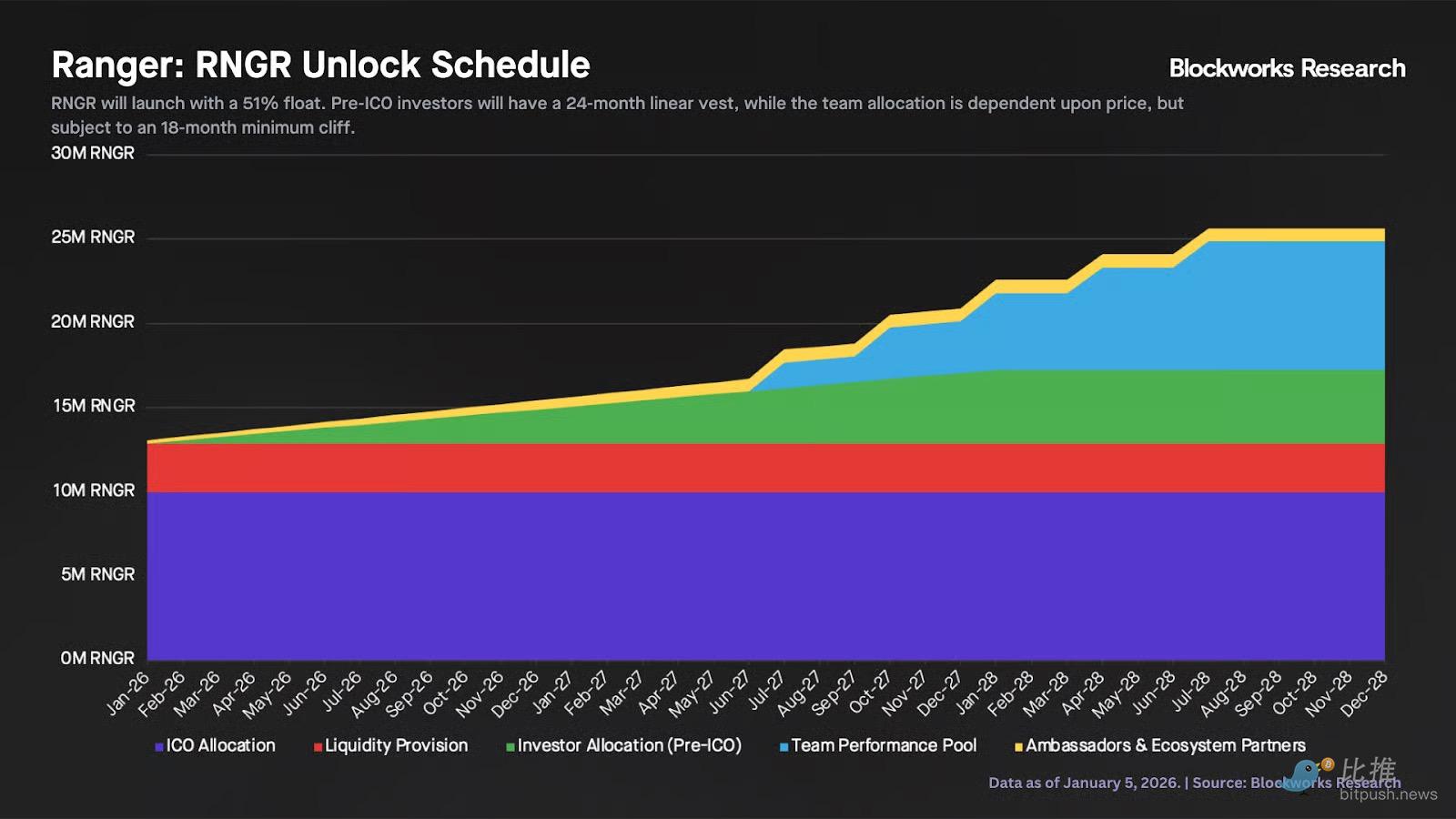
  • Team Allocation: The team allocation (30% of total supply, approx. 7.6 million RNGR) is fully tied to price performance. Unlocking is triggered in five tiers when the token price reaches 2x / 4x / 8x / 16x / 32x the ICO price. Each tier must maintain a 3-month Time-Weighted Average Price (TWAP) and has a minimum lock-up period of at least 18 months. This mechanism极大地 aligns the team's long-term interests with those of the holders.
Farewell to the "Whale Game": Privileges for Points Holders

Looking back at MetaDAO's past 6 ICOs, almost all were severely oversubscribed, with allocations settled pro-rata.

This mechanism明显 favored whales, as only those with extremely large capital could obtain meaningful allocations through oversubscription. Data shows that the average actual allocation ratio for past participants was only about 5% of their applied amount.

Ranger's Innovation:

Ranger has specifically reserved a fixed allocation bucket for points holders. I am very bullish on this structure: it rewards early users and contributors through subscription priority rights, rather than directly airdropping 10%-30% of the tokens like traditional airdrops (which often bring huge selling pressure). If points holders do not fully subscribe, the quota will flow back to public ICO buyers.

MetaDAO: The Leap from "Boutique" to "Assembly Line"

While Ranger itself is very attractive, I believe the bigger story lies in its significance for MetaDAO: it is a catalyst that could re-accelerate MetaDAO's launch frequency and revenue at the beginning of the year.

How does MetaDAO make money?

MetaDAO profits from trading fees on its Futarchy AMM and from its LP positions on Meteora.

  • Fee Adjustment: Originally, the Futarchy AMM charged a 0.5% fee, split equally between MetaDAO and the project. But starting December 28th, by mutual agreement, the full 0.5% fee now goes entirely to MetaDAO.

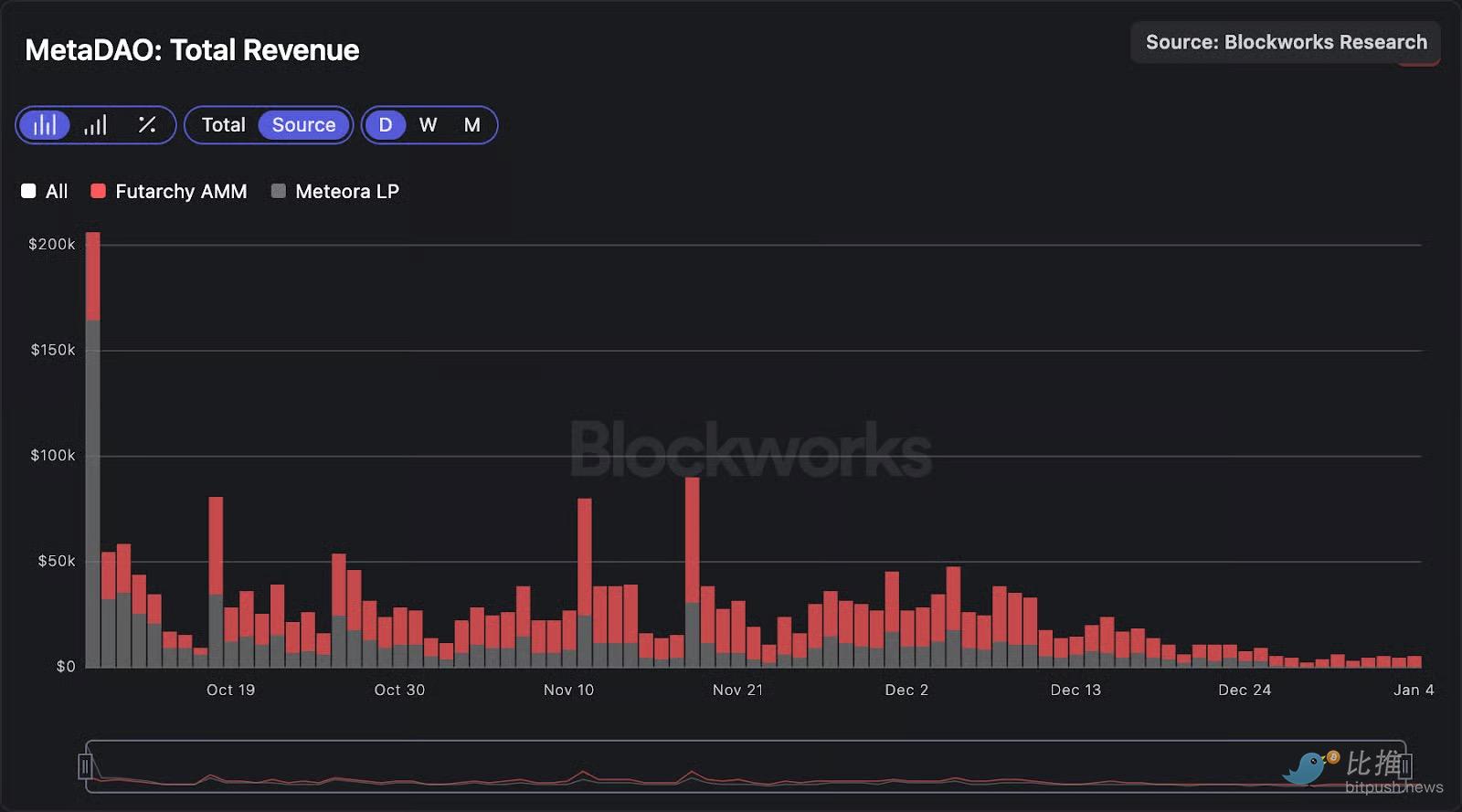
  • Current Revenue: Since its launch on October 10, 2025, MetaDAO has generated approximately $2.4 million in revenue (60% from the AMM, 40% from Meteora LP).
Growing Pains and Opportunities:

Since mid-December, due to the slowdown in ICO activity, MetaDAO's revenue has declined sharply. MetaDAO currently screens ICOs very strictly, placing extreme importance on founder quality and long-term alignment. While this validates product reliability, it also comes at a cost: without continuous new project launches, revenue is difficult to grow.

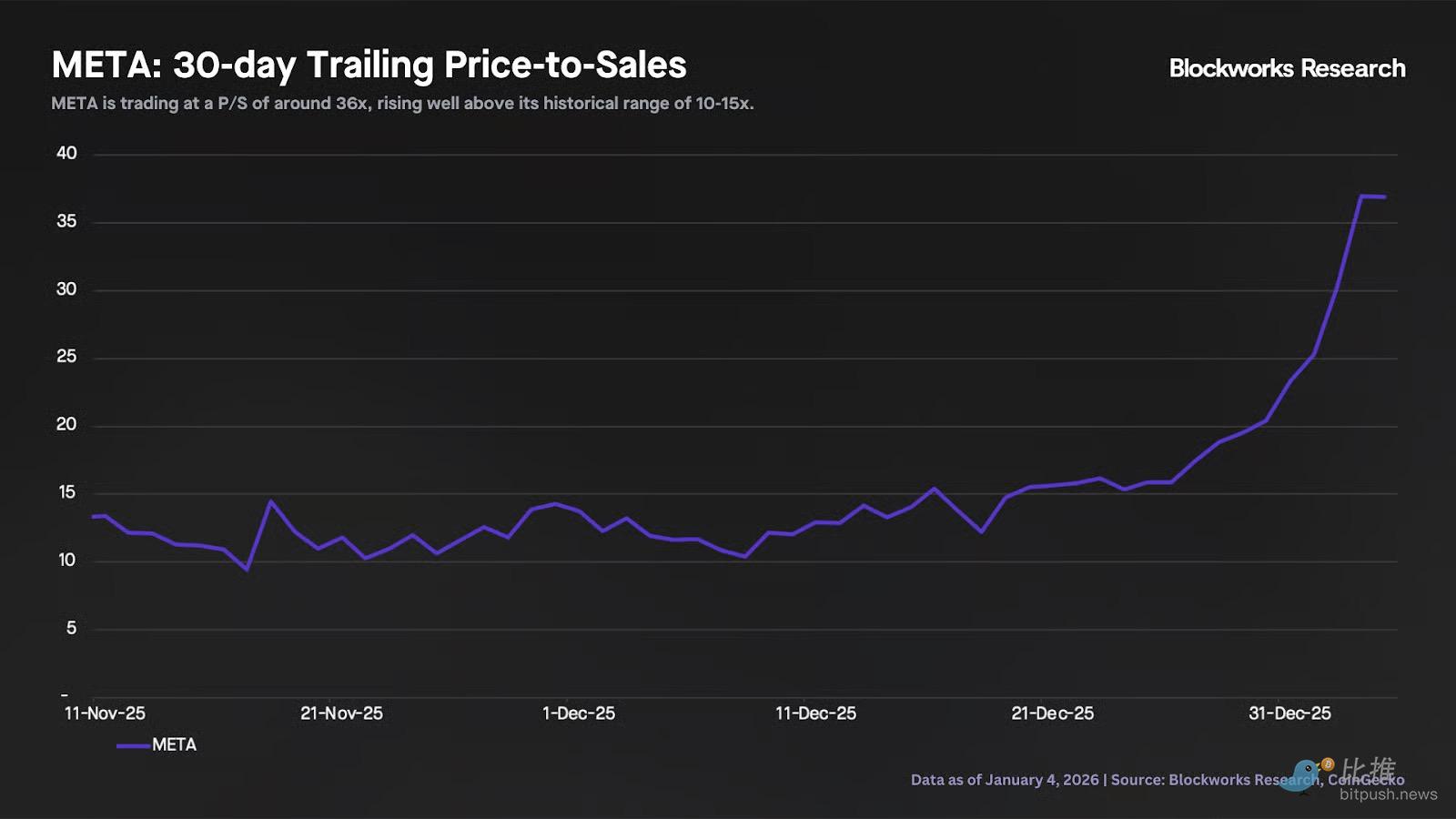
But the market is forward-looking. Despite the drop in daily revenue, the META token still rose about 40% last week. Although the current Price-to-Sales ratio (P/S) has risen to around 36x (previously hovering around 10-15x), I expect that as revenue re-accelerates in the coming months, the P/S will return to its historical range through "revenue growth" rather than "price decline".

Two Major Catalysts in the Coming Months

There are two major近期 catalysts that will directly boost MetaDAO's performance:

Ranger's Listing: Expected to cause severe oversubscription and drive a surge in Futarchy AMM trading volume after TGE.
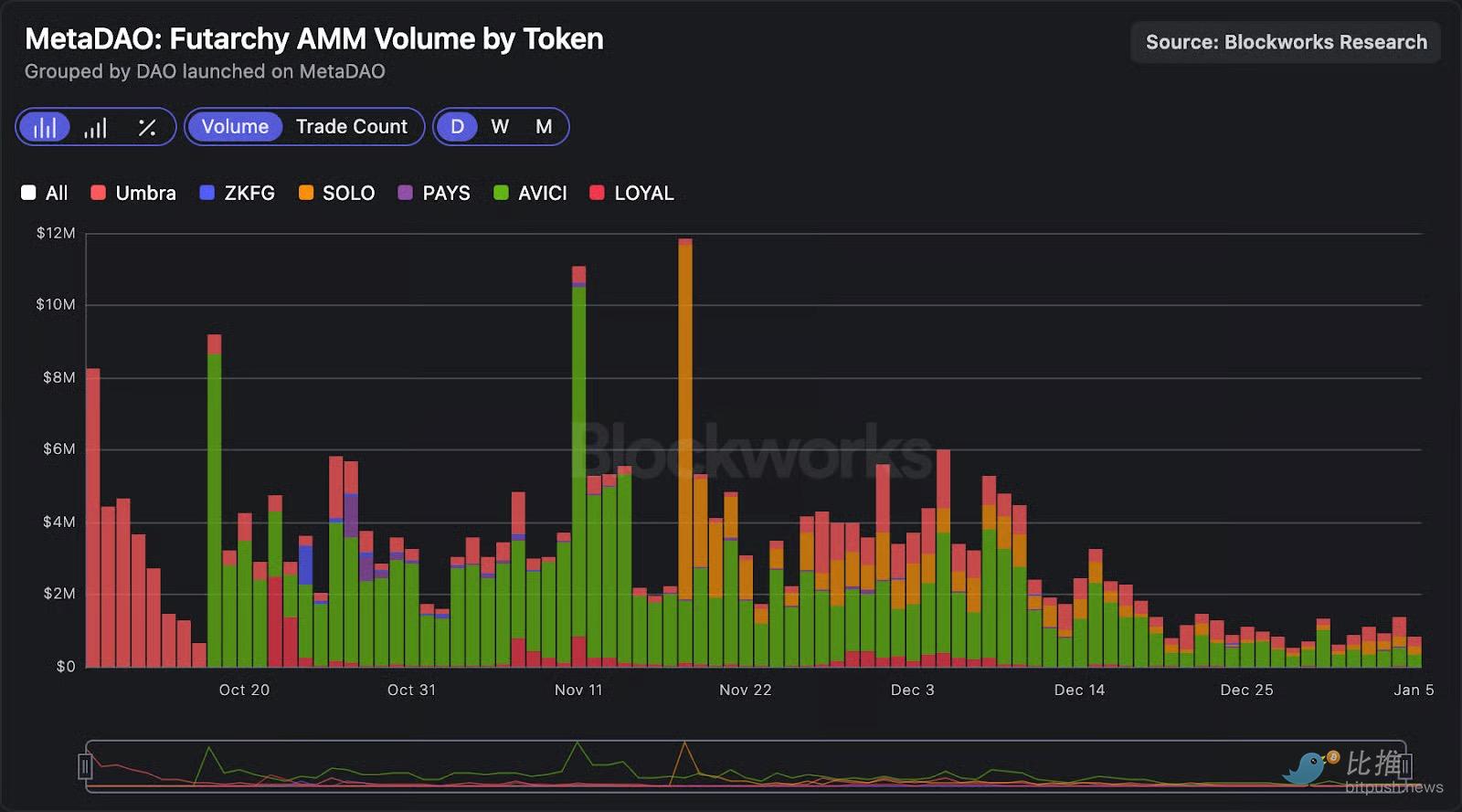
Omnibus Proposal Passed: The proposal was passed last night. It will: a) migrate approximately 90% of META liquidity on Meteora to the Futarchy AMM; b) burn approximately 60,000 META (worth about $550,000 at current price). This will significantly enhance the AMM's ability to capture revenue.
Looking medium to long term, the real "10x" growth will come from:

  • Permissionless Launches: MetaDAO is discussing a shift from "full manual screening" to "permissionless experimentation." While lower-quality projects will increase, this is crucial for improving throughput and validating platform scalability.

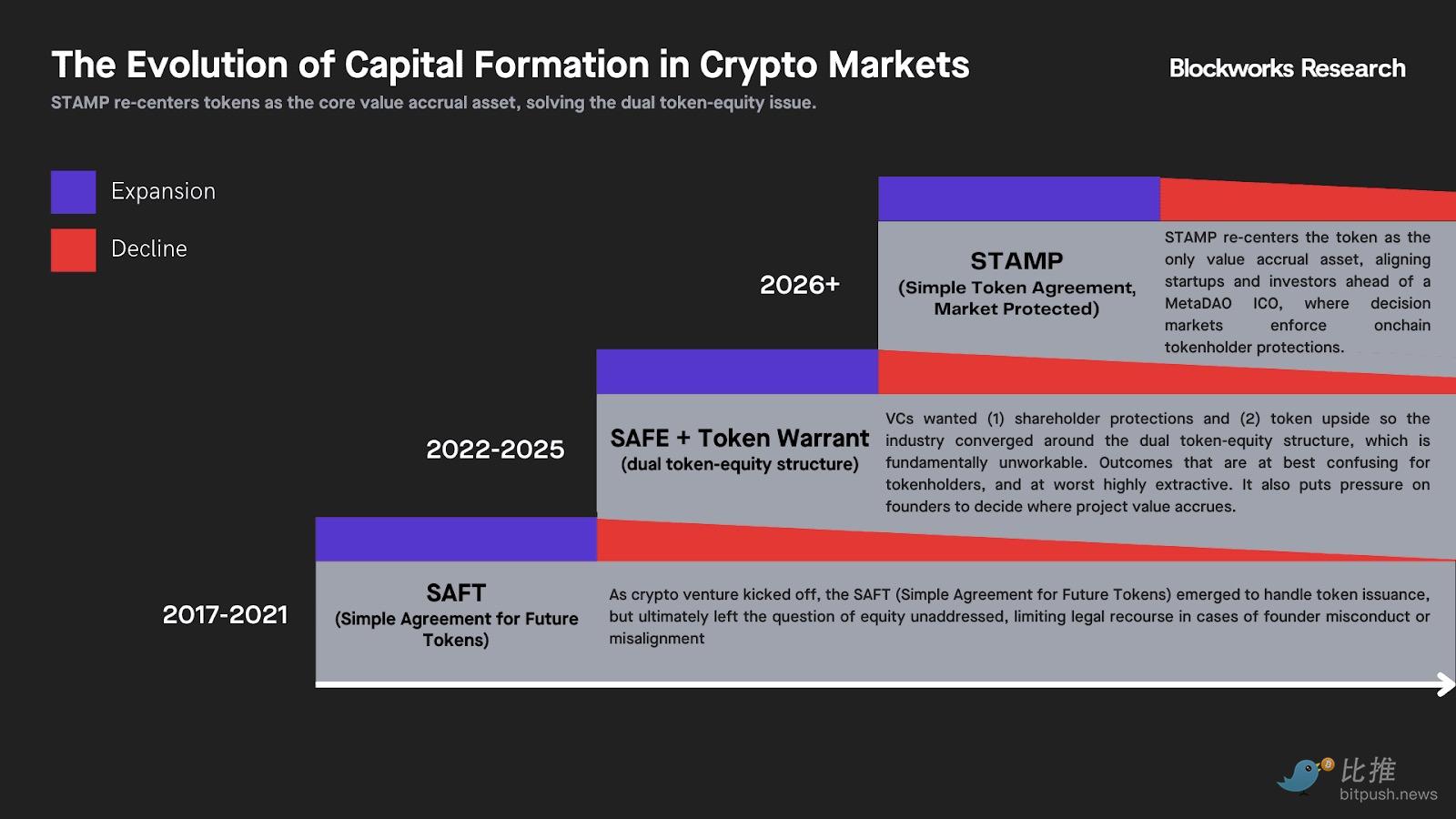
  • Colosseum's STAMP Program: The market is currently severely underestimating the value of this. Colosseum is Solana's entrepreneurial funnel (covering hackathons, accelerators, and venture funds). Top teams like Jito, Kamino, and Drift originated here. The STAMP program directly connects MetaDAO to this top-tier project source, ensuring a steady stream of high-quality projects.
In summary, the Ranger ICO and the Omnibus proposal will address MetaDAO's immediate needs. But what will truly enable MetaDAO's ICO frequency, trading volume, and revenue to achieve 10x growth are the upcoming "permissionless mode" and the deeply integrated ecosystem moat with Colosseum.


Twitter:https://twitter.com/BitpushNewsCN

Bitpush TG Discussion Group:https://t.me/BitPushCommunity

Bitpush TG Subscription: https://t.me/bitpush

Original Link:https://www.bitpush.news/articles/7600532

Trending Cryptos

Related Questions

QWhat are the three core products of the Ranger trading terminal?

ARanger Perps (a perp aggregator), Ranger Spot (a spot aggregator), and Ranger Earn (a yield product with vault infrastructure).

QWhat is the fundraising goal and the percentage of total supply being sold in the Ranger ICO?

AThe fundraising goal is a minimum of $6 million, and the ICO is selling 39% of the total RNGR token supply.

QHow does Ranger's ICO structure benefit its points holders, and how is it different from traditional airdrops?

AIt reserves a fixed allocation bucket specifically for points holders, granting them priority access. This rewards early users without the massive sell pressure typically associated with traditional airdrops that give away 10-30% of tokens for free.

QWhat is the unique mechanism for the Ranger team's token allocation, and how does it align their interests with holders?

AThe team's allocation (30% of supply) is fully performance-vested. It unlocks in five tiers, triggered when the token price reaches 2x, 4x, 8x, 16x, and 32x the ICO price. Each tier requires the price to be maintained for a 3-month TWAP, with an 18-month minimum lockup, strongly aligning long-term interests.

QWhat are the two major catalysts mentioned that are expected to boost MetaDAO's performance in the near future?

AThe listing of Ranger (expected to be severely oversubscribed and drive trading volume) and the passing of the Omnibus proposal (which migrates liquidity and burns tokens).

Related Reads

L2 'Recalibration': When L1 Becomes Its Own Rollup, What Is Ethereum's Endgame?

The article discusses the evolving relationship between Ethereum's Layer 1 (L1) and Layer 2 (L2) solutions, moving beyond the initial "L2 for scaling" model. As Ethereum L1 itself scales (increasing Gas Limit, statelessness, zkEVM), the unique value proposition of L2s shifts from merely providing cheap execution to offering differentiated features like application-specific optimization, privacy, and flexible governance. The piece explores three key themes: 1. **L2's New Role:** L2s are transitioning from a pure scaling technology to a spectrum of execution environments with varying degrees of security inheritance from Ethereum L1. 2. **Interoperability as State Trust:** Solving L2 fragmentation is less about cross-chain bridges and more about enabling faster, trust-minimized state verification between environments. This involves initiatives like faster L1 finality, intent-based architectures (Open Intents Framework), and native account abstraction. 3. **Blurring Layers:** With the potential integration of zk-proofs into L1 validation (making L1 akin to its own "Rollup") and the concept of "Native Rollups," the rigid boundary between L1 and L2 may fade. The future could be a unified system with multiple execution domains (for DeFi, gaming, privacy, etc.) sharing a common security, settlement, and state framework. In conclusion, Ethereum's goal is not to abandon L2s or re-centralize everything on L1, but to re-integrate the fragmented user experience—liquidity, accounts, applications—while preserving the scaling benefits of a multi-environment ecosystem. The endgame is a cohesive "one chain" feeling for users, powered by diverse but securely interconnected execution layers.

marsbit23m ago

L2 'Recalibration': When L1 Becomes Its Own Rollup, What Is Ethereum's Endgame?

marsbit23m ago

The Encryption Bill Clarity's Challenge: A Thorny Path of Bipartisan Compromise in the U.S.

U.S. lawmakers are attempting to advance the Clarity Act, a significant crypto market structure bill, but its path is fraught with partisan hurdles. The process has been rocky since January, when a prior bipartisan deal in the Senate Banking Committee was upended. A key compromise in May on "yield" issues allowed the bill to move forward in committee, but only with the conditional support of two Democratic senators, Angela Alsobrooks and Ruben Gallego. They emphasized that their final vote depends on reaching an agreement on ethics provisions for elected officials. Ultimately, the Senate Agriculture Committee passed its version along party lines without Democratic support. As Republicans push for a full Senate vote in July, the demand for strong ethics language has expanded beyond Democrats. Additional controversies surround provisions related to yields (aligning some Republicans with large banks) and developer protections (opposed by enforcement agencies). Core concerns about illicit finance and consumer protection remain central to the debate. Despite consensus on the need for legislation, achieving the necessary bipartisan compromise is proving difficult. While momentum exists—including recent meetings between senators and White House officials—a reconciled bill text faces skepticism. Senator Gallego has stated that without ethics terms acceptable to Democrats, they will not provide the needed votes. The immediate goals for the crypto community in Congress are unclear: a symbolic Senate vote before the August recess, eventual passage into law by 2026, or forging a final compromise framework. The arduous, vote-by-vote effort to build bipartisan support continues, mirroring the traditional legislative grind the industry must now navigate.

Foresight News1h ago

The Encryption Bill Clarity's Challenge: A Thorny Path of Bipartisan Compromise in the U.S.

Foresight News1h ago

Trading

Spot

Hot Articles

Discussions

Welcome to the HTX Community. Here, you can stay informed about the latest platform developments and gain access to professional market insights. Users' opinions on the price of SOL (SOL) are presented below.

活动图片