Pump.fun Launches Direct Investment, Spending $3 Million to Buy 12 New Meme Tokens

Odaily星球日报Published on 2026-01-20Last updated on 2026-01-20

Abstract

Pump.fun, a leading meme token launch platform, has announced the creation of an investment division called Pump Fund. The fund will launch its first initiative, the "Build in Public (BiP)" hackathon, with an allocation of $3 million to invest in 12 new tokens launched on its platform. Each selected project will receive $250,000 at a valuation of $10 million. Beyond financial backing, Pump.fun will provide mentorship from its founders and other resources. This marks the platform's first direct financial investment into specific meme tokens, signaling strong support for the selected projects. The BiP hackathon requires participants to launch a token on Pump.fun, publicly build a product, retain at least 10% of the token supply, and actively engage with the community on social media and through live streams. Project selection will prioritize organic user growth and long-term sustainability over marketing hype. Applications opened on January 19th and will run for 30 days, with the first winners announced on February 18th. The program is designed to be ongoing. This initiative aims to identify and fund promising new meme tokens with real utility and community traction.

Original | Odaily Planet Daily (@OdailyChina)

Author | Azuma (@azuma_eth)

On the morning of January 20th, Pump.fun officially announced the launch of its investment division, Pump Fund. Pump Fund will initiate its first project, the Build in Public (BiP) Hackathon, this month, investing $3 million in 12 new tokens issued through the platform, with $250,000 allocated to each token, corresponding to a valuation of $10 million. In addition to financial support, Pump.fun will also provide professional guidance from its founders and other substantial resources.

As the project with the strongest revenue-generating capability in the entire Meme sector, this is the first time Pump.fun has openly used official channels to directly invest real money to express support for specific Meme tokens (the attitude may be more important than the funding scale). Therefore, the selected tokens are highly likely to become the seed players in the Meme sector in the coming period.

Pump.fun's Revenue-Generating Capability

Pump.fun's staggering revenue capability is no secret. Data compiled by analyst Adam (@Adam_Tehc) on Dune shows that Pump.fun's historical total revenue has reached $954.8 million. Although daily revenue has significantly declined as the Meme hype cooled, single-day revenue still amounts to hundreds of thousands of dollars.
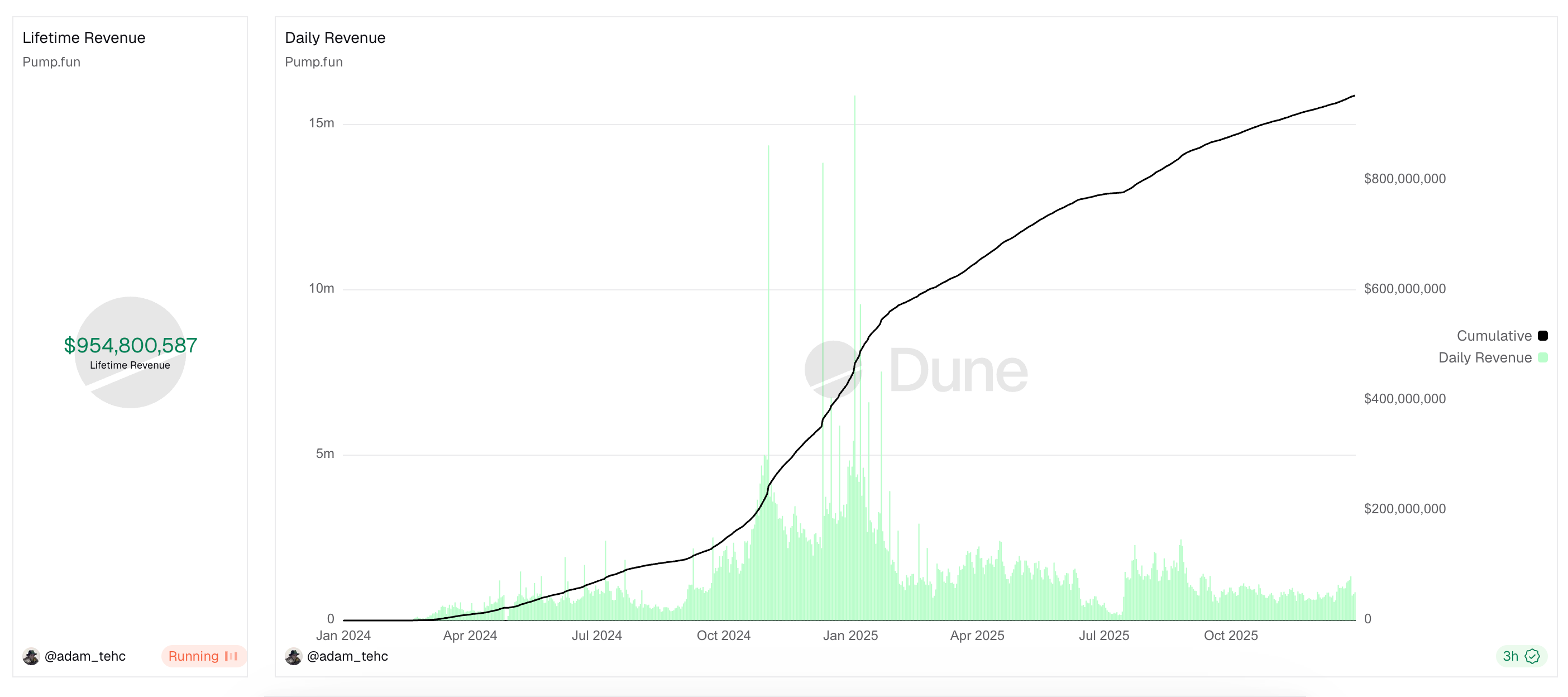
Holding massive real funds, Pump.fun is exploring other ecological feedback paths beyond PUMP token buybacks. Pump Fund and its affiliated BiP Hackathon are Pump.fun's latest attempts.

BiP Hackathon Details

According to the description on the BiP Hackathon's dedicated page, the project aims to support founders who issue tokens on Pump.fun and publicly build products. Unlike the traditional hackathon model where participants rely on VCs or judges for evaluation to compete for prizes, the BiP Hackathon intends to introduce token performance as a variable, allowing the market to determine whether a project is worth advancing, while enabling users to become the earliest investors in the project.

When discussing this key difference, Pump.fun founder Alon stated on X: "Before Pump.fun, my co-founder and I tried many different ideas. Consumer finance, DeFi, SocialFi, NFTs—but all failed. One of the biggest problems we encountered was that we found it very difficult to get our products in front of users. Trying to reach the right user base was extremely tedious work..."

Specifically, the BiP Hackathon requires:

  • Participants must issue a token on Pump.fun and then publicly build a product;
  • Participants must also hold at least 10% of the token supply to align interests;
  • Finally, the event strongly encourages founders to speak publicly on social media like X or livestream on Pump.fun to maintain effective communication with the community.

Regarding the types of participating projects, Pump.fun has not imposed any restrictions; they are not even limited to cryptocurrency-related products. Projects from different market stages and various verticals can participate.

As for how the 12 winning projects will ultimately be selected, Pump.fun did not provide specific rules but pointed out two main principles: first, organic user growth and genuine appeal are preferred over connections and flashy promotions; second, in addition to the appeal of the product itself/social media, the long-term sustainability of the project will also be assessed.

Key Timelines to Note

According to the BiP Hackathon's schedule, the application process opened on January 19th. Participants need to launch their tokens at the time of application and begin public building (including livestreaming development progress, regularly sharing updates, and maintaining community interaction). The application window will be open for 30 days. On February 18th, Pump.fun will announce the first batch of winning projects and provide funding (at least one will be announced). Considering that some projects may need more time to gain market attention and demonstrate appeal, the program will continue to run long-term.

So the timeline is quite clear. If you want to spot potential opportunities among this batch of Meme tokens, you need to start paying attention to newly issued tokens on Pump.fun from now on, especially those with Pump Fund or BiP tags. Although the first batch of winning tokens won't be announced until 30 days later, tokens likely to be selected by Pump.fun will inevitably show competitiveness before then.

Overall, while this Pump.fun event may not drive a collective sentiment recovery in the Meme market, it can at least contribute some new tokens with clearer evaluation dimensions.


Related Questions

QWhat is the purpose of the newly announced Pump Fund by Pump.fun?

APump Fund will invest $3 million in 12 new meme tokens launched on the platform, with $250,000 per token at a valuation of $10 million, and provide professional guidance and resources.

QHow much total revenue has Pump.fun generated historically according to the article?

APump.fun has generated a historical total revenue of $954.8 million.

QWhat are the key requirements for projects to participate in the Build in Public (BiP) hackathon?

AParticipants must launch a token on Pump.fun, publicly build a product, hold at least 10% of the token supply to align interests, and strongly encouraged to communicate publicly on social media or via live streams.

QWhen will the first batch of winning projects for the BiP hackathon be announced?

AThe first batch of winning projects will be announced on February 18th, at least one month after the application opened on January 19th.

QWhat principles will Pump.fun use to select the 12 winning projects in the BiP hackathon?

ASelection will prioritize organic user growth and genuine traction over connections and hype, and evaluate long-term sustainability alongside product and social media appeal.

Related Reads

380,000 Apps Exposed, 2,000+ Apps Leaked Secrets: AI Programming Turns 'Intranet' into Public Internet

Israeli cybersecurity firm RedAccess uncovered a severe data exposure trend linked to "vibe coding" or AI-powered software development tools. Their research found approximately 38,000 publicly accessible web applications built with platforms like Lovable, Base44, Netlify, and Replit. Of these, an estimated 2,000 apps exposed sensitive corporate and personal data, including medical records, financial information, internal strategic documents, and customer chat logs. In some cases, access even granted administrative privileges. The core issue stems from default privacy settings that make applications public by default, combined with a lack of built-in security controls (like authentication) in the AI-generated code. This allows employees without security expertise—"citizen developers"—to easily create and deploy applications that bypass standard corporate security reviews. The exposed apps, often indexed by search engines, are trivially discoverable. While some platform providers (Replit, Lovable, Wix/Base44) argue that security configuration is the user's responsibility and question the validity of some findings, security researchers confirm the widespread reality of such exposures. This pattern, also noted in prior studies, highlights a critical security gap as AI democratizes app creation, potentially leading to massive, unintentional data leaks.

marsbit31m ago

380,000 Apps Exposed, 2,000+ Apps Leaked Secrets: AI Programming Turns 'Intranet' into Public Internet

marsbit31m ago

Attracting Global Capital, Asia's New 'Super Cycle' Is Unfolding

Investors are turning to Asia as the next frontier for global equity growth, with a new "super cycle" unfolding across the region. Driven by the AI revolution, Asian markets, particularly South Korea, have seen significant rallies. According to Morgan Stanley analysis, the underlying drivers of Asia's industrial cycle are shifting from traditional sectors like real estate and manufacturing to massive investments in AI infrastructure, energy security and transition, and supply chain resilience. Fixed asset investment in Asia is projected to grow from around $11 trillion in 2025 to $16 trillion by 2030, with a 7% annual growth rate from 2026-2030. The AI wave is a primary catalyst, driving immense capital expenditure for chips, servers, data centers, and power systems. Asia is central to this hardware supply chain. In China, AI investment is focused on building a full-system domestic capability, with the local AI chip market potentially reaching $86 billion by 2030. Beyond AI, China's export story is expanding from EVs and batteries to robotics. The country already captures about half of new global industrial robot demand and over 90% of humanoid robot shipments. This growth phase mirrors the early stages of China's EV export boom. Simultaneously, energy security investments, spurred by AI's massive power needs, are rising, with China benefiting from its leadership in solar, batteries, and EVs. Regional defense spending is also increasing structurally, supporting demand for advanced manufacturing. The main beneficiaries are China, South Korea, and Japan, positioned in core supply chain areas. However, risks remain, including potential overcapacity, profit margin pressures from competition, persistent technological restrictions, geopolitical friction, and workforce displacement due to AI-driven automation. Market volatility is also expected to increase as investor expectations diverge on the realization of these capital investment and export themes.

marsbit31m ago

Attracting Global Capital, Asia's New 'Super Cycle' Is Unfolding

marsbit31m ago

Funding Weekly Report | 14 Public Funding Events, Kalshi Completes $10B New Funding Round at $220B Valuation Led by Coatue Management

Weekly Funding Roundup: 14 Deals and $10.49B+ in Total Funding, Led by Kalshi's $1B Round Last week (5.4-5.10) saw 14 notable funding events in the global blockchain ecosystem, raising over $10.49 billion in total. Key highlights include Kalshi, a prediction market platform, securing a $1 billion round led by Coatue Management, reaching a $22 billion valuation. The platform now boasts ~2 million MAUs and $178B in annualized trading volume. In DeFi, regulated on-chain reinsurer OnRe raised $5 million in Series A funding, and Bitcoin-backed credit protocol Saturn Credit completed a $2 million seed round. For Infrastructure & Tools, OpenTrade raised $17 million to expand its stablecoin yield infrastructure, and RWA platform Balcony secured $12.7 million to deploy its property settlement service in the US. Centralized Finance saw one deal: AI-driven trading platform Stockcoin.ai completed a seed round led by Amber Group. In the prediction market sector alongside Kalshi, AI-powered platform Elastics raised $2 million. Other notable deals include SC Ventures' strategic investment in crypto market maker GSR and Centrifuge securing a "seven-figure" investment from Coinbase to become a core RWA partner for Base. On the investor side, Haun Ventures raised a new $1 billion fund targeting crypto and AI, and Multi Investment raised ~$616 million to focus on blockchain and Web3 investments.

marsbit1h ago

Funding Weekly Report | 14 Public Funding Events, Kalshi Completes $10B New Funding Round at $220B Valuation Led by Coatue Management

marsbit1h ago

Trading

Spot
Futures

Hot Articles

Discussions

Welcome to the HTX Community. Here, you can stay informed about the latest platform developments and gain access to professional market insights. Users' opinions on the price of MEME (MEME) are presented below.

活动图片