Prominent Analyst Thinks The Bitcoin Macro Bottom Is In, But…?

bitcoinistPublished on 2026-03-24Last updated on 2026-03-24

Abstract

A prominent analyst suggests Bitcoin may have found its macro bottom around $60,000, but uncertainty remains due to several factors. While repeated bounces from this level indicate buyer interest, geopolitical tensions like the US-Iran conflict and oil price volatility could negatively impact the market. Additionally, Bitcoin's 200-week moving average near $58,000 poses a potential support level that bears might target. The analyst notes similarities to the structure preceding January's crash from $98,000. However, bullish signals persist, including positive funding rates and reduced selling on major exchanges like Binance. The Coinbase premium has turned negative but is moving, indicating shifting dynamics. The analyst believes that even if another drop occurs, it would likely be limited to retesting $60,000 or briefly wicking down to $56,000, rather than a severe crash. This suggests a potential foundation for longer-term recovery, though caution is still advised due to ongoing market fear and resistance near $74,400.

With the Bitcoin price continuing to bounce off from the $60,000s level, it is starting to look like the digital asset has found a bottom. Although there is still some weakness in the market, as crypto investors remain fairly cautious, there have been a number of recovery attempts that suggest that buyers are stepping back into the market. If this is indeed a macro bottom, then it only marks the beginning of what could possibly be the next bear market. However, there is still the possibility that the price has not bottomed, and lower lows could be coming.

There Is Still A Lot Of Fear In The Market

As crypto analyst Sykodelic explained in an X post, there is still the possibility that the Bitcoin price has not bottomed, and this is due to a number of factors. The first of these is the budding US-Iran war that has seen oil prices shoot up and could possibly affect the crypto market as well. Even now, there continues to be tensions regarding what could happen regarding the Strait of Hormuz.

Another factor is that the Bitcoin 200 Moving Average (MA) is sitting around $58,000 on the 1-Week chart. This means that there is a possibility that the bears will attempt to push the price toward this level again, given that there is major support brewing there.

Last but not least is the fact that bulls have failed to hold above $74,400, as the price has been ranging between $60,000 and $76,000 for months. Sykodelic believes that currently, the Bitcoin price is looking similar to the structure that led to the crash from $98,000 back in January.
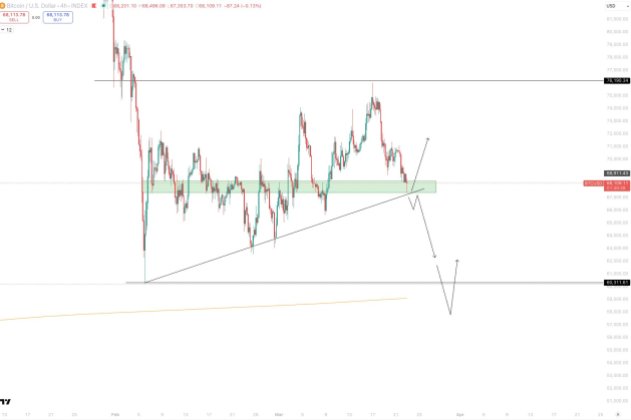
Source: X

Bitcoin Bulls Are Still In The Game

Despite the rising bear structure, there is still a lot of opportunity here for the bulls, according to the crypto analyst. They explain that the price might have already hit its macro bottom, suggesting that the recovery from here would be one that goes on for longer.

Some factors that also serve as evidence for this bullishness are that the funding rate is still positive. This means that long traders are now paying short traders to keep their positions open, something that could be bullish for the short term. Additionally, the Coinbase premium has moved into the negative territory and is continuing to move. Selling has also greatly reduced in favor of buying on centralized crypto exchanges such as Binance.

Given this trend, the crypto analyst believes that even if the Bitcoin price were to crash again, the worst-case scenario would be that the cryptocurrency returns to sweep the $60,000 lows. It could eventually wick down as low as $56,000, but not another major crash as has been seen in recent times.

Bulls continue to push for higher prices | Source: BTCUSD on Tradingview.com

Related Questions

QAccording to the analyst Sykodelic, what are the main factors suggesting that the Bitcoin price may not have bottomed yet?

AThe main factors are the budding US-Iran war and its potential impact on oil and crypto markets, the Bitcoin 200 Moving Average providing major support around $58,000 which could attract bearish pressure, and the bulls' repeated failure to hold the price above $74,400, with the current price action resembling the structure that led to the crash from $98,000 in January.

QWhat evidence does the article provide to support the bullish case that the macro bottom for Bitcoin might be in?

AThe bullish case is supported by positive funding rates indicating long traders are paying shorts, the Coinbase premium moving into negative territory and continuing to shift, and a significant reduction in selling in favor of buying on major centralized exchanges like Binance.

QWhat is the analyst's worst-case price prediction for Bitcoin if it were to experience another crash?

AThe analyst's worst-case scenario is that Bitcoin would return to sweep the $60,000 lows, potentially wicking down as low as $56,000, but not experiencing another major crash like those seen recently.

QWhat key price level does the Bitcoin 200 Moving Average represent on the 1-week chart, and why is it significant?

AThe Bitcoin 200 Moving Average is sitting around $58,000 on the 1-week chart, and it is significant because it represents a major support level that bears might attempt to push the price toward.

QHow does the current trading range for Bitcoin, as mentioned in the article, reflect market uncertainty?

AThe price has been ranging between $60,000 and $76,000 for months, and the bulls have failed to hold above $74,400, which reflects ongoing market uncertainty and the struggle between buyers and sellers to establish a clear trend.

Related Reads

Will the Next Crypto Bull Run Start with On-Chain Trading of SpaceX?

This article presents a scenario-based forecast for the crypto industry from 2026 to 2029, arguing that the next major cycle will be driven not by technological narratives but by legal access to real-world assets. The author predicts that by mid-2026, pre-IPO perpetual contracts for top private companies like SpaceX, OpenAI, and Anthropic on platforms like Hyperliquid will become the primary gateway for accessing quality assets, as most crypto-native tokens fail to capture real value. The much-hyped AI x Crypto intersection largely fails except for prediction markets, which thrive on betting on AI model supremacy. By 2027, public blockchain foundations are forced to choose between catering to retail speculation or building compliant infrastructure for institutions, with many opting for the latter. Growth in stablecoins and tokenized private credit/equity hits a "triple ceiling" due to regulatory and political uncertainty rather than market demand. The pivotal shift is forecast for 2028. A major liquidation event in pre-IPO perpetuals exposes the structural flaw of synthetic markets lacking a real underlying asset anchor. In response, regulatory changes finally allow the public solicitation of private securities resales to verified accredited investors. This creates a legitimate secondary market for real company equity, which then becomes the core asset class of the new bull market, relegating synthetic perps to a niche role. By 2029, the industry becomes "boring" but foundational. Tokens without claims on real cash flows or assets cease trading. Stablecoin growth is steady but politically capped. Crypto infrastructure fades from view as it gets absorbed into traditional finance backends. The article's central thesis is that the key bottleneck for crypto's next phase is legal and regulatory channels for real asset ownership, not technology.

marsbit1h ago

Will the Next Crypto Bull Run Start with On-Chain Trading of SpaceX?

marsbit1h ago

The Value Distribution of Stablecoins

**Summary: The Value Distribution of Stablecoins** The article argues that stablecoins are evolving from mere trading tools into broader channels for dollar access. It divides the stablecoin ecosystem into four layers to analyze how value is distributed: 1. **Issuance Layer:** Mints stablecoins, holds reserve assets, and captures the spread between reserve yield and user costs (e.g., Tether, Circle). This layer currently earns the largest profit margin. 2. **Infrastructure Layer:** Connects stablecoins to the traditional financial system, handling fiat on/off-ramps, banking integration, compliance (KYC/AML), and asset management (e.g., Bridge, BVNK). This is the "unglamorous" but critical work, building the essential bridges between crypto and real-world finance. 3. **Acquiring/Distribution Layer:** Integrates stablecoins into merchant systems, manages payment flows, and provides enterprise financial software (e.g., Stripe, Coinbase). They act as the access point for businesses. 4. **Application Layer:** The end-users and businesses that ultimately use stablecoins for payments, settlements, or as a store of value. They benefit from convenience but have little pricing power. The core thesis is that while the issuance layer currently dominates profits, the often-overlooked **infrastructure layer holds significant long-term potential**. The real challenge and barrier to mass adoption is not the on-chain transfer of stablecoins (which is simple), but the complex "last mile" integration into existing business workflows, banking systems, and regulatory frameworks across different countries. Companies in this layer are currently in a "land grab" phase, investing heavily to build networks, secure bank partnerships, and establish compliance pathways. While their position is currently pressured by the profitable issuers above and distribution platforms below, the article suggests that if stablecoins become a default financial rail for businesses, the infrastructure providers who have done the hard work of integration will ultimately gain strong pricing power and become entrenched, essential players.

marsbit7h ago

The Value Distribution of Stablecoins

marsbit7h ago

The Value Distribution of Stablecoins

The Value Distribution of Stablecoins The article argues that stablecoins are evolving from a mere trading tool into a broad "dollar channel." It analyzes the industry's value chain through four layers: 1. **Issuance Layer (e.g., Tether, Circle):** The top layer that mints stablecoins, holds reserve assets, and captures the thickest interest rate spread. 2. **Infrastructure Layer (e.g., Bridge, BVNK):** Connects stablecoins to the traditional financial system, handling critical but complex "dirty work" like fiat on/off-ramps, banking integration, compliance (KYC/AML), and cross-border settlement. 3. **Acquiring/Distribution Layer (e.g., Stripe, Coinbase):** Embeds stablecoins into merchant systems, manages payment flows, and integrates with enterprise software. 4. **Application Layer:** End-users and businesses that ultimately use stablecoins for payments, settlement, or storing value. The author posits that while the issuance layer currently captures the most profit, the most overlooked and potentially critical layer is infrastructure. The core challenge for stablecoin adoption isn't the on-chain transfer (which is simple), but bridging the gap between blockchain and the real-world financial system. This involves solving practical problems for businesses: fiat conversion, reconciliation, tax handling, and user onboarding. Infrastructure companies are currently in a difficult "land-grab" phase—building networks, securing banking relationships, and achieving compliance country-by-country. They face pressure from both the profitable issuance layer above and distribution platforms below. However, the author suggests this layer is building a crucial moat. Once stablecoins become a default business rail, the infrastructure players who have done the hard work of integration may gain significant, durable value and pricing power.

链捕手8h ago

The Value Distribution of Stablecoins

链捕手8h ago

Trading

Spot
Futures

Hot Articles

What is $BITCOIN

DIGITAL GOLD ($BITCOIN): A Comprehensive Analysis Introduction to DIGITAL GOLD ($BITCOIN) DIGITAL GOLD ($BITCOIN) is a blockchain-based project operating on the Solana network, which aims to combine the characteristics of traditional precious metals with the innovation of decentralized technologies. While it shares a name with Bitcoin, often referred to as “digital gold” due to its perception as a store of value, DIGITAL GOLD is a separate token designed to create a unique ecosystem within the Web3 landscape. Its goal is to position itself as a viable alternative digital asset, although specifics regarding its applications and functionalities are still developing. What is DIGITAL GOLD ($BITCOIN)? DIGITAL GOLD ($BITCOIN) is a cryptocurrency token explicitly designed for use on the Solana blockchain. In contrast to Bitcoin, which provides a widely recognized value storage role, this token appears to focus on broader applications and characteristics. Notable aspects include: Blockchain Infrastructure: The token is built on the Solana blockchain, known for its capacity to handle high-speed and low-cost transactions. Supply Dynamics: DIGITAL GOLD has a maximum supply capped at 100 quadrillion tokens (100P $BITCOIN), although details regarding its circulating supply are currently undisclosed. Utility: While precise functionalities are not explicitly outlined, there are indications that the token could be utilized for various applications, potentially involving decentralized applications (dApps) or asset tokenization strategies. Who is the Creator of DIGITAL GOLD ($BITCOIN)? At present, the identity of the creators and development team behind DIGITAL GOLD ($BITCOIN) remains unknown. This situation is typical among many innovative projects within the blockchain space, particularly those aligning with decentralized finance and meme coin phenomena. While such anonymity may foster a community-driven culture, it intensifies concerns about governance and accountability. Who are the Investors of DIGITAL GOLD ($BITCOIN)? The available information indicates that DIGITAL GOLD ($BITCOIN) does not have any known institutional backers or prominent venture capital investments. The project seems to operate on a peer-to-peer model focused on community support and adoption rather than traditional funding routes. Its activity and liquidity are primarily situated on decentralized exchanges (DEXs), such as PumpSwap, rather than established centralized trading platforms, further highlighting its grassroots approach. How DIGITAL GOLD ($BITCOIN) Works The operational mechanics of DIGITAL GOLD ($BITCOIN) can be elaborated on based on its blockchain design and network attributes: Consensus Mechanism: By leveraging Solana’s unique proof-of-history (PoH) combined with a proof-of-stake (PoS) model, the project ensures efficient transaction validation contributing to the network's high performance. Tokenomics: While specific deflationary mechanisms have not been extensively detailed, the vast maximum token supply implies that it may cater to microtransactions or niche use cases that are still to be defined. Interoperability: There exists the potential for integration with Solana’s broader ecosystem, including various decentralized finance (DeFi) platforms. However, the details regarding specific integrations remain unspecified. Timeline of Key Events Here is a timeline that highlights significant milestones concerning DIGITAL GOLD ($BITCOIN): 2023: The initial deployment of the token occurs on the Solana blockchain, marked by its contract address. 2024: DIGITAL GOLD gains visibility as it becomes available for trading on decentralized exchanges like PumpSwap, allowing users to trade it against SOL. 2025: The project witnesses sporadic trading activity and potential interest in community-led engagements, although no noteworthy partnerships or technical advancements have been documented as of yet. Critical Analysis Strengths Scalability: The underlying Solana infrastructure supports high transaction volumes, which could enhance the utility of $BITCOIN in various transaction scenarios. Accessibility: The potential low trading price per token could attract retail investors, facilitating wider participation due to fractional ownership opportunities. Risks Lack of Transparency: The absence of publicly known backers, developers, or an audit process may yield skepticism regarding the project's sustainability and trustworthiness. Market Volatility: The trading activity is heavily reliant on speculative behavior, which can result in significant price volatility and uncertainty for investors. Conclusion DIGITAL GOLD ($BITCOIN) emerges as an intriguing yet ambiguous project within the rapidly evolving Solana ecosystem. While it attempts to leverage the “digital gold” narrative, its departure from Bitcoin's established role as a store of value underscores the need for a clearer differentiation of its intended utility and governance structure. Future acceptance and adoption will likely depend on addressing the current opacity and defining its operational and economic strategies more explicitly. Note: This report encompasses synthesised information available as of October 2023, and developments may have transpired beyond the research period.

367 Total ViewsPublished 2025.05.13Updated 2025.05.13

What is $BITCOIN

Discussions

Welcome to the HTX Community. Here, you can stay informed about the latest platform developments and gain access to professional market insights. Users' opinions on the price of BTC (BTC) are presented below.

活动图片















