Probability of Shutdown Plummets: Why Was the U.S. Government Shutdown Crisis Suddenly 'Resolved'?

比推Published on 2026-01-29Last updated on 2026-01-29

Abstract

The risk of a U.S. government shutdown at the end of January has significantly decreased, with prediction markets showing the probability dropping from 80% to 42%. The potential shutdown stemmed from a partisan dispute over funding for the Department of Homeland Security (DHS), particularly related to the Immigration and Customs Enforcement (ICE) agency. Democrats sought to limit funding after a controversial ICE operation in Minnesota resulted in fatalities, while Republicans defended ICE's role in immigration enforcement. The shift in shutdown probability reflects a likely political compromise, as both parties recognize that a shutdown could harm their prospects in the upcoming midterm elections. Control of Congress is at stake, and neither side wants to be blamed for economic and operational disruptions. Democrats have proposed separating the DHS funding bill from other appropriations to avoid a full shutdown, and reports indicate negotiations are underway between the White House and Senate leaders to reach a short-term funding extension. The focus is on avoiding a repeat of the 43-day shutdown from late last year.

Author: Golem

Original Title: U.S. Government Shutdown Is Difficult Because Both Parties Have Already Calculated the Cost


A major macroeconomic event this month is whether the U.S. government will shut down at the end of January. Last October, the U.S. government shut down for 43 days, and it has been operating since then only after the passage of a temporary funding bill. January 30 is the expiration date of the temporary funding bill. If Congress fails to pass a formal funding bill or if there is no new temporary bill to extend it, the U.S. government will shut down again.

This time, the dispute between the two U.S. parties is mainly over funding for the Department of Homeland Security (DHS). Democrats believe that ICE (Immigration and Customs Enforcement) has problems with law enforcement in Minnesota, resulting in two deaths, and they want to strictly restrict funding and related operations. However, Republicans disagree, arguing that ICE is a key force in combating illegal immigration and welfare fraud. As a result, the two sides are at a stalemate. (For details on the dispute between the two U.S. parties, please read: "U.S. Government Shutdown Storm Is Brewing Again, Will the Crypto Circle Repeat the Crash Script?")

It is this confrontational state and the approaching expiration date of the temporary funding bill that caused the probability of a U.S. government shutdown at the end of January to rise sharply on prediction markets. However, this morning, Polymarket data showed that the probability of the U.S. government shutting down at the end of January has continued to decline and currently stands at 42%, down from a previous high of 80%.
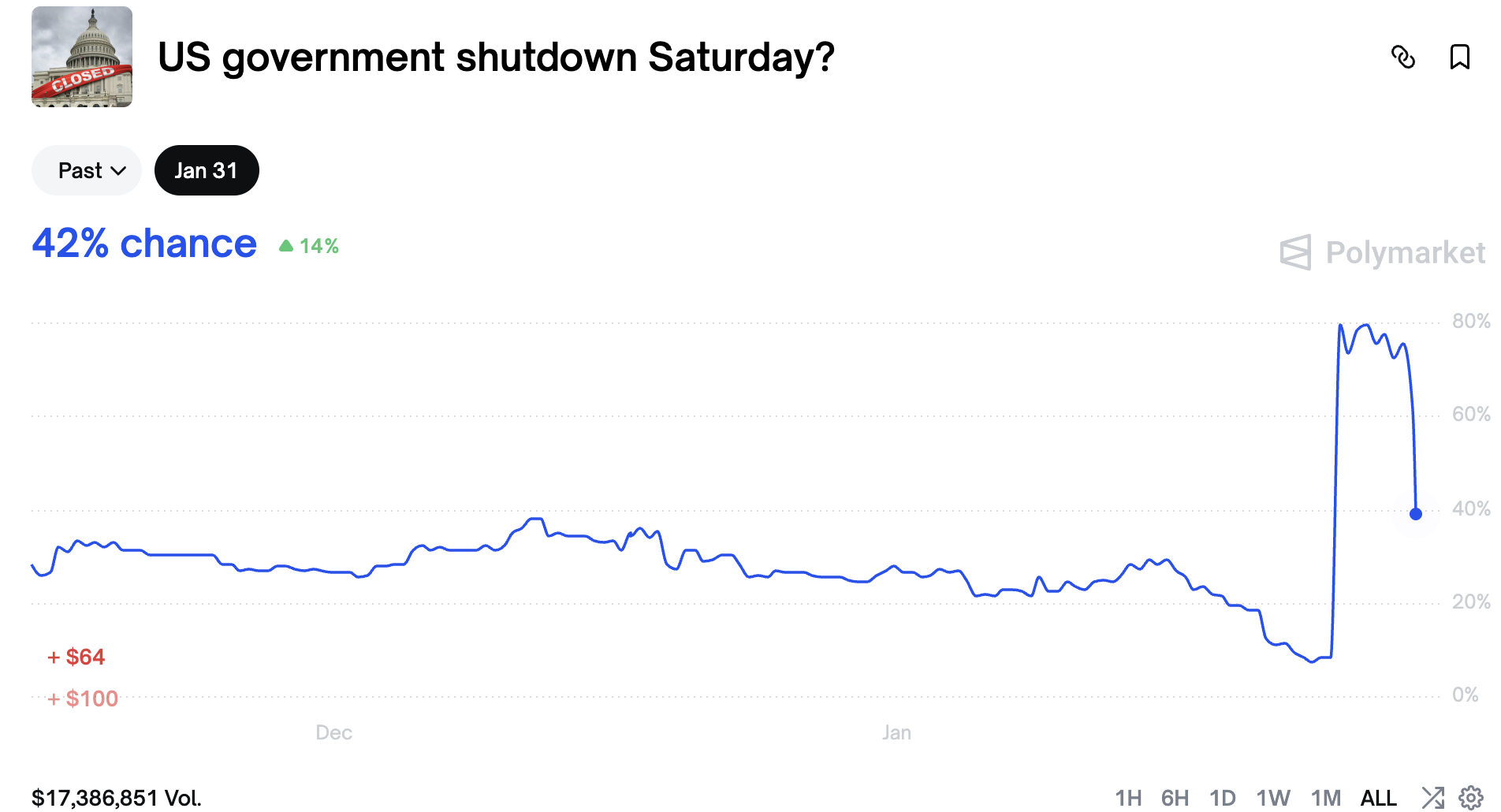
Price changes in prediction markets reflect the results of collective wisdom and博弈. The rising probability that the U.S. government will not shut down at the end of January indicates that people believe the high certainty of a government shutdown suggested by the prediction market probability no longer exists under the current U.S. political situation.

Midterm Elections Are the Key Focus for Both U.S. Parties

On January 28, regarding the risk of another possible U.S. government shutdown, U.S. Treasury Secretary Besant said the situation is still unclear but emphasized that President Trump has urged the Democratic side to avoid this outcome.

This government shutdown crisis is essentially because the Republicans were caught by the Democrats with a political counterattack handle. The shooting death of a U.S. citizen by ICE law enforcement officers in Minnesota on January 24 was essentially a result of the Trump administration's increased immigration enforcement efforts, which also led to large-scale public protests expressing dissatisfaction with the Trump administration. The Democrats reasonably seized this opportunity and used it as an excuse to block the passage of the funding bill in the Senate. Because it reflects the demands of voters, the Democrats' counterattack has taken the political initiative.

The Republicans have thus been put in a passive position. If the U.S. government does shut down as a result, the Democrats could blame all subsequent economic and livelihood problems caused by the shutdown (delayed release of economic data, large-scale flight delays at airports, etc.) on the incompetence of the Republican government.

And this series of possible chain reactions will also affect the issue that both U.S. parties truly care about this year: the U.S. midterm elections.

The U.S. "midterm elections" are held in the second year of a presidential term. All 435 seats in the House of Representatives will be re-elected, and approximately one-third of the seats in the Senate are usually re-elected. Currently, the Republicans hold a majority in both the House (218 seats) and the Senate (53 seats). For the Republicans to maintain their seat advantage after the midterm elections at the end of the year and reduce governance difficulties, they cannot accumulate too many "stains" politically this year.

At the same time, although the midterm elections do not involve the U.S. presidential election, they are also regarded as a "midterm referendum" on the incumbent president, which will affect the president's policy orientation in the latter two years and also reshape the intra-party power structure and the candidate landscape for the next presidential election. Therefore, it is extremely important for Trump as well.

From the above analysis, it can be seen that this government shutdown is no longer a simple funding issue but a political battlefield set up in advance by both U.S. parties for the midterm elections at the end of the year. The Republicans, who are in a passive position, are highly likely to compromise to resolve the crisis and矛盾.

For the Democrats, if the Republicans compromise, it would also be a political victory.

Compromise Is Already Underway

This U.S. government shutdown crisis will not be a "full shutdown" like last October (when all 12 funding bills expired). The scale of the shutdown may be much smaller. Funding for the Commerce Department (responsible for releasing GDP and other data) and the Agriculture Department (responsible for food benefits) has already been secured, but about 78% of federal government functions—involving the remaining 6 funding bills—may face funding cuts.

The Democrats have actually already given the Republicans a way out. Senate Minority Leader Chuck Schumer (D-N.Y.) said on January 28 that Senate Democrats are "prepared to quickly advance five funding bills by the January 30 deadline, separate from the Department of Homeland Security funding bill," which could be a way to avoid a large-scale government shutdown. However, Senate Republicans have not yet agreed to separate the DHS bill from the overall funding package.

On the other hand, it is unrealistic to demand changes to the DHS funding before January 30, as any changes to the remaining six funding bills must be submitted to the House of Representatives for approval, and the House will not reconvene until February 2.

For the Democrats, forcing the U.S. government into a shutdown state by being too rigid about amending the funding bill would not be of much benefit, and the "offensive and defensive态势" with the Republicans could even reverse. Therefore, the current consensus between the two U.S. parties may be to pass a temporary funding bill to first solve the potential government shutdown problem and postpone the矛盾 between the two parties.

And just as Odaily was writing this article speculating that the two parties might compromise to avoid a government shutdown, The New York Times also reported that Trump is reaching a possible agreement with Chuck Schumer to avoid a U.S. government shutdown.

According to two informed officials, under the plan being developed, the Senate would separate one bill from the six spending bills, which is intended to fund the Department of Homeland Security to maintain funding for the military, medical programs, and other federal agencies for the remainder of the fiscal year. The Senate will pass these bills by the Friday midnight deadline, and Congress will also consider a short-term extension of homeland security operations to prevent service disruptions at the TSA, Coast Guard, and Federal Emergency Management Agency.

It is still unclear how this potential agreement will affect this week's funding bill vote, but it at least indicates that the White House and the Senate are working towards resolving the crisis.


Twitter:https://twitter.com/BitpushNewsCN

Bitpush TG Discussion Group:https://t.me/BitPushCommunity

Bitpush TG Subscription: https://t.me/bitpush

Original link:https://www.bitpush.news/articles/7607037

Related Questions

QWhy did the probability of a US government shutdown at the end of January drop significantly?

AThe probability dropped because both political parties recognized that a shutdown could negatively impact the midterm elections. The Republican party, in particular, was in a politically vulnerable position and was likely to compromise to avoid the economic and public backlash associated with a shutdown.

QWhat was the main point of contention between Democrats and Republicans that threatened a government shutdown?

AThe main contention was over funding for the Department of Homeland Security (DHS), specifically related to the Immigration and Customs Enforcement (ICE) agency. Democrats wanted to restrict funding and actions for ICE following a fatal incident in Minnesota, while Republicans defended ICE's role in combating illegal immigration.

QHow are the upcoming US midterm elections connected to the government shutdown crisis?

AThe midterm elections are the key political priority for both parties. A government shutdown would create economic and logistical problems that could be used as political ammunition. Republicans, who control both chambers of Congress, want to avoid any 'stains' on their record to maintain their majority, making them more willing to compromise.

QWhat specific compromise was proposed by Democrats to avoid a full government shutdown?

ASenate Democratic Leader Chuck Schumer proposed separating the Homeland Security funding bill from the other five remaining appropriations bills. This would allow the non-controversial bills to pass quickly before the deadline, avoiding a full shutdown, while negotiations on DHS funding continued.

QWhat was reported that indicated a deal was being made to prevent the shutdown?

AThe New York Times reported that President Trump and Senator Chuck Schumer were working on a potential deal. The plan involved separating the Homeland Security appropriations bill from the others and passing a short-term extension for DHS to prevent service disruptions while a longer-term solution was negotiated.

Related Reads

Dialogue with a Macro Analyst: AI Drains All Liquidity from U.S. Stocks, $40K Bitcoin is the True Bottom

In a recent discussion, macro strategist Luke Groman, founder of FFT LC, presented a sobering analysis of current markets. He argues that while the S&P 500 hits new highs, this is largely driven by just seven AI stocks, which are "sucking all the oxygen and liquidity out of the room." Bitcoin, which he calls the "last working smoke alarm for liquidity," is signaling trouble, having entered a difficult period. Groman explains that the AI boom is fueled by accounting practices that front-load revenue, creating an illusion of high profits while cash is being depleted. He warns this cycle could reverse sharply when construction slows. His base case is that stocks will rise in dollar terms but fall significantly when measured in gold or Bitcoin, highlighting that long-term US Treasury futures have already lost 90% of their value against gold over the past decade. He points to major structural risks, including China's dominance in rare earths—a small commodity market underpinning trillions in tech stock value—and the prolonged closure of the Strait of Hormuz, which he calls a "Suez Moment" for the US. This, combined with a shift towards a "no ticky, no washy" proof-of-work system for settling trade (using gold, not trust), signals deeper systemic distrust. Regarding US debt, Groman notes that historically, all 58 countries that reached a 130% debt-to-GDP ratio defaulted, primarily through inflation. The US crossed this threshold in 2020. He also highlights a contradiction in the AI narrative: if it's as transformative as claimed, it must destroy white-collar jobs, threatening half of US tax revenue—a reality at odds with the "no job loss" messaging from tech leaders. On Bitcoin, Groman sold most of his position near the top and hasn't fully re-entered. Citing technical analysis from Northstar Bad Charts, he suggests a potential bottom around $40,000 could materialize in Q3 or Q4. He concludes that while he may be labeled a doomsayer, his view is simply realistic, grounded in historical precedents and current macro pressures.

marsbit11m ago

Dialogue with a Macro Analyst: AI Drains All Liquidity from U.S. Stocks, $40K Bitcoin is the True Bottom

marsbit11m ago

Apple's Desired On-Device AI Sees a Dark Horse Emerge: The First Cognitive Model is Born, 4B Matches GPT-5.4

A Chinese company, Tomorrow's Journey (Nextie), has introduced what it is calling the industry's first "cognitive model" for edge devices. Named New Journey Alpha, this 4-billion-parameter model reportedly matches the performance of trillion-parameter giants like GPT-5.4 in group intelligence tasks such as debate and collective decision-making. The development follows Andrej Karpathy's vision of stripping vast factual knowledge from large language models to retain only a smaller "cognitive core" capable of reasoning, planning, and knowing its own limits. This approach directly addresses the soaring computational costs and token expenses hindering AI's widespread deployment, as highlighted by incidents like Amazon shutting down an internal AI tool due to prohibitive costs. Trained via reinforcement learning on a corpus of academic papers from 1800-2020 to enhance generalization, the model enables three key advancements: 1) Improved decision quality in multi-agent systems, 2) Drastically reduced compute costs, allowing for cost-effective cloud or on-device (e.g., MacBook) deployment, and 3) The feasibility of "proactive" AI agents that act autonomously without user prompts, unlocking new commercial possibilities beyond today's reactive models. Built by the former Microsoft Xiaoice team—known for creating a 3.6B model that outperformed a 65B Llama model—the company is now focusing on the multi-agent systems sector, a field gaining significant investor interest. The model's economic impact is profound; by achieving high-level performance with minimal parameters, it fundamentally alters the cost structure of AI services, challenging the prevailing model of ever-larger parameter counts.

marsbit3h ago

Apple's Desired On-Device AI Sees a Dark Horse Emerge: The First Cognitive Model is Born, 4B Matches GPT-5.4

marsbit3h ago

Trading

Spot
Futures
活动图片