Polymarket 2025: In-Depth Report on Six Profit Models, Starting from 95 Million On-Chain Transactions

marsbitPublished on 2025-12-29Last updated on 2025-12-29

Abstract

This report analyzes six proven profit strategies on Polymarket, a decentralized prediction market with over 95 million transactions and $21.5 billion in nominal volume in 2025. Based on an analysis of 86 million on-chain transactions, the strategies are: 1. **Information Arbitrage**: Exemplified by a French trader who made $85M on the 2024 US election by conducting unique "neighbor effect" polls, exploiting systematic market pricing errors. 2. **Cross-Platform Arbitrage**: Earning risk-free profits by capitalizing on price discrepancies for the same event across different prediction markets (e.g., Polymarket vs. Kalshi), netting over $40M collectively. 3. **High-Probability "Bonding"**: Consistently buying high-probability outcomes (e.g., >95% certainty) for steady, short-term returns, with potential yields exceeding 1800% annualized. 4. **Liquidity Providing (LP)**: Acting as a market maker to earn spreads and rewards, though returns have diminished post-2024 election due to increased competition and lower rewards. 5. **Domain Specialization**: Achieving high win rates (e.g., 96%) by developing deep expertise in a niche area (e.g., sports, specific event mentions), making infrequent but high-conviction bets. 6. **Speed Trading**: Using automated systems and low-latency tech to profit from brief information advantages, a strategy increasingly dominated by institutional players. The analysis concludes that successful traders systematically identify market inefficienci...

Original Author: Lin Wanwan's Cat (X: @linwanwan823)

On the night of the 2024 U.S. election, a French trader netted $85 million on Polymarket.

This figure surpassed the annual performance of the vast majority of hedge funds.

Polymarket, a decentralized prediction market that has processed over $9 billion in trading volume and attracted 314,000 active traders, is redefining the boundaries of "voting with money."

But first, we must be honest: prediction markets are a zero-sum game.

Only 0.51% of Polymarket wallets have achieved profits exceeding $1,000.

So, what did the winners do right?

I recently wrote a series of strategies and attempted to systematically analyze over 86 million on-chain transactions,

(Data is based on academic research from IMDEA Networks Institute, covering complete on-chain records of over 86 million transactions and 17,218 market conditions from April 1, 2024, to April 1, 2025.

According to Dune Analytics data, Polymarket processed over 95 million transactions in 2025, with a nominal trading volume exceeding $21.5 billion, though there is some double-counting.)

dissecting the position logic and entry/exit timing of top traders,

and summarizing six proven profitable strategies: from the French whale's "neighbor poll" information arbitrage to a high-probability bond strategy with 1800% annualized returns; from cross-platform spread capture to a niche specialization approach with a 96% win rate.

Our retrospective analysis reveals that the common trait of top traders is not "predictive ability,"

but three things:

systematically capturing market mispricing,近乎偏执的严格风险管理, and the patience to build a碾压级 information advantage in a single领域.

If you've read this far, I suspect that sooner or later in 2026, you will try it yourself.

Of course, this is not a guide on "how to gamble,"

but rather aims to provide a systematic strategic framework and replicable methodological reference for prediction market participants, especially beginners.

Keywords: Prediction Markets; Polymarket; Trading Strategies; Arbitrage; Risk Management; Blockchain

I will cover this in five parts. If you only want to see the strategies, jump directly to Part Three.

I. Research Background

II. Evaluation Dimensions and Criteria

III. Six Core Strategies for 2025

IV. Position Management and Strategy

V. Conclusion

I. Research Background

In October 2025, ICE, the parent company of the NYSE, wrote a $2 billion check to Polymarket, valuing it at $9 billion.

A month later, Polymarket acquired a CFTC-licensed exchange, officially returning to the U.S. The "gray area project" expelled by regulators three years prior had become a darling of traditional finance.

The turning point was the 2024 election.

When all mainstream polls were saying "too close to call," Polymarket's odds steadily pointed to Trump. $3.7 billion in bets ultimately predicted the result earlier and more accurately than professional polling agencies. Academia began re-examining an old question: Does forcing people to "put their money where their mouth is" truly elicit more honest judgments?

The first thirty years of the internet created three types of infrastructure: search engines tell you "what happened," social media tells you "what others think," and algorithmic recommendations tell you "what you might want to see." But one piece was always missing: a place that could reliably answer "what will happen next."

Polymarket is filling this gap and has become crypto's first truly breakout application, targeting the rigid demand for "information pricing."

When media outlets start checking odds before writing news, when investors start consulting the market for decisions, when political teams start monitoring Polymarket instead of polls.

It is evolving from gambling toward a form of "pricing consensus."

A market that makes Wall Street pay, regulators relent, and polls sweat is worth serious study.

II. Research Methods and Evaluation Criteria

2.1 Data Sources

This study uses multiple data sources for cross-validation:

(1) Polymarket official leaderboard data;

(2) Polymarket Analytics third-party analysis platform (updated every 5 minutes);

(3) PolyTrack trader tracking tool;

(4) Dune Analytics on-chain data dashboard;

(5) Chainalysis blockchain analysis reports.

Data covers the complete on-chain records of over 86 million transactions and 17,218 market conditions from April 2024 to December 2025.

2.2 Evaluation Dimensions and Weights

Strategy evaluation uses a multi-dimensional comprehensive assessment system, including:

Absolute Profitability (Weight 30%):

Core metric is cumulative profit and loss (PnL),统计策略产生的总利润金额. Data shows that wallets with PnL exceeding $1,000 account for only 0.51% of the total, and whale accounts with trading volume over $50,000 account for only 1.74%.

Risk-Adjusted Returns (Weight 25%):

Calculating metrics like Return on Investment (ROI) and Sharpe Ratio. Excellent traders typically maintain a 60-70% win rate while controlling single-position risk exposure to 20-40% of total capital.

Strategy Replicability (Weight 20%):

Assessing the systematic and rule-based nature of the strategy. Profits purely reliant on insider information or luck are excluded.

Sustainability and Stability (Weight 15%):

Examining the strategy's consistency across different market cycles, excluding "one-hit wonder" gambling-style gains.

Scalability (Weight 10%):

Analyzing the strategy's applicability at larger capital scales, considering liquidity constraints and market impact costs.

2.3 Exclusion Criteria

The following situations are excluded from the best strategy评选:

(1) Suspected market manipulation, such as the UMA token governance attack in March 2025, where a whale holding 5 million UMA tokens (25% voting power) manipulated the settlement of a market worth $7 million;

(2) Gambling-style trades with single positions exceeding 40-50% of capital;

(3) Unverifiable or non-replicable "black box" strategies;

(4) Insider trading relying on non-public information.

III. Review of the Six Core Profit Strategies for 2025

1. Information Arbitrage Strategy: When a Frenchman Understood the Election Better Than All U.S. Polling Agencies

In the early hours of November 5, 2024, when CNN and Fox News anchors were still cautiously saying "the race is tight,"

an anonymous account, Fredi9999, was already showing an unrealized gain of over $50 million.

A few hours later, Trump declared victory. This account, along with its 10 associated wallets, ultimately harvested $85 million in profits.

The person behind the account was Théo, a French trader who had previously worked on Wall Street.

When all mainstream polls showed Harris and Trump neck and neck,

he did something seemingly crazy: sold almost all his liquid assets, raised $80 million, and went all-in on Trump winning.

Théo didn't ask voters "who are you voting for," but commissioned YouGov to conduct a special poll in the swing states of Pennsylvania, Michigan, and Wisconsin, asking: "Who do you think your neighbor will vote for?"

The logic of this "neighbor effect" poll was simple: some people are ashamed to admit they support Trump, but they don't mind saying their neighbor does.

The results were "stunningly in favor of Trump." The moment he got the data, Théo went from a 30% position to All-in.

This case reveals the essence of information arbitrage: not knowing more than others, but asking the right questions. Théo spent less than $100,000 on the poll for an $85 million return.

This might be the highest ROI market research in human history. He currently ranks first in total profits on Polymarket.
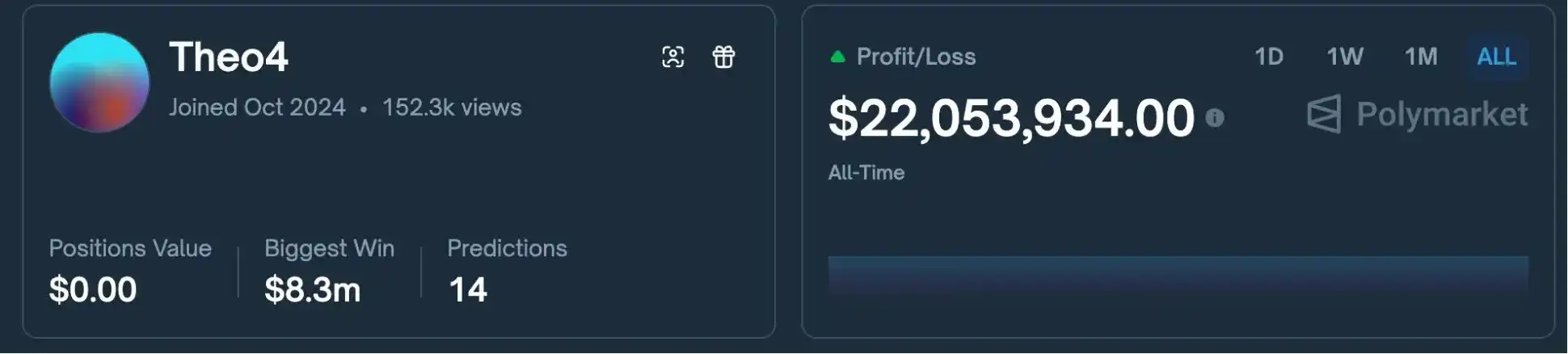
Replicability Assessment: The barrier to information arbitrage is extremely high, requiring original research methodology, large capital, and the psychological fortitude to stick to your judgment when "everyone says you're wrong." But its core idea—finding systematic biases in market pricing—applies to any contentious prediction market.

2. Cross-Platform Arbitrage Strategy: The Art of "Picking Up Money" Between Two Markets

If information arbitrage is an "intellectual game," cross-platform arbitrage is "manual labor": tedious, mechanical, but almost risk-free.

Its principle is simple enough for a child to understand: the same event sells for $45 in Store A and $48 in Store B. You buy both sides to hedge, profiting from the差价 regardless of the outcome.

From April 2024 to April 2025, academic research recorded a number: arbitrageurs extracted over $40 million in "risk-free profits" from Polymarket. The top three wallets alone made $4.2 million.

A real案例: On a certain day in 2025, for the question "Will Bitcoin break $95,000 within one hour?", the YES price was $0.45 on Polymarket, while the NO price for the same event on competitor Kalshi was $0.48.

A smart trader bought both sides simultaneously for a total cost of $0.93. Whether Bitcoin rose or not, he would get back $1, a 7.5% risk-free return, realized in one hour.

But there is a "critical detail": the definition of the "same event" may differ between platforms.

During the 2024 U.S. government shutdown event, a group of arbitrageurs found that Polymarket resolved "shutdown occurred" (YES), while Kalshi resolved "shutdown did not occur" (NO).

Their supposedly guaranteed hedged positions lost money on both sides.

Reason? Polymarket's settlement standard was "OPM announces shutdown," while Kalshi required "actual shutdown lasting over 24 hours."

Arbitrage isn't just picking up money blindly. Behind every cent of price difference lies the detail of settlement rules.

Replicability Assessment: This is the lowest barrier to entry among the six strategies. All you need is accounts on multiple platforms, some starting capital, and the patience to compare spreads. There are even open-source arbitrage bot codes on GitHub. However, as institutional capital floods in, the arbitrage window is visibly narrowing.

3. High-Probability Bond Strategy: Turning "Almost Certain" into a Business with 1800% Annualized Returns

Most people come to Polymarket for the thrill: betting on dark horses, predicting upsets.

But the real "smart money" does the exact opposite: they专门 buy things that are "already in the bag."

Data shows that over 90% of large orders exceeding $10,000 on Polymarket occur at prices above $0.95. What are these "whales" doing? They are "Bonding," buying almost certain events like bonds.

An example: Three days before the December 2025 Fed meeting, the YES contract for "a 25 basis point rate cut" was at $0.95. Economic data was clear, Fed officials' speeches heavily hinted—no room for surprise. You spend $0.95 to buy, get back $1 upon settlement three days later, a 5.2% return in 72 hours.

5% doesn't sound like much? Do the math: if you can find two such opportunities per week, that's 52 weeks × 2 times × 5% = 520% simple return per year. Considering compounding, annualized returns easily exceed 1800%. And the risk you take is接近 zero.

Some traders, using this strategy, make only a few trades per week and earn over $150,000 annually.

Of course, "almost certain" is not "absolutely certain."

The biggest enemy of the bond strategy is the black swan, those 0.01% probability surprises. One mistake can wipe out the profits of dozens of successes. So the core skill of top bond players is not finding opportunities, but identifying "false certainty": things that look like sure bets but hide risks.

Replicability Assessment: This is the most suitable strategy for beginners. It requires no deep research, no speed advantage, just patience and discipline. But its profit ceiling is also the lowest. When your capital reaches a certain size, there simply aren't enough 95%+ opportunities in the market for you to "harvest."

4. Liquidity Provider (LP) Strategy: Just Earning "Toll Fees"? Not That Simple

Why does the casino always win? Because it doesn't bet against you; it just takes a cut.

On Polymarket, some people choose to "be the casino" rather than "be the gambler"—they are Liquidity Providers (LPs).

The LP's job: place both buy and sell orders on the order book, earning the spread in between. For example, you place a buy order at $0.49 and a sell order at $0.51. No matter who trades, you earn the $0.02 difference. You don't care about the event outcome, only if someone trades.

Polymarket sees new markets every day. New markets are characterized by: poor liquidity, wide spreads, many retail traders. For LPs, this is heaven. Data shows that providing liquidity in new markets can yield annualized equivalent returns of 80%-200%.

A trader named @defiance_cr was interviewed by Polymarket官方, detailing how he built an automated market-making system. At its peak, this system generated $700-800 in profit daily.

He started with $10,000 capital, initially earning about $200 per day. As the system optimized and capital grew, profits increased to $700-800 daily. The core was utilizing Polymarket's liquidity reward program, where placing orders on both sides of the market could yield nearly 3x the rewards.
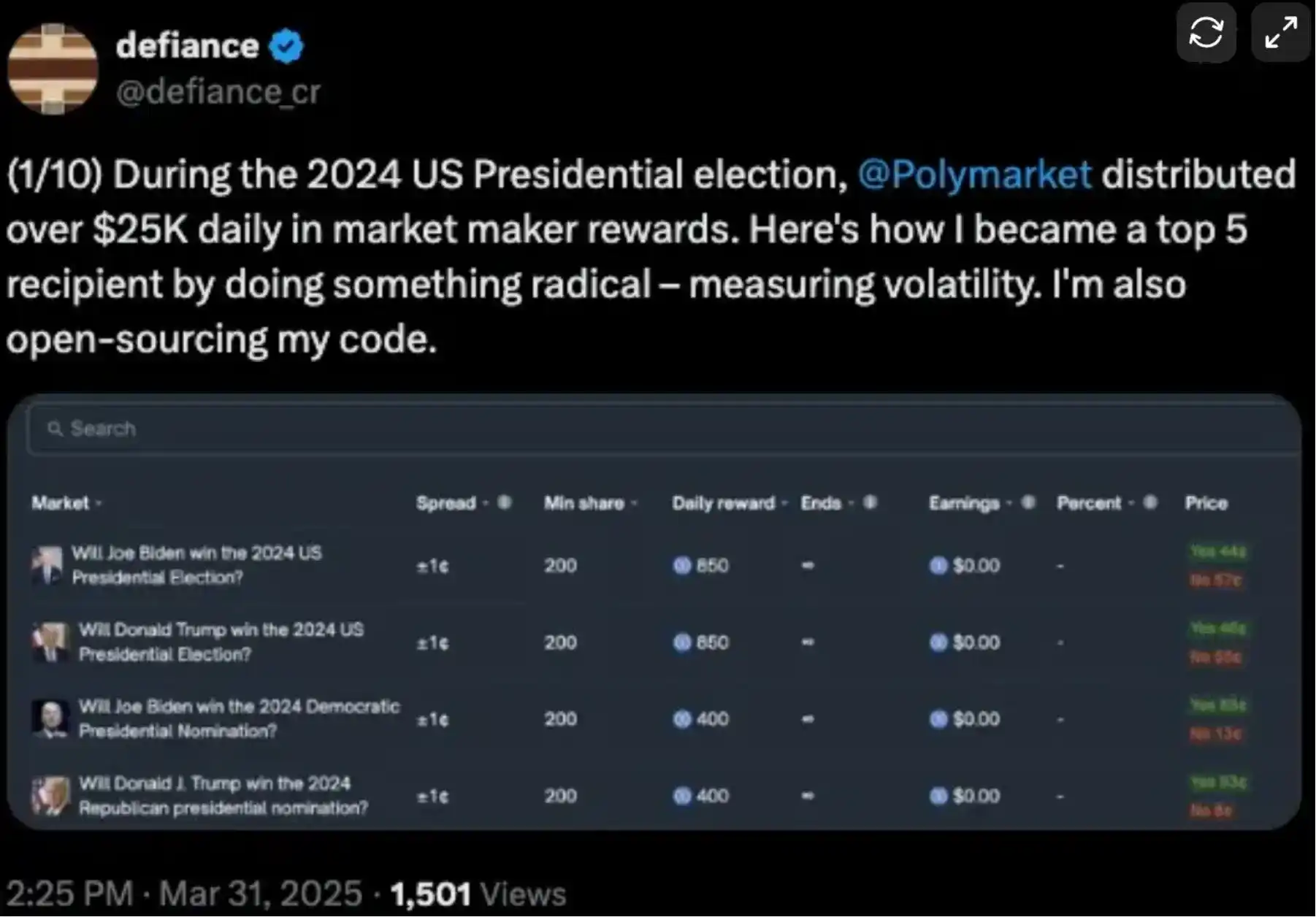
His system consisted of two core modules: a data collection module pulling historical prices from the Polymarket API, calculating volatility indicators, estimating expected returns per $100 invested, and sorting by risk-adjusted returns; a trade execution module automatically placing orders based on preset parameters—narrow spreads for liquid markets, wide spreads for volatile markets.

But after the election, Polymarket's liquidity rewards significantly decreased.

The LP strategy remained viable in late 2025, but with lower returns and increased competition. The cost of high-frequency trading infrastructure is higher than an average employee's salary. High-end VPS infrastructure needs to be hosted near Polymarket's servers. Quant algorithms are optimized for fast execution.

So don't envy "those traders making $200,000 a month确实存在. They are the top 0.5%."

This combination of "market making + prediction" is the standard for high-level players.

Replicability Assessment: The LP strategy requires a deep understanding of market microstructure, including order book dynamics, spread management, inventory risk control, etc. It's not as mechanical as arbitrage, nor does it require unique insight like information arbitrage, but sits between, requiring skill, but skill that can be learned.

5. Niche Specialization Strategy: The 10,000-Hour Rule in Prediction Markets

An interesting phenomenon on the Polymarket leaderboard: the most profitable people are almost all "specialists." They are not generalists who know a little about everything, but experts with a碾压级 advantage in a narrow field.

Look at some real cases:

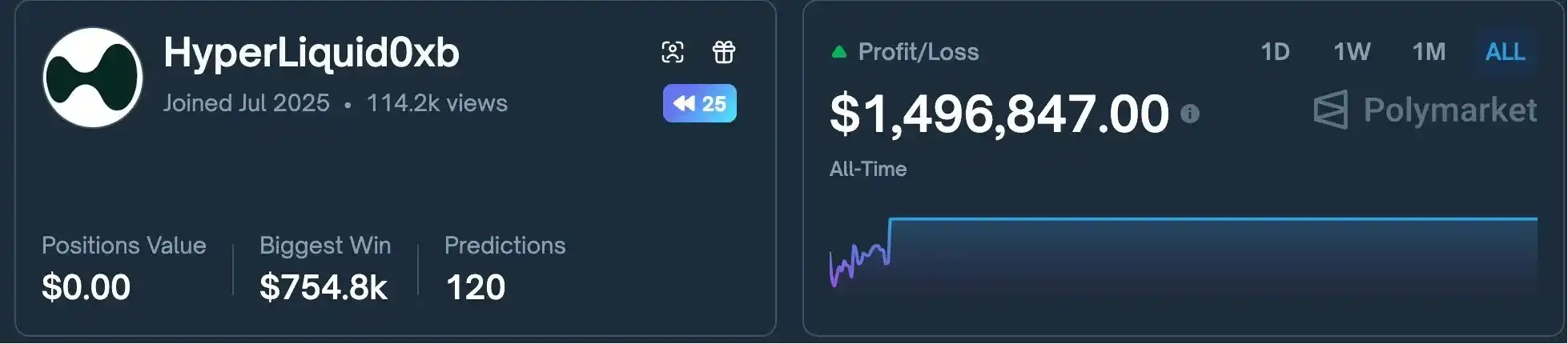
Sports Market Dominator HyperLiquid0xb: Total profits over $1.4 million, single largest gain of $755,000 from predicting a baseball game. His familiarity with MLB data rivals that of professional analysts, allowing him to quickly adjust judgments mid-game based on pitcher rotations, weather changes.
Mention Market Wizard Axios: Maintains a terrifying 96% win rate in markets like "Will Trump say 'crypto' in his speech?". His method is simple but extremely time-consuming: analyze all past public speeches of the target person,统计 the frequency and context of specific words, build a prediction model. While others are "gambling," he is "calculating."
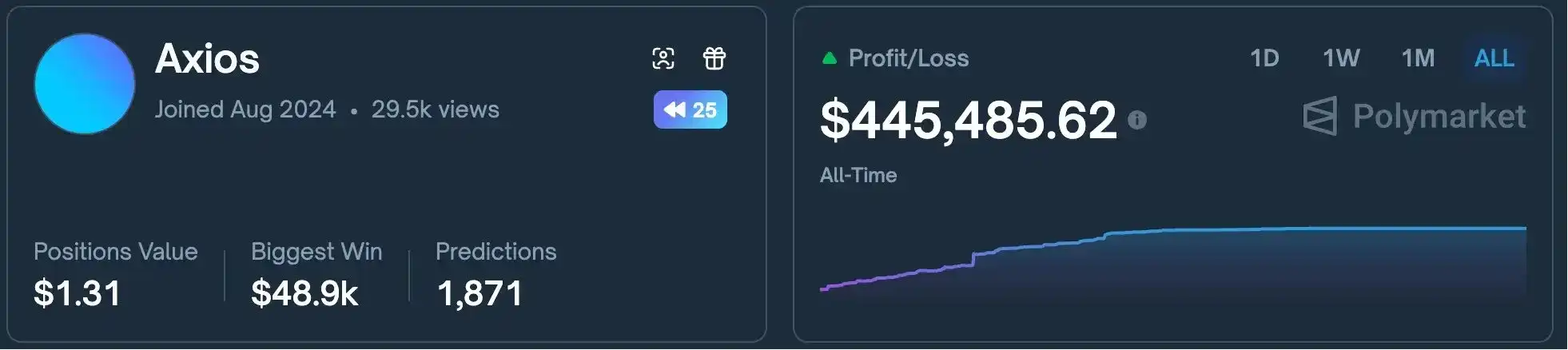
These cases share a common point: expert traders may only engage in 10-30 trades per year, but each has extremely high confidence and profit potential.

So specialization is more profitable than breadth.

Of course, I also saw a sports expert, SeriouslySirius, lose $440,000 on a single World Series bet, followed by losses in a series of events.
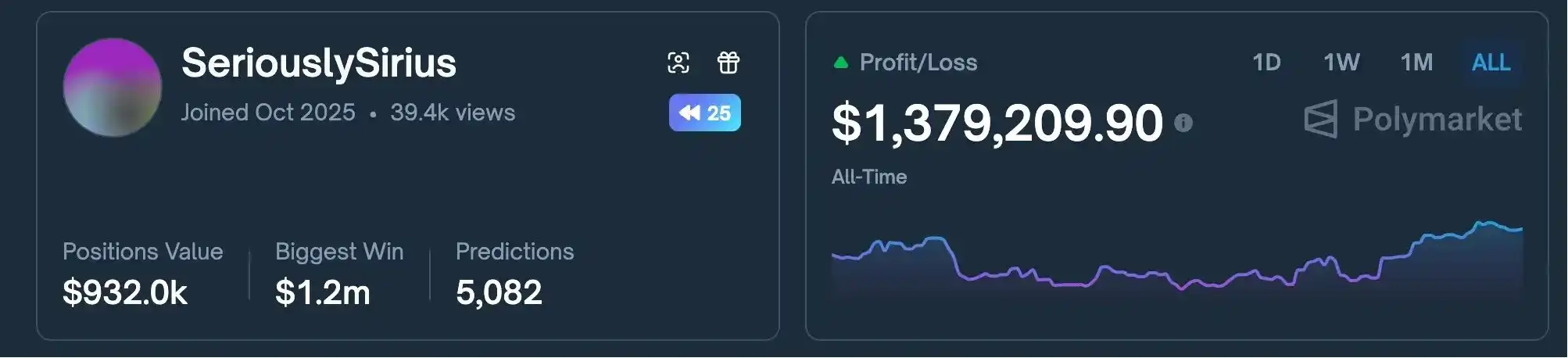
If you are only "somewhat knowledgeable," you are giving money to the experts. Of course,所谓的“懂”, is also another form of gambling.

Replicability Assessment: This is the strategy requiring the most time investment, but also the one with the highest barriers. Once you build an information advantage in a field, it's hard to replicate.建议 choosing an area where you already have knowledge or professional experience.

6. Speed Trading Strategy: Beating the World to the Punch

One Wednesday afternoon in 2024 at 2 PM, Fed Chair Powell began speaking. Within 8 seconds of him saying "we will adjust policy at the appropriate time," the price of the "Fed December rate cut" contract on Polymarket jumped from $0.65 to $0.78.

What happened in those 8 seconds? A small group of "speed traders," monitoring the live feed with preset triggers, placed their orders before the average person could even "understand" what Powell said.

Trading legend GCR once said the core of speed trading is "reaction." It exploits the time window between information generation and its digestion by the market, usually only a few seconds to minutes.

This strategy is particularly effective in "Mention markets." For example, "Will Biden mention China in his speech today?" If you can know the answer 30 seconds faster than others (by monitoring the White House live stream instead of waiting for news alerts), you can build a position before the price moves.

Some quant teams have industrialized this strategy. According to on-chain data analysis, between 2024-2025, top algorithmic traders executed over 10,200 speed trades, generating累计 $4.2 million in profits. Their tools include: low-latency API access, real-time news monitoring systems, preset decision rule scripts, and capital distributed across multiple platforms.

But speed trading is becoming increasingly difficult. As more institutional capital enters, the arbitrage window has compressed from "minutes" to "seconds," making it almost impossible for retail to participate. It's an arms race, and散户 tools are far inferior to institutions.

Replicability Assessment: Unless you have a technical background and time to invest in developing a trading system, it's not recommended. The alpha in speed trading is disappearing fast, leaving little room for retail. If you must try, start practicing in low-competition niche markets (like local elections, niche sports).

IV. Risk Management and Strategy Portfolio

4.1 Position Management Principles

Successful traders generally follow these position management principles:

Hold 5-12 uncorrelated positions simultaneously; Mix short-term (days) and long-term (weeks/months) holdings;

Keep 20-40% of capital as reserve for new opportunities;

Single trade risk exposure not exceeding 5-10% of total capital.

Over-diversification (30+ positions) dilutes returns, while over-concentration (1-2 positions) is too risky.

The optimal number of positions is usually between 6-10.

4.2 Strategy Portfolio Suggestions

Strategy allocation suggestions based on risk appetite are as follows.

  • Conservative Investors: 70% Bond Strategy + 20% Liquidity Providing + 10% Copy Trading.
  • Balanced Investors: 40% Niche Specialization + 30% Arbitrage + 20% Bonds + 10% Event-Driven.
  • Aggressive Investors: 50% Information Arbitrage + 30% Niche Specialization + 20% Speed Trading.

Regardless of the combination, avoid allocating over 40% of capital to a single event or a group of highly correlated events.

V. Conclusion

2025 was a pivotal year for Polymarket's transition from fringe experiment to mainstream finance.

The six盈利 strategies reviewed here—information arbitrage, cross-platform arbitrage, high-probability bonds, liquidity providing, niche specialization, and speed trading—represent proven sources of alpha in prediction markets.

In 2026, prediction markets will face fiercer competition and higher专业化门槛.

It is recommended that newcomers focus on: (1) Choosing a vertical field where they can build an information advantage; (2) Starting with small-scale bond strategies to accumulate experience; (3) Using tools like PolyTrack to跟踪和学习头部交易者的模式; (4) Maintaining close attention to regulatory changes and platform rule updates.

The essence of prediction markets is a "truth discovery mechanism powered by monetary votes."

In this market, the true edge comes not from luck, but from better information, more rigorous analysis, and more rational risk management. May this review provide you with a systematic map for navigating this new world.

References

[1] Chainalysis. "Polymarket Whale Analysis Report." November 2024.

[2] The Free Press. "How a French Whale Made $85 Million off Trump's Win." November 2024.

[3] Polymarket Analytics. "Trader Leaderboard and Performance Metrics." December 2025.

[4] PolyTrack. "Best Polymarket Traders to Follow 2025." November 2025.

[5] Dune Analytics. "Prediction Market Volume and Open Interest Data." September 2025.

[6] Wall Street Journal. "The French Trader Who Bet Big on Trump." November 2024.

[7] Bloomberg. "Trump Whale's Polymarket Haul Boosted to $85 Million." November 2024.

[8] CBS News 60 Minutes. "How a French 'whale' made over $80 million on Polymarket." December 2025.

Original Article Link

Related Questions

QWhat are the six core profit strategies identified in the Polymarket 2025 report?

AThe six core profit strategies are: 1. Information Arbitrage, 2. Cross-Platform Arbitrage, 3. High-Probability Bond Strategy, 4. Liquidity Providing, 5. Domain Specialization, and 6. Speed Trading.

QWhat was the key insight behind the French trader Théo's successful $85 million information arbitrage bet on the 2024 U.S. election?

AThéo's key insight came from a unique poll he commissioned that asked voters in swing states 'Who do you think your neighbor will vote for?' instead of who they would vote for themselves. This 'neighbor effect' poll revealed a significant, hidden bias towards Trump that mainstream polls missed.

QWhat is the main risk associated with the seemingly low-risk Cross-Platform Arbitrage strategy?

AThe main risk is that different platforms may have subtly different definitions or settlement criteria for what constitutes the 'same event'. A trader's hedged position can lose money on both sides if one platform resolves to YES and another to NO based on these differing rules.

QAccording to the report, what is the common characteristic of the most profitable traders, beyond prediction skill?

AThe most profitable traders systematically identify market pricing errors, practice extremely strict and近乎偏执 (paranoid) risk management, and patiently build a crushing information advantage in a single, specialized domain.

QWhat recommendation does the report give to new entrants for building experience in 2026?

AThe report recommends that new entrants should: 1. Focus on a vertical domain where they can build an information advantage, 2. Start by accumulating experience with small-scale Bond strategies, 3. Use tools like PolyTrack to learn from the patterns of top traders, and 4. Maintain close attention to regulatory changes and platform rule updates.

Related Reads

How Many Tokens Away Is Yang Zhilin from the 'Moon Chasing the Light'?

The article explores the intense competition between two leading Chinese AI companies, DeepSeek and Kimi (Moon Dark Side), and the mounting pressure on Yang Zhilin, the founder of Kimi. While DeepSeek re-emerged after 15 months of silence with its powerful V4 model—boasting 1.6 trillion parameters and low-cost, long-context capabilities—Kimi has been focusing on long-context processing and multi-agent systems with its K2.6 model. Yang faces a threefold challenge: technological rivalry, commercialization pressure, and investor expectations. Despite Kimi’s high valuation (reaching $18 billion), its revenue heavily relies on a single product with low paid conversion rates, while DeepSeek’s strategic silence and open-source influence have strengthened its market position and valuation prospects, now targeting over $20 billion. Both companies reflect broader trends in China’s AI ecosystem: Kimi aims for global influence through open-source contributions and agent-based advancements, while DeepSeek prioritizes foundational innovation and hardware independence, notably shifting to Huawei’s chips. Their competition is seen as vital for China’s AI progress, with the gap between top Chinese and U.S. models narrowing to just 2.7% on the Elo rating scale. Ultimately, the article argues that this rivalry, though anxiety-inducing for leaders like Zhilin, is essential for driving innovation and solidifying China’s role in the global AI landscape.

marsbit6h ago

How Many Tokens Away Is Yang Zhilin from the 'Moon Chasing the Light'?

marsbit6h ago

TechFlow Intelligence Bureau: ChatGPT Helps Amateur Mathematician Crack 60-Year-Old Problem, CFTC Sues New York Regulator Over Coinbase and Gemini

An amateur mathematician, with the assistance of ChatGPT, has solved a combinatorial mathematics puzzle originally proposed by Hungarian mathematician Paul Erdős in the 1960s. This marks another milestone in AI-aided mathematical research, demonstrating the evolving capabilities of large language models in formal reasoning. In other AI developments, OpenAI introduced a new privacy filter tool for enterprise API usage, automatically screening sensitive data. Meanwhile, the Qwen3.6-27B model achieved 100 tokens per second on a single RTX 5090 GPU using quantization, significantly lowering the cost barrier for local AI deployment. In crypto and Web3, the U.S. CFTC sued New York’s financial regulator, challenging its oversight of Coinbase and Gemini—a first-of-its-kind federal-state regulatory clash. Following a vulnerability, KelpDAO and major DeFi protocols established a recovery fund. Tether froze $344 million in assets linked to Iran’s central bank upon U.S. Treasury request, highlighting the centralized control risks in stablecoins. Separately, Litecoin underwent a 3-hour chain reorganization to undo a privacy-layer exploit. In the U.S., former President Trump invoked the Defense Production Act to address power grid bottlenecks affecting AI data centers and dismissed the entire National Science Board, raising concerns over research independence. A retail trader gained 250% on a $600k Intel options bet amid AI-related speculation. Xiaomi announced its first performance electric vehicle, targeting rivals like Tesla. Meanwhile, iPhone users reported devices automatically reinstalling a hidden app daily, suspected to be MDM-related. A Chinese securities report noted that A-share institutional crowding has reached its second-longest streak since 2007, signaling high valuations and potential style rotation. The day’s developments reflect a dual narrative: AI is enabling unprecedented individual breakthroughs, while centralized power structures—whether governmental or corporate—are becoming more assertive, underscoring that decentralization is as much a political-economic challenge as a technical one.

marsbit6h ago

TechFlow Intelligence Bureau: ChatGPT Helps Amateur Mathematician Crack 60-Year-Old Problem, CFTC Sues New York Regulator Over Coinbase and Gemini

marsbit6h ago

Trading

Spot
Futures

Hot Articles

What is SONIC

Sonic: Pioneering the Future of Gaming in Web3 Introduction to Sonic In the ever-evolving landscape of Web3, the gaming industry stands out as one of the most dynamic and promising sectors. At the forefront of this revolution is Sonic, a project designed to amplify the gaming ecosystem on the Solana blockchain. Leveraging cutting-edge technology, Sonic aims to deliver an unparalleled gaming experience by efficiently processing millions of requests per second, ensuring that players enjoy seamless gameplay while maintaining low transaction costs. This article delves into the intricate details of Sonic, exploring its creators, funding sources, operational mechanics, and the timeline of significant events that have shaped its journey. What is Sonic? Sonic is an innovative layer-2 network that operates atop the Solana blockchain, specifically tailored to enhance the existing Solana gaming ecosystem. It accomplishes this through a customised, VM-agnostic game engine paired with a HyperGrid interpreter, facilitating sovereign game economies that roll up back to the Solana platform. The primary goals of Sonic include: Enhanced Gaming Experiences: Sonic is committed to offering lightning-fast on-chain gameplay, allowing players and developers to engage with games at previously unattainable speeds. Atomic Interoperability: This feature enables transactions to be executed within Sonic without the need to redeploy Solana programmes and accounts. This makes the process more efficient and directly benefits from Solana Layer1 services and liquidity. Seamless Deployment: Sonic allows developers to write for Ethereum Virtual Machine (EVM) based systems and execute them on Solana’s SVM infrastructure. This interoperability is crucial for attracting a broader range of dApps and decentralised applications to the platform. Support for Developers: By offering native composable gaming primitives and extensible data types - dining within the Entity-Component-System (ECS) framework - game creators can craft intricate business logic with ease. Overall, Sonic's unique approach not only caters to players but also provides an accessible and low-cost environment for developers to innovate and thrive. Creator of Sonic The information regarding the creator of Sonic is somewhat ambiguous. However, it is known that Sonic's SVM is owned by the company Mirror World. The absence of detailed information about the individuals behind Sonic reflects a common trend in several Web3 projects, where collective efforts and partnerships often overshadow individual contributions. Investors of Sonic Sonic has garnered considerable attention and support from various investors within the crypto and gaming sectors. Notably, the project raised an impressive $12 million during its Series A funding round. The round was led by BITKRAFT Ventures, with other notable investors including Galaxy, Okx Ventures, Interactive, Big Brain Holdings, and Mirana. This financial backing signifies the confidence that investment foundations have in Sonic’s potential to revolutionise the Web3 gaming landscape, further validating its innovative approaches and technologies. How Does Sonic Work? Sonic utilises the HyperGrid framework, a sophisticated parallel processing mechanism that enhances its scalability and customisability. Here are the core features that set Sonic apart: Lightning Speed at Low Costs: Sonic offers one of the fastest on-chain gaming experiences compared to other Layer-1 solutions, powered by the scalability of Solana’s virtual machine (SVM). Atomic Interoperability: Sonic enables transaction execution without redeployment of Solana programmes and accounts, effectively streamlining the interaction between users and the blockchain. EVM Compatibility: Developers can effortlessly migrate decentralised applications from EVM chains to the Solana environment using Sonic’s HyperGrid interpreter, increasing the accessibility and integration of various dApps. Ecosystem Support for Developers: By exposing native composable gaming primitives, Sonic facilitates a sandbox-like environment where developers can experiment and implement business logic, greatly enhancing the overall development experience. Monetisation Infrastructure: Sonic natively supports growth and monetisation efforts, providing frameworks for traffic generation, payments, and settlements, thereby ensuring that gaming projects are not only viable but also sustainable financially. Timeline of Sonic The evolution of Sonic has been marked by several key milestones. Below is a brief timeline highlighting critical events in the project's history: 2022: The Sonic cryptocurrency was officially launched, marking the beginning of its journey in the Web3 gaming arena. 2024: June: Sonic SVM successfully raised $12 million in a Series A funding round. This investment allowed Sonic to further develop its platform and expand its offerings. August: The launch of the Sonic Odyssey testnet provided users with the first opportunity to engage with the platform, offering interactive activities such as collecting rings—a nod to gaming nostalgia. October: SonicX, an innovative crypto game integrated with Solana, made its debut on TikTok, capturing the attention of over 120,000 users within a short span. This integration illustrated Sonic’s commitment to reaching a broader, global audience and showcased the potential of blockchain gaming. Key Points Sonic SVM is a revolutionary layer-2 network on Solana explicitly designed to enhance the GameFi landscape, demonstrating great potential for future development. HyperGrid Framework empowers Sonic by introducing horizontal scaling capabilities, ensuring that the network can handle the demands of Web3 gaming. Integration with Social Platforms: The successful launch of SonicX on TikTok displays Sonic’s strategy to leverage social media platforms to engage users, exponentially increasing the exposure and reach of its projects. Investment Confidence: The substantial funding from BITKRAFT Ventures, among others, emphasizes the robust backing Sonic has, paving the way for its ambitious future. In conclusion, Sonic encapsulates the essence of Web3 gaming innovation, striking a balance between cutting-edge technology, developer-centric tools, and community engagement. As the project continues to evolve, it is poised to redefine the gaming landscape, making it a notable entity for gamers and developers alike. As Sonic moves forward, it will undoubtedly attract greater interest and participation, solidifying its place within the broader narrative of blockchain gaming.

1.1k Total ViewsPublished 2024.04.04Updated 2024.12.03

What is SONIC

What is $S$

Understanding SPERO: A Comprehensive Overview Introduction to SPERO As the landscape of innovation continues to evolve, the emergence of web3 technologies and cryptocurrency projects plays a pivotal role in shaping the digital future. One project that has garnered attention in this dynamic field is SPERO, denoted as SPERO,$$s$. This article aims to gather and present detailed information about SPERO, to help enthusiasts and investors understand its foundations, objectives, and innovations within the web3 and crypto domains. What is SPERO,$$s$? SPERO,$$s$ is a unique project within the crypto space that seeks to leverage the principles of decentralisation and blockchain technology to create an ecosystem that promotes engagement, utility, and financial inclusion. The project is tailored to facilitate peer-to-peer interactions in new ways, providing users with innovative financial solutions and services. At its core, SPERO,$$s$ aims to empower individuals by providing tools and platforms that enhance user experience in the cryptocurrency space. This includes enabling more flexible transaction methods, fostering community-driven initiatives, and creating pathways for financial opportunities through decentralised applications (dApps). The underlying vision of SPERO,$$s$ revolves around inclusiveness, aiming to bridge gaps within traditional finance while harnessing the benefits of blockchain technology. Who is the Creator of SPERO,$$s$? The identity of the creator of SPERO,$$s$ remains somewhat obscure, as there are limited publicly available resources providing detailed background information on its founder(s). This lack of transparency can stem from the project's commitment to decentralisation—an ethos that many web3 projects share, prioritising collective contributions over individual recognition. By centring discussions around the community and its collective goals, SPERO,$$s$ embodies the essence of empowerment without singling out specific individuals. As such, understanding the ethos and mission of SPERO remains more important than identifying a singular creator. Who are the Investors of SPERO,$$s$? SPERO,$$s$ is supported by a diverse array of investors ranging from venture capitalists to angel investors dedicated to fostering innovation in the crypto sector. The focus of these investors generally aligns with SPERO's mission—prioritising projects that promise societal technological advancement, financial inclusivity, and decentralised governance. These investor foundations are typically interested in projects that not only offer innovative products but also contribute positively to the blockchain community and its ecosystems. The backing from these investors reinforces SPERO,$$s$ as a noteworthy contender in the rapidly evolving domain of crypto projects. How Does SPERO,$$s$ Work? SPERO,$$s$ employs a multi-faceted framework that distinguishes it from conventional cryptocurrency projects. Here are some of the key features that underline its uniqueness and innovation: Decentralised Governance: SPERO,$$s$ integrates decentralised governance models, empowering users to participate actively in decision-making processes regarding the project’s future. This approach fosters a sense of ownership and accountability among community members. Token Utility: SPERO,$$s$ utilises its own cryptocurrency token, designed to serve various functions within the ecosystem. These tokens enable transactions, rewards, and the facilitation of services offered on the platform, enhancing overall engagement and utility. Layered Architecture: The technical architecture of SPERO,$$s$ supports modularity and scalability, allowing for seamless integration of additional features and applications as the project evolves. This adaptability is paramount for sustaining relevance in the ever-changing crypto landscape. Community Engagement: The project emphasises community-driven initiatives, employing mechanisms that incentivise collaboration and feedback. By nurturing a strong community, SPERO,$$s$ can better address user needs and adapt to market trends. Focus on Inclusion: By offering low transaction fees and user-friendly interfaces, SPERO,$$s$ aims to attract a diverse user base, including individuals who may not previously have engaged in the crypto space. This commitment to inclusion aligns with its overarching mission of empowerment through accessibility. Timeline of SPERO,$$s$ Understanding a project's history provides crucial insights into its development trajectory and milestones. Below is a suggested timeline mapping significant events in the evolution of SPERO,$$s$: Conceptualisation and Ideation Phase: The initial ideas forming the basis of SPERO,$$s$ were conceived, aligning closely with the principles of decentralisation and community focus within the blockchain industry. Launch of Project Whitepaper: Following the conceptual phase, a comprehensive whitepaper detailing the vision, goals, and technological infrastructure of SPERO,$$s$ was released to garner community interest and feedback. Community Building and Early Engagements: Active outreach efforts were made to build a community of early adopters and potential investors, facilitating discussions around the project’s goals and garnering support. Token Generation Event: SPERO,$$s$ conducted a token generation event (TGE) to distribute its native tokens to early supporters and establish initial liquidity within the ecosystem. Launch of Initial dApp: The first decentralised application (dApp) associated with SPERO,$$s$ went live, allowing users to engage with the platform's core functionalities. Ongoing Development and Partnerships: Continuous updates and enhancements to the project's offerings, including strategic partnerships with other players in the blockchain space, have shaped SPERO,$$s$ into a competitive and evolving player in the crypto market. Conclusion SPERO,$$s$ stands as a testament to the potential of web3 and cryptocurrency to revolutionise financial systems and empower individuals. With a commitment to decentralised governance, community engagement, and innovatively designed functionalities, it paves the way toward a more inclusive financial landscape. As with any investment in the rapidly evolving crypto space, potential investors and users are encouraged to research thoroughly and engage thoughtfully with the ongoing developments within SPERO,$$s$. The project showcases the innovative spirit of the crypto industry, inviting further exploration into its myriad possibilities. While the journey of SPERO,$$s$ is still unfolding, its foundational principles may indeed influence the future of how we interact with technology, finance, and each other in interconnected digital ecosystems.

54 Total ViewsPublished 2024.12.17Updated 2024.12.17

What is $S$

What is AGENT S

Agent S: The Future of Autonomous Interaction in Web3 Introduction In the ever-evolving landscape of Web3 and cryptocurrency, innovations are constantly redefining how individuals interact with digital platforms. One such pioneering project, Agent S, promises to revolutionise human-computer interaction through its open agentic framework. By paving the way for autonomous interactions, Agent S aims to simplify complex tasks, offering transformative applications in artificial intelligence (AI). This detailed exploration will delve into the project's intricacies, its unique features, and the implications for the cryptocurrency domain. What is Agent S? Agent S stands as a groundbreaking open agentic framework, specifically designed to tackle three fundamental challenges in the automation of computer tasks: Acquiring Domain-Specific Knowledge: The framework intelligently learns from various external knowledge sources and internal experiences. This dual approach empowers it to build a rich repository of domain-specific knowledge, enhancing its performance in task execution. Planning Over Long Task Horizons: Agent S employs experience-augmented hierarchical planning, a strategic approach that facilitates efficient breakdown and execution of intricate tasks. This feature significantly enhances its ability to manage multiple subtasks efficiently and effectively. Handling Dynamic, Non-Uniform Interfaces: The project introduces the Agent-Computer Interface (ACI), an innovative solution that enhances the interaction between agents and users. Utilizing Multimodal Large Language Models (MLLMs), Agent S can navigate and manipulate diverse graphical user interfaces seamlessly. Through these pioneering features, Agent S provides a robust framework that addresses the complexities involved in automating human interaction with machines, setting the stage for myriad applications in AI and beyond. Who is the Creator of Agent S? While the concept of Agent S is fundamentally innovative, specific information about its creator remains elusive. The creator is currently unknown, which highlights either the nascent stage of the project or the strategic choice to keep founding members under wraps. Regardless of anonymity, the focus remains on the framework's capabilities and potential. Who are the Investors of Agent S? As Agent S is relatively new in the cryptographic ecosystem, detailed information regarding its investors and financial backers is not explicitly documented. The lack of publicly available insights into the investment foundations or organisations supporting the project raises questions about its funding structure and development roadmap. Understanding the backing is crucial for gauging the project's sustainability and potential market impact. How Does Agent S Work? At the core of Agent S lies cutting-edge technology that enables it to function effectively in diverse settings. Its operational model is built around several key features: Human-like Computer Interaction: The framework offers advanced AI planning, striving to make interactions with computers more intuitive. By mimicking human behaviour in tasks execution, it promises to elevate user experiences. Narrative Memory: Employed to leverage high-level experiences, Agent S utilises narrative memory to keep track of task histories, thereby enhancing its decision-making processes. Episodic Memory: This feature provides users with step-by-step guidance, allowing the framework to offer contextual support as tasks unfold. Support for OpenACI: With the ability to run locally, Agent S allows users to maintain control over their interactions and workflows, aligning with the decentralised ethos of Web3. Easy Integration with External APIs: Its versatility and compatibility with various AI platforms ensure that Agent S can fit seamlessly into existing technological ecosystems, making it an appealing choice for developers and organisations. These functionalities collectively contribute to Agent S's unique position within the crypto space, as it automates complex, multi-step tasks with minimal human intervention. As the project evolves, its potential applications in Web3 could redefine how digital interactions unfold. Timeline of Agent S The development and milestones of Agent S can be encapsulated in a timeline that highlights its significant events: September 27, 2024: The concept of Agent S was launched in a comprehensive research paper titled “An Open Agentic Framework that Uses Computers Like a Human,” showcasing the groundwork for the project. October 10, 2024: The research paper was made publicly available on arXiv, offering an in-depth exploration of the framework and its performance evaluation based on the OSWorld benchmark. October 12, 2024: A video presentation was released, providing a visual insight into the capabilities and features of Agent S, further engaging potential users and investors. These markers in the timeline not only illustrate the progress of Agent S but also indicate its commitment to transparency and community engagement. Key Points About Agent S As the Agent S framework continues to evolve, several key attributes stand out, underscoring its innovative nature and potential: Innovative Framework: Designed to provide an intuitive use of computers akin to human interaction, Agent S brings a novel approach to task automation. Autonomous Interaction: The ability to interact autonomously with computers through GUI signifies a leap towards more intelligent and efficient computing solutions. Complex Task Automation: With its robust methodology, it can automate complex, multi-step tasks, making processes faster and less error-prone. Continuous Improvement: The learning mechanisms enable Agent S to improve from past experiences, continually enhancing its performance and efficacy. Versatility: Its adaptability across different operating environments like OSWorld and WindowsAgentArena ensures that it can serve a broad range of applications. As Agent S positions itself in the Web3 and crypto landscape, its potential to enhance interaction capabilities and automate processes signifies a significant advancement in AI technologies. Through its innovative framework, Agent S exemplifies the future of digital interactions, promising a more seamless and efficient experience for users across various industries. Conclusion Agent S represents a bold leap forward in the marriage of AI and Web3, with the capacity to redefine how we interact with technology. While still in its early stages, the possibilities for its application are vast and compelling. Through its comprehensive framework addressing critical challenges, Agent S aims to bring autonomous interactions to the forefront of the digital experience. As we move deeper into the realms of cryptocurrency and decentralisation, projects like Agent S will undoubtedly play a crucial role in shaping the future of technology and human-computer collaboration.

555 Total ViewsPublished 2025.01.14Updated 2025.01.14

What is AGENT S

Discussions

Welcome to the HTX Community. Here, you can stay informed about the latest platform developments and gain access to professional market insights. Users' opinions on the price of S (S) are presented below.

活动图片













