Policy Pilot First: Central Bank Explores Direct 'Money Distribution', Digital Yuan Users Already Benefiting

比推Published on 2026-01-21Last updated on 2026-01-21

Abstract

China's digital yuan (e-CNY) has entered a significant upgrade phase, transitioning from a non-interest-bearing digital cash (M0) to an interest-bearing asset classified as M1. As of January 1, 2026, users holding funds in verified tier 1-3 digital yuan wallets can earn interest at the current demand deposit rate of 0.05% per annum, paid quarterly. This move, a world-first for a central bank digital currency (CBDC), aims to boost user adoption by providing a tangible benefit for holding the digital currency, which had previously struggled to compete with established payment platforms like Alipay and WeChat Pay despite extensive pilot programs and government subsidies. A key structural change is the shift away from the 100% reserve requirement for commercial banks. Banks can now use a portion of the e-CNY deposits for lending and developing financial products, transforming the digital yuan from a cost center into a potential profit source and incentivizing them to promote it more actively. In contrast, non-bank payment institutions must still maintain 100% reserves. Beyond payments, the digital yuan is positioning itself as a programmable financial infrastructure. Its smart contract capability, though using a restricted Turing-complete design for security, enables complex applications like controlled fund disbursement for pre-paid services, family budgeting, and government subsidies. It also supports offline transactions via NFC. A major strategic focus is cross-border payme...

Author: Nancy, PANews

Original Title: While Wall Street Still Debates, Digital Yuan Already 'Distributes Money' to Users


Historically, in financial customer acquisition battles, 'distributing money to users' has always been the simplest and most effective weapon.

Over a decade ago, products like Yu'ebao used visible, calculable yields to pry open the cognitive boundaries of ordinary people towards financial products, also launching a frontal assault on traditional finance.

A similar game is playing out again across the ocean. These days, Wall Street elites and crypto-native giants are arguing fiercely over market structure bills related to stablecoin yields. One side attempts to defend the high walls of traditional finance through regulation, while the other tries to compete for the market with real money.

Shifting focus back to China, the digital yuan is undergoing a critical upgrade. As is well known, after several years of pilot programs, red envelope incentives, scenario promotions, and policy pushes have been deployed in turn, but the digital yuan has consistently struggled to become commonplace in every household.

As the digital yuan enters version 2.0 this year, it begins to possess interest-bearing capabilities, giving users, for the first time, an intuitive and practical reason to hold it: earning interest on holdings. Simultaneously, the digital yuan also transitions from being classified as M0 to M1, charting a longer-term path through smart contracts to become an underlying digital payment infrastructure.

Entering the Interest-Bearing Era, Upgrading to a 'Yield-Bearing Stablecoin'

If judged solely by scale, the progress of the digital yuan hasn't been slow.

After a decade of R&D exploration and pilot promotion, the digital yuan has reached a considerable size. As of the end of November 2025, it had cumulatively processed 3.48 billion transactions, with a transaction value of 167 trillion yuan; 230 million personal wallets and 18.84 million corporate wallets were opened, with pilot coverage extending to 26 regions across 17 provinces (autonomous regions, municipalities).

From infrastructure construction and technical verification to payment scenario implementation, the digital yuan has completed the phased goal of moving from usable to practical. This progress benefits both from the continuous improvement of underlying technology and strong policy-level promotion, creating usage opportunities for the digital yuan through methods like red envelope subsidies and consumption rebates.

But is the digital yuan truly common in daily life? The answer is unfortunately not optimistic.

Placed within the larger payment system, the contrast is particularly stark. In the third quarter of 2025 alone, Chinese non-bank payment institutions handled online payment business volume amounting to 85.28 trillion yuan, with 338.019 billion transactions. Not to mention, commercial payment networks formed by platforms like Alipay and WeChat Pay have long penetrated high-frequency scenarios such as daily necessities, clothing, housing, and transportation. Whether in terms of transaction scale, user stickiness, or fund settlement capacity, they far surpass what the digital yuan currently offers.

For most ordinary users and businesses, the digital yuan is just renminbi in a different guise; its essence remains funds sitting idle in an account, not earning interest. There is no difference from the user's perspective compared to balances in WeChat or Alipay wallets, so users naturally lack the motivation to change long-established usage habits.

This situation finally saw a turning point on January 1, 2026, when the digital yuan officially upgraded to a 'yield-bearing stablecoin'.

According to the latest policy, users can download the digital yuan App from official app stores and have funds in Tier 1, Tier 2, and Tier 3 real-name wallets accrue interest based on the listed demand deposit interest rate. The current annual interest rate is 0.05%, with interest settlement dates on March 20, June 20, September 20, and December 20 each year; it is important to note that anonymous wallets (Tier 4 wallets) opened solely with mobile number verification do not accrue interest for now.

This means users now have a channel for their short-term idle funds to appreciate, with automatic interest calculation and zero operational cost. Although this interest rate is not high, it provides a reason for users to retain funds and gives the digital yuan a competitive advantage compared to traditional financial products.

In the crypto world, stablecoin yield is not new, often achieved through DeFi, staking, or shadow interest rates. However, these mechanisms also come with challenges such as smart contract vulnerabilities, depegging risks, and regulatory uncertainty.

In contrast, the yield of the digital yuan is established within a safe and controllable framework under central bank supervision, ensuring fund stability and security. The digital yuan is included in the deposit insurance scope, enjoying the same safety guarantees as ordinary deposits, with coverage for compensation up to a limit of 500,000 yuan. This safety structure, backed by national credit, is fundamentally different from the crypto world's reliance on code and consensus mechanisms.

With this latest upgrade of the digital yuan, China has become the first economy globally to pay interest on a central bank digital currency.

Bidding Farewell to 100% Reserves, Banks Finally Have Motivation

Besides insufficient motivation on the user side, bank participation and incentive were also major challenges in promoting the digital yuan.

Initially, the digital yuan was positioned as M0 (digital cash). This design limited its application scenarios and could not generate yield for users. More importantly, it adopted a 100% reserve requirement system. This meant that commercial banks could not utilize the digital yuan deposited by users for fund utilization or lending; every unit of digital yuan received by banks had to be fully surrendered to the central bank and frozen in central bank accounts.

Consequently, banks not only failed to generate income from these funds but also bore significant operational costs for wallet opening, scenario expansion, anti-money laundering, customer service, etc. Therefore, banks lacked sufficient motivation to actively promote the digital yuan.

"The traditional account system has little room for innovation left. After the digital yuan is positioned as M1, it is becoming a piece of financial infrastructure, giving market institutions more space," according to a bank insider cited by Caixin Net.

The situation changed as the digital yuan gradually ascended to an M1 form.

In the new M1 model, the digital yuan balance in customers' real-name bank wallets becomes a liability of the commercial banks. Banks only need to deposit a portion of the funds with the central bank according to the statutory reserve requirement ratio; the remaining funds can be used for independently developing value-added services, such as launching exclusive wealth management products for digital yuan.

This institutional adjustment provides banks with more profit potential, incentivizing their active participation in building the digital yuan ecosystem. It also transforms banks from cost centers into profit centers, thereby enhancing their motivation to promote the digital yuan.

Currently, banks including Industrial and Commercial Bank of China (ICBC), Agricultural Bank of China (ABC), Bank of China (BOC), China Construction Bank (CCB), Bank of Communications, China Postal Savings Bank, and China Merchants Bank all provide digital wallet services.

It is important to note that non-bank payment institutions (such as Alipay and WeChat Pay) still need to maintain 100% reserves and cannot enjoy the relatively flexible fund operation space like banks.

Shedding the Payment Label, Smart Contracts Become New Financial Infrastructure

The digital yuan is gradually shedding its label as a 'payment substitute' and transforming towards a stickier digital financial infrastructure.

Unlike WeChat and Alipay, which are essentially payment tools storing traditional currency, the digital yuan is itself a form of money, used like electronic cash. Also, the digital yuan is not built on a blockchain but based on a newly designed account system. However, programmability based on smart contracts is its core competitive advantage, enabling it to be embedded into more complex performance and regulatory scenarios.
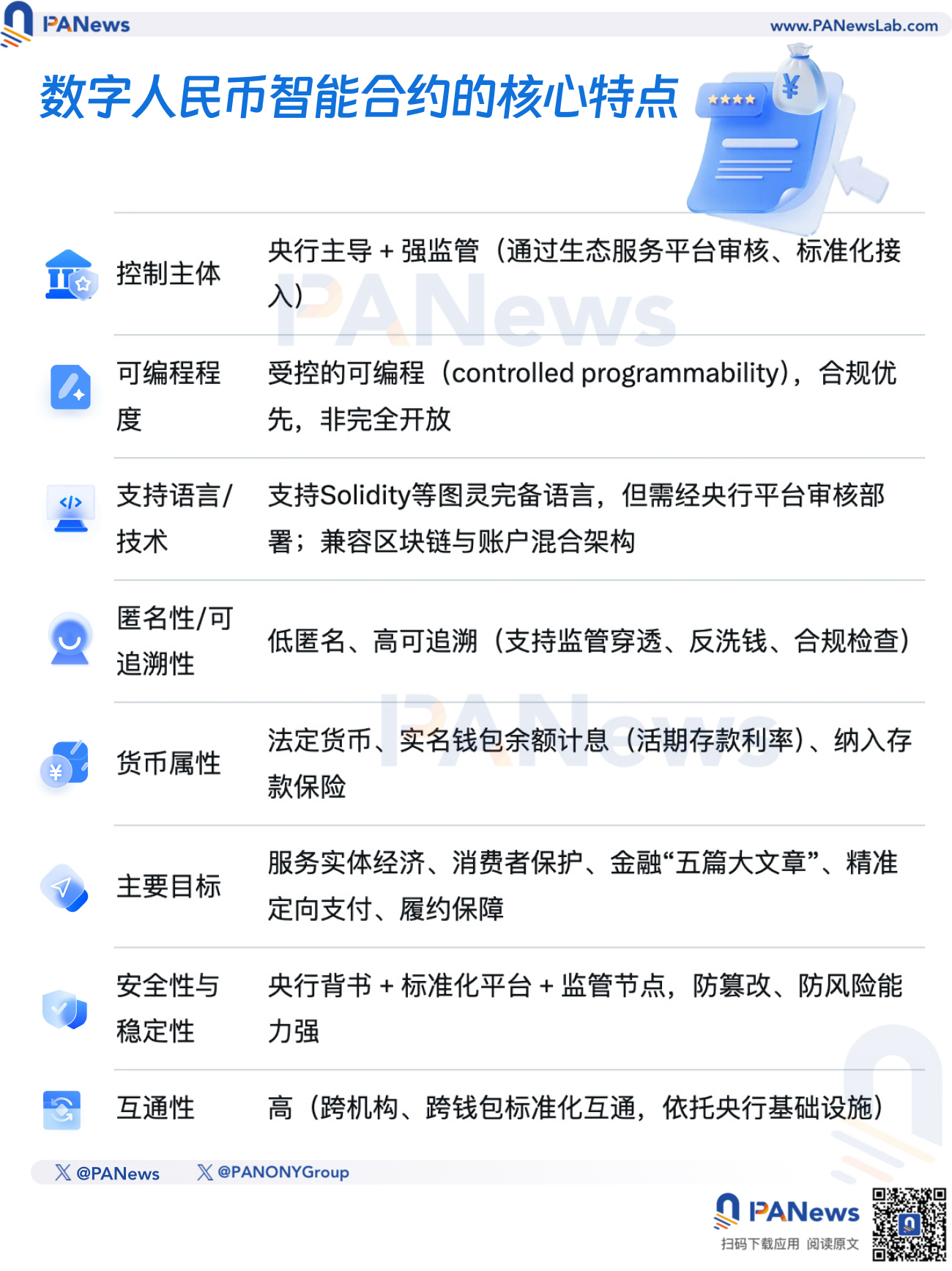
For example, in the pre-paid field, the digital yuan can achieve fund management modes like 'thawing in installments, paying per use'; in family and campus scenarios, parents can restrict children's accounts to specific consumption ranges; in government subsidy areas, the use of funds can also be precisely controlled.

In terms of technical implementation, according to disclosures by Caixin Net, the digital yuan adopts a restricted Turing-complete design, only supporting templated scripts permitted by the central bank. This design, while limiting certain functions, effectively ensures system security and controllability. Compared to the fully Turing-complete smart contracts of the crypto world, this design of the digital yuan avoids common risks like vulnerabilities, attacks, and governance failures in smart contracts. It is worth mentioning that the development of digital yuan smart contracts supports multiple programming languages, including fully Turing-complete languages compatible with Ethereum like Solidity. Therefore, development potential is not limited.

Furthermore, the digital yuan has demonstrated payment resilience. Its dual-offline payment function allows both payer and payee to complete transactions via手机NFC (Near Field Communication) in a no-network environment. This capability is irreplaceable in emergency scenarios and special environments. In contrast, in crypto systems, whether Bitcoin or stablecoin payments, they almost all rely on continuous internet connection to complete ledger synchronization and final settlement.
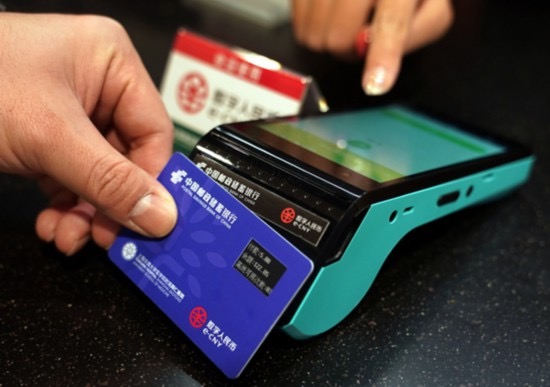
To bridge the 'digital divide' and adapt to the usage habits of different groups such as the elderly, students, and overseas visitors to China, the digital yuan also offers various forms of hard wallets, including IC cards, wearable devices (e.g., watches), SIM cards, and mobile terminals. This is fundamentally different from crypto hard wallets, which are primarily used for 'cold storage' of private keys as a defense against hacking attacks; digital yuan hard wallets focus more on the inclusivity of high-frequency payments. However, currently limited by the cost of deploying merchant acceptance terminals and the willingness to upgrade, the actual usage scope of digital yuan hard wallets remains limited, and their practical penetration effect still requires further observation.

Currently, the digital yuan is accelerating its evolution into a full-scenario currency. Its applications have broken through the retail sphere, forming replicable and promotable application models in areas like wholesale payments, public services, social governance, and even cross-border settlement, covering both online and offline scenarios. It is expected to further become an indispensable infrastructure in the digital economy.

Cross-border payment, in particular, is an important direction after its upgrade, supporting three-level transfers for countries, merchants, and individuals. As stablecoins rapidly penetrate the global cross-border payment field, the digital yuan is accelerating its 'going global' journey, becoming an important driving force for the internationalization of the renminbi. Through cross-border payments, the digital yuan can not only improve payment efficiency and reduce costs but also secure a place in the global payment system. For example, when overseas tourists consume in China, they don't need to exchange foreign currency; they can simply use the digital yuan App to scan a code and complete payment in their local currency at the real-time exchange rate. Currently, cross-border transfers conducted via mBridge have cumulatively exceeded $55 billion, with 95% settled using digital yuan.

In summary, for the digital yuan to truly complete the leap from a policy tool to a mass-market product, the real test may have just begun. But its path and potential are clearer than ever before.


Twitter:https://twitter.com/BitpushNewsCN

Bitpush TG Discussion Group:https://t.me/BitPushCommunity

Bitpush TG Subscription: https://t.me/bitpush

Original Link:https://www.bitpush.news/articles/7604656

Related Questions

QWhat is the major upgrade that digital yuan (e-CNY) underwent on January 1, 2026, and how does it benefit users?

AThe major upgrade is that digital yuan transitioned to an 'interest-bearing stablecoin.' Users with verified (Class I, II, and III) wallets can now earn interest on their holdings at the current demand deposit rate of 0.05% per annum, paid quarterly. This provides users with a reason to hold digital yuan as their short-term idle funds can now generate yield automatically and with zero operational cost.

QHow did the initial M0 (digital cash) positioning of the digital yuan limit its adoption by commercial banks, and how has the shift to M1 changed this?

AInitially, as M0, the digital yuan operated on a 100% reserve system. This meant commercial banks had to deposit 100% of the digital yuan they received with the central bank, freezing those funds. Banks could not use them for lending or other profitable activities, making the system a cost center with little incentive for promotion. The shift to M1 reclassifies the funds in user wallets as a liability of the commercial banks. Now, banks only need to deposit a portion (the required reserve ratio) with the central bank and can use the remaining funds to develop profitable services, such as exclusive wealth management products, turning digital yuan into a potential profit center and incentivizing banks to promote it.

QWhat is a key technological advantage of the digital yuan's smart contracts compared to those in the crypto world, according to the article?

AA key technological advantage is its security and controllability. The digital yuan uses a 'restricted Turing-complete' design, which only supports templated scripts permitted by the central bank. This design, while still supporting languages like Solidity, effectively avoids common risks found in fully Turing-complete smart contracts in the crypto world, such as vulnerabilities, attacks, and governance failures, ensuring system safety and control.

QBesides retail payments, in which other significant area is the digital yuan expanding its application, and what is a specific example provided?

AThe digital yuan is expanding significantly into cross-border payments. A specific example is the mBridge project, through which cross-border transfers have cumulatively exceeded $55 billion, with 95% of these settlements conducted using the digital yuan. This facilitates more efficient and lower-cost international transactions and serves as a key driver for the internationalization of the renminbi.

QHow does the security backing for the digital yuan's value differ from that of crypto-based stablecoins?

AThe value of the digital yuan is backed by the full faith and credit of the Chinese state. It is included within the deposit insurance system, guaranteeing compensation of up to 500,000 yuan per account in case of bank failure. This state-backed security framework is fundamentally different from crypto stablecoins, which rely on code, algorithmic mechanisms, or collateral reserves that are subject to smart contract risks, de-pegging events, and regulatory uncertainty.

Related Reads

SemiAnalysis Dissects Huawei's Kirin 9030: Process Technology Halted, So They Folded the Chip

SemiAnalysis has published a detailed teardown report on the HiSilicon Kirin 9030 Pro chipset found in Huawei's Mate 80 Pro. Fabricated using SMIC's most advanced N+3 node without EUV lithography, the analysis reveals significant technical achievements and strategic shifts. The report indicates SMIC's N+3 has achieved transistor density comparable to TSMC's N6 (113.4 vs 107.7 MTr/mm²), primarily through aggressive use of Self-Aligned Quadruple Patterning (SAQP) for its metal layers. This results in a notably small 32.5nm M0 metal pitch. However, SemiAnalysis notes this achievement comes with significantly higher process complexity, cost, and potential yield challenges compared to competitors using more advanced tools. The Kirin 9030 design maximizes this constrained density. While its GPU performance has improved ~70% and matches Qualcomm's 2022 flagship level, the CPU core's IPC lags behind current top-tier designs from Apple and Qualcomm, a gap attributed to the underlying manufacturing technology rather than design capability. Facing long-term restrictions on advanced tools, Huawei is charting a new path. The report highlights the company's "LogicFolding" roadmap, a 3D stacking technique aimed at shortening signal paths to boost performance and efficiency. The goal is to reach 5GHz frequency and a projected density of 295 MTr/mm² by 2031. SemiAnalysis concludes that export controls have not halted China's chip progress but have fundamentally altered its trajectory, making it more expensive and complex. This has spurred innovation in alternative areas like 3D stacking and domestic EDA tool development, with Huawei's supply chain also beginning to integrate Chinese memory from CXMT.

marsbit33m ago

SemiAnalysis Dissects Huawei's Kirin 9030: Process Technology Halted, So They Folded the Chip

marsbit33m ago

How Will the Price Move Before SpaceX's Next Share Unlock?

TL;DR Investors buying SPCX after SpaceX's IPO are not simply investing in a typical tech stock. It’s a high-valuation asset driven by Musk's narrative, Starlink, and space transport potential, but with a key twist: a very small initial float of ~4% has led to significant post-listing price appreciation. The current price action reflects a timing gap. Before the first lock-up expiration (estimated around August, subject to official confirmation), scarcity and high demand could continue to push prices up. Short-term bulls focus on low float, FOMO, and potential index inclusion. However, bears point to the supply dynamics that will change post-lockup. Existing shareholders still hold over 95% of shares, which will be released in stages starting from the first unlock window. This introduces future selling pressure from low-cost holders. The upcoming Q2 earnings report is a critical catalyst before the unlock. It will test whether the company's fundamentals can justify the current ~$2.1T valuation. Strong results could support the pre-unlock momentum, while weak figures could amplify concerns about future supply. The trading thesis is shifting from immediate scarcity ("can't buy enough") to evaluating future absorption capacity ("who will buy when more supply hits"). The path ahead hinges on the specifics of the unlock schedule, Q2 earnings performance, and whether anticipated passive index buying materializes.

marsbit53m ago

How Will the Price Move Before SpaceX's Next Share Unlock?

marsbit53m ago

Bitcoin Short-Term Bullish Structure Validated, HYPE Low-Entry Window Opens | Guest Analysis

**Market Analysis Summary (Week of June 2026)** **Overall Market Context:** The market environment is exceptionally complex, with the unexpected US-Iran agreement and the reopening of the Strait of Hormuz triggering a global asset repricing and significant volatility. This heightened noise underscores the importance of a structured analytical framework. **Bitcoin (BTC) Analysis & Strategy:** * **Current Status:** The price has climbed above $65,000, currently in a rebound phase (segment 38-39) following a complex 12-segment correction from the May high of $82,850. * **Key Levels:** * **Primary Resistance:** $69,500–$70,500. A successful breakout above $65,000 targets this zone. * **Primary Support:** $65,000 (immediate), followed by $59,000–$60,000 and $55,000. * **Weekly Outlook & Strategy:** The focus is on the confirmation of the $65,000 level. * **Bullish Scenario (Hold $65K):** A move toward the $69.5K–$70.5K resistance zone is anticipated, which is a potential area for initiating medium-term short positions. * **Bearish Scenario (Break below $65K):** A retest of the $60,000–$62,000 support range is likely. * **Medium-Term Strategy:** Currently neutral. Plan to establish short positions (up to 60% allocation) either in the $69.5K–$70.5K resistance zone upon signs of rejection, or on a confirmed breakdown below $65,000 and further below $59K–$60K. * **Short-Term Strategy:** Utilize 30% capital for scalping opportunities based on support/resistance levels, using 30/60-minute charts. **HYPE Analysis & Strategy:** * **Current Status:** The price has stabilized around $52 after a four-segment decline from the June high of $75.87 and is now in a rebound (segment 50-51). * **Key Levels:** * **Primary Resistance:** $62.50–$64.57. Watch for potential rejection here to form a lower high. * **Primary Support:** $52–$55.50, followed by $47–$49. * **Weekly Outlook & Strategy:** Adopt a "buy on dips, avoid chasing rallies" approach. * **Core View:** Monitor the price action and potential formation of a lower high ("endpoint 51") in the $62.50–$64.57 resistance zone. * **Short-Term Strategy:** Consider light long positions (max 30% allocation) if the price finds support and shows reversal signals in the $52–$54.50 or deeper $47–$49 support zones, confirmed by proprietary quantitative bottom signals. **Trade Review:** Last week's HYPE short-term long trade, executed based on proprietary "Price Difference" and "Momentum" model signals, yielded a profit of approximately 11.88%. The entry was near $54.39 and exit near $60.85. **Risk Management Reminder:** Always set an initial stop-loss upon entry. Move stop-loss to breakeven at +1% profit, then trail it upwards to lock in gains as the trade progresses. *Disclaimer: All analysis, models, and strategies are based on personal technical analysis for educational purposes only, not investment advice. The market carries inherent risk.*

Odaily星球日报58m ago

Bitcoin Short-Term Bullish Structure Validated, HYPE Low-Entry Window Opens | Guest Analysis

Odaily星球日报58m ago

Bitcoin Short-Term Bullish Structure Validated, HYPE Accumulation Window Opens | Guest Analysis

**Bitcoin and HYPE Market Analysis: Short-Term Outlook and Trading Strategies** This market analysis examines Bitcoin (BTC) and HYPE amid volatile conditions, providing short-term outlooks and specific trading strategies. **Key Outlooks:** * **Bitcoin (BTC):** Focus is on whether BTC's recent move above $65,000 holds. A successful breakout could lead to a test of the $69,500-$70,500 resistance zone, where medium-term short positions are considered. A failure, breaking below $65,000, may trigger a decline towards the $59,000-$60,000 support area. * **HYPE:** The token completed a four-wave correction and is now rebounding. The key resistance zone is $62.5-$64.57. The trading strategy is "buy on dips," looking for entry opportunities near the $52-$54.5 or deeper $47-$49 support zones, pending confirmation from proprietary models. **BTC Trading Strategy:** * **Medium-term:** Primarily looking to establish short positions (up to 60% allocated capital) if price rallies to the $69,500-$70,500 resistance area and shows signs of reversal. Alternative plans involve initiating shorts on a breakdown below $65,000. * **Short-term:** Allocate up to 30% capital for intraday "spread" trades based on support/resistance levels on 30/60-minute charts. **HYPE Trading Strategy:** * **Short-term:** Adopt a dip-buying approach. Consider light long positions (under 30% capital) when price tests key support levels ($52-$54.5 or $47-$49) and shows stabilization, confirmed by proprietary "Price Spread" and "Momentum Quant" models. **Trade Recap:** The analysis reviews a successful HYPE long trade from the previous week, executed at ~$54.39 and closed at ~$60.85 for an ~11.88% gain, based on signals from the aforementioned models. **Risk Management Emphasis:** The article stresses strict capital allocation (under 30-60%), immediate initial stop-loss placement, and a trailing stop-loss protocol to lock in profits as trades move favorably. ***Disclaimer:** All analysis, models, and strategies are for educational purposes based on technical analysis, not investment advice. Markets are volatile; trade with caution.*

marsbit1h ago

Bitcoin Short-Term Bullish Structure Validated, HYPE Accumulation Window Opens | Guest Analysis

marsbit1h ago

Trading

Spot
Futures

Hot Articles

What is $BANK

Bank AI: A Revolutionary Step in the Future of Banking Introduction In an era marked by rapid advancements in technology, Bank AI stands at the intersection of artificial intelligence (AI) and banking services. This innovative project seeks to redefine the financial landscape, enhancing operational efficiency, security measures, and customer experiences through the power of AI. As we embark on this exploration of Bank AI, we will delve into what the project entails, its operational dynamics, its historical context, and significant milestones. What is Bank AI? At its core, Bank AI represents a transformative initiative aimed at integrating artificial intelligence into various banking operations. This project harnesses the capabilities of AI to automate processes, improve risk management protocols, and enhance customer interaction through personalised services. The primary objectives of Bank AI include: Automation of Banking Functions: By leveraging AI technologies, Bank AI aims to automate routine tasks, reducing the burden on human resources and enhancing efficiency. Enhanced Risk Management: The project utilises AI algorithms to predict and identify risks, thereby fortifying security measures against fraud and other threats. Personalisation of Banking Services: Bank AI focuses on offering tailored financial products and services by analysing customer data and behaviours. Improving Customer Experience: The implementation of AI-driven solutions, such as chatbots and virtual assistants, aims to provide users with more human-like interactions, revolutionising the way customers engage with banks. With these goals, Bank AI positions itself as a crucial player in rendering banking more efficient, secure, and user-centric. Who is the Creator of Bank AI? Details regarding the creator of Bank AI remain unknown. As such, no specific individual or organisation has been identified in the available information. The anonymity surrounding the project's inception raises questions but does not detract from its ambitious vision and objectives. Who are the Investors of Bank AI? Similar to the project's creator, specific information regarding the investors or supporting organisations of Bank AI has not been disclosed. Without this information, it is challenging to outline the financial backing and institutional support that might be propelling the project forward. Nevertheless, the importance of having a robust investment foundation is pivotal for sustaining development in such an innovative field. How Does Bank AI Work? Bank AI operates on several innovative fronts, focusing on unique factors that differentiate it from traditional banking frameworks. Below are key operational features: Automation: By applying machine learning algorithms, Bank AI automates various manual processes within banks. This results in reduced operational costs and allows human workers to redirect their efforts towards more strategic activities. Advanced Risk Management: The integration of AI into risk management practices equips banks with tools to accurately predict potential threats such as fraud, ensuring that customer information and assets remain secure. Tailored Financial Recommendations: Through continuous learning from customer interactions, the AI systems develop a nuanced understanding of user needs, enabling them to offer tailored advice on financial decisions. Enhanced Customer Interactions: Utilizing chatbots and virtual assistants powered by AI, Bank AI enables a more engaging customer experience, allowing users to have their queries resolved quickly, thus reducing wait times and improving satisfaction levels. Together, these operational features position Bank AI as a pioneer in the banking sector, establishing new benchmarks for service delivery and operational excellence. Timeline of Bank AI Understanding the trajectory of Bank AI requires a look at its historical context. Below is a timeline highlighting important milestones and developments: Early 2010s: The conceptualisation of AI integration into banking services began to gain attention as banking institutions recognised the potential benefits. 2018: A marked increase in the implementation of AI technologies occurred when banks started using AI tools like chatbots for basic customer service and risk management systems for improved security handling. 2023: The sophistication of AI continued to advance, with generative AI being introduced for more complex tasks such as document processing and real-time investment analysis. This year marked a significant leap in the capabilities afforded to banks by AI technology. 2024-Current Status: As of this year, Bank AI is on an upward trajectory, with ongoing research and developments poised to further enhance capabilities in banking operations. Continued exploration of AI applications hints at exciting developments yet to come. Key Points About Bank AI Integration of AI in Banking: Bank AI focuses on adopting artificial intelligence to streamline banking processes and improve user experiences. Automation and Risk Management Focus: The project strongly emphasises these areas, aiming to shift the burden of routine tasks while enhancing security frameworks through predictive analytics. Personalised Banking Solutions: By harnessing customer data, Bank AI enables tailored banking services that cater to individual user needs. Commitment to Development: Bank AI remains committed to ongoing research and development efforts, ensuring its adaptability and ongoing relevance as technology continues to evolve. Conclusion In summary, Bank AI exemplifies a crucial step forward in the banking industry, leveraging artificial intelligence to reshape operational paradigms, enhance security, and promote customer satisfaction. Despite gaps in information surrounding the creator and investors, the clear objectives and functional mechanisms of Bank AI provide a strong foundation for its ongoing evolution. As AI technology continues to advance and merge with the banking sector, Bank AI is well-positioned to significantly impact the future of financial services, enhancing the way we understand and interact with banking.

152 Total ViewsPublished 2024.04.06Updated 2024.12.03

What is $BANK

Discussions

Welcome to the HTX Community. Here, you can stay informed about the latest platform developments and gain access to professional market insights. Users' opinions on the price of BANK (BANK) are presented below.

活动图片