OpenSea Launches ERC-8257: A Tool Store for AI Agents, Unlock APIs by Buying an NFT

marsbitPublished on 2026-05-27Last updated on 2026-05-27

Abstract

OpenSea has merged the ERC-8257 standard, an on-chain "Agent Tool Registry" that enables AI Agents to autonomously discover, pay for, and access tools. This standard allows developers to publish tools with programmable access rules (e.g., NFT ownership, subscriptions) and pricing directly on-chain. For example, an AI Agent needing a premium API can buy the required NFT itself and gain access without human intervention, turning NFTs into keys for the agent economy. The system works with complementary standards like ERC-8004 for agent identity and x402 for payments. A live demo shows an NFT appraisal tool offering discounted rates to holders of a specific NFT collection. ERC-8257 aims to decentralize tool distribution and access control, allowing any on-chain asset to grant utility to AI agents. The SDK is available for building on Ethereum and Base.

Author: OpenSea

Compiled by: TechFlow

TechFlow Introduction: When an AI Agent is denied by an API due to insufficient permissions, it goes and buys an NFT on-chain, then retries and succeeds — this is not science fiction; OpenSea's newly merged ERC-8257 standard makes this a reality. For NFT holders, the JPGs you own might suddenly become keys to the Agent economy. For developers, tool publishing, pricing, and access control are all placed on-chain, no longer requiring endorsement from centralized platforms.

App Store provides developers with a place to publish tools, users with a place to browse, and built-in access control and payment. The AI Agent tool ecosystem requires similar infrastructure.

But today, Agent tools are scattered across documentation, GitHub repositories, and centralized directories. There is no open tool registry, no standardized access control, and Agents cannot browse available tools and acquire them as needed.

Watching a software pay another software autonomously for access, with no human intervention — it feels a bit strange indeed. But that's precisely the point.

ERC-8257: Agent Tool Registry is the foundational layer that makes all this work. This is the newly merged open Ethereum standard: an on-chain registry where anyone can publish tools, declare access rules and pricing, allowing Agents to autonomously meet these requirements.

For Tool Developers: Publish once, set access thresholds for your NFT holders, offer subscription packages, limit seat counts, let them trade in open markets. Your rules, executed on-chain.

For Agents: Browse the registry, see what's required, then handle it. Purchase an NFT, mint a subscription, sign a payment. No human intervention needed.

Imagine This Scenario

An AI Agent is helping you evaluate NFT prices. It tries to call a professional pricing tool. The tool responds: Access denied, you need to hold a specific NFT for a discounted price. The Agent immediately buys one on-chain, retries, and gets the answer.

Seconds, not days. No human involvement throughout.

This is the world ERC-8257 makes possible. Not five years from now. Today.

Why On-Chain?

Crypto is the only infrastructure that allows access rules to be both rich and self-service. x402 proved it: pay-per-call, immediate access. But pay-per-call is just one form of access. Trading signals might need limited seats. Partner APIs might be open only to holders. Research subscriptions might require tiered pricing. ERC-8257 handles it all.

How It Works

You register a tool with a manifest (tool functions, invocation methods, fees) and an "access predicate." The access predicate is a smart contract that answers one question: Does this address have access?

A predicate can check any condition: NFT ownership, active subscription (ERC-5643), whitelist, ZK proof, DAO vote, staking amount. Predicates are pluggable, following the same pattern as Seaport zones and Uniswap v4 hooks: an extension point, an open design space.

ERC-8257 handles discovery and access control. Payment is handled by the most suitable protocol: x402 for micropayments, MPP for metered billing, others join as needed. These layers are composable.

What This Means for NFTs

Every NFT collection just gained new potential utility.

Hold the right token, and your Agent gets cheaper API packages. Mint a limited seat, and your Agent gains access that others can't buy at any price. PFP collections, membership passes, CC0 artwork — any on-chain asset can become a key to tools your Agent needs to do its job.

Projects built around community identity now have a way to extend membership into the Agent economy.

Its Place in the Tech Stack
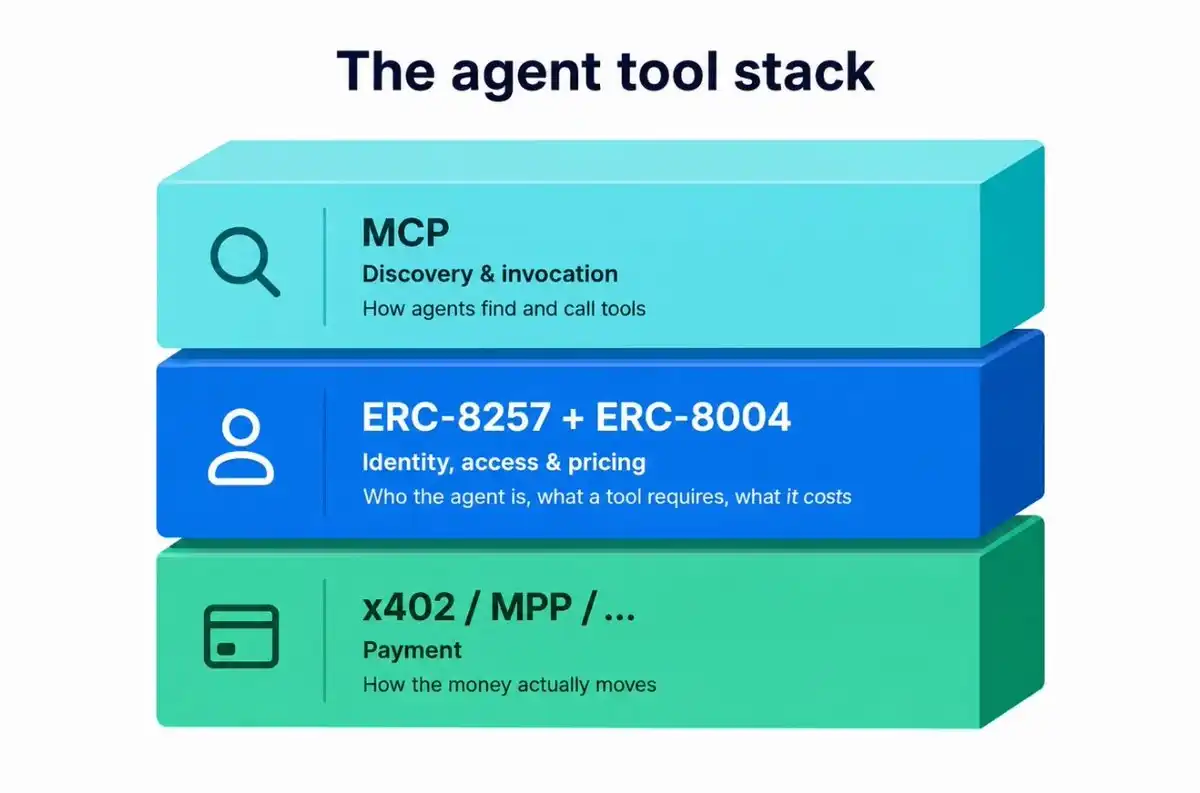
MCP tells your Agent what tools exist. ERC-8004 defines your Agent's identity. ERC-8257 explains how to actually use a tool. x402 handles payment. Each layer is composable.

An Agent registered via ERC-8004 can link to restricted tools from the ERC-8257 registry in its services array. You don't need to choose between them. They are different layers of the same tech stack.

See It in Action

nft-appraisal-tool: Point it to any NFT, it returns a price appraisal including low/mid/high ranges, confidence, recent trades, and comparable cases. Two tiers: 0.05 USD/call for anyone, 0.01 USD/call for CHONK holders on Base.

An Agent without CHONK calls the holder endpoint. Response: 403 — predicate gate denied. You need CHONK on Base.

The Agent buys one, retries, and the same call returns success.

$ npx @opensea/tool-sdk pay https://nft-appraisal-tool.vercel.app/api/holder --auth siwe \

--body '{"chain":"ethereum","contractAddress":"0x79fcdef22feed20eddacbb2587640e45491b757f","tokenId":"4707"}'

Wallet: 0x3184...0465

Response (403):

{"error":"Predicate gate: access predicate denied","toolId":"2","predicate":"0xc872..."}

The predicate explicitly tells it what's needed: CHONK on Base. The Agent buys one on OpenSea and retries, the call goes through.

$ npx @opensea/tool-sdk pay https://nft-appraisal-tool.vercel.app/api/holder --auth siwe \
--body '{"chain":"ethereum","contractAddress":"0x79fcdef22feed20eddacbb2587640e45491b757f","tokenId":"4707"}'
Wallet: 0x5eca...e2a8

Response (200):
{
"low": {"amount": "1.8", "currency": "ETH", "usd": 5460},
"mid": {"amount": "2.3", "currency": "ETH", "usd": 6970},
"high": {"amount": "3.1", "currency": "ETH", "usd": 9400},
"confidence": "medium",
"reasoning": "Comparable Squiggles in this color band sold between 1.9 and 2.6 ETH...",
...
}

No human between the 403 and the 200. Whoever holds the access NFT has the access.

What Can Be Built Next?

Professional pricing oracles. On-chain analytics subscriptions. Research subscriptions. Partner whitelist APIs. Limited-seat tools traded in open markets like any other asset.

None of these needed to exist a year ago. The moment the registry goes live, they all become possible.

Start Building

Live on Ethereum and Base.

@opensea/tool-sdk handles the low-level details, providing scaffolding, gating, registration, deployment to Vercel, Cloudflare, or Express. Includes usable examples.

npx @opensea/tool-sdk init my-tool

Full specification at 8257.ai.

Get Involved

ERC-8257 is still in draft. Help us improve the spec before we launch Registry 1.0. Publish a tool, even a small one. We'll promote interesting projects.

Join the Telegram group t.me/ERC8257 to discuss ERC, tool SDK, and more with the authors @CodinCowboy and @ralxz.

Disclaimer: This content is for informational purposes only and does not constitute financial or trading advice. Mention of specific projects, products, services, or tokens does not constitute endorsement, sponsorship, or recommendation by OpenSea. OpenSea does not guarantee the accuracy or completeness of the information presented, and readers should independently verify any statements before taking action. Readers should conduct their own due diligence and assume full responsibility for any decisions made.


Trending Cryptos

Related Questions

QWhat is the main purpose of ERC-8257 introduced by OpenSea?

AThe main purpose of ERC-8257 is to serve as an on-chain registry for AI agent tools. It allows developers to publish tools, set access rules (like requiring a specific NFT for access), define pricing, and manage subscriptions. This enables AI agents to autonomously discover, pay for, and use these tools without human intervention.

QHow does an AI agent gain access to a restricted tool according to the article's example?

AIn the article's example, an AI agent is initially denied access (403 error) to an NFT appraisal tool because it lacks the required CHONK NFT on Base. The agent autonomously purchases the necessary NFT on-chain and retries the request. With the NFT now in its possession, the access predicate grants permission, and the tool call succeeds (200 response), providing the price assessment.

QWhat is an 'access predicate' in the context of ERC-8257?

AAn 'access predicate' in ERC-8257 is a smart contract that defines the conditions for accessing a tool. Its sole function is to answer the question: 'Does this address have access?' It can check for various conditions such as NFT ownership, active subscriptions (e.g., ERC-5643), inclusion in a whitelist, ZK proofs, DAO votes, or staking amounts, making the access control system flexible and pluggable.

QHow does ERC-8257 potentially change the utility of existing NFTs?

AERC-8257 gives existing NFT collections new potential utility by allowing them to act as keys or passes for AI agent tool access. Holding a specific NFT could grant an agent discounted API rates, exclusive tool access, or membership privileges. This extends the value of PFP collections, membership passes, and other on-chain assets into the emerging agent economy.

QWhat role does the x402 protocol play in the ERC-8257 ecosystem?

AThe x402 protocol handles the payment layer within the ERC-8257 ecosystem. It is designed for micro-payments, enabling per-use, immediate payment for tool access. While ERC-8257 manages tool discovery and access control, x402 (alongside other protocols like MPP for metered billing) provides the financial infrastructure for agents to autonomously pay for the services they consume.

Related Reads

Annual Salary of Millions Competing for Electricians, Meta Rushes to Open Its Own Technical School

The AI boom is facing an unexpected bottleneck: a severe shortage of skilled construction workers and electricians. As tech giants like Meta, OpenAI, and Alphabet race to build massive data centers—such as OpenAI's $16 billion "Stargate" project—they are hitting a critical labor wall. The U.S. needs an estimated 130,000 more electricians, 240,000 construction workers, and 150,000 supervisors by 2030 for AI infrastructure alone, but tens of thousands of electrician jobs go unfilled each year. While AI companies offer high premiums, with electricians earning up to $280,000 annually, worker scarcity still causes massive losses—delays on a single project can cost $14.2 million per month. The complexity of building AI data centers, which require immense power (equivalent to powering hundreds of thousands of homes), sophisticated electrical systems, and advanced liquid cooling solutions, demands highly skilled technicians who are in short supply. To combat this, companies are investing heavily in training. Meta has committed $115 million to a free training school offering tuition, housing, and stipends, targeting 5,000 new workers. OpenAI is partnering with unions to secure skilled labor. These efforts are paying off, with a significant rise in Gen Z interest in trade schools over college. However, the power demands are staggering. AI data centers are driving a rapid surge in electricity consumption, projected to account for up to 12% of U.S. power use by 2028 and raising costs for consumers. Furthermore, the construction boom is project-based, leading to a potential future glut of trained workers once building peaks, which could depress wages industry-wide. The race for AI supremacy now depends as much on skilled hands as on advanced chips.

marsbit49m ago

Annual Salary of Millions Competing for Electricians, Meta Rushes to Open Its Own Technical School

marsbit49m ago

OpenAI No Longer Sells Its Most Expensive Model for Profit

OpenAI is shifting its business strategy away from promoting its most expensive, flagship models for every task. Recent price cuts—80% for GPT-5.6 Luna and 20% for Terra—signal a deeper change: the company now actively advises users that many tasks don't require the most powerful model. Instead, OpenAI recommends a tiered approach: use the high-end GPT-5.6 Sol for complex planning and analysis, then delegate execution to cheaper models like Luna. This mirrors moves by Anthropic, which recently launched Claude Opus 5 at half the price of its top model, Fable 5. Both companies are de-emphasizing flagship models as primary revenue drivers, using them instead for brand prestige and technological showcases. The industry is entering a "mass-market" phase, similar to automotive, where high-volume, cost-effective models handle daily operations and drive scale. OpenAI's price reductions are partly enabled by AI models themselves optimizing underlying code and infrastructure, creating a self-reinforcing cycle of efficiency gains and cost reduction. Competition is shifting from "who is smartest" to "who offers the best value." The goal is no longer selling individual models but fostering widespread API adoption and ecosystem lock-in. By making AI calls cheap and ubiquitous, companies like OpenAI aim to become the indispensable, utility-like infrastructure powering automated workflows—the "water and electricity" of software, quietly embedded everywhere.

marsbit49m ago

OpenAI No Longer Sells Its Most Expensive Model for Profit

marsbit49m ago

Will the Fed Definitely Raise Interest Rates in September? How Will Crypto and U.S. Stocks Withstand the Pressure?

The market's expectation for a September Fed rate hike surged dramatically in early August, jumping from under 50% to over 80% within a week. This shift followed a contentious July FOMC meeting, where a 9-3 vote to hold rates revealed growing dissent from hawkish members advocating for an immediate hike to combat persistent inflation. The primary catalyst for this repricing is rising oil prices, driven by renewed geopolitical tensions around the Strait of Hormuz, which threaten global supply. Energy costs directly influence inflation metrics, making the upcoming July CPI report (due August 12th) a critical data point. If it shows inflation reaccelerating, the probability of a September hike will solidify. For Bitcoin and crypto assets, this is typically bearish news. Bitcoin continues to behave as a high-beta, liquidity-sensitive risk asset. A rate hike raises the opportunity cost of holding non-yielding assets and could drive capital toward money markets, pressuring crypto prices in the short term. However, historical patterns suggest that if a hike is perceived as the end of a tightening cycle rather than the start, any negative price impact may be brief. U.S. stocks, particularly crypto-linked equities like Coinbase and growth-oriented tech stocks, are also vulnerable. Higher rates increase discount rates in valuation models, putting pressure on high-multiple companies. This coincides with a pivotal tech earnings season where investor focus has shifted from massive AI capital expenditure to tangible revenue and cash flow generation. Companies with negative cash flow and weak growth narratives could face heightened volatility if borrowing costs rise in September. In summary, a September Fed hike has evolved into a mainstream market scenario. Key factors to watch are oil prices, the July CPI report, and Fed communications, which will determine the final decision and its impact on volatile crypto and equity markets.

marsbit1h ago

Will the Fed Definitely Raise Interest Rates in September? How Will Crypto and U.S. Stocks Withstand the Pressure?

marsbit1h ago

Trading

Spot

Hot Articles

How to Buy NFT

Welcome to HTX.com! We've made purchasing AINFT (NFT) simple and convenient. Follow our step-by-step guide to embark on your crypto journey.Step 1: Create Your HTX AccountUse your email or phone number to sign up for a free account on HTX. Experience a hassle-free registration journey and unlock all features.Get My AccountStep 2: Go to Buy Crypto and Choose Your Payment MethodCredit/Debit Card: Use your Visa or Mastercard to buy AINFT (NFT) instantly.Balance: Use funds from your HTX account balance to trade seamlessly.Third Parties: We've added popular payment methods such as Google Pay and Apple Pay to enhance convenience.P2P: Trade directly with other users on HTX.Over-the-Counter (OTC): We offer tailor-made services and competitive exchange rates for traders.Step 3: Store Your AINFT (NFT)After purchasing your AINFT (NFT), store it in your HTX account. Alternatively, you can send it elsewhere via blockchain transfer or use it to trade other cryptocurrencies.Step 4: Trade AINFT (NFT)Easily trade AINFT (NFT) on HTX's spot market. Simply access your account, select your trading pair, execute your trades, and monitor in real-time. We offer a user-friendly experience for both beginners and seasoned traders.

7.7k Total ViewsPublished 2024.03.29Updated 2026.06.02

How to Buy NFT

What is Altura NFT?

Altura: Providing One-Stop NFT Solutions for Game Developers

56.3k Total ViewsPublished 2024.06.12Updated 2024.06.12

What is Altura NFT?

What is AINFT

EternaFi Agents and $AINFT: A Comprehensive Analysis of AI-Powered NFT Infrastructure in the Web3 Ecosystem The intersection of artificial intelligence (AI) and blockchain technology is rapidly evolving, establishing innovative platforms that redefine ownership models and economic participation. EternaFi Agents, along with its native token $AINFT, exemplifies a groundbreaking approach to the tokenization of AI infrastructures through the means of non-fungible tokens (NFTs). Launched in July 2025 by the development team at Nova Club, EternaFi merges the advancements of AI with the decentralized financial mechanisms of blockchain, presenting a unique investment opportunity for participants within the web3 ecosystem. This article aims to provide an in-depth assessment of EternaFi Agents, covering its core components, functionality, and significance within the crypto landscape. Introduction and Project Overview EternaFi Agents stands as a salient example of how blockchain technology can democratize access to advanced AI capabilities. The project endeavors to reshape the paradigm of AI ownership by diversifying economic participation, making sophisticated AI systems accessible to a larger pool of stakeholders. At its core, the project tokenizes a proprietary large language model (LLM) developed by Nova Club, allowing NFT holders to gain fractional exposure to the model's economic performance. By utilizing NFTs representing stakes in the LLM, EternaFi Agents fosters a model wherein stakeholders not only participate in AI service consumption but also enjoy sharing in the economic rewards generated by the platform. This transformative approach enables the development of sustainable revenue models for AI services, all the while promoting broad community engagement and facilitating transparent governance. What is EternaFi Agents? EternaFi Agents represents an AI-NFT infrastructure project that aims to blend the capabilities of AI with blockchain technology in a coherent ecosystem. The essential feature of this project is the creation of NFTs that serve as financial instruments, representing fractions of ownership in Nova Club's proprietary AI infrastructure. Each NFT symbolizes direct exposure to the economic performance of the underlying AI system, providing a lucrative opportunity for investors. The project operates on the Base blockchain, known for its scalability and efficiency, thus ensuring manageable transaction costs while facilitating a seamless operational experience. One of the notable features includes a revenue-sharing mechanism, wherein NFT holders can receive portions of subscription income generated by the AI services provided on the platform. This innovative approach establishes a connection between the success of the AI services and the economic dividends distributed among the holders, thus ensuring an alignment of interests across the community. Who is the Creator of EternaFi Agents? The creative force behind EternaFi Agents is Nova Club, a development team based in Singapore proficient in the amalgamation of AI and blockchain technology. Their prior experience in AI development and cryptocurrency analysis gives credence to the project, contributing a breadth of expertise to the creation of EternaFi Agents. Nova Club’s mission centers on democratizing access to cutting-edge AI technologies while building sustainable economic models that benefit users alongside developers. Their commitment to transparency, community governance, and innovation is reflected in the design and implementation of the EternaFi platform, aiming to establish a unique ecosystem that fosters positive engagement and long-term value creation. Who are the Investors of EternaFi Agents? The specific details concerning investors or investment organizations backing EternaFi Agents are not publicly available. However, EternaFi has adopted an inclusive approach to funding its development through the sale of NFTs to the public, allowing a wide array of participants to invest in the ecosystem. The project’s architecture ensures that core infrastructure is funded responsibly while allowing community members to partake in the ownership and economic returns generated from the AI services. This model emphasizes community engagement by aligning the interests of investors and project developers, creating a collaborative environment where long-term participation is incentivized. How Does EternaFi Agents Work? EternaFi Agents operates through a multifaceted ecosystem where NFTs serve as a primary means of ownership representation within the project. Each NFT holder is entitled to a share of the monthly subscription income produced by the underlying AI-powered platform, thereby positioning NFT ownership as a lucrative investment vehicle. Revenue Generation Mechanism The primary source of revenue generation for the EternaFi platform stems from subscription fees related to the AI services provided. Users can access various tiered services, ranging from basic market analysis tools to comprehensive AI-assisted trading solutions. These services are monetized and form the basis for the revenue-sharing framework, which distributes profits to NFT holders through automated smart contracts. An innovative feature of the EternaFi ecosystem is the revenue-sharing mechanism that operates transparently, ensuring that rewards are allocated based on verifiable metrics from the AI platform's operations. This creates a direct link between the performance of AI services and the returns available to community investors, establishing a sustainable economic model. Staking and Vesting Mechanisms Participants within EternaFi can engage in staking their NFTs to unlock additional economic benefits. The vesting schedule is designed to promote long-term commitment among participants, rewarding those who exhibit ongoing support for the project. This ensures a robust alignment of interests and fosters a sense of community engagement essential for achieving the project's long-term goals. Transparent Governance EternaFi Agents embraces decentralized governance, allowing NFT holders to play an active role in decision-making regarding the platform's development and future directions. The governing structure includes community voting mechanisms, providing NFT holders with the opportunity to influence significant decisions and contributing to a collaborative approach to project growth. Timeline of EternaFi Agents The development trajectory of EternaFi Agents showcases a systematic approach toward building a sustainable AI infrastructure while meeting the needs of community participants. Below is a timeline of important milestones in the project’s history: July 2025: Launch of EternaFi Agents, including the public sale of NFTs and deployment of the $AINFT token on the Base blockchain. Q4 2025: Establishment of market infrastructure including liquidity pools and launch of staking dashboards for NFT holders. 2026: Initiation of community engagement programs, expanding AI capabilities, and integration with cross-chain technologies. Q4 2026: Implementation of the dividend distribution system, allowing NFT holders to reap economic benefits from their investments. These milestones signify the focus on establishing a functional and participative ecosystem while ensuring continuous evolution to meet market demands. Technological Infrastructure and Blockchain Integration EternaFi Agents is anchored in an advanced technological framework combining AI systems with blockchain capabilities. Operating on the Base blockchain, the project leverages the advantages of scalability and low transaction costs. The underlying smart contract architecture governs the NFT ownership, revenue sharing, and community management features, ensuring efficiency and transparency. AI System Development The proprietary large language model underpinning EternaFi Agents has been independently developed and designed to cater to revenue-generating applications without reliance on proprietary external frameworks. This endeavor reflects a commitment to creating a versatile and adaptable AI infrastructure capable of delivering meaningful services to users, thus generating economic value for investors. Security Measures The robustness of EternaFi’s security infrastructure is paramount. Regular audits and stringent security measures ensure the integrity of the AI systems and blockchain mechanisms, safeguarding against potential vulnerabilities while fostering confidence among participants. Conclusion EternaFi Agents signifies a landmark innovation within the realm of artificial intelligence and blockchain technology, opening avenues for community ownership and economic participation in advanced AI capabilities. The project’s comprehensive strategy to tokenize AI infrastructure via NFTs establishes a precedent for future decentralized ecosystems. By harmonizing technical sophistication with user-centric economic models, EternaFi not only fosters engagement but also generates a sustainable revenue-sharing framework for community participants. The significance of EternaFi extends well beyond its operational success as it exemplifies how blockchain can democratize cutting-edge AI technologies, paving the way for future ventures in this intersectional space. The evolution of EternaFi Agents may herald a new era of AI development characterized by participant-driven governance, sustainable economic models, and transparent verification, ultimately contributing to the broader democratization of AI and technology accessibility across industries.

5.0k Total ViewsPublished 2025.08.14Updated 2025.08.14

What is AINFT

Discussions

Welcome to the HTX Community. Here, you can stay informed about the latest platform developments and gain access to professional market insights. Users' opinions on the price of NFT (NFT) are presented below.

活动图片