OpenClaw Endorses Venice.ai, VVV Token Surges Over 500% in One Month

marsbitPublished on 2026-03-04Last updated on 2026-03-04

Abstract

OpenClaw, an open-source self-hosted AI agent platform, has listed Venice.ai—a privacy-focused, decentralized AI project with a native token—among its recommended model providers. This move comes shortly after OpenClaw founder publicly discouraged engagement with cryptocurrencies. Venice.ai, founded by crypto OG Erik Voorhees, emphasizes private, uncensored AI interactions by not storing any user data on its servers. Venice operates a dual-token economy: VVV, a stakable capital asset with an ~19% APY, and DIEM, which is minted from VVV and acts as a perpetual AI compute credit. 1 DIEM (≈$670) provides $1 daily in API credits, making it cost-effective for heavy users like AI agents. VVV’s price surged over 500% in a month, rising from ~$1.5 to ~$8.4, driven by supply constraints—including a token burn of unclaimed airdrops and reduced annual emissions—and growing demand. Venice now has over 25,000 API users, partly fueled by OpenClaw’s endorsement. The project positions itself as a privacy-backend for agent-based AI, combining crypto-economic incentives with scalable, private AI infrastructure.

Original | Odaily Planet Daily (@OdailyChina)

Author | DingDang (@XiaMiPP)
Last week, the statement from the founder of Openclaw advising young people "not to waste time on cryptocurrency" stung the crypto industry. This week, however, the situation took a subtle turn. In the official OpenClaw documentation, an encrypted project with a native Token, Venice.ai, was quietly listed as a recommended model provider. Over the past month, the price of Venice's native token VVV has also risen from a low of around $1.5 to a high of around $8.4, with a maximum increase of over 500%.

On one hand, there's discouragement; on the other, there's integration. Why did OpenClaw specifically push a project with an encrypted token economic structure into the spotlight?
Venice's Origins: What Happens When a Crypto OG Does AI?

To understand Venice, one must first understand OpenClaw's positioning. It is an open-source, self-hosted AI agent platform that can integrate with chat software to become a user's 24/7 personal assistant, helping with tasks like sending/receiving emails and managing calendars. However, OpenClaw itself does not provide AI large language model (LLM) capabilities; it is merely an "execution and routing layer." The actual intelligence (thinking, planning, generating responses) must come from external model providers.

Venice is a generative AI platform focused on privacy and lack of censorship, positioning itself as a decentralized version of ChatGPT. The project launched in May 2024 but has not conducted any fundraising, has no VC rounds, and was entirely started with personal funding from its founder, Erik Voorhees.

Erik Voorhees himself is a crypto old-timer (OG), having entered the crypto industry in 2011. After the collapse of Mt. Gox in 2014, he founded ShapeShift, one of the first trading platforms to emphasize non-custodial and privacy-first principles. In 2021, he chose to transition ShapeShift to DAO governance, completing its decentralization. His career trajectory seems to revolve around "reducing reliance on trust in centralized structures."

Another core team member is Teana Baker-Taylor, with an impressive resume having held executive roles in operations and compliance at HSBC, Circle, Binance, and Crypto.com. Other team members are mostly anonymous or low-key. Based on current public data, the Venice team has about 20 members.

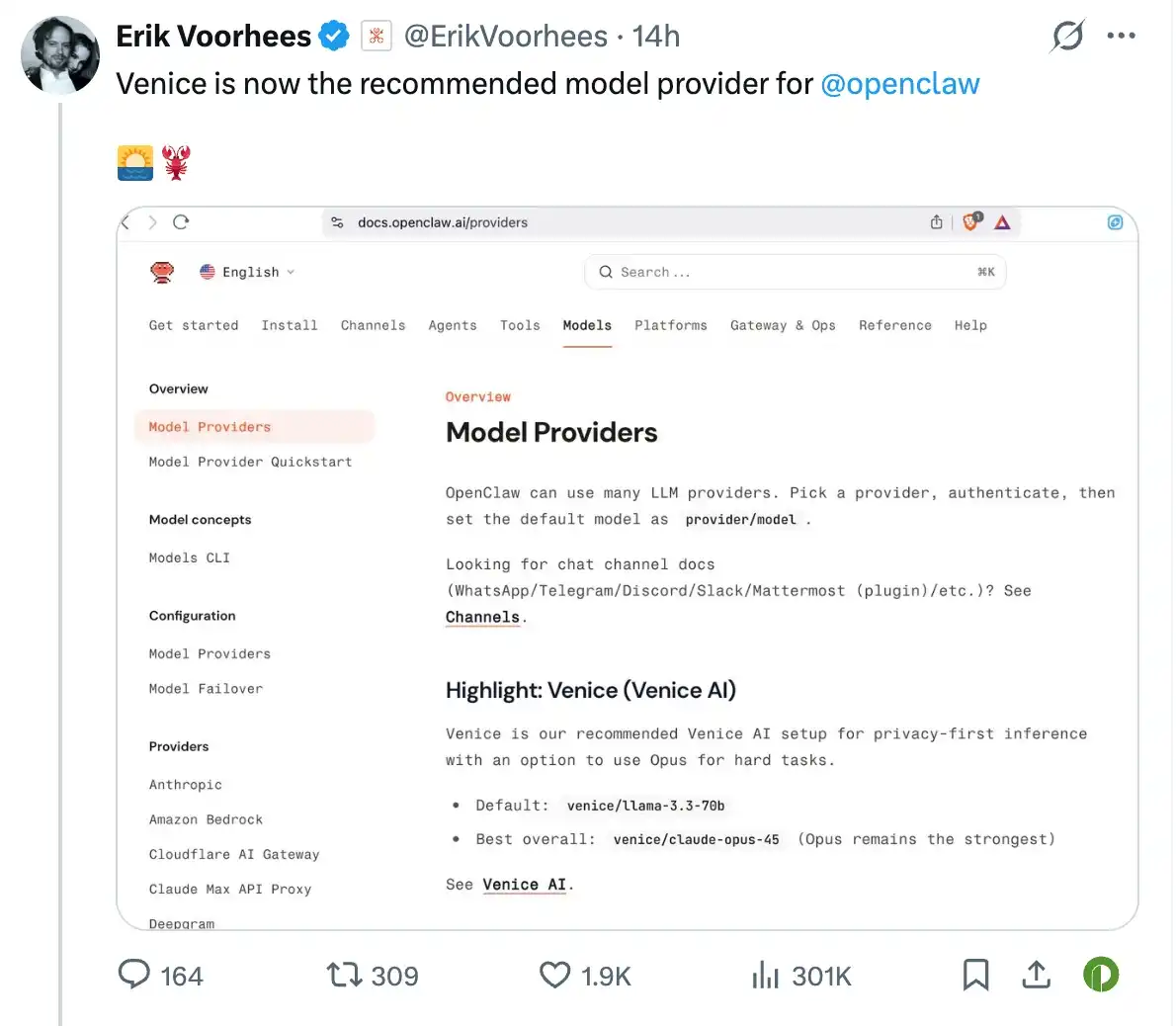
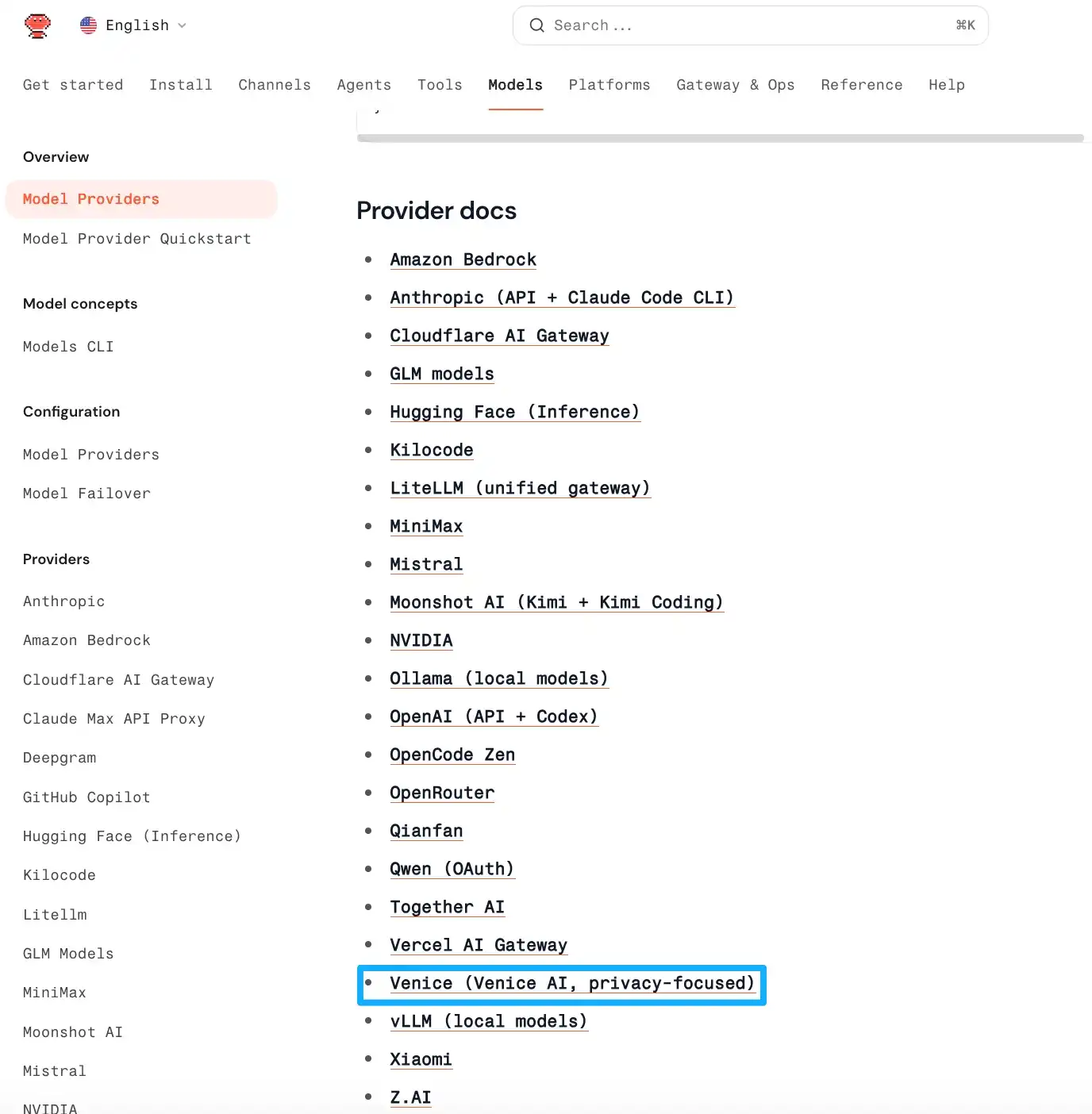
OpenClaw currently lists 22 model providers, including large tech companies like Amazon, Anthropic, and Cloudflare. In terms of size and brand, Venice is clearly not the most prominent one; it might even be the least noticeable. Yet, it was highlighted and recommended in the official documentation as a model provider with a native token economy. However, this highlighting might have been a merge error in the docs; it has since been removed, but Venice was included in OpenClaw's list of model providers earlier.

Even so, why would OpenClaw choose a small, obscure company? The answer is simple: Privacy.

After all, alongside AI's great success, controversies surrounding data leaks and model training related to AI continue to accumulate. Users are beginning to realize that the real risk is not whether the model is "smart," but whether data or information "will be leaked."
So, how exactly does Venice achieve privacy? Its core philosophy is "You don’t have to protect what you do not have." Simply put, Venice does not store any user content—prompts, replies, generated images, uploaded documents—on any Venice servers at all. This data is only encrypted and saved locally on the user's own browser (or device). Once you clear your browser data or manually delete chat history, this content is permanently gone.

Venice also explicitly states that it does not use user data for model training, does not log, and does not analyze behavior. This stands in stark contrast to mainstream platforms (like OpenAI, Anthropic), which often store conversations long-term to improve models or for compliance review.

Furthermore, Venice distinguishes between two privacy modes with different strengths: Private and Anonymized. The former is maximum privacy, using open-source models that run on decentralized GPUs. During processing, no identity-linked information is attached. The underlying compute nodes might briefly see the plaintext prompt, but Venice itself cannot see or access the user's history. In the latter mode, the underlying providers can see the prompt content, but Venice strips all metadata (IP, account fingerprints, historical associations), making it impossible for them to trace the information back to the user.

So, although Venice may not be the most prominent name in the provider list, its privacy architecture made it the specially highlighted "privacy-first choice" in OpenClaw's documentation. Currently, OpenClaw's default model is Llama 3.3, but Erik himself suggested in a reply that users switch to the smarter GLM 4.6.

What does this mean for Venice itself?

OpenClaw is currently experiencing viral扩散 (viral spread), and its call volume is entering a phase of exponential growth. With OpenClaw's official endorsement, it might pull Venice's推理 capacity (inference capacity)需求 to a new level. This means Venice is undergoing a qualitative change. It is no longer just "an AI project with a crypto background" but is attempting to become the default privacy backend for the mainstream open-source Agent ecosystem.

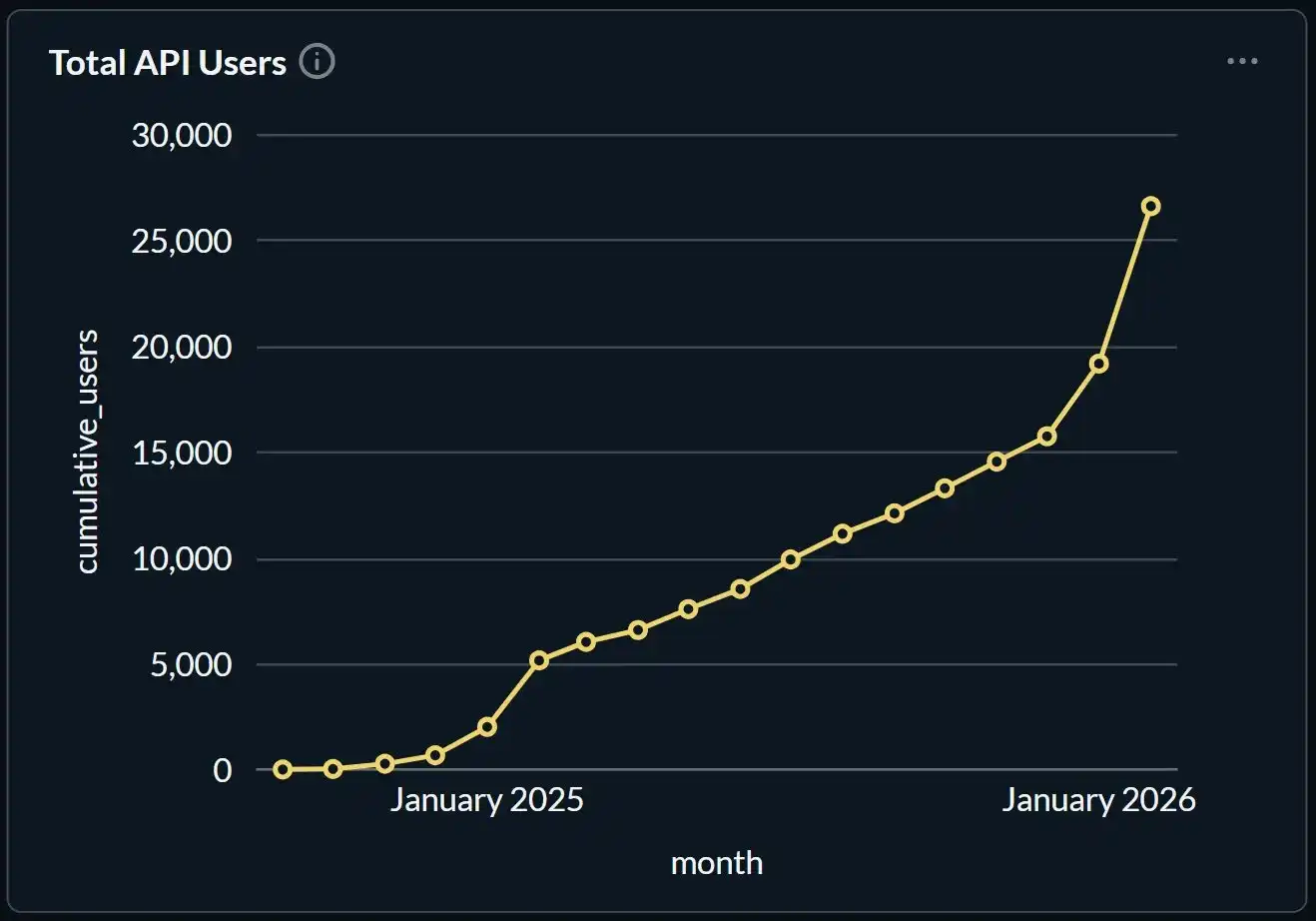
According to the latest data Erik released on March 1st, since the beginning of 2026, the number of Venice API users has begun to grow rapidly, now exceeding 25,000 users.
Token Model: One-Time Investment, Lifetime Compute Power

As a crypto project, can its token economy handle this level of traffic growth?

Within the Venice ecosystem, there are two core Tokens: VVV and DIEM. They are tightly bound through a "one-way minting + reversible redemption" mechanism, forming a two-tier economic structure.

VVV is the capital asset of the entire ecosystem, which can be held directly or staked. Staking VVV yields continuous staking rewards, currently around 19% APY. Another key function of VVV is to mint DIEM, and it is the only way to generate DIEM.

After minting, DIEM can be traded on secondary markets, such as on DEXs like Aerodrome and Uniswap. Or it can be staked to activate spending credit. DIEM represents ownable, perpetual AI computing assets. 1 DIEM = $1 per day of Venice API credit, used to call all of Venice's models (text generation, image/video generation, code, etc.), including the highest privacy, uncensored models in Private mode. This credit is permanently valid and automatically renewed daily during your staking period, effectively acting as a permanent AI subscription voucher.

The $1 credit is somewhat abstract. Within the Venice ecosystem, it's not a fixed "number of tokens" but rather the ability to consume $1 worth of inference resources. The more expensive the model, the less content you can create; the cheaper the model, the more content you can create. This abstract pricing makes DIEM a kind of "compute power share certificate." I asked Venice's AI to quantify what the $1 credit can get you:
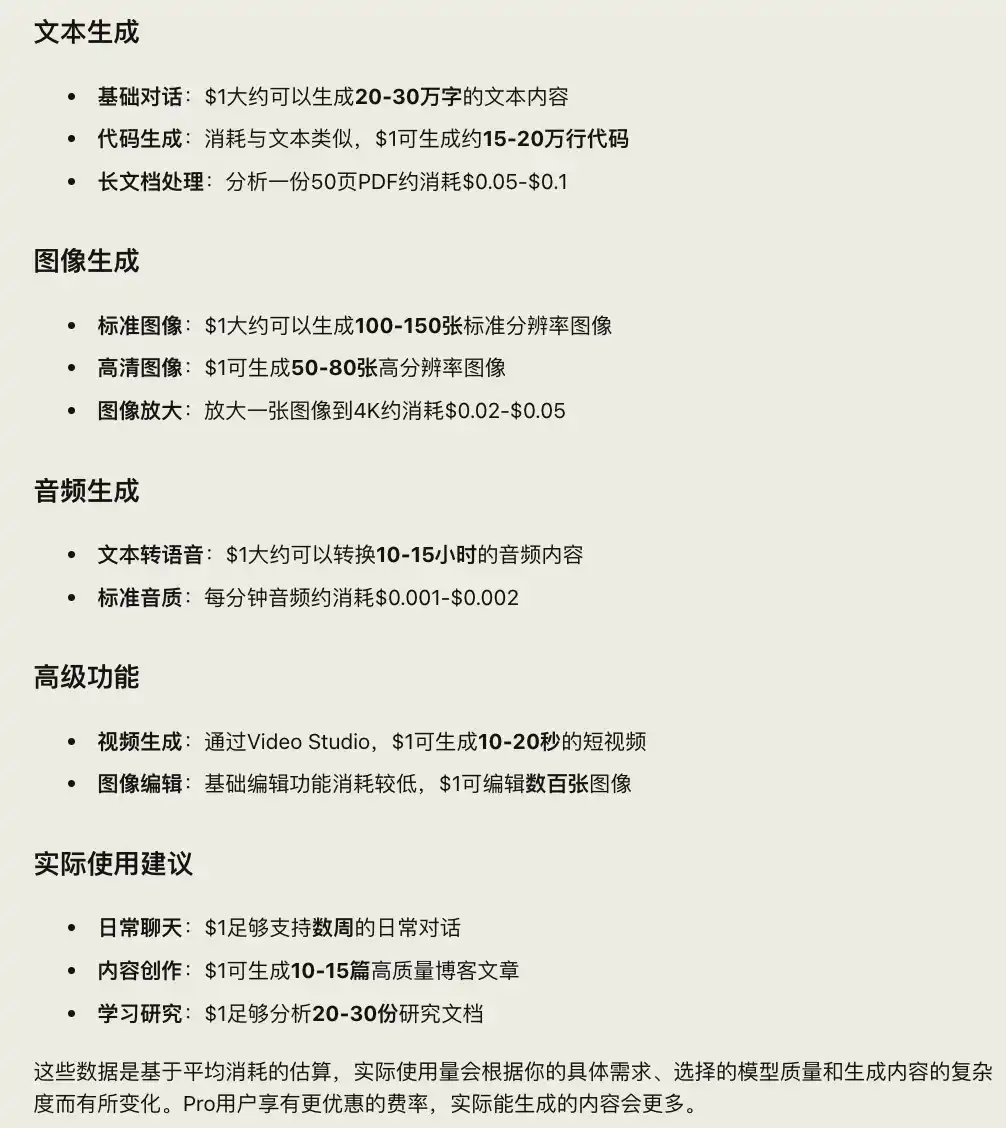
Because traditional AI APIs are pay-per-use, costs can explode exponentially for high-frequency, long-term, automated tasks (like an AI Agent making hundreds or thousands of calls per day). However, Venice, through DIEM, completely颠覆 (overt颠覆 might be intended, meaning颠覆/subvert) this into a one-time investment换取 (in exchange for) long-term fixed quotas. Currently, 1 DIEM is worth about $670. Once staked, it automatically provides $1 worth of API credit per day. To方便对比 (facilitate comparison) whether buying DIEM is more cost-effective or traditional pay-per-use is better, I used Grok to generate a rough table:
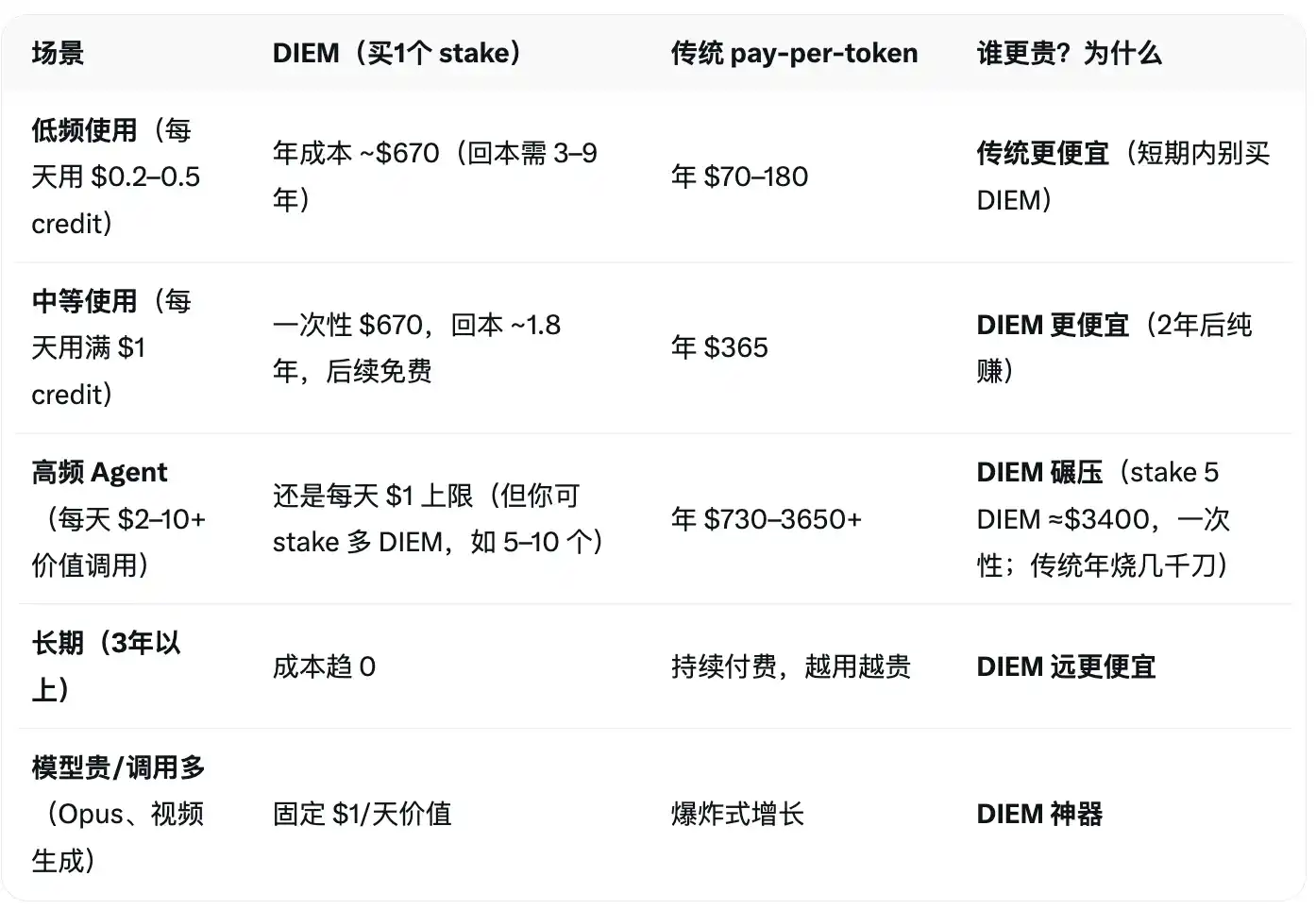
Based on the data above, for low-frequency users, there is no need to purchase DIEM at all. For medium to high-frequency users who need to run Agents daily and generate large amounts of content, the marginal cost decreases continuously with long-term use, giving DIEM a clear advantage.

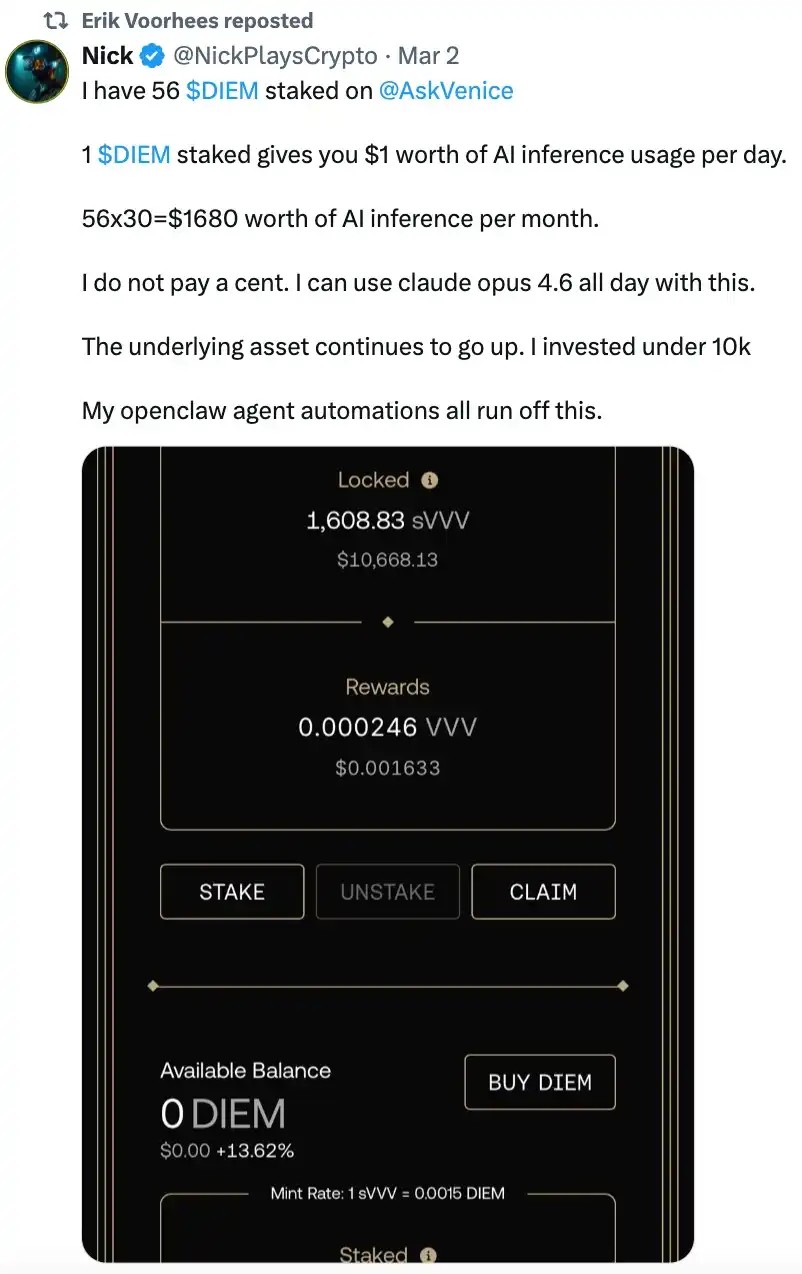
Some users have already come forward to share their experience. One claimed that staking 56 DIEM allows them to use the Claude opus 4.6 model全天 (all day), with a principal cost of less than $10,000.
Moreover, community users have already developed a credit租赁市场 (leasing market), cheaptokens.ai, where unused credit can be sold. An ecosystem market around Venice's compute power is萌芽 (sprouting).

Overall, the core of Venice's economic model lies in separating the "growth logic" from the "usage logic". VVV, as a pure growth asset, carries the platform's overall valuation narrative, directly benefiting from user growth, network effects, ecological expansion, and other positive flywheels. DIEM, as a perpetual subscription functional asset, truly serves product use and value consumption, handling the daily interaction and task execution消费逻辑 (consumption logic).

Based on current data performance, DIEM shows clear advantages in long-term, high-frequency, continuous task scenarios,高度契合 (highly compatible) with the current Agent-driven intensive usage模式 (mode). This strong real demand can, in turn, effectively stimulate users' willingness to stake VVV, forming a positive closed loop from the usage end to the growth end.

Supply and Deflation: The Real Background of the Price Rise

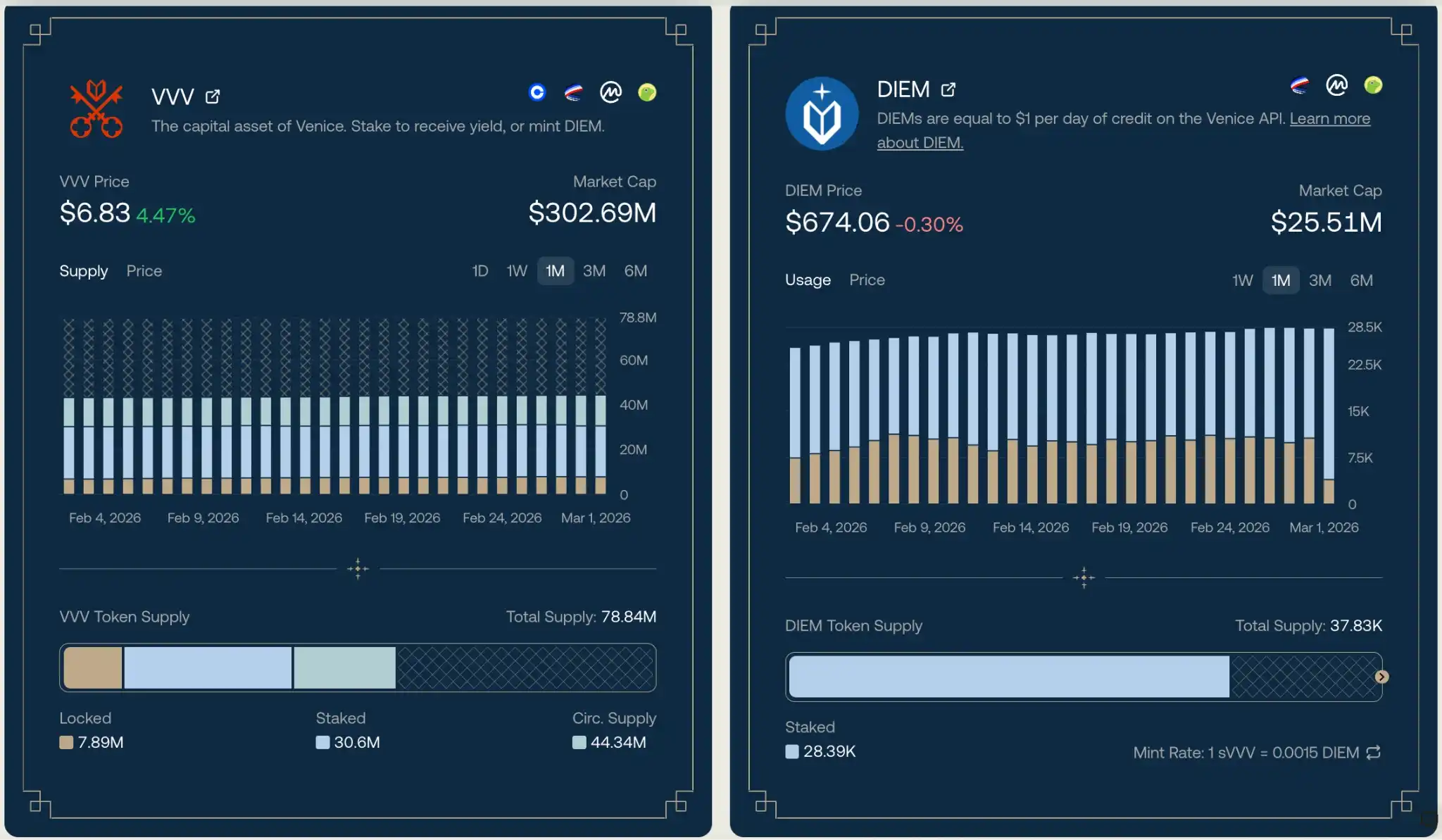
According to data provided on the Venice website, the current total token supply is 78.84 million tokens. Of these, 7.89 million are locked, and the staked amount is 30.60 million, with a staking rate as high as 38.8%. The circulating supply is only 44.34 million tokens. In the initial economic model, the total VVV token supply was 100 million, with 50% allocated for community airdrops, targeting early Venice users, AI project parties, etc. The airdrop claim window lasted about 45 days. Ultimately, over 40,000 people claimed 17.40 million VVV, accounting for about 35% of the community allocation. The remaining unclaimed portion was about 32.68 million tokens, worth about $100 million at the time. The team decided to permanently burn this remainder to reduce circulating supply and enhance scarcity.
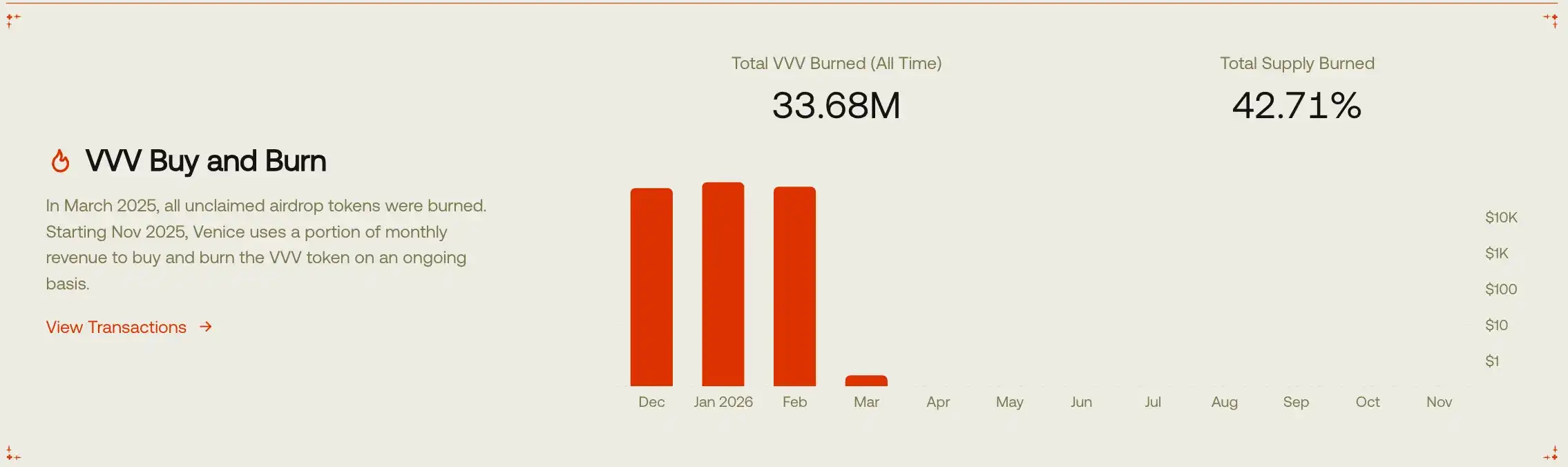
Starting in October 2025, Venice announced a reduction of the original emission plan from 10 million VVV/year to 8 million VVV/year. Simultaneously, it launched a monthly revenue buyback + burn mechanism. The current monthly burn capacity is 30,000 to 50,000 tokens, worth about $60,000 to $90,000. Currently, 42.71% of the token supply has been burned. Then, in early February 2026, the team announced another emission reduction plan, cutting from 8 million VVV/year to 6 million VVV/year. This series of adjustments directly changed the supply expectations. Looking at the token price performance, this was also the starting point for VVV's rise.

Therefore, the rise of VVV is not driven solely by narrative but by the叠加 (superimposition/combination) of changes in supply structure and demand growth.

Conclusion

As AI becomes the central narrative of the era, is Crypto really bowing out? Venice is trying to provide its own answer. If future intelligent agent systems need a privacy backend, if Agents require long-term stable compute structures, then perhaps the crypto logic has not disappeared.


Trending Cryptos

Related Questions

QWhat is the main reason for the significant price surge of Venice.ai's native token VVV in the past month?

AThe price surge of VVV is driven by a combination of supply structure changes, including emission cuts from 10 million VVV/year to 6 million VVV/year, and demand growth due to OpenClaw's endorsement and increasing user adoption.

QHow does Venice.ai ensure user privacy in its AI services?

AVenice.ai ensures privacy by not storing any user data on its servers. All content is encrypted and stored locally on the user's device, with two modes: Private (using decentralized GPU nodes with no identity linkage) and Anonymized (stripping metadata to prevent user tracking).

QWhat are the roles of VVV and DIEM tokens in the Venice.ai ecosystem?

AVVV is the capital asset used for staking and generating yields, while DIEM is minted from VVV and represents perpetual AI computing credits. 1 DIEM provides $1 worth of daily API credits, functioning as a lifetime subscription for AI services.

QWhy did OpenClaw highlight Venice.ai as a recommended model provider despite its smaller size?

AOpenClaw prioritized Venice.ai due to its strong privacy-focused architecture, which aligns with the need for data security in AI agent operations, making it a standout choice for privacy-sensitive users.

QWhat is the current staking rate and total supply of VVV tokens?

AThe current staking rate for VVV is 38.8%, with 30.6 million tokens staked out of a total supply of 78.84 million tokens. The circulating supply is 44.34 million tokens after burns and locks.

Related Reads

STAR 50 Soars 10.73%, Why Did A-Shares Stage a "V-Shaped Reversal"?

After a prolonged decline, the Chinese A-share market staged a strong rally on July 21. The STAR 50 index surged 10.73%, its largest single-day gain in nearly a year, leading a broad-based "V-shaped" reversal. The Shanghai Composite Index rose 1.79%, the Shenzhen Component Index gained 4.81%, and the ChiNext Index jumped 7.05%. Total market turnover reached 2.97 trillion yuan, an increase of 256.1 billion yuan from the previous session, with over 3,100 stocks advancing. The semiconductor sector spearheaded the rebound, with related ETFs posting significant gains. Analysts attribute the surge to three converging factors. First, coordinated capital inflows from "national team" institutions, insurance funds, listed company buybacks, and fund house self-purchases have bolstered market liquidity and confidence. Second, supportive policy signals, including commitments from regulators to ensure stable market operations, provided a favorable backdrop. Third, a stabilization and recovery in overseas markets, notably South Korea, created a positive external environment. Institutions suggest the most severe panic selling phase for the tech sector has likely passed, following a significant digestion of crowded positions and leveraged funds. While short-term volatility may persist, the medium to long-term outlook remains underpinned by enduring trends like AI computing demand expansion and semiconductor localization. The market's focus now shifts to the sustainability of supportive fund flows, earnings reports, and upcoming catalysts from the global AI industry chain.

marsbit3m ago

STAR 50 Soars 10.73%, Why Did A-Shares Stage a "V-Shaped Reversal"?

marsbit3m ago

U.S. Tech Momentum Stocks Post Largest Single-Day Gain Ever, But Is the Plunge Over?

US tech momentum stocks staged a sharp rebound on Tuesday (July 21st). Morgan Stanley's TMT Momentum Factor surged over 12%, marking its largest single-day gain on record, exceeding even peaks from the 2000 dot-com bubble. Key momentum indices from Goldman Sachs also posted their strongest daily performances in years. The rally was led by semiconductors, with the Philadelphia Semiconductor Index jumping 4.6%. This rebound followed three consecutive down days and a cumulative 33% plunge in momentum stocks, one of the steepest drawdowns since the dot-com era. Analysts attribute the surge largely to a short squeeze. Heavy selling had pushed high-beta momentum stocks into deeply oversold territory, forcing many short sellers, particularly in Asia, to cover their positions, creating a self-reinforcing buying spiral. However, the rebound's internals appear weak. Trading volume was notably low, and advancing stocks still lagged decliners on the S&P 500, indicating a narrow, concentrated rally rather than broad market participation. Diverging views emerge on the outlook. BTIG warns the bounce has hit key resistance and recommends selling into strength, citing extreme volatility and historical parallels to past market tops. Conversely, Goldman Sachs and UBS believe the momentum unwind is nearing its end, suggesting it may be time to gradually add exposure, as positioning has been significantly reduced. They caution, however, that high volatility warrants a measured approach, potentially using defined-risk strategies. The upcoming earnings season, particularly reports from major tech firms like Alphabet, is seen as a critical test for the rally's sustainability. Simultaneously, bond markets flashed a warning, with yields rising partly due to spiking oil prices. Analysts note that if long-term Treasury yields break decisively higher, it could pose a significant headwind for equities, especially growth stocks.

marsbit11m ago

U.S. Tech Momentum Stocks Post Largest Single-Day Gain Ever, But Is the Plunge Over?

marsbit11m ago

U.S. Tech Momentum Stocks Record Largest Single-Day Gain Ever, but Has the Rout Ended?

U.S. tech momentum stocks staged a dramatic rebound on Tuesday, July 21st. Key momentum indices like the Morgan Stanley TMT Momentum Factor and Goldman Sachs' High Beta Momentum Long Index posted historic or near-historic single-day gains, fueled largely by semiconductor stocks. This sharp rally followed a severe three-day sell-off that saw momentum stocks plunge 33%, marking one of the steepest pullbacks since the dot-com bubble. Analysts attribute the bounce primarily to a short squeeze, as forced covering from over-leveraged traders, particularly in Asia, created a buying spiral. However, the rally's health is questioned due to weak market breadth—overall trading volume was low, and decliners outnumbered advancers in the S&P 500 despite the index's gain—suggesting a narrow, concentrated surge rather than broad recovery. Opinions on the sustainability diverge. BTIG strategists warn the rebound has hit key resistance levels, citing extreme volatility and historic stock dispersion as signs of an ongoing broader correction, and recommend selling into strength. Conversely, Goldman Sachs and UBS view the aggressive momentum unwinding as nearing its end, noting reduced positioning and a lack of new fundamental catalysts. They suggest the sell-off presents a selective opportunity to add exposure, albeit cautiously and gradually using defined-risk strategies. The immediate trajectory hinges on the ongoing earnings season, with market focus on Alphabet's capital expenditure guidance for AI investment clarity. Meanwhile, bond markets present a risk, with rising Treasury yields—potentially heading toward 5.5%—and widening credit spreads for mega-cap tech companies posing a threat to equity valuations. The combination of technical factors, earnings results, and macro conditions leaves the durability of the rebound in doubt.

链捕手13m ago

U.S. Tech Momentum Stocks Record Largest Single-Day Gain Ever, but Has the Rout Ended?

链捕手13m ago

Long-Divided Must Unite, Long-United Must Divide: When L1 Becomes Its Own Rollup, What Is Ethereum's Endgame?

"The Inevitable Cycle: When L1 Becomes Its Own Rollup – What is Ethereum's Endgame?" For years, the Ethereum community grappled with concerns that L2s were fragmenting the ecosystem and eroding L1's value. While L2s provided cheaper execution, they also splintered liquidity and the unified user experience of a single chain. This has prompted a fundamental reassessment of the relationship between L1 and L2. Ethereum's roadmap is evolving. The "Scale" initiative merges L1 and L2 expansion into a holistic framework. L1 itself is advancing with higher gas limits, statelessness, and zkEVM verification, no longer content to be just a low-throughput settlement layer. Consequently, the primary value proposition of L2s is shifting from merely providing cheap blockspace to offering L1 cannot easily provide: application-specific optimizations, privacy features, and flexible governance models. L2s are becoming a spectrum of execution environments with varying degrees of security inheritance from Ethereum. A critical challenge in this multi-chain future is interoperability. The vision is to make Ethereum "feel like one chain again." This relies on advancements in native account abstraction (like EIP-7702) and intent-based architectures (Open Intents Framework), where users declare desired outcomes, and solvers handle the complex cross-chain execution. Furthermore, shortening Ethereum's finality time from minutes to seconds is crucial, as it underpins trust between chains for bridges, stablecoins, and cross-chain applications. Perhaps the most provocative idea is that Ethereum L1 itself could become a form of "its own Rollup." As zkEVM and proof systems mature, high-performance nodes could execute transactions and generate validity proofs. Regular validators would then verify these proofs instead of re-executing all transactions. This blurs the traditional L1/L2 hierarchy, making "Rollup" more of a general execution-verification architecture. Native Rollup aims to integrate L2 validation more directly into the Ethereum protocol, allowing L2s to inherit L1's security more fully and move away from reliance on security councils. In the end, L2s are not destined to replace L1 or be made obsolete by it. The likely future is a unified system where diverse execution environments—each optimized for specific use cases like DeFi, gaming, or privacy—coexist. They will share a common foundation of security, liquidity, and verifiable state, seamlessly connected to restore a cohesive user experience. The next phase for Ethereum is not just about scaling through separation, but about intelligently reintegrating what was separated back into a coherent whole.

链捕手29m ago

Long-Divided Must Unite, Long-United Must Divide: When L1 Becomes Its Own Rollup, What Is Ethereum's Endgame?

链捕手29m ago

Trading

Spot

Hot Articles

How to Buy ONE

Welcome to HTX.com! We've made purchasing Harmony (ONE) simple and convenient. Follow our step-by-step guide to embark on your crypto journey.Step 1: Create Your HTX AccountUse your email or phone number to sign up for a free account on HTX. Experience a hassle-free registration journey and unlock all features.Get My AccountStep 2: Go to Buy Crypto and Choose Your Payment MethodCredit/Debit Card: Use your Visa or Mastercard to buy Harmony (ONE) instantly.Balance: Use funds from your HTX account balance to trade seamlessly.Third Parties: We've added popular payment methods such as Google Pay and Apple Pay to enhance convenience.P2P: Trade directly with other users on HTX.Over-the-Counter (OTC): We offer tailor-made services and competitive exchange rates for traders.Step 3: Store Your Harmony (ONE)After purchasing your Harmony (ONE), store it in your HTX account. Alternatively, you can send it elsewhere via blockchain transfer or use it to trade other cryptocurrencies.Step 4: Trade Harmony (ONE)Easily trade Harmony (ONE) on HTX's spot market. Simply access your account, select your trading pair, execute your trades, and monitor in real-time. We offer a user-friendly experience for both beginners and seasoned traders.

4.4k Total ViewsPublished 2024.03.29Updated 2026.06.02

How to Buy ONE

Discussions

Welcome to the HTX Community. Here, you can stay informed about the latest platform developments and gain access to professional market insights. Users' opinions on the price of ONE (ONE) are presented below.

活动图片