Odds Of Crypto Market Structure Bill Passing This Year Fall To 40% On Polymarket

bitcoinistPublished on 2026-02-25Last updated on 2026-02-25

Abstract

According to prediction market Polymarket, the odds of the crypto market structure bill, the CLARITY Act, passing this year have fallen sharply to 42%. This drop reflects growing skepticism that ongoing high-level negotiations between the crypto industry and banking representatives will reach a breakthrough in time, despite months of discussions at the White House. A key sticking point is draft legislation addressing bank concerns, particularly around crypto rewards programs. A major outcome is that paying yield on idle stablecoin balances is now off the table. The debate has shifted to whether rewards can be tied to specific user activities instead of simple account balances. Market experts suggest that if passed, the bill could significantly impact Bitcoin derivatives markets. It would likely cement the CFTC's authority, potentially leading to more regulated US trading venues and the emergence of CFTC-registered perpetual futures platforms. This clarity could encourage greater institutional participation and reduce discrepancies between spot and futures markets. Furthermore, Bitcoin options markets might see new regulated venues and potentially lower volatility, making strategies like hedging more accessible.

The likelihood that the long‐awaited crypto market structure legislation, known as the CLARITY Act, will become law this year has fallen sharply over the past 24 hours, according to data from prediction platform Polymarket.

Traders now assign the bill a 42% chance of passing in 2026, reflecting growing skepticism that ongoing negotiations between the crypto industry and the banking sector will produce a breakthrough in time.

Crypto And Banks Remain Divided

The drop in confidence comes despite months of high-level discussions at the White House. Lawmakers and industry representatives have been attempting to build consensus around a broader market structure framework.

However, three key White House meetings between crypto firms and banking representatives have yet to yield a final agreement. Even so, public messaging from officials has remained upbeat.
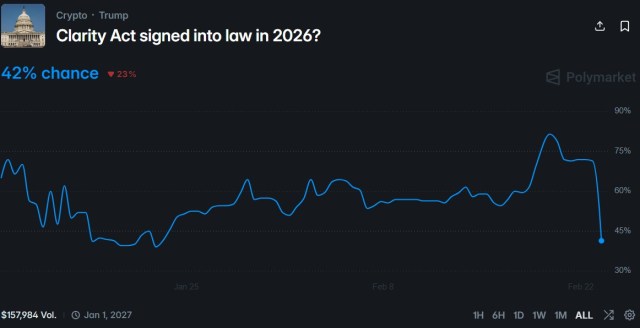
Crypto market structure bill odds of passing drop to 42%. Source: Polymarket

As Bitcoinist reported last week, Patrick Witt, Executive Director of the President’s Council of Advisors for Digital Assets, described the latest round of talks as “a big step forward.” “We’re close,” Witt wrote, adding that if both sides continue negotiating in good faith, he expects the administration’s March 1 deadline to be met.

At the center of the discussions is draft legislative language designed to address concerns raised by banks in a document titled “Yield and Interest Prohibition Principles.”

While the proposed text acknowledges the banking sector’s objections, it also makes clear that any restrictions on crypto rewards programs would be narrowly tailored.

One significant outcome of the negotiations is that paying yield on idle stablecoin balances — a major objective for many crypto firms — is effectively off the table.

Instead, the debate has shifted toward whether companies should be permitted to offer rewards tied to specific user activities rather than simple account balances.

How New Rules Could Change Bitcoin Derivatives Markets

Beyond the political back‐and‐forth, market expert MartyParty recently highlighted potential structural shifts that could follow the bill’s passage, arguing that the changes may be more significant than many investors realize.

In the Bitcoin (BTC) futures market, clearer jurisdictional boundaries would likely cement the Commodity Futures Trading Commission’s (CFTC) authority over digital asset commodities.

The expert believes that could accelerate the growth of regulated US trading venues, similar to CME, and potentially open the door to CFTC‐registered perpetual futures platforms.

According to MartyParty’s analysis, clear commodity classification may also encourage greater institutional participation, particularly from funds that are restricted from investing in assets deemed securities.

Perpetual futures contracts — a crypto‐native product widely used outside the United States — could also evolve. With CFTC registration, US‐based perpetual products might emerge with stronger consumer protections, greater transparency around funding rates, and tighter safeguards against manipulation.

Greater regulatory clarity could also reduce discrepancies between spot and futures markets, narrowing price gaps and stabilizing funding dynamics. At the same time, stricter leverage caps or margin requirements imposed under CFTC rules could limit the extreme levels of retail speculation currently seen on offshore platforms.

Bitcoin options markets would likely experience parallel shifts. The expert asserts that a clearer regulatory framework could encourage the development of additional US‐regulated options venues offering both physically settled and cash‐settled contracts tied to Bitcoin futures.

Reduced enforcement uncertainty may also lower implied volatility premiums, potentially making options more affordable for hedging and speculative strategies.

Institutional investors, in particular, could more confidently deploy advanced strategies — including collars and straddles — if Bitcoin’s commodity status is firmly established.

The 1D chart shows BTC’s price consolidation, currently at around $66,000. Source: BTCUSDT on TradingView.com

Featured image from OpenArt, chart from TradingView.com

Related Questions

QAccording to Polymarket, what are the current odds that the CLARITY Act will pass this year?

AThe current odds that the CLARITY Act will pass this year are 42%.

QWhat is the major sticking point in the negotiations between the crypto industry and banks, as mentioned in the article?

AA major sticking point is the debate over whether companies should be permitted to offer rewards tied to specific user activities rather than simple account balances, with paying yield on idle stablecoin balances effectively being off the table.

QWhich US regulatory body is expected to gain clearer authority over digital asset commodities if the bill passes?

AThe Commodity Futures Trading Commission (CFTC) is expected to have its authority over digital asset commodities cemented.

QWhat potential benefit for institutional investors does the expert MartyParty highlight regarding Bitcoin's classification?

AMartyParty highlights that if Bitcoin's commodity status is firmly established, institutional investors could more confidently deploy advanced options strategies like collars and straddles.

QWhat was the public messaging from officials like, despite the lack of a final agreement from the White House meetings?

ADespite the lack of a final agreement, public messaging from officials remained upbeat, with one executive director describing the latest talks as 'a big step forward' and expressing that they are 'close' to a deal.

Related Reads

In-Depth Report on the On-Chain Lending Market: When Off-Chain Credit Meets On-Chain Liquidation

The on-chain lending market has evolved from a peripheral DeFi niche into core financial infrastructure. As of early 2026, total value locked (TVL) in on-chain lending protocols has reached $64.3 billion, accounting for 53.54% of total DeFi TVL, making it the largest and most mature vertical within decentralized finance. Aave dominates the sector with approximately $32.9 billion in TVL, commanding nearly half of the market—a leadership position that is unlikely to be challenged in the foreseeable future. However, the path of on-chain lending forward is not without risk. Liquidation cascades, credit defaults, and cross-chain vulnerabilities remain systemic threats hanging over the industry. At the same time, a deeper structural transformation is underway: on-chain lending is shifting from a “leverage tool for crypto-native users” to a “compliant gateway for institutional capital”. The scale of RWA (Real World Asset) lending has surpassed $18.5 billion, with U.S. Treasuries and government securities increasingly serving as core collateral. Institutional capital inflows are reshaping both the user base and risk appetite of the sector. This report systematically analyzes the evolution of on-chain lending definitions, competitive dynamics, core risks, and future trends, providing a comprehensive industry outlook for investors and trade practitioners. Key findings suggest that the “one dominant player with several strong challengers” structure will persist in the short term, while fixed-rate lending, compliant collateral, and institutional credit underwriting will define the next phase of competition. For investors focused on DeFi infrastructure, three key opportunity tracks stand out, namely, the Aave ecosystem (Morpho, Spark), RWA lending protocols (Ondo, Maple) and fixed-rate innovation (Notional, Pendle).

HTX Learn38m ago

In-Depth Report on the On-Chain Lending Market: When Off-Chain Credit Meets On-Chain Liquidation

HTX Learn38m ago

Fu Peng's First Public Speech in 2026: What Exactly Are Crypto Assets? Why Did I Join the Crypto Asset Industry?

Fu Peng, a renowned macroeconomist and now Chief Economist at New火 Group, delivered his first public speech of 2026 at the Hong Kong Web3 Festival. He explained his perspective on crypto assets and why he joined the industry, framing it within the context of macroeconomic trends and financial evolution. Fu emphasized that crypto assets are transitioning from an early, belief-driven phase to a mature, institutionally integrated asset class. He drew parallels to the 1970s-80s, when technological advances (like computing) revolutionized traditional finance, leading to the rise of FICC (Fixed Income, Currencies, and Commodities). Similarly, current advancements in AI, data, and blockchain are reshaping finance, with crypto assets becoming part of a new "FICC + C" (C for Crypto) framework. He noted that institutional capital, including traditional hedge funds, avoided early crypto due to its speculative nature but are now engaging as regulatory clarity emerges (e.g., stablecoin laws, CFTC classifying crypto as a commodity). Fu predicted that 2025-2026 marks a turning point where crypto becomes a standardized, financially viable asset for diversified portfolios, akin to commodities or derivatives in traditional finance. Fu defined Bitcoin not as "digital gold" in a simplistic sense but as a value-preserving, financially tradable asset. He highlighted that crypto's future lies in regulated, institutional adoption, moving away from retail-dominated trading. His entry into crypto signals this maturation, where traditional finance integrates crypto into mainstream asset management.

marsbit1h ago

Fu Peng's First Public Speech in 2026: What Exactly Are Crypto Assets? Why Did I Join the Crypto Asset Industry?

marsbit1h ago

Justin Sun Sues Trump Family: What $75 Million Bought Was Only a Blacklist

Justin Sun, founder of Tron, has filed a lawsuit in federal court against World Liberty Financial (WLF), alleging he was made the "primary target of a fraudulent scheme" after investing $75 million. Sun claims the investment secured him an advisor title and WLFI tokens, which were later frozen by WLF, causing "hundreds of millions in losses." The dispute began in late 2024 when Sun's investment helped revive WLF's struggling token sale, which ultimately raised $550 million. Shortly after, the SEC dropped its lawsuit against Sun following Donald Trump's inauguration. However, relations soured when Sun refused WLF's demands for additional funding. In August 2025, WLF added a "blacklist" function to its smart contract, allowing it to unilaterally freeze tokens. Sun's holdings, worth approximately $107 million, were frozen, and he was threatened with token destruction. The lawsuit highlights WLF's structure, which directs 75% of token sale profits to the Trump family, who had earned $1 billion by December 2025. WLF's CEO is Zach Witkoff, son of U.S. Middle East envoy Steve Witkoff. The project faces scrutiny for opaque operations, including a controversial loan arrangement on the Dolomite platform, co-founded by a WLF advisor. Despite Sun's history with the SEC, the case underscores centralization risks within DeFi, as WLF controls governance and holds powers to freeze assets arbitrarily. Sun's tokens remain frozen as legal proceedings begin.

marsbit1h ago

Justin Sun Sues Trump Family: What $75 Million Bought Was Only a Blacklist

marsbit1h ago

Trading

Spot
Futures
活动图片





