NYSE parent in talks to invest in crypto company MoonPay: Report

cointelegraphPublished on 2025-12-18Last updated on 2025-12-18

Abstract

Intercontinental Exchange (ICE), parent company of the New York Stock Exchange, is reportedly in talks to invest in cryptocurrency payments firm MoonPay, which is seeking a $5 billion valuation in its latest funding round. This follows ICE’s recent $2 billion investment in prediction platform Polymarket. MoonPay provides infrastructure for buying and selling crypto using traditional payment methods. The move reflects growing convergence between Wall Street and crypto, as seen in ICE's earlier partnership with Circle to explore stablecoin integration and the DTCC’s approval to offer tokenized bonds and stocks. These developments highlight the increasing institutional adoption of blockchain and tokenization technologies.

Intercontinental Exchange (ICE), the parent company of the New York Stock Exchange (NYSE), is in talks to invest in crypto payments company MoonPay as part of the company’s latest funding round.

MoonPay is seeking to raise funds at a $5 billion valuation, according to Bloomberg, which cited sources familiar with the deal and did not disclose the dollar amount of the potential investment.

In October, ICE invested $2 billion in prediction platform Polymarket, in a funding round that brought the company’s valuation to $9 billion.

MoonPay is a financial technology company that provides infrastructure for buying, selling and using cryptocurrencies through fiat on-ramps and off-ramps. Founded in 2019, it enables users to purchase crypto using traditional payment methods such as debit and credit cards, while offering services to wallets, exchanges and enterprises seeking to integrate crypto payments.

Polymarket founder Shayne Coplan (left) and Intercontinental Exchange CEO Jeffrey Sprecher (right) in front of the New York Stock Exchange after the $2 billion deal. Source: Shayne Coplan

Cointelegraph reached out to ICE and MoonPay but had not received a response at time of publication.

The investment deals reflect the growing ties between crypto and Wall Street, as traditional financial institutions adopt blockchain technology and form partnerships with crypto companies.

Related: Acting CFTC chair to join MoonPay after leaving agency

Wall Street and Crypto continue to converge, blurring the lines between both worlds

Stablecoin company Circle and ICE began exploring a stablecoin integration with ICE’s various clearing and data services in March.

The products being tested for possible integrations include Circle’s USDC (USDC) dollar-pegged stablecoin and its tokenized money market fund, US Yield Coin (USYC), an onchain yield-bearing product backed by short-term US Treasurys.

In December, the US Securities and Exchange Commission (SEC) gave the green light to the Depository Trust and Clearing Corporation (DTCC), a financial settlement and clearing infrastructure company, to begin offering tokenized bonds and stocks.

Real-world asset (RWA) tokenization is a way of representing physical or traditional assets on a blockchain, which allows for faster settlement times, cross-border transactions and the ability to use assets as collateral in decentralized finance (DeFi) applications.
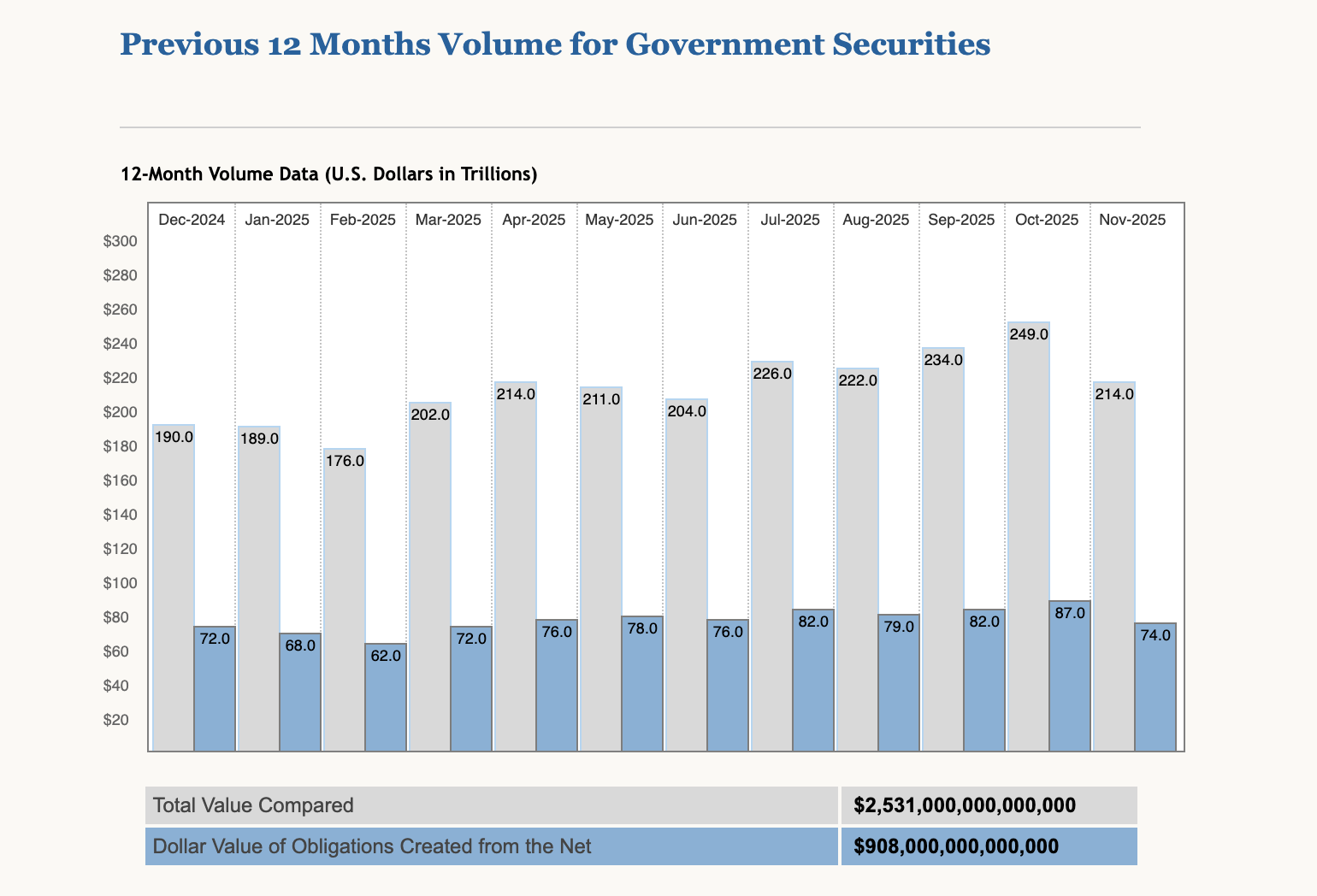
Volume of 12-month government securities settled using the DTCC’s infrastructure. Source: DTCC

DTCC handled about $3.7 quadrillion in settlement volume in 2024 and is considered the backbone of the traditional financial system, clearing transactions across the equity, bond, fixed income and financial derivatives markets.

The DTCC is expected to launch its tokenized trading services in the second half of 2026 and will mint some US Treasurys onchain using the Canton Network, a permissioned network of blockchain infrastructure geared toward financial institutions.

Magazine: Unstablecoins: Depegging, bank runs and other risks loom

Related Questions

QWhat is the parent company of the New York Stock Exchange (NYSE) and which cryptocurrency firm is it reportedly in talks to invest in?

AIntercontinental Exchange (ICE), the parent company of the NYSE, is in talks to invest in the cryptocurrency payments company MoonPay.

QAt what valuation is MoonPay seeking to raise funds in its latest funding round, as reported by Bloomberg?

AMoonPay is seeking to raise funds at a valuation of $5 billion.

QWhat was the size of ICE's previous investment in Polymarket and what was the resulting valuation of that company?

AICE invested $2 billion in Polymarket, which brought the company's valuation to $9 billion.

QWhat specific services does MoonPay provide in the cryptocurrency space?

AMoonPay provides infrastructure for buying, selling, and using cryptocurrencies through fiat on-ramps and off-ramps. It enables users to purchase crypto using traditional payment methods like debit and credit cards, and offers services to wallets, exchanges, and enterprises.

QWhat major traditional financial infrastructure company received SEC approval to begin offering tokenized bonds and stocks, and what network will it use to mint some US Treasurys onchain?

AThe Depository Trust and Clearing Corporation (DTCC) received SEC approval to offer tokenized bonds and stocks. It will mint some US Treasurys onchain using the Canton Network.

Related Reads

Bitcoin Withdrawals Continue: 8 Years of Storage in a Coldcard Cold Wallet Ended in Zero

Coldcard Hardware Wallet Hacked: Losses Mount Due to Vulnerable Seed Generation A critical vulnerability in Coldcard hardware wallets has led to a continued wave of fund thefts. According to Galaxy Research, the total stolen has reached 1,367.05 BTC (approx. $88.6 million) from 4,585 addresses, a significant increase from the initial 594.5 BTC reported on July 30, 2026. Most of the stolen funds remain on the attackers' addresses. The issue is not with the current firmware, which Coinkite has updated, but with seed phrases generated on vulnerable devices between March 2021 and the release of fixed firmware versions. Due to a programmer error, devices switched from using a hardware random number generator to the software-based Yasmarang generator, which was initialized with publicly accessible data like the chip's serial number. This made the seed phrases predictable through offline brute-force attacks, meaning wallets remain at risk until funds are moved to a new wallet generated with the patched firmware. Affected devices include Mk2/Mk3 with firmware 4.0.1–4.1.9 (and up to 5.0.3), Mk4/Mk5 up to version 5.6.0, and Q models up to 1.5.0Q. The only exceptions are seeds created with a high-entropy method like at least 50 independent dice rolls or a strong unique BIP-39 passphrase. All other owners must generate a new seed on the fixed firmware and transfer their assets. A case highlighting the human impact involves a 39-year-old long-term investor who lost 2 BTC (approx. $130,000) in minutes. He had accumulated the Bitcoin over eight years through physical labor, viewing it as a financial lifeline and a retirement plan in a country suffering from hyperinflation. His story underscores that even conservative "buy and hold in cold storage" strategies can be compromised by such underlying technical flaws. From a technical perspective, this incident echoes historical failures where weak random number generators undermined cryptographic security, challenging the assumption that offline storage is automatically foolproof.

cryptonews.ru4h ago

Bitcoin Withdrawals Continue: 8 Years of Storage in a Coldcard Cold Wallet Ended in Zero

cryptonews.ru4h ago

Trading

Spot
活动图片





