NYSE and Nasdaq Enter the Fray, U.S. Stock Tokenization Begins Close Combat

marsbitPublished on 2026-03-25Last updated on 2026-03-25

Abstract

On March 24, the New York Stock Exchange (NYSE) announced a partnership with tokenization platform Securitize to develop a digital trading platform for tokenized securities. Just six days earlier, the SEC approved Nasdaq’s rule amendments to enable tokenized versions of Russell 1000 stocks and major index ETFs. The two largest U.S. stock exchanges unveiled their tokenization strategies in the same month, marking a significant acceleration in institutional adoption. Throughout March, multiple major players advanced tokenization initiatives. Nasdaq partnered with Kraken’s parent company Payward to offer tokenized stock distribution for non-U.S. users. S&P Dow Jones licensed its flagship S&P 500 to on-chain protocol Trade.xyz for perpetual contracts on Hyperliquid. Invesco, managing $2.2 trillion in assets, took over Superstate’s $967 million on-chain treasury fund. The House Financial Services Committee also held a hearing titled "Tokenization and the Future of Securities." Notably, Nasdaq and NYSE are pursuing different technical approaches. Nasdaq’s model integrates with the existing Depository Trust Company (DTC) system, using blockchain as an optional layer while maintaining unified liquidity and settlement. In contrast, NYSE is building a separate, blockchain-native infrastructure with Securitize as its digital transfer agent, aiming for 24/7 trading and near-instant settlement. Regulatory progress is also advancing, including the CLARITY Act moving toward markup and an...

On March 24, the New York Stock Exchange announced the signing of a memorandum of understanding with tokenization platform Securitize to jointly develop a digital trading platform for tokenized securities. Just six days earlier, the SEC had approved Nasdaq's rule amendments to trade Russell 1000 component stocks and major index ETFs in tokenized form. The two largest stock exchanges in the United States each unveiled their own tokenization plans within the same month.

This is not an isolated move by one or two institutions. Spreading out the calendar for March reveals a rare density of activity.

On March 9, Nasdaq partnered with Payward, the parent company of crypto exchange Kraken, planning to provide a distribution channel for tokenized stocks to non-U.S. users. On March 18, the SEC approved Nasdaq's rule amendments; on the same day, S&P Dow Jones Indices licensed its flagship S&P 500 index to the on-chain protocol Trade.xyz to issue perpetual contracts on the decentralized derivatives platform Hyperliquid.

On March 24, the NYSE signed with Securitize; on the same day, Invesco, which manages $2.2 trillion in assets, announced it would take over the USTB fund from on-chain treasury management company Superstate, with a size of $967 million. On March 25, the U.S. House Financial Services Committee held a special hearing, "Tokenization and the Future of Securities: Modernizing Our Capital Markets." According to FinTech Weekly, attendees included Kenneth Bentsen Jr., CEO of the Securities Industry and Financial Markets Association (SIFMA), and Summer Mersinger, CEO of the Blockchain Association.
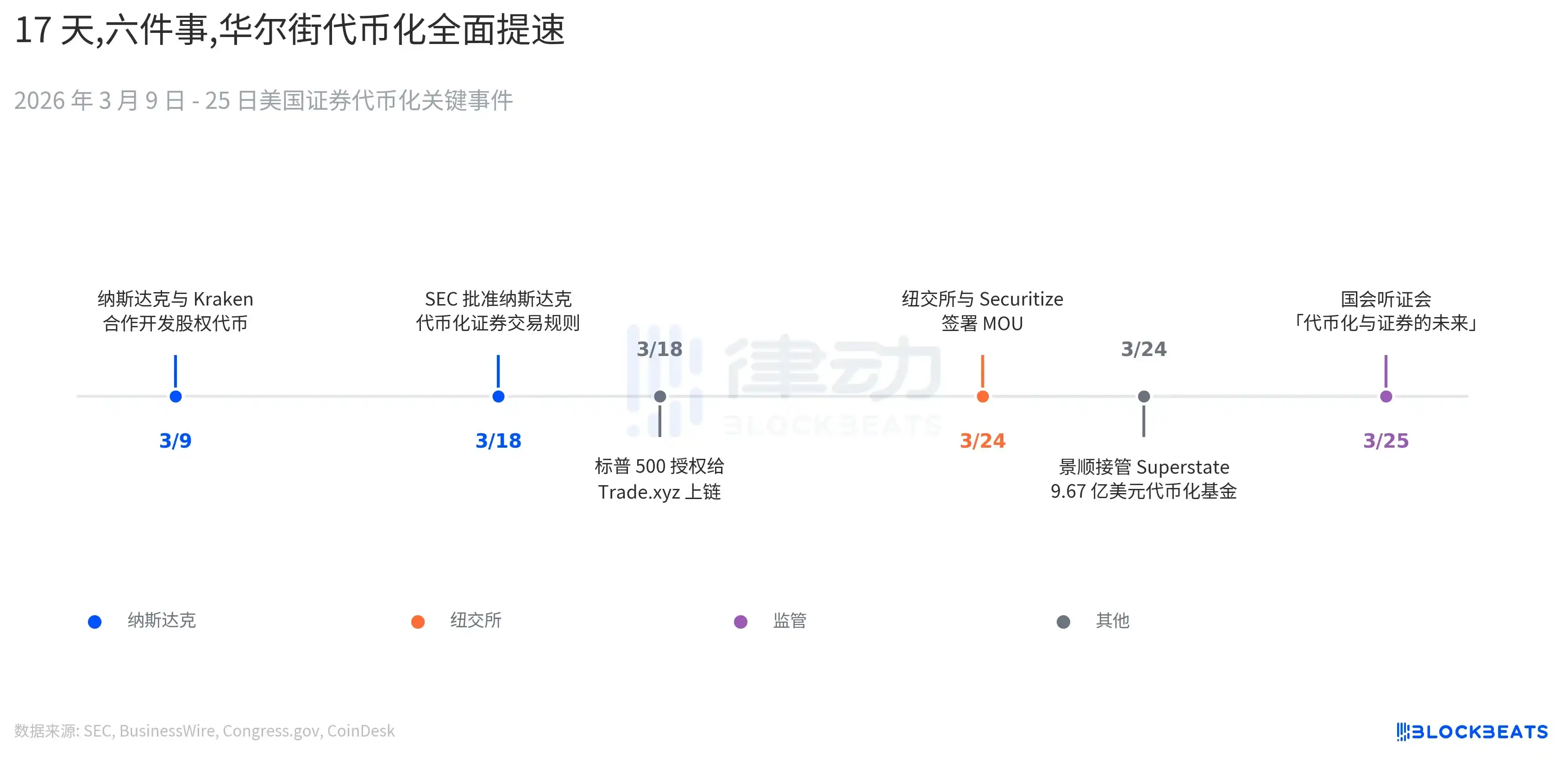
Six events in 17 days. Two major exchanges, three traditional asset management firms, one SEC approval, one congressional hearing. Among these events, the plans of Nasdaq and the NYSE are the most worthy of closer examination. The two are following different technical paths, and the divergence is greater than most realize.

Nasdaq is taking a compatibility route. According to the approval document (34-105047) released by the SEC on March 18, Nasdaq's tokenized securities trading will still be settled through the existing clearing system of the Depository Trust Company (DTC). Traders select a tokenized asset when placing an order, specify the blockchain and wallet address, and the DTC handles verification and settlement on the backend. Tokenized shares share the same CUSIP number as traditional shares, are matched on the same order book, and have identical execution priority. If the DTC determines that a participant is ineligible or the specified blockchain is incompatible, the transaction is automatically reverted to traditional settlement methods. In this setup, the blockchain is an optional wrapper; the underlying clearing pipeline remains unchanged. According to an analysis by the legal website Free Writings & Perspectives, eligible assets include Russell 1000 index components and ETFs tracking the S&P 500 and Nasdaq 100. The first tokenized trades are expected to launch in the third quarter of 2026.

The NYSE is taking a different path. According to a BusinessWire press release, the NYSE has designated Securitize as its first "Digital Transfer Agent," responsible for minting blockchain-native securities on-chain, maintaining ownership records, and handling corporate actions like dividends. According to CoinDesk, the NYSE is collaborating with Bank of New York Mellon and Citigroup to integrate tokenized deposits and stablecoin payments, aiming to enable 24/7 trading and near-instant settlement. This path is not about adding a layer on top of the existing clearing pipeline but about building an independent on-chain settlement infrastructure. The wording of Lynn Martin, President of NYSE Group, in the press release skipped "exploring" and "piloting," directly stating that the development of the new infrastructure must "preserve the trust, transparency, and protection that investors expect."
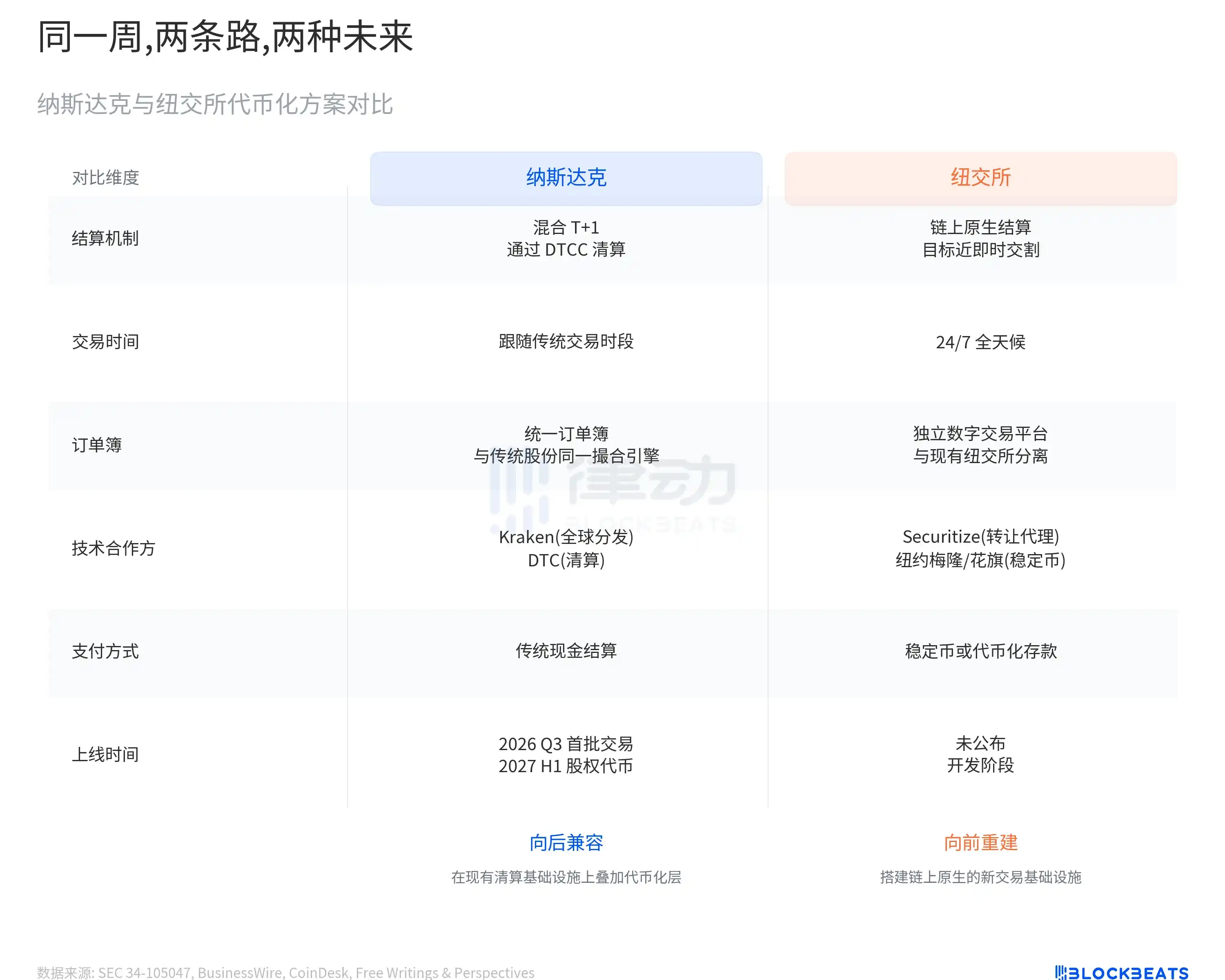
The core of the divergence is this: Nasdaq is adding functionality to its existing order book, maintaining unified liquidity, and can launch once the DTC updates its systems. The NYSE is building a separate digital trading platform that will run in parallel with the existing exchange, prioritizing 24/7 trading and instant settlement, though a specific launch date has not been announced according to CoinDesk. Securitize is the core technical support for the NYSE's plan. According to PRNewswire data, it currently manages approximately $4.6 billion, representing about 25% of the tokenized RWA market share.

It is also the technology provider for BlackRock's BUIDL fund. According to public data, BUIDL reached a size of $2.38 billion within 15 months of launch, making it the world's largest tokenized treasury fund. According to CoinDesk, Securitize's revenue for the first three quarters of 2025 grew 841% year-over-year to $55.6 million, and according to PRNewswire, it is going public via a SPAC with a valuation of $1.25 billion. By choosing Securitize as its first Digital Transfer Agent, the NYSE is entrusting the minting authority for tokenized securities to an infrastructure company on the verge of an IPO.

The regulatory side is also advancing. According to CoinDesk, the CLARITY Act, previously stalled for months due to stablecoin yield provisions, recently reached an "agreement in principle," and according to FinTech Weekly, the Senate Banking Committee has set a markup target for late April. In December 2025, the SEC issued a No-Action Letter to the DTC; according to a DTCC official announcement, this letter authorizes the DTC to provide tokenization services under a regulated framework, which is the prerequisite for Nasdaq's plan to proceed.

All of this happened within one month. What does this pace mean globally?
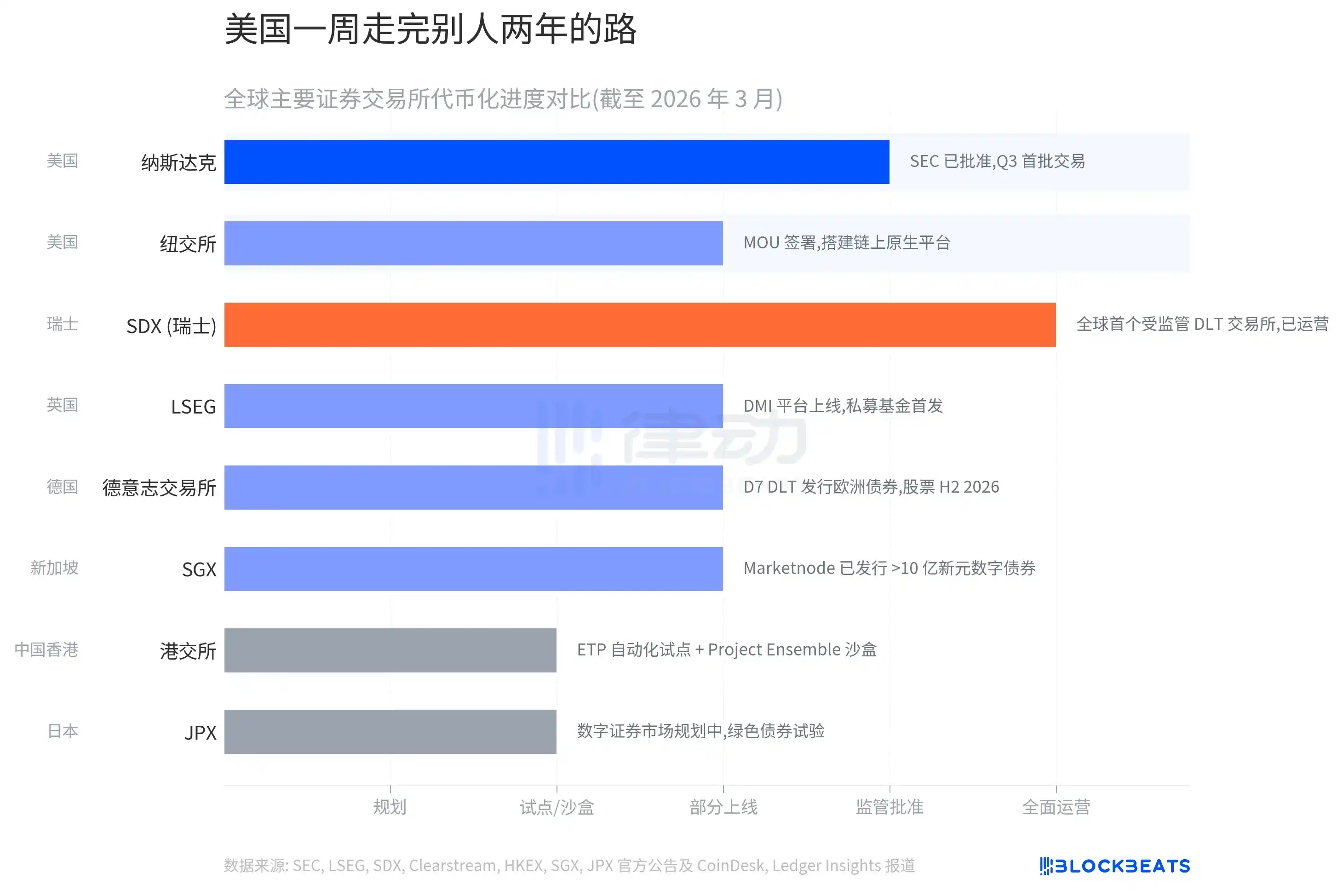
Switzerland's SIX Digital Exchange (SDX) was the world's first fully licensed DLT exchange, launching in 2021. According to Ledger Insights, it has issued over CHF 400 million in tokenized bonds, but its daily trading volume is only CHF 2-5 million, with influence largely confined to Switzerland. The London Stock Exchange Group (LSEG) launched its Digital Markets Infrastructure (DMI) platform in September 2025; according to an LSEG official announcement, the first transaction involved private fund tokenization, and it is currently applying for a Digital Securities Depository (DSD) license.

Deutsche Börse's Clearstream began issuing tokenized European bonds on its D7 platform in Q4 2025; according to the Clearstream website, tokenized equities are expected to launch in the second half of 2026. The Singapore Exchange (SGX), through its joint venture with Temasek, Marketnode, has issued over SGD 1 billion in digital bonds according to SGX website data. The Hong Kong Exchange (HKEX) and Japan Exchange Group (JPX) are still in the pilot and planning stages.

Most of these exchanges took two to three years to move from pilot to partial launch. Nasdaq went from SEC approval to its first expected trades in just over a quarter. The NYSE moved from signing an MOU directly to targeting on-chain native settlement. What took SDX five years to achieve, the two major U.S. exchanges have reached their respective starting lines for in a month. Nasdaq added a layer on the existing foundation; the NYSE is pouring a new foundation right next to it.


Related Questions

QWhat are the two different technical approaches taken by NASDAQ and NYSE in their recent tokenization initiatives?

ANASDAQ is taking a compatibility approach, integrating tokenized securities into the existing DTC clearing system, where tokenized shares share the same CUSIP and order book as traditional shares. The NYSE is building an independent, blockchain-native digital trading platform with Securitize as its digital transfer agent, aiming for 24/7 trading and near-instant settlement.

QWhat key regulatory approval did NASDAQ receive from the SEC on March 18th, and what does it allow?

AOn March 18th, the SEC approved NASDAQ's rule filing (34-105047) to allow the trading of tokenized versions of Russell 1000 index constituents and major index ETFs, with the first tokenized trades expected to launch in Q3 2026.

QWhich company did the NYSE partner with as its first 'Digital Transfer Agent' and what is this company's significance in the market?

AThe NYSE partnered with Securitize as its first Digital Transfer Agent. Securitize is a significant player, managing approximately $4.6 billion in assets, representing about 25% of the tokenized RWA market, and is the technology provider for BlackRock's $2.38 billion BUIDL fund.

QHow does the speed of the US exchanges' tokenization progress compare to other global exchanges like SDX and LSEG?

AThe US exchanges are moving much faster. While Swiss SDX took years to launch and has limited volume, and LSEG is still applying for licenses, NASDAQ went from SEC approval to an expected launch in one quarter, and the NYSE is directly targeting native on-chain settlement, compressing a multi-year process into a single month.

QWhat role did the DTC's No-Action Letter from the SEC in December 2025 play in enabling these tokenization efforts?

AThe No-Action Letter authorized the DTC to provide tokenization services under a regulated framework. This was a critical prerequisite that enabled NASDAQ's compatibility-based approach to move forward, as it relies on the existing DTC clearing infrastructure.

Related Reads

From South Korea to the United States: Blue-Collar Jobs Are Becoming Increasingly Popular, Thanks to AI

AI is reshaping the labor market's value proposition. The traditional four-year college degree is losing its appeal as a guaranteed career path, while skilled blue-collar trades like electricians, welders, and plumbers are experiencing historic demand and wage premiums. This shift is driven by dual pressures: AI's displacement of certain white-collar roles and a booming need for physical infrastructure and data center construction. Data confirms the trend. In the U.S., vocational school revenue surged, and a significant portion of recent layoffs are AI-related. Surveys show a majority of Gen Z adults plan to pursue blue-collar work, citing better job security against AI automation. Vocational education interest has exploded recently. Experts cite a psychological shift as younger generations seek tangible, AI-resistant careers and avoid high student debt. In many cases, salaries for skilled trades now match or exceed those requiring a bachelor's degree. In South Korea, semiconductor vocational high schools boast near-total employment, with graduates securing high-paying roles at companies like Samsung. The shortage is structural, exacerbated by a retiring baby boomer workforce and massive infrastructure projects. Companies like JPMorgan Chase, Meta, and Lowe's are investing heavily in training programs. However, overcoming historical stigma and a "perception gap" around trade careers remains a key challenge to closing the talent gap.

marsbit1h ago

From South Korea to the United States: Blue-Collar Jobs Are Becoming Increasingly Popular, Thanks to AI

marsbit1h ago

Qualcomm: AI Hype Subsides, When Will Smartphones Emerge from the Gloom?

Qualcomm reported its Q3 FY2026 results (ending June 2026), with revenue of $9.95B, down 4% YoY but above expectations. Gross margin declined to 53.1%, pressured by rising costs across manufacturing and memory. Key business segments showed mixed performance: Handset revenue fell 19.6% YoY to $5.09B, dragged by an 11% decline in non-Apple Android shipments and weaker high-end mix. Conversely, Automotive revenue surged 61% to $1.59B, and IoT grew 9% to $1.83B. Core operating profit dropped 41% YoY due to margin compression and higher expenses. Management's Q4 FY2026 guidance projects revenue of $9.7B-$10.5B, in line with consensus, but Non-GAAP EPS guidance of $2.05-$2.25 fell short of expectations. Amidst persistent weakness in its core handset market, Qualcomm is pursuing growth in AI, focusing on Edge AI (smartphones, PCs, automotive) and Data Center AI. Its data center strategy includes four pillars: AI accelerators (e.g., AI200), commercial CPUs (Dragonfly C1000), custom silicon, and connectivity solutions. While these initiatives initially boosted its stock, concerns over AI capital expenditure sustainability have since erased those gains. The company targets $5B in data center revenue for FY2027 and $15B for FY2029. The report concludes that with the traditional handset business still under pressure, the data center opportunity is currently viewed as a longer-term option, and a more conservative valuation based on core operations may be warranted until AI contributions materialize.

marsbit1h ago

Qualcomm: AI Hype Subsides, When Will Smartphones Emerge from the Gloom?

marsbit1h ago

From TPU to Self-Evolving Agents: How Jeff Dean Predicts the Next Step in AI

At the 2026 YC Startup School, Jeff Dean outlined his vision for AI's next phase, shifting focus from simply scaling models to building intelligent, autonomous systems. He believes AI's progress is no longer just about creating smarter models, but about integrating them into systems capable of long-term, iterative work, automated experimentation, and continuous learning. This evolution moves the competition from "who has the bigger model" to "who can best organize intelligence." Dean suggests AI capabilities are now comparable to a junior engineer, enabling the automation of complex workflows. However, the true challenge and opportunity lie in managing these AI "workers" at scale. He emphasizes the importance of **context engineering**—structuring tools, memory, and feedback loops—over raw model power. For startups, this means building deep expertise in niche domains where general models currently fail (near 0-1% success rates), leveraging proprietary data, specialized tools, and domain-specific evaluators. A recurring theme is re-examining fundamental constraints. Dean's past work, like moving Google's search index to memory or creating the TPU, stemmed from questioning outdated assumptions about hardware and cost. He sees similar inflection points today, particularly in **specialized inference hardware** to drastically reduce latency and energy consumption for real-time Agent operation. Notably, he points out that in modern AI systems, the dominant cost is often not computation but **data movement**. Reliable, long-running Agents require robust system design, borrowing concepts from distributed computing like checkpointing, state management, and parallel exploration to handle failures and maintain progress over days or weeks. As AI automates execution, the scarcest human skills will shift to **defining clear specifications**, **judging what problems are worth solving** (taste), and designing effective feedback loops. Ultimately, Dean's framework prioritizes understanding the problem deeply, identifying the true bottlenecks, and systematically building closed-loop systems where AI can not only perform tasks but also improve AI itself.

marsbit1h ago

From TPU to Self-Evolving Agents: How Jeff Dean Predicts the Next Step in AI

marsbit1h ago

Trading

Spot
活动图片




