Number of transactions on Solana reaches a record 4.2 billion as SOL rises 40%

cryptonews.ruPublished on 2026-08-25Last updated on 2026-08-25

Abstract

In July, Solana network activity surged to unprecedented levels, with its native token SOL breaking above $100 for the first time since February amid a broader crypto market recovery. According to on-chain data from The Kobeissi Letter, Solana processed a record 4.2 billion transactions during the month, marking a 13.5% increase from June and a 91% rise since December. This activity coincided with the expansion of the real-world asset (RWA) tokenization market, where the total value distributed across tracked blockchain networks surpassed $38 billion. Solana's own RWA volume neared $4 billion, growing by roughly 11.8% in the past month. The network's surge occurred alongside an approximately 40% rally in SOL's price over eight days, fueled by a recovering crypto market. The rally gained momentum after the U.S. Treasury Department announced plans to double its buyback amount for certain long-term bonds to at least $4 billion per operation, lowering yields and boosting investor risk appetite in crypto markets.

In July, activity on the Solana network reached a record level. Then $SOL rose above $100 for the first time since February amid a recovery in the crypto market.

On-chain data presented by The Kobeissi Letter showed: in July, Solana processed a record 4.2 billion transactions — 13.5% more than in the previous month. Since December, the number of transactions has increased by approximately 2 billion, or 91%.

The growth coincided with the expansion of the real-world tokenized assets market. The Kobeissi Letter cited data from RWA.xyz: the volume of deployed RWAs across tracked blockchain networks exceeded $38 billion.
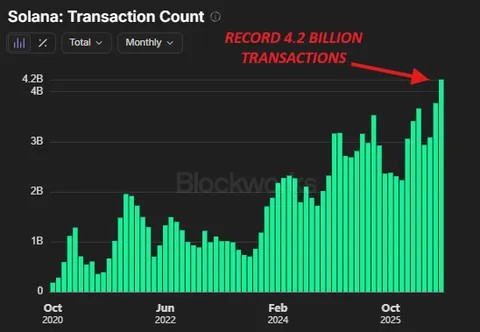
Source: The Kobeissi Letter

On Solana, the volume of tokenized real-world assets approached $4 billion, increasing by approximately 11.8% over the past month.

The surge in network activity coincided with a roughly 40% increase in $SOL over eight days. A significant part of the rise occurred during the crypto market recovery, according to CoinMarketCap data.

The rally accelerated after the US Treasury Department announced plans to double the volume of buybacks for some long-term bonds — to at least $4 billion per operation. This lowered yields and increased investor risk appetite in crypto markets.

Related materials: Standard Chartered analyst forecasts BTC rise to $100,000 amid US Treasury doubling long-term bond buybacks

end-content
Trending Cryptos

Related Questions

QWhat record did the Solana network achieve in July according to the article?

AIn July, the Solana network processed a record 4.2 billion transactions.

QHow much did the price of SOL increase during the eight-day rally mentioned in the article?

AThe price of SOL increased by approximately 40% during the eight-day rally.

QWhat major factor, related to the US government, contributed to the increased investor risk appetite in crypto markets?

AThe US Treasury Department's announcement to double the size of some long-term bond buybacks to at least $4 billion per operation lowered yields and increased investor risk appetite.

QWhat is the approximate value of Real World Assets (RWA) tokenized on the Solana blockchain as reported?

AThe value of Real World Assets (RWA) tokenized on Solana is close to $4 billion.

QCompared to December, by what percentage has the number of transactions on Solana grown by July?

AThe number of transactions on Solana grew by approximately 91% from December to July.

Related Reads

Websea's Third Anniversary: The Adjustments and Choices of a Mid-Sized Exchange During an Industry Shakeout Period

Websea, a mid-sized cryptocurrency exchange, celebrated its third anniversary in 2026 amid a period of industry consolidation. While the crypto landscape broadens with TradFi, RWA, and stablecoins, several established exchanges have retreated. This highlights the challenge for mid-tier platforms: growth is not automatic and depends on liquidity, compliance, security, and user retention. Websea has recently focused on strategic product adjustments. Key initiatives include enhancing risk management tools like contract insurance and copy trading, expanding its asset offerings to include TradFi CFDs (gold, silver, indices, forex), launching a Proof of Reserves (PoR) system for transparency, and engaging in regional RWA development through events like a summit in Almaty. The article analyzes these moves. Risk management products aim to improve user experience and retention, but their long-term viability hinges on clear rules and sustainable mechanisms. Offering TradFi CFDs seeks to capture user engagement during crypto market lulls, though it introduces new operational complexities. The PoR report addresses transparency concerns, but its value depends on regular updates. Regional RWA exploration offers potential access to real-world assets but faces significant hurdles in legal structuring and productization. Ultimately, Websea's three-year mark showcases a strategy to compete by broadening tradable assets, strengthening risk and transparency features, and exploring niche opportunities. The critical test will be whether these adjustments translate into sustainable trading volume, lasting user loyalty, and verifiable business growth over time.

marsbit19m ago

Websea's Third Anniversary: The Adjustments and Choices of a Mid-Sized Exchange During an Industry Shakeout Period

marsbit19m ago

iPhone Owners Will Not Be Able to Use the Digital Ruble - Vedomosti

iPhone users in Russia will face obstacles in using the digital ruble, the country's central bank's new digital currency, according to a report by Vedomosti. The Bank of Russia's website states iOS device owners can only use the digital ruble with an updated banking app containing the necessary features. However, banks cannot upload these updated apps to the App Store by the September 1st deadline. The main hurdles are sanctions and technical requirements. Apple blocks apps from sanctioned Russian banks. Furthermore, the Bank of Russia mandates that apps use Russian cryptographic standards, connect to specific central bank domains and APIs. Apple identifies these technical elements as markers of affiliation with the Russian state financial infrastructure, leading to app rejection. Certified solutions already exist for Android. Apple's review process scrutinizes not just code but also the build's origin—including developer accounts, cryptographic keys, and network requests—which can lead to blocks for apps or entire developer accounts. While "guerrilla apps" or clones sometimes appear, they are typically removed from the App Store within days or hours. For iPhone users, some banks offer web-based access to digital ruble functions as an alternative. However, major banks like VTB, RSHB, and "Russia" told Vedomosti the digital ruble is only available in their Android apps. Starting September 1st, 12 systemically important Russian banks, including Sberbank, VTB, and Alfa-Bank, are required to provide access to the digital ruble, which must be integrated as a wallet within their own banking applications, not a separate app. Also from September, all major Russian companies are mandated to begin accepting digital ruble payments, with telecom operators and marketplaces announcing the service's launch.

cryptonews.ru44m ago

iPhone Owners Will Not Be Able to Use the Digital Ruble - Vedomosti

cryptonews.ru44m ago

Trading

Spot

Hot Articles

Discussions

Welcome to the HTX Community. Here, you can stay informed about the latest platform developments and gain access to professional market insights. Users' opinions on the price of SOL (SOL) are presented below.

活动图片