Summary
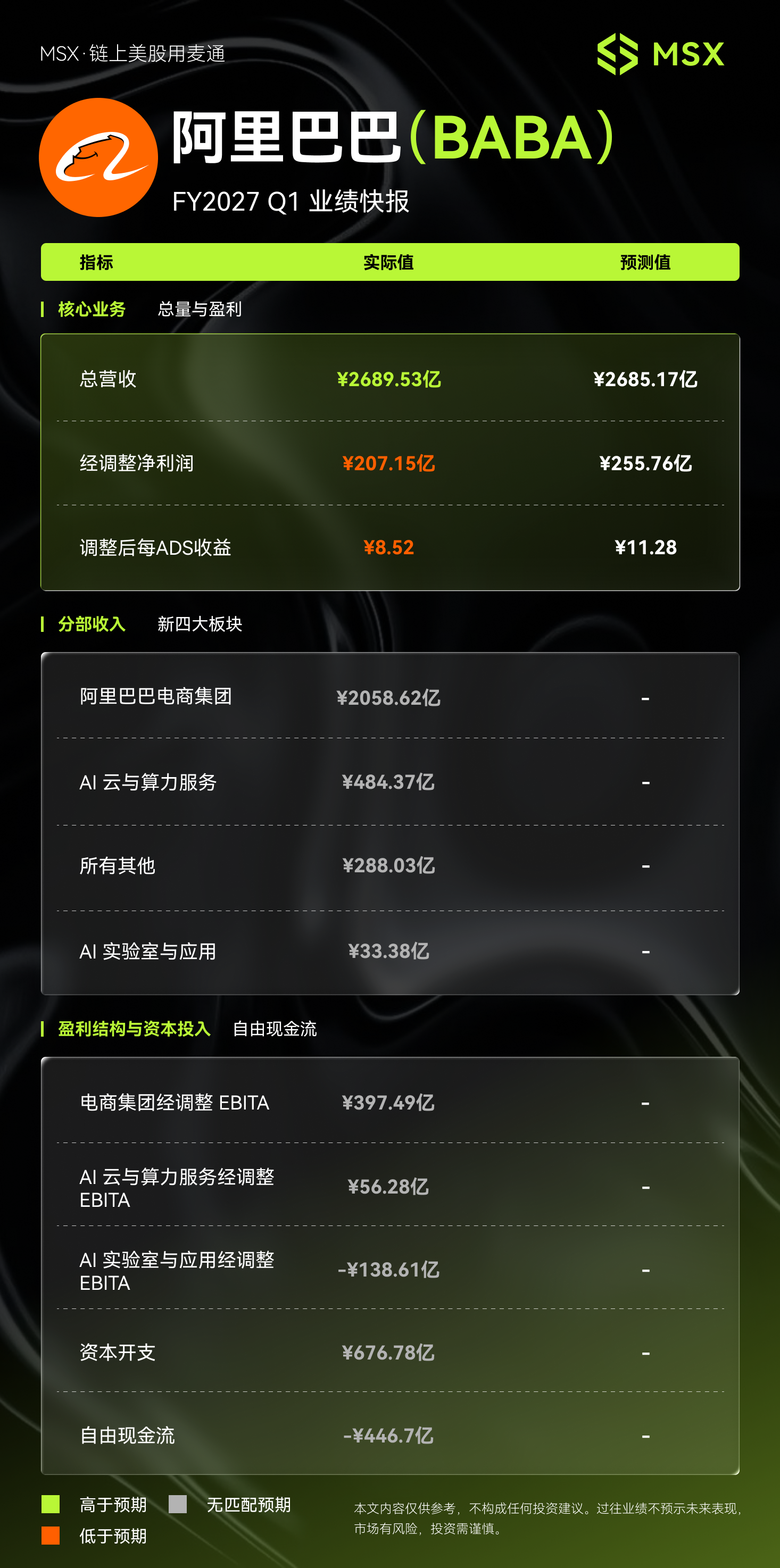
Alibaba's AI Cloud and Computing Services revenue recorded its fastest growth rate in 22 quarters, with the segment's adjusted EBITA increasing 133% year-on-year to RMB 56.3 billion, and the profit margin rising to about 12%. While the Group's profits were weighed down by heavy investments, the cloud business showed simultaneous acceleration in both revenue and profits, indicating that AI demand is driving higher-quality growth.
The most easily overlooked figure in Alibaba's earnings report is not the 45% cloud revenue growth, but the 133% profit growth for the cloud business.
This quarter, AI Cloud and Computing Services revenue reached RMB 484.4 billion, a 45% year-on-year increase, marking the fastest growth rate in 22 quarters. More crucially, the segment's adjusted EBITA reached RMB 56.3 billion, up 133% year-on-year, with the profit margin climbing to about 12%. Revenue is accelerating, and profit growth significantly outpaces revenue growth, meaning Alibaba's AI investments are no longer just "burning money for scale."
Cloud Business Begins to Show Economies of Scale
The early stages of cloud computing require constructing data centers, purchasing servers, and deploying networks, resulting in high fixed costs. However, once the platform reaches scale, the same infrastructure can serve more customers, and incremental revenue does not require a proportional increase in sales and operational costs. Therefore, when utilization rates improve, profit growth has the potential to exceed revenue growth.
This quarter, Alibaba's AI product revenue was RMB 123.8 billion, up approximately 38% quarter-on-quarter from RMB 89.7 billion last quarter. Activities such as enterprises training models, deploying agents, and increasing inference calls directly consume cloud computing power. The more stable the demand, the better Alibaba can improve its infrastructure utilization and translate its technological investments into higher segment profits.
Developing proprietary chips is another path to improving costs. Alibaba's T-Head chips have already been adopted by over 650 external customers across more than 20 industries. As the deployment of self-developed chips expands, Alibaba has the opportunity to reduce dependence on single external suppliers and optimize performance and energy consumption for its own cloud platform. For the cloud business, every reduction in the unit cost of computing power directly impacts long-term gross margin potential.
High Capital Expenditure Remains a Question That Must Be Answered
This quarter, Alibaba's capital expenditure reached RMB 676.8 billion, equivalent to investing approximately RMB 1.4 for every RMB 1 of cloud revenue generated. The Group's free cash flow had a net outflow of RMB 446.7 billion, and net profit also declined significantly. In other words, while the profit quality of the cloud business itself is improving, the Group is still at the peak of its infrastructure investment cycle.
This is also the core point of divergence in BABA's valuation. Cautious investors worry that the competition in AI computing power will become a never-ending race of capital expenditure; optimistic investors see that the 45% revenue growth and 133% EBITA growth already prove that demand and profitability can emerge simultaneously.
To judge which side is closer to the truth, we need to watch two numbers going forward: whether cloud revenue can continue to grow faster than the Group's overall rate, and whether the segment's profit margin can keep rising amid expanded investments. At least this quarter, Alibaba Cloud's answers are relatively positive. It is not only the Group's fastest-growing business but is also becoming a new engine that can contribute tangible profits, which is more valuable than merely pursuing model parameters and leaderboard rankings.
---