Not Just USDT: Tether Wallet Is Attempting to Take Over the Payment System for Ordinary People

marsbitPublished on 2026-04-15Last updated on 2026-04-15

Abstract

Tether, the issuer of the world's largest stablecoin USDT, has launched Tether Wallet, branded as "The People's Wallet," marking a strategic shift from being primarily an asset issuer to directly engaging with end-users. This move aims to capture retail traffic and create a closed-loop ecosystem by offering a simplified payment interface. The wallet eliminates key barriers to crypto adoption: complex hexadecimal addresses are replaced with human-readable usernames (e.g., username@tether), transaction fees (gas) are abstracted and paid directly in the transferred asset, and self-custody is combined with an encrypted cloud backup system for easier recovery. Supported assets include USDT on Ethereum, Polygon, and other networks, as well as Bitcoin and Tether’s gold-backed XAUT. Notably, it does not yet support Tron, where nearly half of all USDT is issued. By drastically reducing friction in cross-border payments—enabling instant, low-cost transfers via email-like addresses—Tether is positioning USDT to dominate small-value international settlements, particularly in emerging markets. This challenges traditional remittance services and competing stablecoins like USDC by leveraging its first-mover advantage and network effects. The piece also highlights underlying tensions: while promoting financial inclusion for the unbanked, Tether’s centralized infrastructure creates potential regulatory vulnerabilities. The wallet’s design also anticipates future use by AI agents for machi...

In the power landscape of Web 3, Tether has long played the role of a silent yet immensely wealthy shadow dollar printing machine.

On the evening of April 14, Tether announced the official launch of Tether Wallet, calling it "The People's Wallet." The emergence of this product essentially represents the "interface sinking" of this stablecoin giant, directly reaching end users.

From an asset issuer to a user gateway. Previously, Tether only "printed money"; now it wants to define how people transfer assets and how they hold them. By directly controlling C-end traffic, Tether is transforming into a closed-loop ecosystem with traffic sovereignty.

This is also a defense of its shadow dollar status. In emerging markets, USDT has already become the de facto standard substitute. But as Circle continues to strengthen its compliance narrative and squeeze the market, Tether must lower the physical barriers to use, firmly locking the billions of users abandoned by traditional finance into its official gateway.

What Is the True Core of Tether Wallet?

In the product logic of Web 3, user experience has always been a false proposition. When you ask a user on a street in Latin America trying to transfer $10 to hand-copy 12 illogical English words and warn them that "losing them means bankruptcy," financial inclusivity dies at the starting line.

The core highlight of Tether Wallet is its attempt to use a transparent, white-box approach to dismantle the three major hurdles of self-custody wallets: addresses, fees, and seed phrases, focusing on "simplicity" and "convenience," compressing the experience to the extreme.
First, it makes on-chain addresses identity-based.

For a long time, long hexadecimal string addresses have been the biggest obstacle to mass adoption. Tether Wallet introduces a payment username system (e.g., [email protected]). This means that in cross-border transfer scenarios, USDT completely sheds the obscurity of crypto assets and becomes as simple as sending an email or a message.

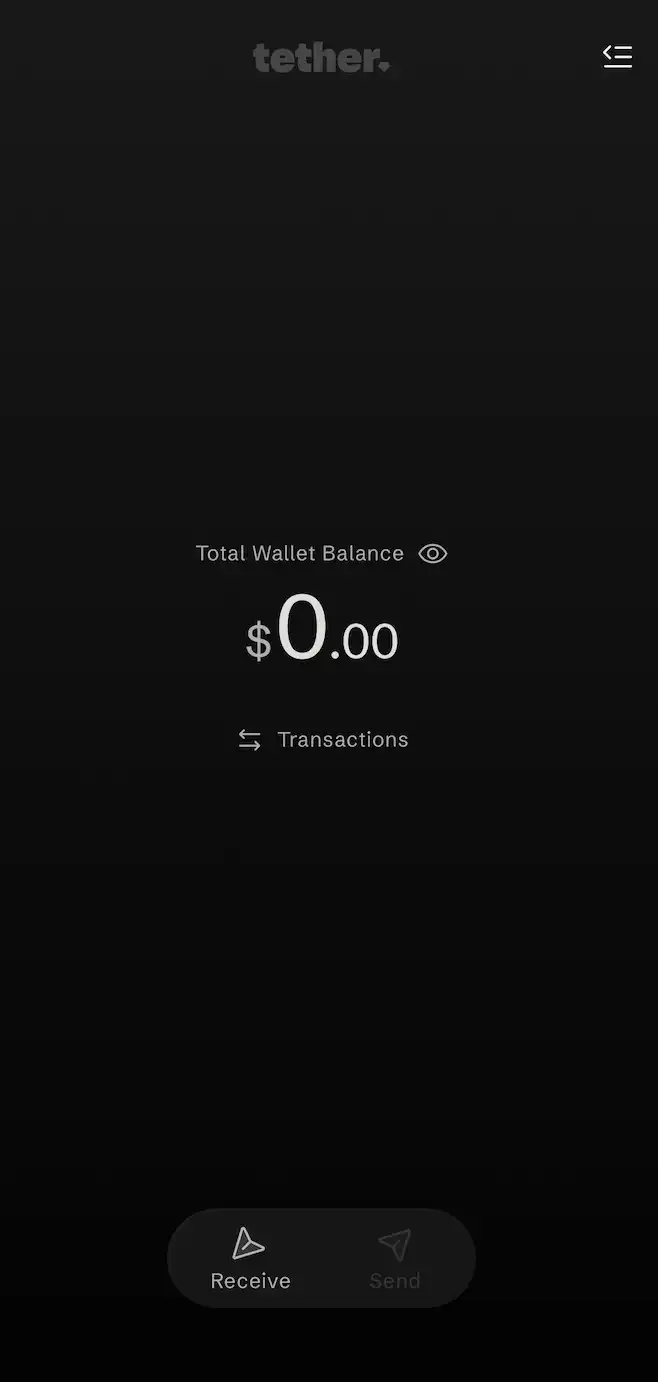
Based on actual testing, Tether Wallet requires an email to log in and register. Currently, payment usernames must and only support lowercase letters and numbers, with a length limit of 4 to 15 characters.

Second, true Gas abstraction, with fees directly deducted from the transferred assets.

Tether Wallet itself does not charge fees and supports using the transferred assets to directly deduct network fees.

The technology is not innovative, but being natively integrated by Tether changes everything: it completes the payment experience loop at the protocol layer. This "Gas abstraction," natively integrated by the issuer, means it completes the payment experience loop at the underlying protocol level. Users only need to care about how much to transfer, not the "road toll."

Third, self-custody design and cloud backup solution

Tether Wallet uses a self-custody design; all transactions are signed and confirmed on the user's own device before being sent to the blockchain. Tether Wallet also provides an encrypted cloud backup solution (Cloud Backup), where wallet data is encrypted and stored on Tether's servers, while the key is stored in the user's own iCloud/Google Drive. Neither party can unlock it alone; they are only combined when the user logs in on the device. To restore the wallet on a new device, simply log in with the email.

Of course, users can still choose to back up manually.

Currently, Tether Wallet supports assets and networks including:

· USDT: Ethereum, Polygon, Plasma, Arbitrum

· XAUT: Same as above

· USAT: Ethereum

· Bitcoin: On-chain + Lightning Network

It is worth noting that currently 45% of the circulating USDT supply is on Tron, but Tether Wallet does not currently support Tron.

When Stablecoins Transition into High-Frequency Payment Assets

When the threshold for payment is as low as needing just an email and a username, USDT is no longer just an anchor of value in the crypto world; it begins to exert a terrifying gravitational effect, attempting to devour the entire real-world small-value cross-border settlement market.

First, it is a dimensional打击 (dimensional strike) against traditional cross-border payment intermediaries. Before tether.wallet, workers in emerging markets had to pay high fees and endure settlement cycles lasting several days to send money to their families. The logic of Tether Wallet is: Since USDT is already the shadow standard currency in these regions, instant, low-cost transfers can be achieved through the Lightning Network or other blockchains.

There is also the生存挤压 (survival squeeze) on competing stablecoins. In the past, Circle (USDC) or PayPal (PYUSD) tried to capture the market through compliance and institutional endorsement.

But Tether realized that at the retail end, liquidity inertia is greater than everything. When a user gets used to smoothly transferring money with an @username in Tether's official wallet, they have no incentive to switch to a payment tool with higher fees and a smaller circle. Tether is turning its first-mover advantage into irreversible usage inertia.

A deeper impact is that Tether is redefining financial inclusion. This self-custody wallet allows Southeast Asian farmers and Latin American vendors who have never had a bank account to, for the first time, obtain an equal, unilaterally unclosable seat in the global financial infrastructure.

Power Boundaries and Protocol Vitality in the AI Era

In the tether.wallet documentation, one word is mentioned twice: Left behind. However, as these groups forgotten by the traditional financial system flock into the new infrastructure built by Tether, a series of unsolved questions about power also emerge.

First is the regulatory暗战 (shadow war) disguised under self-custody. Although Tether emphasizes that users own the private keys, when it natively integrates cloud backup functionality and supports the @username system, it naturally leaves nodes that can be介入 (intervened) by regulation.

If regulators require marking specific accounts or pressuring cloud data, Tether will have to choose between "decentralized creed" and "commercial survival." This will be a key battleground for the future博弈 (game) between crypto and sovereignty.

Second, AI Agents are the second growth curve. Paolo Ardoino's statement is highly预见性 (prescient): this wallet is also prepared for AI Agents. In the interconnected future, human biological identity may no longer be the core of financial accounts.

When an AI agent needs to instantly pay for computing power, a stablecoin wallet that can be调度 (dispatched) through a simple interface will become the "blood" of machine civilization.

Finally, we need to face that ultimate contradiction. Tether is a complex综合体 (complex): it has a centralized core, yet it is spreading extremely decentralized tools outward.

This contradiction may be a true reflection of the current evolution of global finance. The old order is difficult to shake, and the new order only grows in the cracks. Tether Wallet is not trying to create a utopia; it is merely opening a window in the wall of reality, allowing people to discover that dollar transfers can be as simple as sending a text message.

An era of global value transmission, dominated by a stablecoin giant, silent yet powerful, is accelerating its arrival. However, the premise of all this is: we must清醒地认识到 (clearly recognize) that convenience is never free. We cannot avoid a fundamental question: while pursuing efficiency and inclusion, how do we find a truly sustainable balance between the walls of the old order and the野蛮生长 (wild growth) of the new order?


Trending Cryptos

Related Questions

QWhat is the core innovation of Tether Wallet in terms of user experience?

ATether Wallet's core innovation lies in removing the major barriers of self-custody wallets: complex addresses, gas fees, and seed phrases. It introduces a payment username system (like an email), abstracts gas fees by allowing them to be paid with the transferred asset, and offers a secure cloud backup solution for easy recovery.

QHow does Tether Wallet aim to impact cross-border payments, especially in emerging markets?

ATether Wallet aims to revolutionize cross-border payments by offering instant, low-cost transfers using USDT, which acts as a shadow currency in many emerging markets. It eliminates high fees and long settlement times associated with traditional systems, providing financial inclusion tool for the unbanked.

QWhat strategic advantage does Tether gain by launching its own wallet and directly engaging with end-users?

ABy launching its own wallet, Tether transitions from being just an asset issuer to controlling the user interface and flow. This allows it to lock users into its ecosystem, create usage inertia, and defend its market dominance against competitors like Circle (USDC) by making switching costly and inconvenient.

QWhat are the potential regulatory challenges or power dynamics mentioned regarding Tether Wallet's design?

AThe wallet's design, while self-custodial, incorporates centralized elements like usernames and cloud backups. This creates potential regulatory attack vectors, where authorities could pressure Tether to monitor accounts or freeze funds, forcing a choice between decentralization ideals and operational survival.

QHow does Tether Wallet envision its role in the future with AI agents, according to the article?

ATether Wallet is designed to serve AI agents' needs in an interconnected future. It provides a simple interface for machines to make instant micropayments (e.g., for compute resources), positioning USDT as the 'blood' for machine-to-machine transactions in a new digital economy.

Related Reads

Annual Salary of Millions Competing for Electricians, Meta Rushes to Open Its Own Technical School

The AI boom is facing an unexpected bottleneck: a severe shortage of skilled construction workers and electricians. As tech giants like Meta, OpenAI, and Alphabet race to build massive data centers—such as OpenAI's $16 billion "Stargate" project—they are hitting a critical labor wall. The U.S. needs an estimated 130,000 more electricians, 240,000 construction workers, and 150,000 supervisors by 2030 for AI infrastructure alone, but tens of thousands of electrician jobs go unfilled each year. While AI companies offer high premiums, with electricians earning up to $280,000 annually, worker scarcity still causes massive losses—delays on a single project can cost $14.2 million per month. The complexity of building AI data centers, which require immense power (equivalent to powering hundreds of thousands of homes), sophisticated electrical systems, and advanced liquid cooling solutions, demands highly skilled technicians who are in short supply. To combat this, companies are investing heavily in training. Meta has committed $115 million to a free training school offering tuition, housing, and stipends, targeting 5,000 new workers. OpenAI is partnering with unions to secure skilled labor. These efforts are paying off, with a significant rise in Gen Z interest in trade schools over college. However, the power demands are staggering. AI data centers are driving a rapid surge in electricity consumption, projected to account for up to 12% of U.S. power use by 2028 and raising costs for consumers. Furthermore, the construction boom is project-based, leading to a potential future glut of trained workers once building peaks, which could depress wages industry-wide. The race for AI supremacy now depends as much on skilled hands as on advanced chips.

marsbit57m ago

Annual Salary of Millions Competing for Electricians, Meta Rushes to Open Its Own Technical School

marsbit57m ago

OpenAI No Longer Sells Its Most Expensive Model for Profit

OpenAI is shifting its business strategy away from promoting its most expensive, flagship models for every task. Recent price cuts—80% for GPT-5.6 Luna and 20% for Terra—signal a deeper change: the company now actively advises users that many tasks don't require the most powerful model. Instead, OpenAI recommends a tiered approach: use the high-end GPT-5.6 Sol for complex planning and analysis, then delegate execution to cheaper models like Luna. This mirrors moves by Anthropic, which recently launched Claude Opus 5 at half the price of its top model, Fable 5. Both companies are de-emphasizing flagship models as primary revenue drivers, using them instead for brand prestige and technological showcases. The industry is entering a "mass-market" phase, similar to automotive, where high-volume, cost-effective models handle daily operations and drive scale. OpenAI's price reductions are partly enabled by AI models themselves optimizing underlying code and infrastructure, creating a self-reinforcing cycle of efficiency gains and cost reduction. Competition is shifting from "who is smartest" to "who offers the best value." The goal is no longer selling individual models but fostering widespread API adoption and ecosystem lock-in. By making AI calls cheap and ubiquitous, companies like OpenAI aim to become the indispensable, utility-like infrastructure powering automated workflows—the "water and electricity" of software, quietly embedded everywhere.

marsbit57m ago

OpenAI No Longer Sells Its Most Expensive Model for Profit

marsbit57m ago

Will the Fed Definitely Raise Interest Rates in September? How Will Crypto and U.S. Stocks Withstand the Pressure?

The market's expectation for a September Fed rate hike surged dramatically in early August, jumping from under 50% to over 80% within a week. This shift followed a contentious July FOMC meeting, where a 9-3 vote to hold rates revealed growing dissent from hawkish members advocating for an immediate hike to combat persistent inflation. The primary catalyst for this repricing is rising oil prices, driven by renewed geopolitical tensions around the Strait of Hormuz, which threaten global supply. Energy costs directly influence inflation metrics, making the upcoming July CPI report (due August 12th) a critical data point. If it shows inflation reaccelerating, the probability of a September hike will solidify. For Bitcoin and crypto assets, this is typically bearish news. Bitcoin continues to behave as a high-beta, liquidity-sensitive risk asset. A rate hike raises the opportunity cost of holding non-yielding assets and could drive capital toward money markets, pressuring crypto prices in the short term. However, historical patterns suggest that if a hike is perceived as the end of a tightening cycle rather than the start, any negative price impact may be brief. U.S. stocks, particularly crypto-linked equities like Coinbase and growth-oriented tech stocks, are also vulnerable. Higher rates increase discount rates in valuation models, putting pressure on high-multiple companies. This coincides with a pivotal tech earnings season where investor focus has shifted from massive AI capital expenditure to tangible revenue and cash flow generation. Companies with negative cash flow and weak growth narratives could face heightened volatility if borrowing costs rise in September. In summary, a September Fed hike has evolved into a mainstream market scenario. Key factors to watch are oil prices, the July CPI report, and Fed communications, which will determine the final decision and its impact on volatile crypto and equity markets.

marsbit1h ago

Will the Fed Definitely Raise Interest Rates in September? How Will Crypto and U.S. Stocks Withstand the Pressure?

marsbit1h ago

Trading

Spot

Hot Articles

How to Buy PEOPLE

Welcome to HTX.com! We've made purchasing ConstitutionDAO (PEOPLE) simple and convenient. Follow our step-by-step guide to embark on your crypto journey.Step 1: Create Your HTX AccountUse your email or phone number to sign up for a free account on HTX. Experience a hassle-free registration journey and unlock all features.Get My AccountStep 2: Go to Buy Crypto and Choose Your Payment MethodCredit/Debit Card: Use your Visa or Mastercard to buy ConstitutionDAO (PEOPLE) instantly.Balance: Use funds from your HTX account balance to trade seamlessly.Third Parties: We've added popular payment methods such as Google Pay and Apple Pay to enhance convenience.P2P: Trade directly with other users on HTX.Over-the-Counter (OTC): We offer tailor-made services and competitive exchange rates for traders.Step 3: Store Your ConstitutionDAO (PEOPLE)After purchasing your ConstitutionDAO (PEOPLE), store it in your HTX account. Alternatively, you can send it elsewhere via blockchain transfer or use it to trade other cryptocurrencies.Step 4: Trade ConstitutionDAO (PEOPLE)Easily trade ConstitutionDAO (PEOPLE) on HTX's spot market. Simply access your account, select your trading pair, execute your trades, and monitor in real-time. We offer a user-friendly experience for both beginners and seasoned traders.

7.8k Total ViewsPublished 2024.03.29Updated 2026.06.02

How to Buy PEOPLE

Discussions

Welcome to the HTX Community. Here, you can stay informed about the latest platform developments and gain access to professional market insights. Users' opinions on the price of PEOPLE (PEOPLE) are presented below.

活动图片