Nietzsche Penguin Soars 6000x in a Week, Solana Meme Coin Reforging Glory?

marsbitPublished on 2026-01-26Last updated on 2026-01-26

Abstract

The article discusses the resurgence of Solana meme coins, focusing on $PENGUIN (Nietzschean Penguin), which recently listed on Binance Alpha—the first "pure" Solana meme coin to do so in over a year. The token is inspired by a viral clip from Werner Herzog’s 2007 documentary, featuring a penguin walking alone toward certain death, symbolizing nihilism and defiance of societal norms. The meme gained renewed popularity on social media in 2025, often paired with the phrase "But Why," reflecting a desire for personal freedom and self-exploration. The narrative took a political turn when the White House X account posted an image of the penguin carrying a US flag alongside Donald Trump, referencing Trump’s repeated interest in purchasing Greenland. The posts framed Trump’s ambition as a form of heroic, "America-first" determination, despite widespread ridicule. This politicization amplified $PENGUIN’s appeal, drawing comparisons to earlier politically-themed meme coins like $PNUT. The token’s rapid growth—reaching a $100 million market cap within 10 days—and its Binance Alpha listing have sparked optimism among crypto traders, seen as a potential revival for Solana meme coins and renewed institutional support. The piece concludes by questioning whether this momentum can be leveraged into sustained success.

How long has it been since Binance Alpha last listed a Solana meme coin? The previous Solana meme coin listed on Binance Alpha was JELLYJELLY ($JELLY) on February 26, 2025, nearly a year ago.

The reason for $JELLY's listing wasn't 'pure'; it was related to an incident with Hyperliquid. If we set stricter standards and exclude AI meme coins like Zerebro and elizaOS that can 'get things done,' the last pure Solana meme coin listed on Binance Alpha without other factors was Fartcoin, on December 18, 2024.

We have finally waited for another Solana meme coin to be listed on Binance Alpha—$PENGUIN (Nietzschean Penguin).

The token's story originates from a viral clip in the 2007 documentary "Encounters at the End of the World" by German director Werner Herzog. In that clip, a penguin turns its back on its colony and heads toward the ocean—the source of food and life.

To reach the ocean, it ventures alone inland, heading toward distant mountains, with the faraway sea being 5,000 kilometers away. Everyone knows this means hunger and cold, exhaustion and certain death.

By the mid-2010s, this video had gained widespread popularity due to its "nihilistic" interpretation. In late August 2015, YouTube user Seppe uploaded this clip to YouTube titled "Nihilistic Penguin," and this version quickly went viral, garnering nearly 2 million views to date.

This old meme has gradually regained vitality on TikTok and Instagram since the beginning of this year. Just as the meme's name "Nietzsche Penguin/Nihilistic Penguin" suggests, the related viral videos and memes almost always feature the keyword "But Why." People worldwide use this meme to question themselves—but why must my life be lived this way?

Society tells us we should find a good job, get married, have children, and avoid thinking about meaningless or impractical things. But isn't the meaning of life precisely about exploring life's purpose in the way we desire? They ask us why, but there is no why—it's simply what we want to do. Living authentically, disregarding世俗的眼光, is about transcending oneself.

If this meme had followed its original development path, $PENGUIN would have been similar to $NEET, both reflecting contemporary people's desire to escape the世俗 'system,' pursue freedom, and awaken self-awareness. However, the White House's use of this meme has added a new layer of meaning, transforming this meme coin from a social media trend/consciousness-raising meme coin into a political one.

Yesterday at 6 a.m., the White House X account posted a tweet saying, "Embrace the penguin," accompanied by an image of the "Nietzsche Penguin" holding an American flag and walking alongside Trump toward the distant mountains.
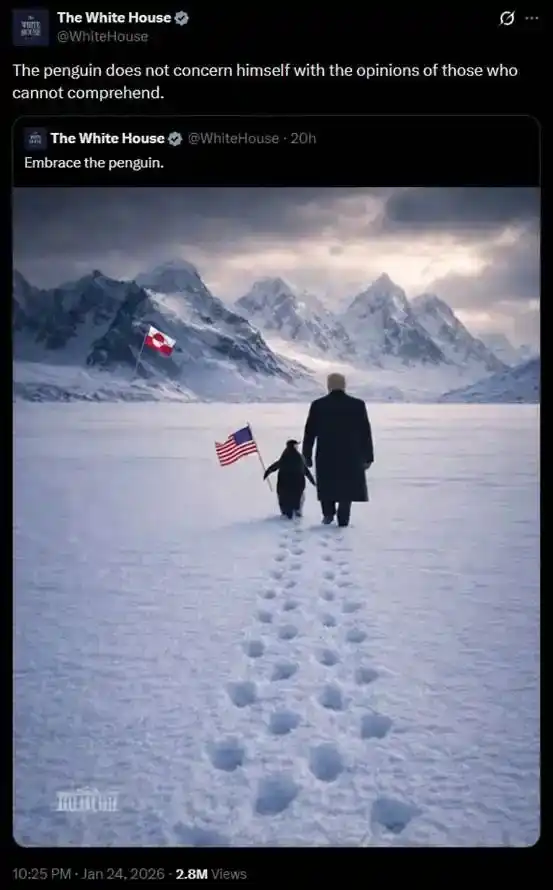
At 10:30 p.m. the same day, the White House X account again quoted this tweet, adding, "This penguin never cared what those who didn't understand it thought."

These two tweets coincided with Trump once again publicly expressing his interest in acquiring Greenland. Trump first proposed this idea in 2019, and after the tumultuous journey of leaving office and winning the election again, he still hasn't given up on his desire for Greenland.

This desire, in the eyes of most people, is yet another crazy delusion. The White House's use of this meme amplifies the personal angle of exploring life's meaning, emphasizing Trump's disregard for ridicule and practical obstacles, instead portraying his 'madness' as a heroic, America-first pursuit.

The aforementioned image sparked widespread mockery. Netizens pointed out that there are no penguins in the Arctic, and such a basic error is as anti-intellectual as Trump's suggestion during the pandemic to inject disinfectant to kill the virus. However,有趣的是, many netizens also升华ed this image further, linking Trump's proposal to buy Greenland to the 1867 purchase of Alaska from Russia, viewing it as America's "Manifest Destiny"—the unique mission to expand influence, spread systems, or acquire resources.

And there are no penguins in the Arctic? No matter, if Trump wants it, Trump gets it. This was interpreted as a Trump-style humor, conveying a "reality doesn't matter, will does" spirit of triumphing over nature through human effort.

By this point, we can already understand why $PENGUIN is being anticipated by crypto players with expectations similar to $PNUT. This anticipation also resonates with the reality of Solana meme coins—after that glorious meme season, it has been too long since we last saw a meme coin突破 $100 million market cap within 10 days of deployment.

Binance Alpha listing a pure Solana meme coin again after more than a year has also excited crypto players, seen as Binance once again opening its arms to Solana meme coins and the beginning of Solana meme coins reforging their glory.

This time, we dare to dream—will we truly get it?

Related Questions

QWhat is the significance of the $PENGUIN (Nietzschean Penguin) meme coin being listed on Binance Alpha?

AIt marks the first 'pure' Solana meme coin listing on Binance Alpha in over a year, signaling a potential resurgence and renewed institutional interest in the Solana meme coin ecosystem.

QWhat is the origin of the $PENGUIN meme, and why is it called 'Nietzschean Penguin'?

AThe meme originates from a scene in Werner Herzog's 2007 documentary 'Encounters at the End of the World,' depicting a penguin walking alone toward certain death. It gained a 'nihilistic' interpretation online, leading to the name 'Nietzschean Penguin' or 'Nihilist Penguin'.

QHow did the White House's use of the 'Nietzschean Penguin' meme change its meaning?

AThe White House used an image of the penguin carrying a US flag and walking with Donald Trump to reframe the meme from a personal quest for meaning into a political symbol, portraying Trump's persistence in pursuing seemingly impossible goals, like buying Greenland, as a form of heroic, 'America First' determination.

QWhy is the $PENGUIN coin compared to $PNUT and seen as having significant potential?

AIt is compared to $PNUT due to its rapid growth and the high expectations from the crypto community, fueled by its massive cultural and political relevance, achieving a $100 million market cap within 10 days of deployment—a feat not seen since the last Solana meme season.

QWhat does the Binance Alpha listing of $PENGUIN represent for the future of Solana meme coins?

AThe listing is viewed as Binance reopening its doors to Solana meme coins after a long hiatus, potentially heralding a new era of growth and legitimacy for the category, often referred to as 'reforging the glory' of Solana meme coins.

Related Reads

380,000 Apps Exposed, 2,000+ Apps Leaked Secrets: AI Programming Turns 'Intranet' into Public Internet

Israeli cybersecurity firm RedAccess uncovered a severe data exposure trend linked to "vibe coding" or AI-powered software development tools. Their research found approximately 38,000 publicly accessible web applications built with platforms like Lovable, Base44, Netlify, and Replit. Of these, an estimated 2,000 apps exposed sensitive corporate and personal data, including medical records, financial information, internal strategic documents, and customer chat logs. In some cases, access even granted administrative privileges. The core issue stems from default privacy settings that make applications public by default, combined with a lack of built-in security controls (like authentication) in the AI-generated code. This allows employees without security expertise—"citizen developers"—to easily create and deploy applications that bypass standard corporate security reviews. The exposed apps, often indexed by search engines, are trivially discoverable. While some platform providers (Replit, Lovable, Wix/Base44) argue that security configuration is the user's responsibility and question the validity of some findings, security researchers confirm the widespread reality of such exposures. This pattern, also noted in prior studies, highlights a critical security gap as AI democratizes app creation, potentially leading to massive, unintentional data leaks.

marsbit8m ago

380,000 Apps Exposed, 2,000+ Apps Leaked Secrets: AI Programming Turns 'Intranet' into Public Internet

marsbit8m ago

Attracting Global Capital, Asia's New 'Super Cycle' Is Unfolding

Investors are turning to Asia as the next frontier for global equity growth, with a new "super cycle" unfolding across the region. Driven by the AI revolution, Asian markets, particularly South Korea, have seen significant rallies. According to Morgan Stanley analysis, the underlying drivers of Asia's industrial cycle are shifting from traditional sectors like real estate and manufacturing to massive investments in AI infrastructure, energy security and transition, and supply chain resilience. Fixed asset investment in Asia is projected to grow from around $11 trillion in 2025 to $16 trillion by 2030, with a 7% annual growth rate from 2026-2030. The AI wave is a primary catalyst, driving immense capital expenditure for chips, servers, data centers, and power systems. Asia is central to this hardware supply chain. In China, AI investment is focused on building a full-system domestic capability, with the local AI chip market potentially reaching $86 billion by 2030. Beyond AI, China's export story is expanding from EVs and batteries to robotics. The country already captures about half of new global industrial robot demand and over 90% of humanoid robot shipments. This growth phase mirrors the early stages of China's EV export boom. Simultaneously, energy security investments, spurred by AI's massive power needs, are rising, with China benefiting from its leadership in solar, batteries, and EVs. Regional defense spending is also increasing structurally, supporting demand for advanced manufacturing. The main beneficiaries are China, South Korea, and Japan, positioned in core supply chain areas. However, risks remain, including potential overcapacity, profit margin pressures from competition, persistent technological restrictions, geopolitical friction, and workforce displacement due to AI-driven automation. Market volatility is also expected to increase as investor expectations diverge on the realization of these capital investment and export themes.

marsbit8m ago

Attracting Global Capital, Asia's New 'Super Cycle' Is Unfolding

marsbit8m ago

Funding Weekly Report | 14 Public Funding Events, Kalshi Completes $10B New Funding Round at $220B Valuation Led by Coatue Management

Weekly Funding Roundup: 14 Deals and $10.49B+ in Total Funding, Led by Kalshi's $1B Round Last week (5.4-5.10) saw 14 notable funding events in the global blockchain ecosystem, raising over $10.49 billion in total. Key highlights include Kalshi, a prediction market platform, securing a $1 billion round led by Coatue Management, reaching a $22 billion valuation. The platform now boasts ~2 million MAUs and $178B in annualized trading volume. In DeFi, regulated on-chain reinsurer OnRe raised $5 million in Series A funding, and Bitcoin-backed credit protocol Saturn Credit completed a $2 million seed round. For Infrastructure & Tools, OpenTrade raised $17 million to expand its stablecoin yield infrastructure, and RWA platform Balcony secured $12.7 million to deploy its property settlement service in the US. Centralized Finance saw one deal: AI-driven trading platform Stockcoin.ai completed a seed round led by Amber Group. In the prediction market sector alongside Kalshi, AI-powered platform Elastics raised $2 million. Other notable deals include SC Ventures' strategic investment in crypto market maker GSR and Centrifuge securing a "seven-figure" investment from Coinbase to become a core RWA partner for Base. On the investor side, Haun Ventures raised a new $1 billion fund targeting crypto and AI, and Multi Investment raised ~$616 million to focus on blockchain and Web3 investments.

marsbit1h ago

Funding Weekly Report | 14 Public Funding Events, Kalshi Completes $10B New Funding Round at $220B Valuation Led by Coatue Management

marsbit1h ago

Trading

Spot
Futures

Hot Articles

Discussions

Welcome to the HTX Community. Here, you can stay informed about the latest platform developments and gain access to professional market insights. Users' opinions on the price of MEME (MEME) are presented below.

活动图片