New Capital Favors 'Old Altcoins'

marsbitPublished on 2026-01-21Last updated on 2026-01-21

Abstract

New capital is increasingly flowing towards established "old guard" cryptocurrencies, leading to a significant market structure shift. Bitcoin's dominance has surged to 65%, its highest since 2021, driven by institutional adoption via ETFs which attracted over $150 billion. Stablecoins and on-chain derivatives now represent 12.5% of the total crypto market cap, further squeezing altcoins. Within the altcoin sector, capital is concentrating heavily. The top 10 altcoins now constitute 82% of the altcoin market cap, up from 64% in 2021. The number of altcoins with a market cap over $1 billion has nearly halved, indicating a focus on larger, more mature assets with clear use cases and regulatory paths. Performance data confirms this trend. Since January 2023, large-cap assets have significantly outperformed mid and small-caps, with returns of ~365% compared to ~70% and ~55%, respectively. This highlights a investor preference for liquidity and lower volatility, a trend likely reinforced by recent market sell-offs. The market is maturing, with capital becoming highly selective and favoring established players and critical infrastructure.

The landscape of crypto investment continues to expand. Hundreds of new tokens are launched each year, the number of equity stocks related to digital asset businesses is increasing, and tokenization technology is gradually bringing traditional assets like stocks and commodities on-chain. While investment choices are becoming more abundant, market capital is also becoming more selective.

Bitcoin's market dominance has rebounded to around 65%, reaching its highest level since early 2021; at the same time, the combined market capitalization of stablecoins and on-chain derivatives (such as wrapped tokens, staked tokens, cross-chain bridge tokens, etc.) now accounts for nearly 12.5% of the total crypto market cap. As a result, altcoins are facing a double squeeze—despite the growing number of tokens, their overall market share is shrinking.

This issue of the "State of the Network Market" report explores whether the crypto market is undergoing a structural shift towards capital concentration. We will analyze trends in market dominance and returns across assets of different market cap tiers and sectors to investigate whether capital is consistently aggregating towards fewer, larger, and more mature tokens, or if investment opportunities remain widely distributed.

Evolution of Market Cap Dominance

First, we begin our analysis from market cap dominance. Bitcoin's market dominance (i.e., Bitcoin's market cap as a percentage of the total crypto market cap) climbed to 65% in 2025, hitting a new high since 2021. Notably, this growth is not a short-term spike but a long-term, steady upward trend since its trough in 2022.

The launch of Bitcoin spot ETFs has deepened institutionalization, attracting over $150 billion in long-term capital, further driving the sustained rise in its market dominance. This trend solidifies Bitcoin's position as a "safe-haven asset" in the crypto market and makes it a highly liquid, standardized entry point for traditional institutional investors. Compared to previous bull markets where "altcoin seasons" quickly diluted Bitcoin's market share, Bitcoin's dominance in this cycle is more enduring.
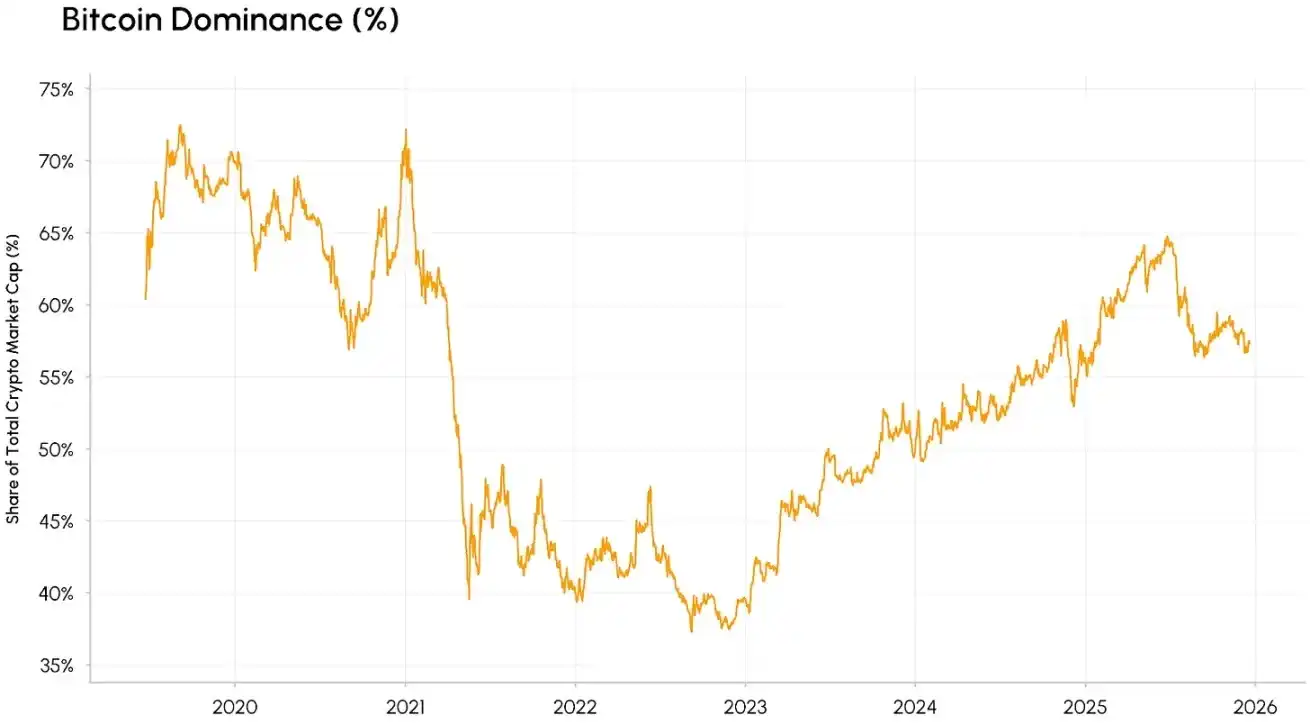
Bitcoin Dominance, Data Source: Coin Metrics

The structure of other assets in the crypto market is also changing. Stablecoins, with a current market cap exceeding $300 billion, and on-chain derivatives are increasingly accounting for a larger share of the total market capitalization. These tokens serve different functions within the crypto ecosystem: stablecoins are the primary medium of exchange in the market, while on-chain derivatives provide investors with claims on the returns of underlying assets or channels for generating yield.
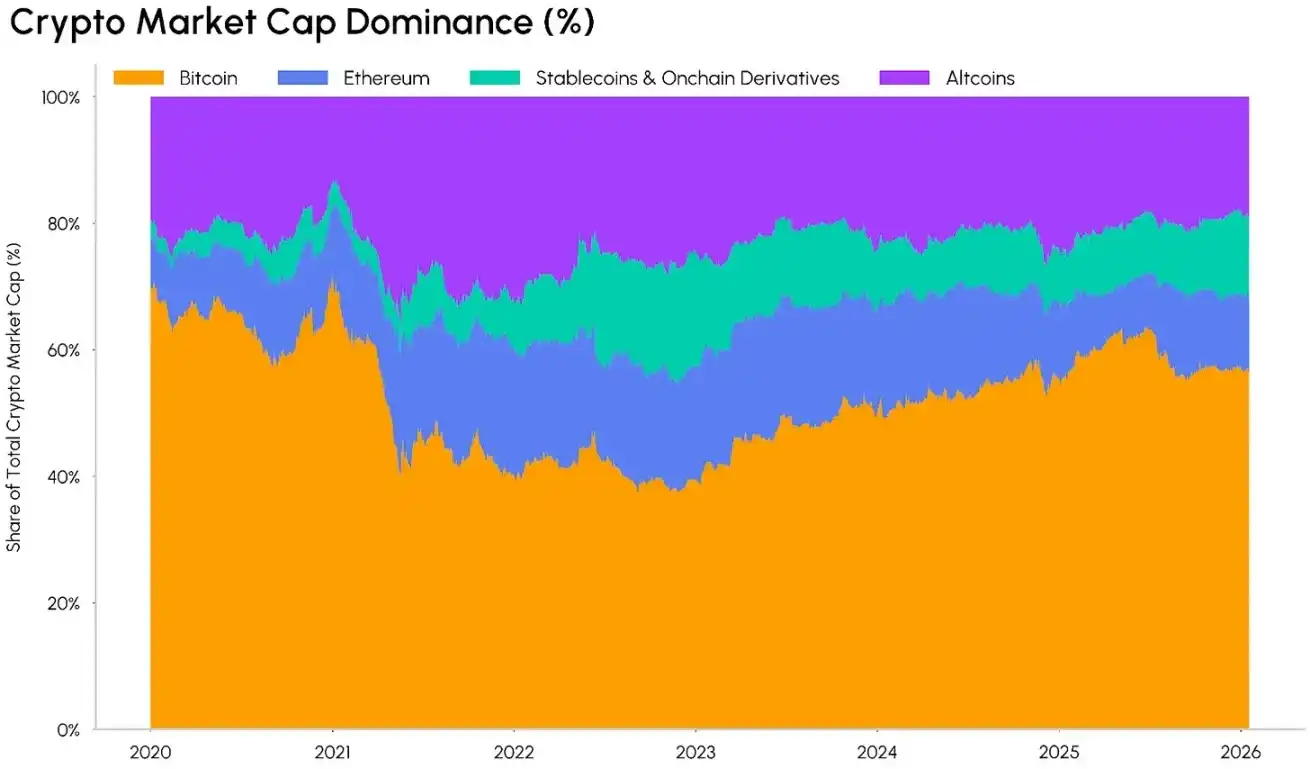
Crypto Market Dominance Distribution, Data Source: Coin Metrics

As a result, the altcoin market is facing a dilemma. The range of investable targets is continuously narrowing, and the concentration effect at the top is becoming more pronounced: market value is consistently aggregating towards more liquid and mature assets, which often have clear use cases, defined regulatory development paths, and can fully benefit from the growth waves of stablecoins, decentralized finance (DeFi), and asset tokenization.

Unlike previous market cycles, the speed of capital rotation from major coins to altcoins has significantly slowed in this cycle. ETFs and various institutional investment tools have locked market liquidity firmly in top-tier assets. However, this market structure may change with the implementation of universal listing standards, the launch of altcoin and multi-asset ETFs broadening investment channels for more large-cap altcoins, and the advancement of market structure-related legislation.

The 'Giant Monopoly' Trend Within the Altcoin Sector

Even within the altcoin sector itself, the trend of capital concentration is intensifying. The current top 10 altcoins by market cap (excluding Bitcoin) account for about 82% of the sector's total market value, a significant increase from 64% during the 2021 bull market. In the previous bull cycle, a large number of small-cap altcoins that briefly created value have gradually exited the market, replaced by a sector structure with stronger top-heavy effects, and the lifecycle of various short-term market narratives has shortened, making it difficult to sustain the continued rise in asset value.
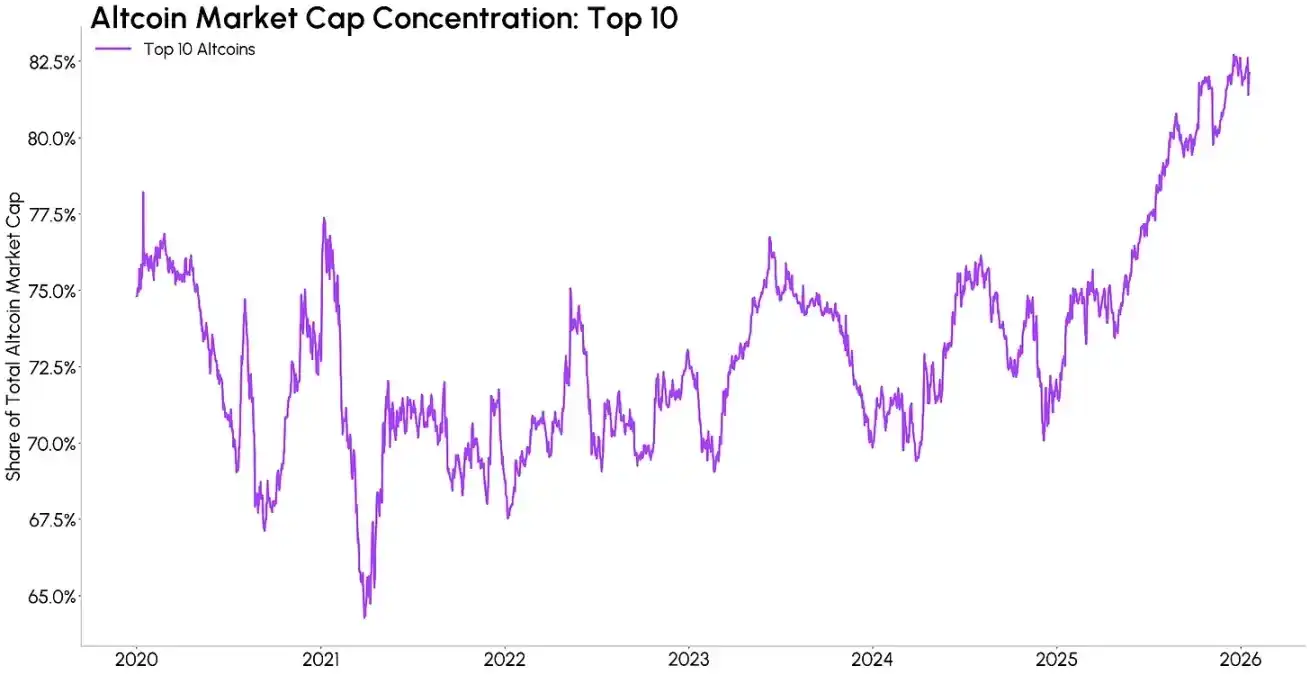
Top 10 Altcoin Market Cap Share, Data Source: Coin Metrics

We can also observe this concentration trend by looking at the number of tokens breaking through specific market cap thresholds. Although the total crypto market cap has repeatedly reached new all-time highs, the number of altcoins with a market cap exceeding $1 billion has shrunk from about 105 at the peak in 2021 to about 58 currently. This means that even as the total number of assets in the market increases, the number of truly "investable" altcoins is decreasing. While this does not necessarily mean the altcoin sector is declining, the focus of market funds may further aggregate towards targets with solid fundamentals and stronger risk resistance.
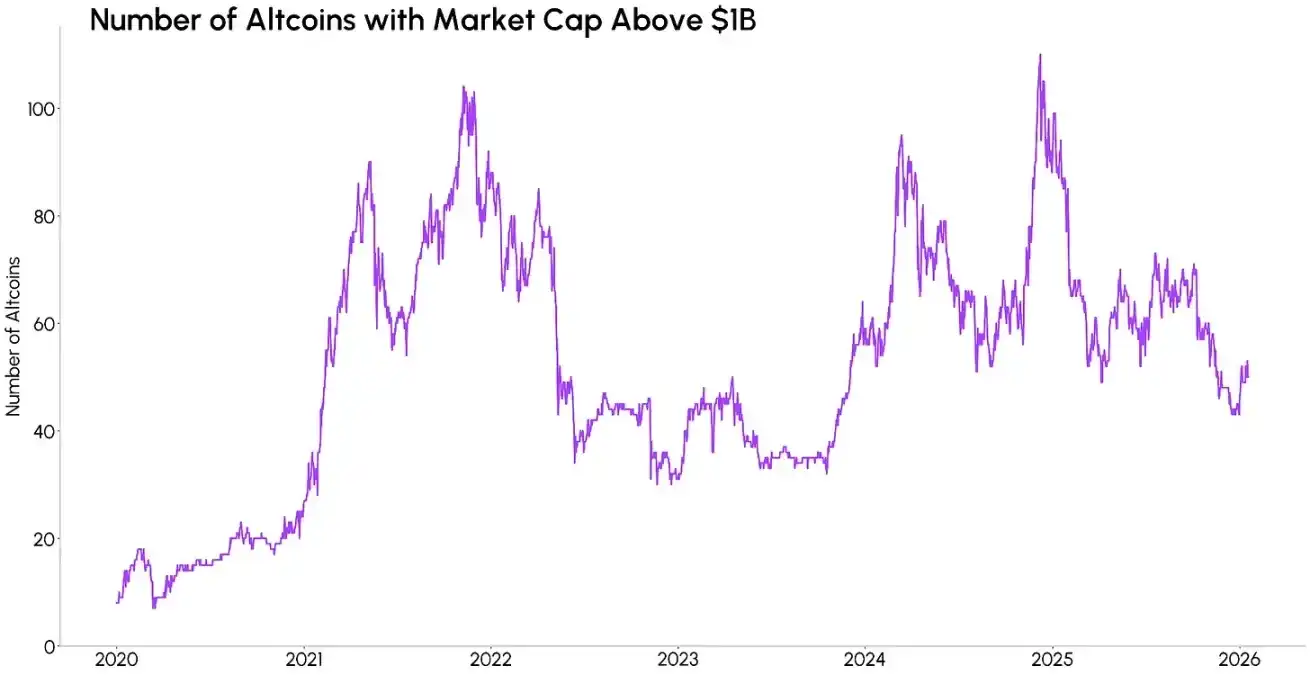
Number of Altcoins with Market Cap Over $1 Billion, Data Source: Coin Metrics

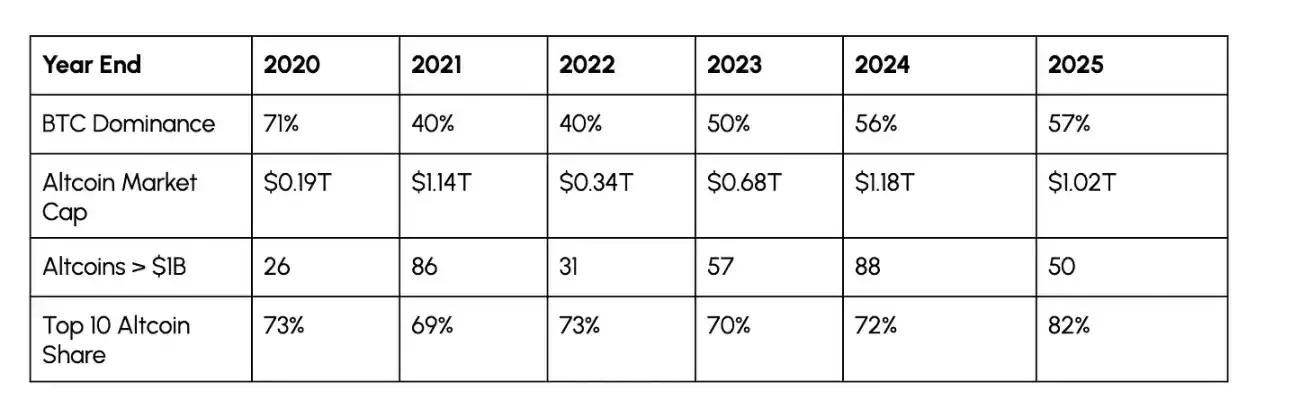
The table below summarizes the annual evolution characteristics of the aforementioned market trends. Some indicators still show cyclical features, such as Bitcoin's market dominance falling in bull markets and rising in bear markets, but the market share of the top 10 altcoins has shown a different trend: from 2020 to 2024, regardless of market conditions, this ratio remained stable between 69%-73%, but it surged to 82% in 2025. This change indicates a structural shift tilting towards mature leading assets, rather than merely short-term "chasing quality assets" behavior.
Data Source: Coin Metrics

Capital Flows to Major Coins

This capital concentration trend is also reflected in asset return performance. Since 2023, mid-cap coins (market cap $1B - $10B) and especially small-cap coins (market cap $10B) during early and late phases of 2024, but this trend reversed sharply in 2025, driven by a rapid fading of market sentiment towards Meme coins and other short-term narrative rotations.

Calculated on an equal-weight basis, from January 2023 to the present, the overall return of crypto large-cap coins is approximately 365%, while the returns of mid-cap and small-cap coins are only about 70% and 55% respectively, with most of the earlier gains being given back. This divergence in returns fully demonstrates that market performance is increasingly tilting towards developed, liquid assets, and the gains of small-cap tokens are unlikely to replicate the sustainability seen in previous cycles.
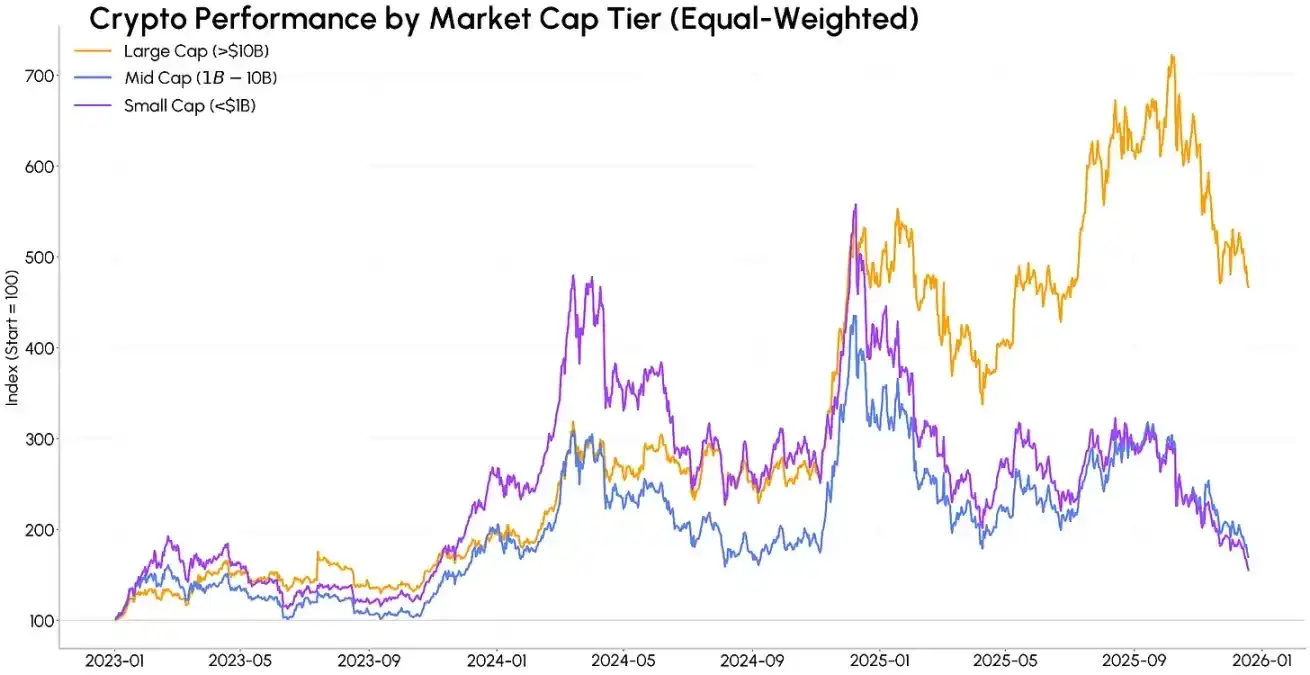
Market Performance of Tokens by Market Cap Sizes, Data Source: Coin Metrics

On October 10, 2025, the market experienced a large-scale liquidation event triggered by high leverage and liquidity drying up. This event may further strengthen the trend of capital shifting towards defensive assets, with investors increasingly favoring highly liquid assets over significantly more volatile small-cap assets.

Conclusion

Various data indicate that the crypto market is in a stage of structural change, gradual maturation, and consolidation. Although the number of crypto assets continues to increase, and as underlying infrastructure, the types of traditional assets being onboarded are becoming richer, the overall liquidity of the market is limited. Furthermore, within multi-asset portfolios, crypto assets must also compete for space with popular investment themes in the stock market and traditional safe-haven assets like gold.

Currently, capital is continuously aggregating towards crypto large-cap coins and the infrastructure sectors supporting stablecoins, tokenized assets, and decentralized finance. The importance of liquidity and scale has increased further compared to the past, and the threshold for altcoins to attract long-term capital has risen significantly.

Of course, if market structure-related rules become clearer, altcoin and multi-asset ETFs continue to gain popularity, coupled with improved market liquidity conditions, a new altcoin season could still be catalyzed. However, it is foreseeable that the beneficiaries among altcoins in this cycle will be more concentrated, and capital's choices will be more selective than in any previous cycle.


Related Questions

QWhat is the main trend observed in the cryptocurrency market regarding capital allocation, according to the article?

ACapital is increasingly concentrating towards larger, more established assets like Bitcoin and top-tier altcoins, rather than being widely distributed across newer or smaller tokens.

QHow has Bitcoin's market dominance changed recently, and what contributed to this trend?

ABitcoin's market dominance has risen to around 65%, its highest level since early 2021, driven by institutional adoption via Bitcoin ETFs, which attracted over $150 billion in long-term capital.

QWhat impact have stablecoins and on-chain derivatives had on the altcoin market?

AStablecoins and on-chain derivatives now account for nearly 12.5% of the total crypto market capitalization, squeezing the altcoin market by reducing the share of investable altcoins and intensifying competition for capital.

QHow has the concentration of capital within the altcoin sector itself evolved?

AThe top 10 altcoins now represent about 82% of the total altcoin market cap, up from 64% during the 2021 bull market, indicating stronger capital concentration towards mature, high-liquidity assets.

QWhat does the performance data reveal about returns for large-cap vs. small-cap cryptocurrencies since January 2023?

ALarge-cap cryptocurrencies have significantly outperformed, with returns of about 365%, while mid-cap and small-cap tokens returned only approximately 70% and 55%, respectively, highlighting a shift towards safer, more liquid assets.

Related Reads

a16z: From Companies to DAOs, DUNA May Become the Next Generation Organizational Form

This article, "From Companies to DAOs: How DUNA Could Become the Next Organizational Form," traces the 500-year evolution of business collaboration. It begins with medieval structures like the *commenda* and Florentine *compagnia*, which exposed partners to personal risk. The modern corporation, exemplified by the Dutch East India Company (VOC), was a revolutionary leap, enabling large-scale, capital-intensive ventures by offering limited liability and reducing coordination costs. However, corporations introduced new challenges like principal-agent problems and bureaucratic overhead. The piece argues that software and internet-native protocols are now reducing these traditional overheads. Decentralized Autonomous Organizations (DAOs) emerged as a new model for coordination without centralized management. Yet, DAOs face a significant legal vacuum: they lack legal recognition, leaving members exposed to unlimited personal liability, and their tokens are vulnerable to being classified as securities under unclear regulations (e.g., the Howey Test). This has forced projects into suboptimal workarounds like offshore foundations. The article identifies the Decentralized Unincorporated Nonprofit Association (DUNA) as a potential solution. Recently legalized in states like Wyoming, the DUNA provides a legal wrapper for decentralized networks. It grants key protections—legal personality, limited liability, and perpetual existence—to a group without imposing a traditional hierarchical management structure. This allows token-holder communities to govern, hold assets, and contract as a single legal entity, aligning with their decentralized nature. While DUNA doesn't solve all governance challenges or magically resolve securities law questions, it represents a crucial step. It fills the legal recognition gap, offering a native legal form for internet-scale, decentralized collaboration and extending the separation of personal risk from organizational venture into a new domain.

marsbit2m ago

a16z: From Companies to DAOs, DUNA May Become the Next Generation Organizational Form

marsbit2m ago

2026 Mid-Year Report On-Chain RWA: Tokenized Stock Market Cap Doubles in a Year, But 90% of Rights Are Hollow Shells

The 2026 Mid-Year Report on On-Chain RWA highlights a significant growth in tokenized stock market capitalization, which nearly doubled from $951 million in March to $1.89 billion by July. However, the report reveals a fundamental contradiction in this "layer 2.5" ecosystem: products with the strongest legal foundation (like regulated U.S. infrastructure) lack liquidity and distribution, while freely tradable offshored wrapper products often lack substantive ownership rights. The increase is driven largely by a few products (SECZ, FGRS, STRCx) and platforms (Ondo, xStocks, Securitize collectively hold over 85% share). While distributed value across networks like Ethereum, Solana, and BNB Chain has grown, the market remains fragmented. Products referencing the same underlying asset (e.g., Apple stock) are distinct legal liabilities with different intermediaries and jurisdictional rules, offering varying degrees of legal claim. The report cautions that headline numbers are misleading, as they reflect changes in distributed token value—driven by issuance, conversions, and price movements—not pure investor inflows. True "canonical shares" with legal ownership, wide wallet distribution, institutional liquidity, and independent on-chain price discovery do not yet exist at scale. Tokenized treasuries show stronger product-market fit, and ETFs may be easier to scale than single stocks. The core takeaway is a trade-off: legal certainty versus liquidity and composability.

marsbit51m ago

2026 Mid-Year Report On-Chain RWA: Tokenized Stock Market Cap Doubles in a Year, But 90% of Rights Are Hollow Shells

marsbit51m ago

Coldcard Hardware Wallet Hacked: 594 Bitcoin Withdrawn in 25 Minutes

The Coldcard hardware wallet has been compromised, with hackers stealing approximately 594.5 Bitcoin (~$40 million) from 500 addresses in just 25 minutes. The root cause was a critical software bug, undetected for five years, which disabled the device's secure chip for generating true random numbers. This led to the creation of private keys based on predictable data like the processor's serial number, drastically reducing cryptographic security. The attackers exploited this offline by brute-forcing possible seed phrases, finding active addresses on the public ledger, and signing transactions. Initially, Coinkite (Coldcard's maker) claimed only older models were at risk but later admitted all devices running the compromised firmware were vulnerable. CEO Rodolphe Novak (NVK) apologized but ruled out financial compensation for affected users. To secure funds, owners must urgently update their firmware to specific safe versions, generate a completely new seed phrase on the updated device, and transfer all assets to new addresses created with that new seed. While a BIP-39 passphrase can help, it does not replace this migration process. Other Coinkite products like TAPSIGNER were not affected. This incident underscores that even specialized hardware requires rigorous, independent code audits, especially for cryptographic functions. It parallels past failures, like a 2006 OpenSSL bug in Debian, and raises questions about whether automated code analysis can ever fully replace human scrutiny in critical security areas.

cryptonews.ru3h ago

Coldcard Hardware Wallet Hacked: 594 Bitcoin Withdrawn in 25 Minutes

cryptonews.ru3h ago

Trading

Spot
活动图片




