MoneyGram Expands Cash and Cryptocurrency Conversion Service to Solana

cryptonews.ruPublished on 2026-08-11Last updated on 2026-08-11

Abstract

MoneyGram has expanded its "Ramps" service for cash-to-crypto conversion to the Solana blockchain. The move extends its existing service from the Stellar network, making Solana the second supported blockchain. The integration enables wallets, exchanges, and developers on Solana to offer users the ability to convert between fiat currency and cryptocurrency through MoneyGram's vast retail network, which serves over 60 million customers across nearly 500,000 locations in more than 170 countries. The Rift wallet has become the first Solana wallet to integrate the Ramps service. Through a single API within the Solana Developer Platform, developers can now incorporate MoneyGram's fiat on- and off-ramp infrastructure directly into their applications, eliminating the need for building custom banking integrations. MoneyGram's expansion onto Solana is part of a broader strategy to embed its services across multiple blockchain ecosystems. This follows the company's move in June to become a validator on the Solana network, staking SOL tokens and processing transactions.

MoneyGram has expanded its Ramps service to Solana. Wallets, exchanges, and developers in this network now have access to converting fiat funds to cryptocurrency and vice versa through the company's payment network.

Ramps previously operated on the Stellar network, making Solana the second supported blockchain network. Rift became the first Solana ($SOL) wallet to integrate the service. Now users can transfer funds between cryptocurrencies and local currencies via MoneyGram.

In a post on X announcing the Solana launch, MoneyGram stated that it serves over 60 million customers at nearly 500,000 retail locations across more than 170 countries. Solana developers gained access to this network through a single API.
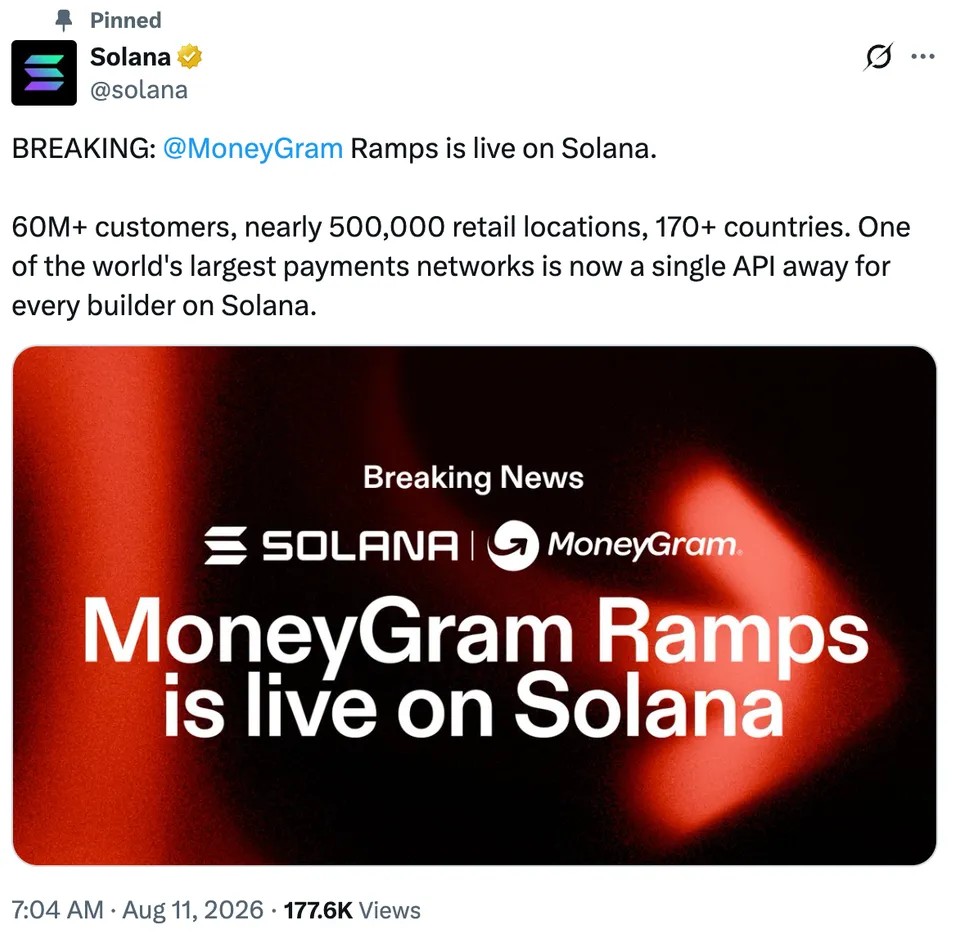
Source: Solana

According to MoneyGram, Ramps supports cash deposits in over 25 countries and cash withdrawals in over 170 countries and territories. The service is integrated into the Solana Developer Platform's payments module: developers can add MoneyGram's infrastructure for fiat on- and off-ramps without building their own bank integrations.

The company stated that launching Ramps on Solana is part of a broader effort to deploy the service across multiple blockchain ecosystems. In June, MoneyGram became a Solana validator by staking $SOL and processing transactions on the network. As part of this expansion, the company joined the Solana Developer Platform.

Magazine: Bitcoin will never drop below $60K again: Nansen founder

end-content

Related Questions

QWhat new blockchain network has MoneyGram expanded its Ramps service to?

AMoneyGram has expanded its Ramps service to the Solana blockchain network.

QWhat is the core function of the MoneyGram Ramps service on Solana?

AThe core function of the MoneyGram Ramps service on Solana is to enable the conversion of fiat money to cryptocurrency and vice versa for wallets, exchanges, and developers.

QWhich Solana wallet was the first to integrate the MoneyGram Ramps service?

ARift was the first Solana wallet to integrate the MoneyGram Ramps service.

QHow many retail locations does MoneyGram reportedly service globally according to the announcement?

AAccording to the announcement, MoneyGram services over 500,000 retail locations globally.

QBesides launching Ramps, how else has MoneyGram recently engaged with the Solana network?

ABesides launching Ramps, MoneyGram recently became a validator on the Solana network by staking SOL and joined the Solana Developer Platform.

Related Reads

Weak US Employment and $1.1 Billion into ETFs: Wintermute on the New Rally and Inflation Risks

Analysts at Wintermute stated that the cryptocurrency market gained support following a weak U.S. jobs report. Against this backdrop, U.S. spot Bitcoin and Ethereum ETFs collectively attracted $1.1 billion in inflows over the week. While demand via ETFs has recovered, there is insufficient data to confirm a sustainable shift in market sentiment. U.S. spot Bitcoin ETFs saw inflows of $853.5 million over five sessions, the best weekly result since mid-April. Ethereum ETFs attracted another $244.9 million, marking a fifth consecutive positive week. Over 80% of the inflows into both groups went to BlackRock. Wintermute notes that relatively restrained trading volumes may indicate large investors gradually building positions rather than short-term capital rotation. A disappointing U.S. employment report for July, which showed a loss of 23,000 jobs versus an expected gain of 80,000, led markets to reduce the probability of a Federal Reserve rate hike in September. This supported risk assets, including crypto. However, Wintermute cautions that the upcoming U.S. Consumer Price Index report on August 12 poses a key test. Higher-than-expected inflation could revive rate hike fears above 50%, risking a reversal of the recent rally. Beyond ETFs, institutional adoption of blockchain infrastructure continues, exemplified by Wells Fargo's planned launch of tokenized deposits. Wintermute views this as banks modernizing their settlement systems, which could eventually support broader digital asset integration. The firm concludes that while the ETF inflows are a positive signal, one week is not enough to confirm a durable trend, and the market remains highly sensitive to macroeconomic data, particularly inflation.

cryptonews.ru35m ago

Weak US Employment and $1.1 Billion into ETFs: Wintermute on the New Rally and Inflation Risks

cryptonews.ru35m ago

Trading

Spot
活动图片