Monero, Zcash, and Canton Network: Who is the True King of Privacy?

marsbitPublished on 2026-01-13Last updated on 2026-01-13

Abstract

Blockchain transparency poses risks for institutions by exposing sensitive corporate and financial data. While Monero offers complete anonymity by hiding all transaction details, it lacks KYC/AML compliance, making it unsuitable for regulated entities. Zcash provides selective privacy through shielded addresses, allowing users to encrypt transactions but only in an all-or-nothing manner. In contrast, Canton Network enables granular, selective disclosure—allowing institutions to share only specific transaction components with authorized parties (e.g., regulators) while keeping other details private. This aligns with institutional needs for both privacy and compliance. Canton’s adoption by DTCC and over 400 institutions highlights its practical design for real-world financial workflows, positioning it as a leading privacy solution for the institutional era.

Written by: Tiger Research

Key Points

  • The core advantage of blockchain—transparency—can expose corporate trade secrets and investment strategies, posing substantial risks to businesses.
  • Fully anonymous privacy models like Monero do not support KYC or AML, making them unsuitable for regulated institutions.
  • Financial institutions require selective privacy, which protects transaction data while remaining compatible with regulatory compliance.
  • Financial institutions must determine how to connect with open Web3 markets for expansion.

1. Why is Blockchain Privacy Necessary?

One of the core features of blockchain is transparency. Anyone can inspect on-chain transactions in real-time, including who sent the funds, to whom, the amount, and when it was sent.

However, from an institutional perspective, this transparency presents obvious problems. Imagine a scenario where the market can observe how much NVIDIA transferred to Samsung Electronics, or precisely when a hedge fund deployed its funds. Such visibility would fundamentally alter competitive dynamics.

The level of information disclosure tolerable for individuals differs from what businesses and financial institutions can accept. A company's transaction history and the timing of institutional investments constitute highly sensitive information.

Therefore, expecting institutions to operate on a blockchain where all activities are fully exposed is unrealistic. For these participants, a system without privacy is less of a practical infrastructure and more of an abstract ideal with limited real-world application.

2. Forms of Blockchain Privacy

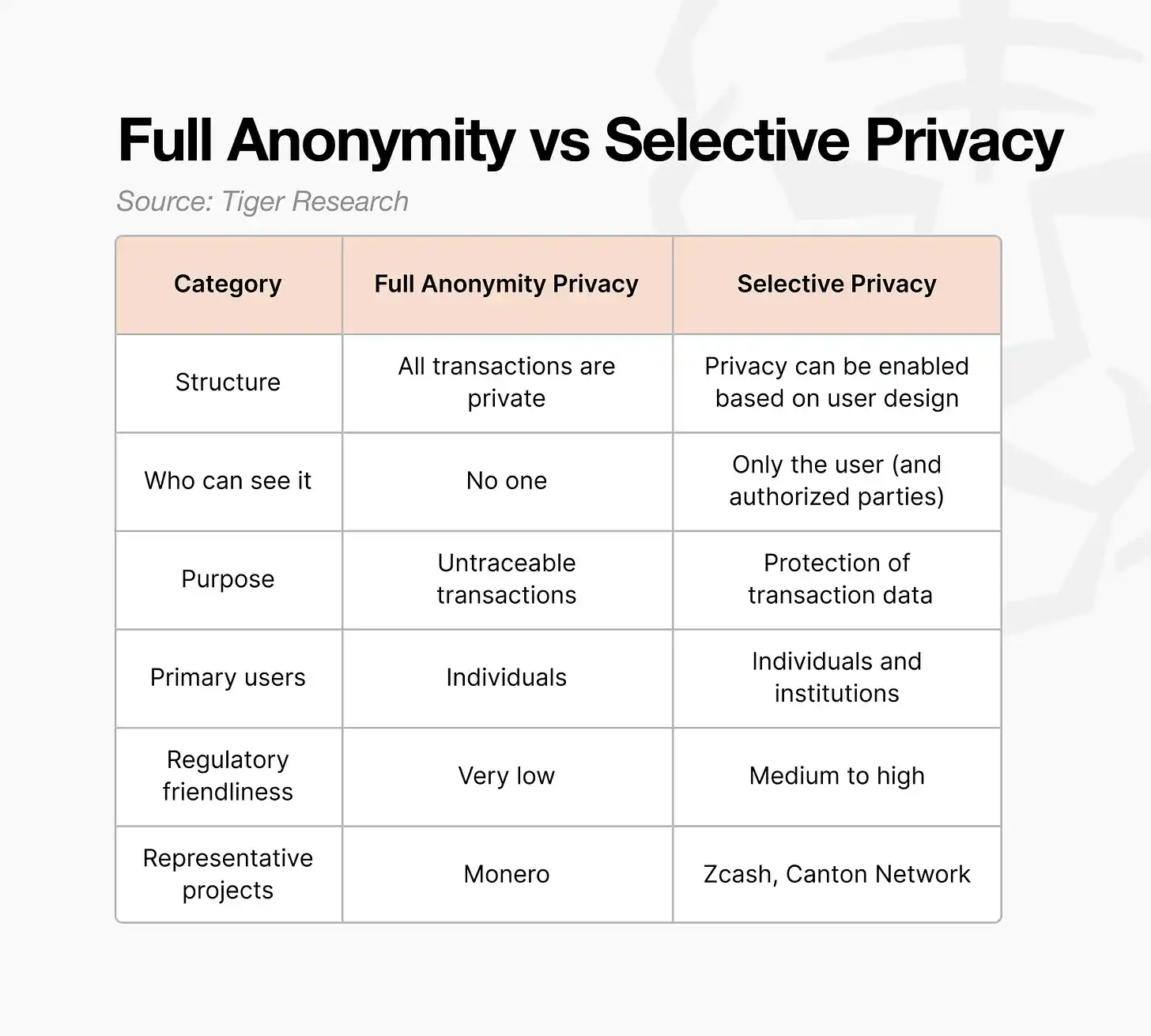
Blockchain privacy is generally divided into two categories:

  • Fully Anonymous Privacy
  • Selective Privacy

The key difference lies in whether information can be disclosed when another party requires verification.
2.1. Fully Anonymous Privacy

Fully anonymous privacy, simply put, hides everything.

The sender, receiver, and transaction amount are all hidden. This model stands in direct opposition to traditional blockchains, which prioritize transparency by default.

The primary goal of fully anonymous systems is to prevent third-party surveillance. Rather than enabling selective disclosure, they aim to completely prevent external observers from extracting meaningful information.
Source: Tiger Research

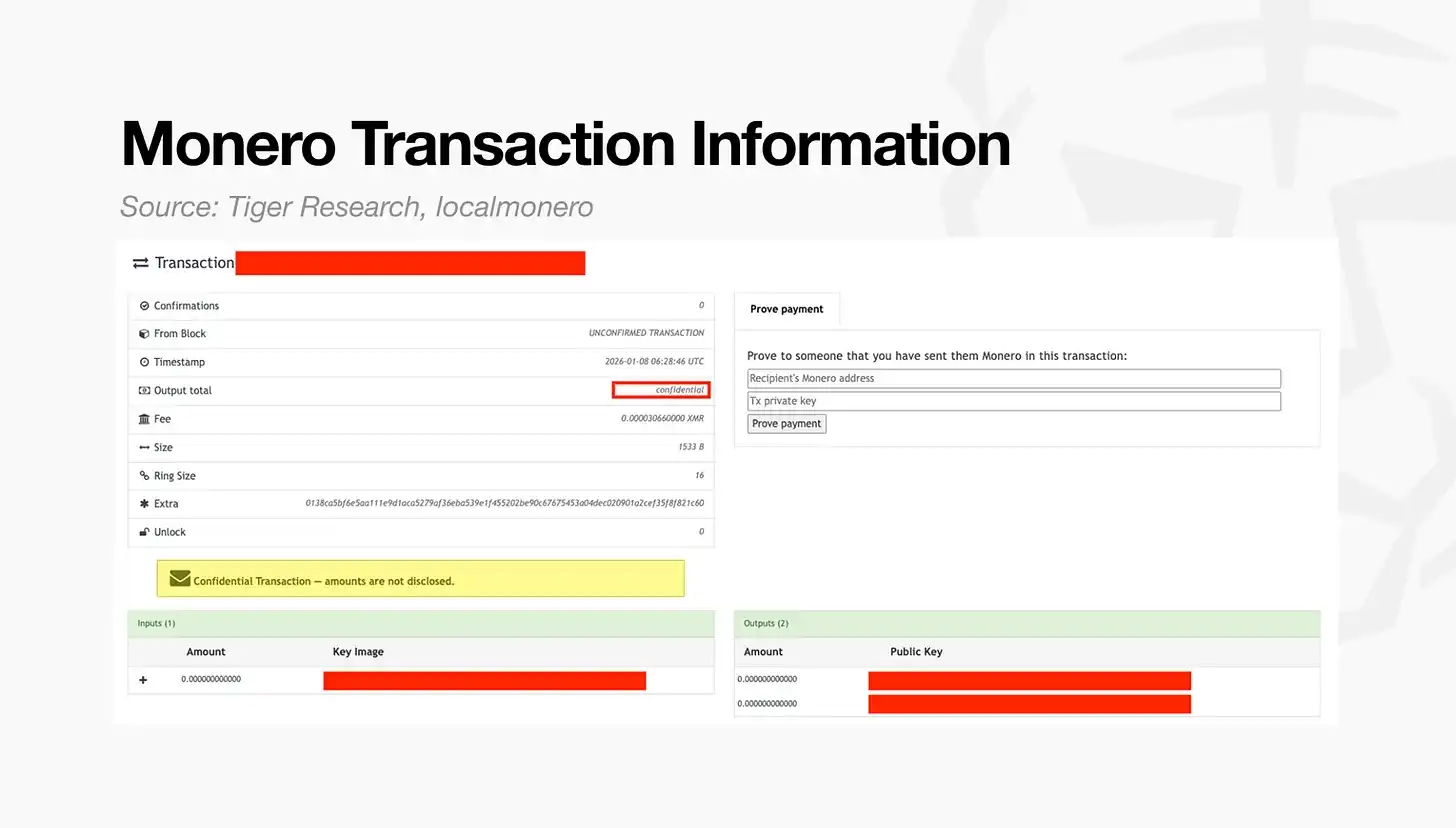
The above image shows a Monero transaction record, a representative example of fully anonymous privacy. Unlike transparent blockchains, details such as the transfer amount and counterparty are not visible.

Two characteristics illustrate why this model is considered fully anonymous:

  • Output Totals: The ledger does not display specific numbers but shows values as "confidential." Transactions are recorded, but their content cannot be interpreted.
  • Ring Signature Size: Although a single sender initiates the transaction, the ledger mixes it with multiple decoys, making it appear as if multiple parties are sending funds simultaneously.

These mechanisms ensure that transaction data remains opaque to all external observers without exception.

2.2. Selective Privacy

Selective privacy operates on a different assumption. Transactions are public by default, but users can choose to make specific transactions private by using designated privacy-enabled addresses.

Zcash provides a clear example. When initiating a transaction, users can choose between two address types:

  • Transparent Addresses: All transaction details are publicly visible, similar to Bitcoin.
  • Shielded Addresses: Transaction details are encrypted and hidden.
Source: Tiger Research

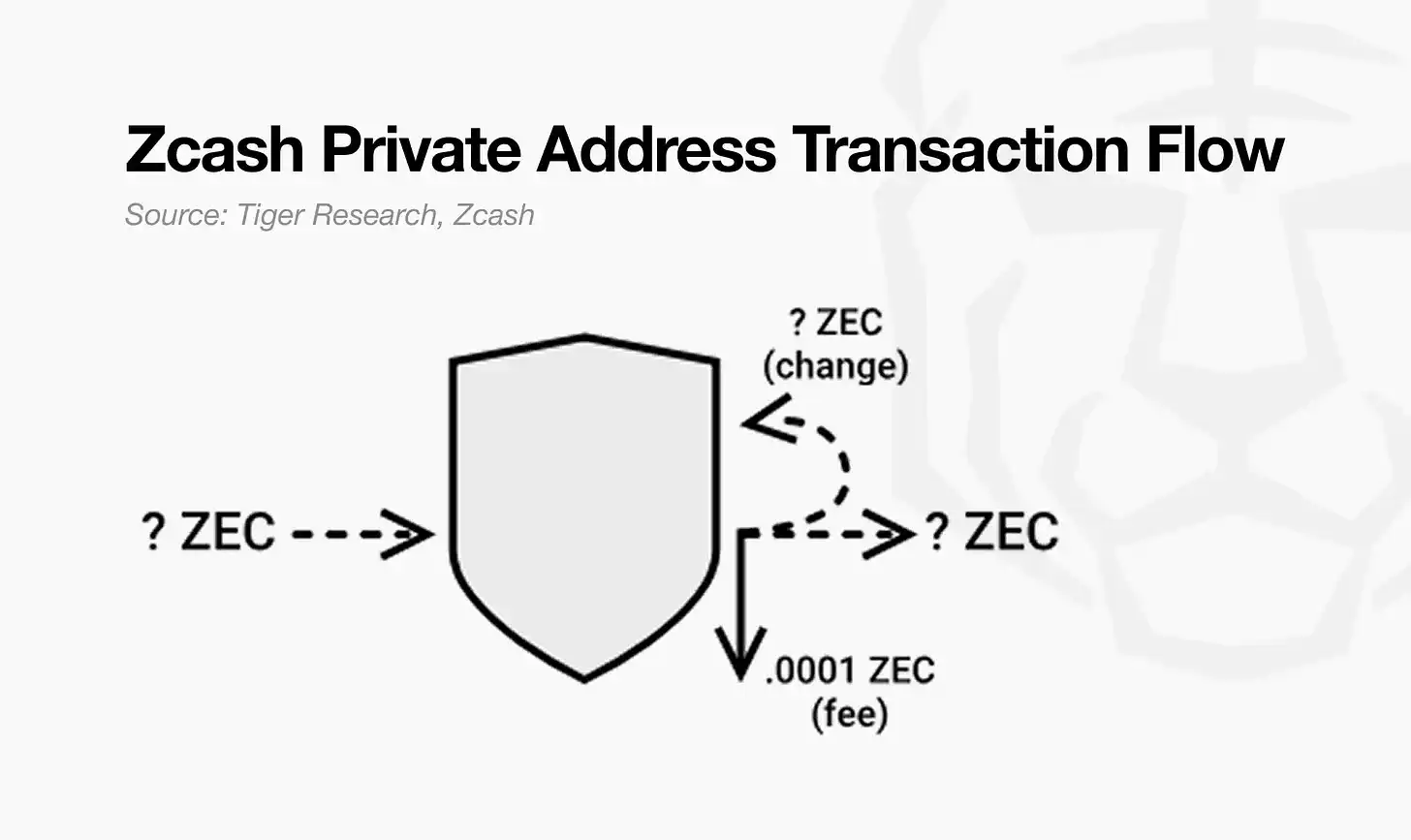
The above image illustrates which elements Zcash can encrypt when using shielded addresses. Transactions sent to shielded addresses are recorded on the blockchain, but their content is stored in an encrypted state.

While the existence of the transaction remains visible, the following information is hidden:

  • Address Type: Shielded (Z) addresses are used instead of transparent (T) addresses.
  • Transaction Record: The ledger confirms that a transaction occurred.
  • Amount, Sender, Receiver: All are encrypted and cannot be observed externally.
  • Viewing Rights: Only parties granted a viewing key can inspect the transaction details.

This is the core of selective privacy. Transactions remain on-chain, but users control who can view their content. When necessary, users can share a viewing key to prove transaction details to another party, while all other third parties remain unable to access that information.

3. Why Financial Institutions Prefer Selective Privacy

Most financial institutions have Know Your Customer (KYC) and Anti-Money Laundering (AML) obligations for every transaction. They must retain transaction data internally and respond immediately to requests from regulators or supervisory bodies.

However, in an environment built on fully anonymous privacy, all transaction data is irreversibly hidden. Because the information cannot be accessed or disclosed under any conditions, institutions are structurally unable to fulfill their compliance obligations.

A representative example is the Canton Network, which has been adopted by the Depository Trust & Clearing Corporation (DTCC) and is currently used by over 400 companies and institutions. In contrast, Zcash, although also a selective privacy project, has seen limited real-world institutional adoption.

What is the reason for this difference?
Source: Tiger Research

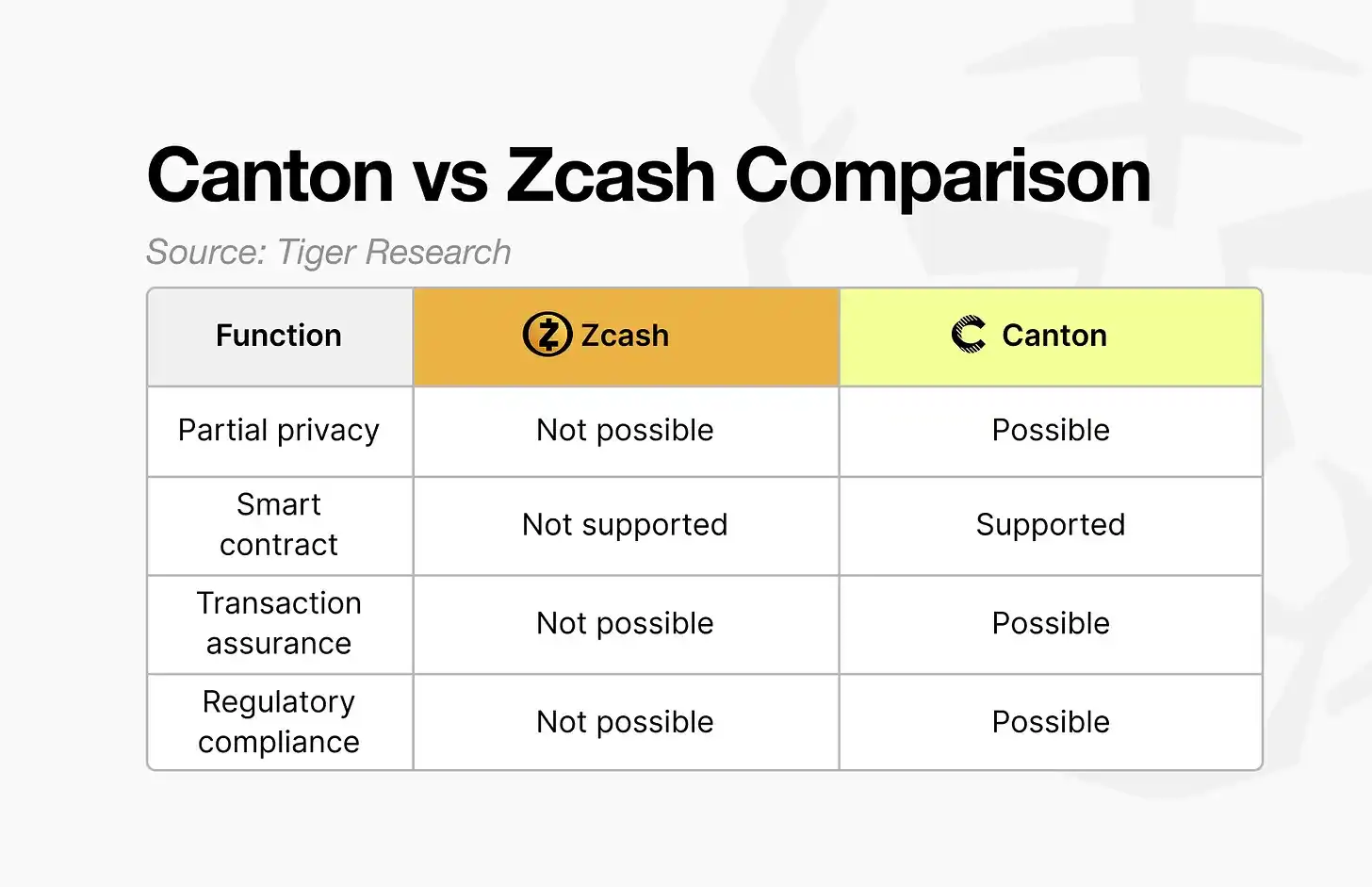
Zcash offers selective privacy, but users cannot choose which information to disclose. Instead, they must choose whether to disclose the entire transaction.

For example, in a transaction where "A sends $100 to B," Zcash does not allow only the amount to be hidden. The transaction itself must be either fully hidden or fully disclosed.

In institutional transactions, different participants require different information. Not all participants need access to all data in a single transaction. However, Zcash's structure forces a binary choice between full disclosure and full privacy, making it unsuitable for institutional transaction workflows.

In contrast, Canton allows transaction information to be divided into separate components for management. For example, if a regulator only requires the transaction amount between A and B, Canton enables the institution to provide only that specific information. This functionality is achieved through Daml, the smart contract language used by the Canton Network.

Other reasons for institutional adoption of Canton are covered in more detail in previous Canton research.

4. Privacy Blockchains in the Institutional Era

Privacy blockchains evolve as demands change.

Early projects like Monero aimed to protect individual anonymity. However, as financial institutions and corporations began entering the blockchain environment, the meaning of privacy shifted.

Privacy is no longer defined as making transactions invisible to everyone. Instead, the core goal has become protecting transactions while still meeting regulatory requirements.

This shift explains why selective privacy models like the Canton Network have gained traction. Institutions need more than just privacy technology; they need infrastructure designed to match real-world financial transaction workflows.

In response to these demands, more institution-oriented privacy projects continue to emerge. Looking ahead, the key differentiator will be how effectively privacy technology can be applied to practical transaction environments.

Alternative forms of privacy that run counter to the current institution-driven trend may emerge. However, in the short term, privacy blockchain is likely to continue evolving around institutional transactions.


Related Questions

QWhy is blockchain privacy necessary for institutions according to the article?

ABlockchain transparency can expose corporate trade secrets and investment strategies, posing substantial risks. Institutions require privacy that protects sensitive transaction data while remaining compatible with regulatory compliance, as full transparency is unrealistic for their operations.

QWhat is the key difference between fully anonymous privacy and selective privacy in blockchain?

AFully anonymous privacy hides all transaction details (sender, receiver, amount) from everyone, while selective privacy allows users to encrypt transactions but grant access to specific parties (e.g., regulators) via view keys when necessary.

QWhy are fully anonymous privacy models like Monero unsuitable for regulated financial entities?

AThey irreversibly hide all transaction data, making it impossible for institutions to fulfill KYC and AML obligations or respond to regulatory requests, as no information can be disclosed under any conditions.

QHow does Canton Network address the limitations of Zcash's selective privacy for institutional use?

ACanton allows granular control over transaction data disclosure using Daml smart contracts, enabling institutions to share specific information (e.g., only amount) with authorized parties, unlike Zcash's all-or-nothing binary approach.

QWhat shift in privacy needs does the article highlight as institutions adopt blockchain technology?

APrivacy is no longer about complete anonymity for all; instead, the focus is on protecting transactions while meeting regulatory requirements, leading to the rise of selective privacy models like Canton Network tailored for real-world financial workflows.

Related Reads

Jensen Huang's CMU Speech: In the AI Era, Don't Just Watch, Build

Jensen Huang, CEO of NVIDIA and a first-generation immigrant, delivered the commencement address to Carnegie Mellon University's class of 2026. He shared his personal journey from a humble background to founding NVIDIA, emphasizing resilience, learning from failure, and the responsibility that comes with leadership. Huang framed the present moment as the dawn of the AI revolution, a shift he believes is more profound than previous computing waves. He described AI as fundamentally resetting computing—moving from human-written software to machines that understand, reason, and use tools. This will create a new industry for generating intelligence and transform every sector. While acknowledging AI's potential to automate tasks and displace some jobs, Huang distinguished between the *tasks* of a job and its core *purpose*. He argued AI will augment human capability, not replace humans. The real risk, he stated, is not AI itself, but people being left behind by those who effectively use AI. He presented AI as a generational opportunity for massive infrastructure investment—in chip factories, data centers, energy grids, and advanced manufacturing—that could re-industrialize nations like the U.S. and bridge the digital divide by making computing and intelligent tools accessible to all. Huang called for a balanced approach: advancing AI safely and responsibly, establishing prudent policies, ensuring broad access, and encouraging universal participation. He urged the graduates not to fear the future but to engage with optimism and ambition, reminding them of CMU's motto, "My heart is in the work." His core message was clear: this is their moment to actively build and shape the AI-powered future, not merely observe it.

marsbit7m ago

Jensen Huang's CMU Speech: In the AI Era, Don't Just Watch, Build

marsbit7m ago

The Era Has Arrived Where Human Writers Must Prove They Are Not Machines

The article describes an era where AI-generated content is flooding the market, forcing human authors to prove they are not machines. It begins with the example of dozens of AI-written, error-ridden biographies of Henry Kissinger appearing on Amazon within hours of his death, a pattern repeated for other deceased celebrities and even living experts who find fraudulent books under their names. This spam content has exploded, with monthly new book releases on platforms like Amazon reaching 300,000 by late 2025. The issue spans genres, from suspiciously high proportions of AI-written teen romance and self-help books to dangerous, AI-generated foraging guides containing lethal advice. The platforms' automated review systems, designed to catch plagiarism and banned words, are ill-equipped to detect AI-generated text that avoids these pitfalls while being nonsensical or fraudulent. The problem has infiltrated traditional publishing. A major publisher, Hachette, had to recall a bestselling horror novel after AI detection tools suggested 78% of its content was machine-generated. An acclaimed European philosophy book was later revealed to be entirely written by AI under a fake author persona. In response, authors are fighting back. At the 2026 London Book Fair, 10,000 writers published a blank book titled "Don't Steal This Book" containing only their signatures—using emptiness as a protest weapon in an age of AI overproduction. Initiatives like the "Human Author Certification" program have emerged, ironically placing the burden on humans to prove their work is not machine-made. The article warns of a vicious cycle: AI-generated low-quality books pollute the data used to train future AI models, leading to "model collapse" and an ever-worsening flood of digital waste, eroding trust in publishing and devaluing human creativity.

marsbit32m ago

The Era Has Arrived Where Human Writers Must Prove They Are Not Machines

marsbit32m ago

Trading

Spot
Futures

Hot Articles

How to Buy CORE

Welcome to HTX.com! We've made purchasing CORE (CORE) simple and convenient. Follow our step-by-step guide to embark on your crypto journey.Step 1: Create Your HTX AccountUse your email or phone number to sign up for a free account on HTX. Experience a hassle-free registration journey and unlock all features.Get My AccountStep 2: Go to Buy Crypto and Choose Your Payment MethodCredit/Debit Card: Use your Visa or Mastercard to buy CORE (CORE) instantly.Balance: Use funds from your HTX account balance to trade seamlessly.Third Parties: We've added popular payment methods such as Google Pay and Apple Pay to enhance convenience.P2P: Trade directly with other users on HTX.Over-the-Counter (OTC): We offer tailor-made services and competitive exchange rates for traders.Step 3: Store Your CORE (CORE)After purchasing your CORE (CORE), store it in your HTX account. Alternatively, you can send it elsewhere via blockchain transfer or use it to trade other cryptocurrencies.Step 4: Trade CORE (CORE)Easily trade CORE (CORE) on HTX's spot market. Simply access your account, select your trading pair, execute your trades, and monitor in real-time. We offer a user-friendly experience for both beginners and seasoned traders.

5.0k Total ViewsPublished 2024.03.29Updated 2025.03.21

How to Buy CORE

Discussions

Welcome to the HTX Community. Here, you can stay informed about the latest platform developments and gain access to professional market insights. Users' opinions on the price of CORE (CORE) are presented below.

活动图片












