Mixed Signals for Ethereum: Technical Milestones and Rising Adoption Offset Market Pressure

bitcoinistPublished on 2026-01-06Last updated on 2026-01-06

Abstract

Despite entering 2026 with mixed signals, Ethereum shows significant progress amid market pressure. The network is advancing technically with upgrades like PeerDAS and zkEVMs improving scalability and reducing validator burdens, while moving toward stronger security goals. Adoption is growing, with stablecoin transfers hitting $8 trillion in Q4 2025 and record activity in transactions and smart contract deployments. However, selling pressure persists, limiting price gains. Overall, Ethereum is in a phase of consolidation, balancing strong foundational growth against a cautious market.

The first week of the year has not been unkind to the market, with Ethereum (ETH) entering 2026 with a mixed narrative that reflects both progress and restraint. On one hand, the network is pushing through long-standing technical limits and seeing broader real-world usage.

On the other hand, market data indicate continued selling pressure, which has kept price action subdued. Together, these trends suggest Ethereum is less in decline than in transition, balancing structural growth against a cautious market environment.
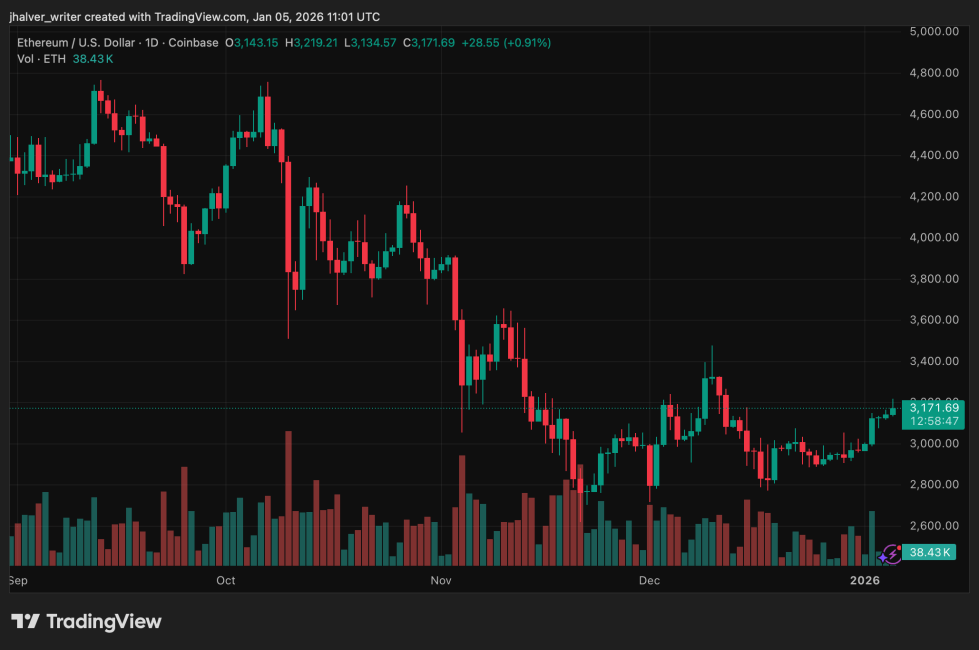
ETH's price trends slightly to the upside on the daily chart. Source: ETHUSD on Tradingview

Technical Progress and Network Upgrades

Recent comments from Ethereum co-founder Vitalik Buterin have drawn renewed attention to the progress on the blockchain trilemma, which is the challenge of balancing decentralization, security, and scalability.

According to Buterin, upgrades such as Peer Data Availability Sampling (PeerDAS) and zero-knowledge Ethereum Virtual Machines (zkEVMs) have moved this goal from theory into live conditions on the mainnet.

PeerDAS, introduced with the Fusaka upgrade in December, reduces the burden on validators by allowing them to verify data availability through sampling rather than processing full datasets. This improves scalability while maintaining accessibility to participation.

At the same time, zkEVMs have reached an early operational stage, with proof generation times falling sharply and verification costs dropping significantly. While still in alpha, these systems are expected to assume a larger validation role between 2027 and 2030, following further security enhancements.

Alongside performance gains, Ethereum’s roadmap is shifting toward protocol safety. The Ethereum Foundation has set a target of achieving 128-bit provable security by late 2026, indicating that recent speed and cost improvements are now being matched with increasingly stringent security goals.

Ethereum (ETH) Adoption Shifts Toward Utility

Beyond core protocol work, Ethereum’s usage metrics point to expanding adoption. Stablecoin transfer volume on the network exceeded $8 trillion in the fourth quarter of 2025, nearly doubling from earlier in the year.

Active addresses and daily transactions also reached record levels, reinforcing Ethereum’s role as a primary settlement layer for payments and tokenized assets.

Industry figures increasingly point to crypto-native neobanks as a key growth driver for 2026. These platforms combine self-custody, stablecoins, and yield products with familiar banking interfaces, lowering barriers for mainstream users.

Institutional participation in 2025, particularly through digital asset treasuries and staking-related structures, has helped lay the groundwork for this shift toward everyday financial use rather than short-term trading.

Market Pressure and Developer Momentum

Despite these developments, market flow data indicate that Ethereum remains under dominant selling pressure, reflecting a broader de-risking trend across cryptocurrency assets. This has limited upside and led to choppy price action, despite the emergence of positive narratives.

Similarly, developer activity tells a different story. An estimated 8.7 million smart contracts were deployed in the fourth quarter of 2025, the highest quarterly figure on record.

Taken together, Ethereum’s current signals point to consolidation rather than contraction. While market conditions continue to weigh on price, technical progress and rising adoption indicate the network is positioning itself for the next phase of growth once broader pressure eases.

Cover image from ChatGPT, ETHUSD chart from Tradingview

Trending Cryptos

Related Reads

The Verdict in Choi Tae-won's Divorce Case: Revealing the Inheritance Undercurrent Behind SK Hynix's Trillion-Won Empire

SK Group Chairman Chey Tae-won's high-profile divorce case, involving a record 1.38 trillion won settlement, has drawn attention to the succession plans for Korea's second-largest conglomerate, especially its crown jewel, SK hynix. Unlike traditional chaebol scripts centered on the eldest son, Chey's three children from his marriage to former President Roh Tae-woo's daughter, Roh Soh-yeong, are carving distinct, non-traditional paths. Eldest daughter Chey Yun-jung (b. 1989) is seen as the most evident successor. With a scientific and consulting background, she holds executive roles at SK bioscience and SK Inc.'s growth support department, focusing on future strategy and biopharma. Her marriage is to an AI infrastructure entrepreneur, not a traditional business alliance. Second daughter Chey Min-jung (b. 1991) took a unique route, voluntarily serving as a South Korean naval officer, including an anti-piracy deployment. She later worked on policy and strategy for SK hynix in Washington D.C. before co-founding an AI-driven healthcare startup. She married a former U.S. Marine Corps officer, connecting her to U.S. defense and policy circles—networks crucial for a global semiconductor giant. The only son, Chey In-geun (b. 1995), who studied physics like his father, worked briefly at SK E&S before joining McKinsey. Despite fitting the traditional "heir" profile as the eldest son, he remains silent and holds no public position or shares in SK, suggesting the old succession playbook is obsolete. As SK hynix's valuation soars, becoming a geopolitical asset in the AI era, the heirs' legitimacy is no longer automatic. They must prove themselves in fields like AI biotech, global policy, and strategic consulting. Their marriages also reflect new elite networks in tech and defense, not old political alliances. Their inheritance is the complex challenge of navigating a globalized, tech-driven world, not just a corporate throne.

marsbitYesterday 09:06

The Verdict in Choi Tae-won's Divorce Case: Revealing the Inheritance Undercurrent Behind SK Hynix's Trillion-Won Empire

marsbitYesterday 09:06

From OpenSea to OpenRouter: Is Alex Atallah Repeating His 'Exit at the Peak' Playbook?

From OpenSea to OpenRouter: Is Alex Atallah Repeating His "Exit at the Peak" Playbook? According to the Wall Street Journal, payments giant Stripe is in talks to acquire the AI model aggregation platform OpenRouter in a potential deal valuing the company near $100 billion. This would mark founder Alex Atallah's second creation of a company reaching a $100 billion valuation, following his co-founding of NFT marketplace OpenSea. OpenRouter, founded just over three years ago, has grown rapidly by acting as a unified gateway for developers to access over 400 AI models. It currently has about 10 million users and processes over 200 trillion tokens monthly. While the platform's annualized revenue is around $50 million, its valuation has skyrocketed from $1.3 billion in March 2026. The potential acquisition by Stripe, a company OpenRouter's founder once likened it to, represents a major expansion into AI infrastructure for the payments leader. This move echoes Atallah's previous timing with OpenSea, where he departed before the NFT market's significant downturn. For OpenRouter, selling now may be strategic. Despite its scale, its business model—charging a 5-5.5% fee on AI inference calls—faces pressure from competition, open-source models, and potential price wars among model providers, limiting its profitability narrative for an IPO. A key asset for potential acquirers like Stripe is OpenRouter's vast repository of real-world AI usage data, which offers unique insights into model performance and developer preferences that are difficult to replicate. Whether this potential deal signifies a new valuation benchmark for AI infrastructure or another market peak signal remains to be seen.

链捕手Yesterday 08:42

From OpenSea to OpenRouter: Is Alex Atallah Repeating His 'Exit at the Peak' Playbook?

链捕手Yesterday 08:42

Trading

Spot

Hot Articles

Discussions

Welcome to the HTX Community. Here, you can stay informed about the latest platform developments and gain access to professional market insights. Users' opinions on the price of ETH (ETH) are presented below.

活动图片