Mixed Signals for Ethereum: Technical Milestones and Rising Adoption Offset Market Pressure

bitcoinistPublished on 2026-01-06Last updated on 2026-01-06

Abstract

Despite entering 2026 with mixed signals, Ethereum shows significant progress amid market pressure. The network is advancing technically with upgrades like PeerDAS and zkEVMs improving scalability and reducing validator burdens, while moving toward stronger security goals. Adoption is growing, with stablecoin transfers hitting $8 trillion in Q4 2025 and record activity in transactions and smart contract deployments. However, selling pressure persists, limiting price gains. Overall, Ethereum is in a phase of consolidation, balancing strong foundational growth against a cautious market.

The first week of the year has not been unkind to the market, with Ethereum (ETH) entering 2026 with a mixed narrative that reflects both progress and restraint. On one hand, the network is pushing through long-standing technical limits and seeing broader real-world usage.

On the other hand, market data indicate continued selling pressure, which has kept price action subdued. Together, these trends suggest Ethereum is less in decline than in transition, balancing structural growth against a cautious market environment.
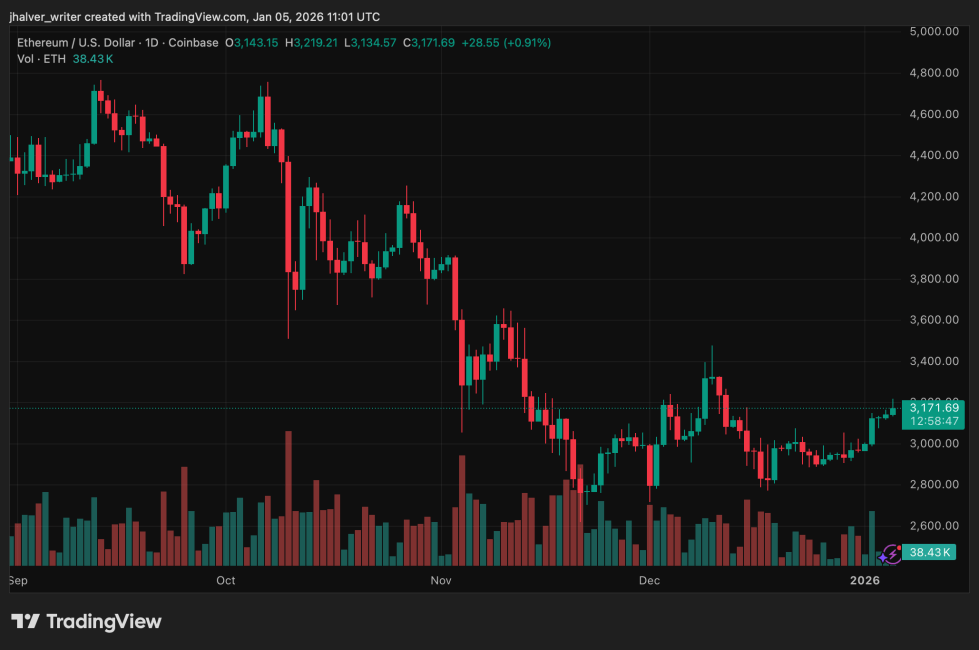
ETH's price trends slightly to the upside on the daily chart. Source: ETHUSD on Tradingview

Technical Progress and Network Upgrades

Recent comments from Ethereum co-founder Vitalik Buterin have drawn renewed attention to the progress on the blockchain trilemma, which is the challenge of balancing decentralization, security, and scalability.

According to Buterin, upgrades such as Peer Data Availability Sampling (PeerDAS) and zero-knowledge Ethereum Virtual Machines (zkEVMs) have moved this goal from theory into live conditions on the mainnet.

PeerDAS, introduced with the Fusaka upgrade in December, reduces the burden on validators by allowing them to verify data availability through sampling rather than processing full datasets. This improves scalability while maintaining accessibility to participation.

At the same time, zkEVMs have reached an early operational stage, with proof generation times falling sharply and verification costs dropping significantly. While still in alpha, these systems are expected to assume a larger validation role between 2027 and 2030, following further security enhancements.

Alongside performance gains, Ethereum’s roadmap is shifting toward protocol safety. The Ethereum Foundation has set a target of achieving 128-bit provable security by late 2026, indicating that recent speed and cost improvements are now being matched with increasingly stringent security goals.

Ethereum (ETH) Adoption Shifts Toward Utility

Beyond core protocol work, Ethereum’s usage metrics point to expanding adoption. Stablecoin transfer volume on the network exceeded $8 trillion in the fourth quarter of 2025, nearly doubling from earlier in the year.

Active addresses and daily transactions also reached record levels, reinforcing Ethereum’s role as a primary settlement layer for payments and tokenized assets.

Industry figures increasingly point to crypto-native neobanks as a key growth driver for 2026. These platforms combine self-custody, stablecoins, and yield products with familiar banking interfaces, lowering barriers for mainstream users.

Institutional participation in 2025, particularly through digital asset treasuries and staking-related structures, has helped lay the groundwork for this shift toward everyday financial use rather than short-term trading.

Market Pressure and Developer Momentum

Despite these developments, market flow data indicate that Ethereum remains under dominant selling pressure, reflecting a broader de-risking trend across cryptocurrency assets. This has limited upside and led to choppy price action, despite the emergence of positive narratives.

Similarly, developer activity tells a different story. An estimated 8.7 million smart contracts were deployed in the fourth quarter of 2025, the highest quarterly figure on record.

Taken together, Ethereum’s current signals point to consolidation rather than contraction. While market conditions continue to weigh on price, technical progress and rising adoption indicate the network is positioning itself for the next phase of growth once broader pressure eases.

Cover image from ChatGPT, ETHUSD chart from Tradingview

Related Reads

Fu Peng's First Public Speech in 2026: What Exactly Are Crypto Assets? Why Did I Join the Crypto Asset Industry?

Fu Peng, a renowned macroeconomist and now Chief Economist at New火 Group, delivered his first public speech of 2026 at the Hong Kong Web3 Festival. He explained his perspective on crypto assets and why he joined the industry, framing it within the context of macroeconomic trends and financial evolution. Fu emphasized that crypto assets are transitioning from an early, belief-driven phase to a mature, institutionally integrated asset class. He drew parallels to the 1970s-80s, when technological advances (like computing) revolutionized traditional finance, leading to the rise of FICC (Fixed Income, Currencies, and Commodities). Similarly, current advancements in AI, data, and blockchain are reshaping finance, with crypto assets becoming part of a new "FICC + C" (C for Crypto) framework. He noted that institutional capital, including traditional hedge funds, avoided early crypto due to its speculative nature but are now engaging as regulatory clarity emerges (e.g., stablecoin laws, CFTC classifying crypto as a commodity). Fu predicted that 2025-2026 marks a turning point where crypto becomes a standardized, financially viable asset for diversified portfolios, akin to commodities or derivatives in traditional finance. Fu defined Bitcoin not as "digital gold" in a simplistic sense but as a value-preserving, financially tradable asset. He highlighted that crypto's future lies in regulated, institutional adoption, moving away from retail-dominated trading. His entry into crypto signals this maturation, where traditional finance integrates crypto into mainstream asset management.

marsbit10m ago

Fu Peng's First Public Speech in 2026: What Exactly Are Crypto Assets? Why Did I Join the Crypto Asset Industry?

marsbit10m ago

Justin Sun Sues Trump Family: What $75 Million Bought Was Only a Blacklist

Justin Sun, founder of Tron, has filed a lawsuit in federal court against World Liberty Financial (WLF), alleging he was made the "primary target of a fraudulent scheme" after investing $75 million. Sun claims the investment secured him an advisor title and WLFI tokens, which were later frozen by WLF, causing "hundreds of millions in losses." The dispute began in late 2024 when Sun's investment helped revive WLF's struggling token sale, which ultimately raised $550 million. Shortly after, the SEC dropped its lawsuit against Sun following Donald Trump's inauguration. However, relations soured when Sun refused WLF's demands for additional funding. In August 2025, WLF added a "blacklist" function to its smart contract, allowing it to unilaterally freeze tokens. Sun's holdings, worth approximately $107 million, were frozen, and he was threatened with token destruction. The lawsuit highlights WLF's structure, which directs 75% of token sale profits to the Trump family, who had earned $1 billion by December 2025. WLF's CEO is Zach Witkoff, son of U.S. Middle East envoy Steve Witkoff. The project faces scrutiny for opaque operations, including a controversial loan arrangement on the Dolomite platform, co-founded by a WLF advisor. Despite Sun's history with the SEC, the case underscores centralization risks within DeFi, as WLF controls governance and holds powers to freeze assets arbitrarily. Sun's tokens remain frozen as legal proceedings begin.

marsbit18m ago

Justin Sun Sues Trump Family: What $75 Million Bought Was Only a Blacklist

marsbit18m ago

$500 to Buy OpenAI Stock: Silicon Valley's Most Respectable Liquidity Invitation

Silicon Valley's largest venture capital platform, AngelList, has launched a new fund called USVC, allowing U.S. retail investors to buy into high-profile AI companies like OpenAI, Anthropic, and xAI with a minimum investment of $500—no accredited investor status required. Promoted by AngelList co-founder Naval Ravikant, the fund is framed as an opportunity for ordinary people to access high-growth private tech investments traditionally reserved for VCs. However, critics argue it functions more like an exit vehicle for early insiders. USVC acquires shares not through primary rounds but largely via secondary transactions—purchasing stakes from early investors, VC funds, and employees looking to cash out at peak valuations. With companies like xAI heavily weighted in the portfolio, the fund effectively channels retail money into providing liquidity for insiders who entered at much lower valuations. The fund’s structure raises concerns: shares are illiquid, with no secondary market, and buybacks are limited and discretionary. The actual annual fee reaches 3.61%, far above the advertised 1% management fee. This model parallels the "low float, high fully diluted valuation" strategy seen in crypto, where early investors profit by selling to latecomers at inflated prices. The timing—alongside similar moves by platforms like Robinhood—suggests that Silicon Valley’s sudden interest in retail inclusion may be less about democratizing access and more about securing exits for insiders.

marsbit48m ago

$500 to Buy OpenAI Stock: Silicon Valley's Most Respectable Liquidity Invitation

marsbit48m ago

Trading

Spot
Futures

Hot Articles

Discussions

Welcome to the HTX Community. Here, you can stay informed about the latest platform developments and gain access to professional market insights. Users' opinions on the price of ETH (ETH) are presented below.

活动图片















