Metaplanet and Hut8 Withdraw $125 Million Worth of Bitcoin from Exchanges

cryptonews.ruPublished on 2026-08-12Last updated on 2026-08-12

Abstract

Metaplanet and Hut8 collectively withdrew approximately $125 million worth of Bitcoin from exchanges. Metaplanet moved 1,473 BTC off-exchange, followed by Hut8 transferring 493 BTC about two hours later. While neither company disclosed the specific reason for these transfers—which could be for cold storage, custodian change, or other financial purposes—large withdrawals from exchanges are generally viewed as a bullish signal for Bitcoin's supply. Metaplanet, a Tokyo-listed firm, has built one of the largest corporate Bitcoin treasuries outside the U.S., holding over 43,000 BTC valued at around $4.09 billion as of August 2026. Its strategy focuses on long-term accumulation, consistently buying and then moving coins to secure storage. Hut8, a mining and digital infrastructure provider, holds Bitcoin both as a treasury asset and as collateral for financing. It currently holds 10,278 BTC, ranking among the top 15 public corporate holders. Earlier in 2026, the company refinanced a $200 million Bitcoin-backed loan at a lower interest rate, freeing up collateral. The withdrawals occurred amid ongoing Bitcoin price volatility, with prices trading just below $64,000. The moves by these two significant corporate treasuries are seen as notable within the market context.

Metaplanet withdrew 1,473 $BTC from an exchange, and about two hours later, Hut8 followed suit by withdrawing 493 $BTC. Combined, these two transfers resulted in 1,966 $BTC (approximately $125 million) being removed from exchange control at once—all against the backdrop of Bitcoin's overall price decline this summer, which has pressured both treasury companies and miners.
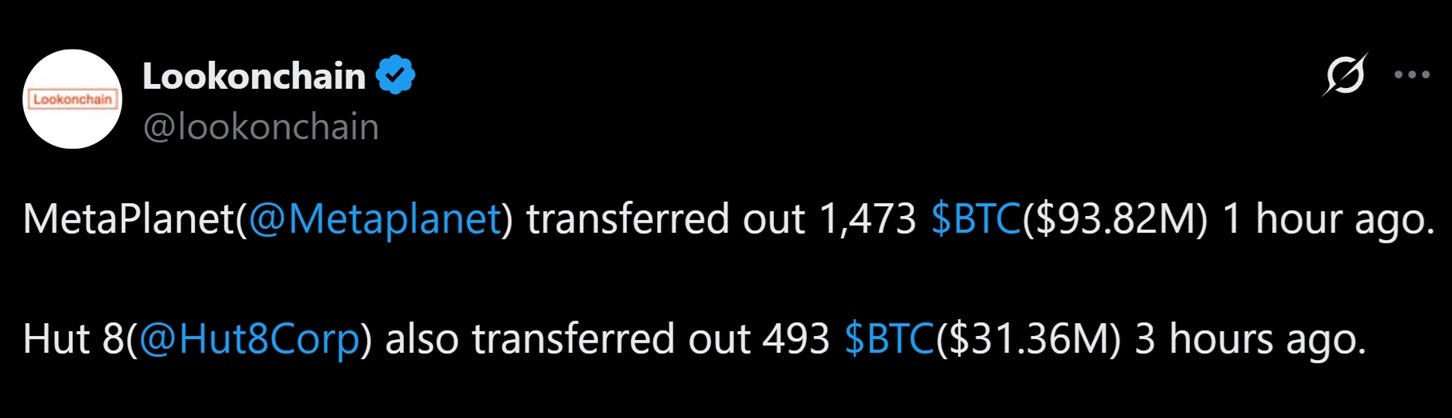
Image Source: X

Neither company has publicly explained the reasons for these specific transfers, and the move could simply indicate a move to cold storage, a custodian change, or a routine financial decision. Nevertheless, it's worth noting that when large holders withdraw Bitcoin from exchanges, it is typically viewed as a 'bullish' supply-side signal.

This information carries particular weight as it comes from known corporate treasuries like Metaplanet and Hut8.

Metaplanet's Broader Bitcoin Strategy

This Tokyo-listed company has built one of the largest corporate Bitcoin treasuries outside the United States. The purchase of 2,823 $BTC in early July increased its total assets to 43,000 $BTC, with the cumulative acquisition cost amounting to about $4.09 billion, making it the third-largest public corporate Bitcoin holder as of August 2026.

Furthermore, as reported by Bitcoin.com News in April, through active purchases in Q1 2026 alone, Metaplanet added 5,075 $BTC to its stockpile, bringing its holdings at that time to over 40,177 $BTC (a pace the company maintained throughout the summer).

However, this accumulation has not been fully reflected in Metaplanet's share price. Publications this month noted that the company's shares have struggled to find buyers, even as its Bitcoin reserves surpassed the 43,000 $BTC mark—this disconnect between asset growth and market reaction has been a recurring theme for Bitcoin-holding stocks in 2026.

Nevertheless, Metaplanet has built its strategy on long-term accumulation rather than trading, so the withdrawal from the exchange fits a pattern the company has repeated throughout the year: purchase first, then move the coins into long-term storage.

Hut8's Balance Between Mining and Holding

Hut8 operates differently from pure accumulation companies because, as a mining company and digital infrastructure provider, it holds $BTC both as a treasury asset and as collateral for financing. According to online treasury asset trackers, Hut8's total assets amount to 10,278 $BTC, placing it among the top 15 public corporate holders and representing approximately 0.065% of the total Bitcoin supply in circulation.
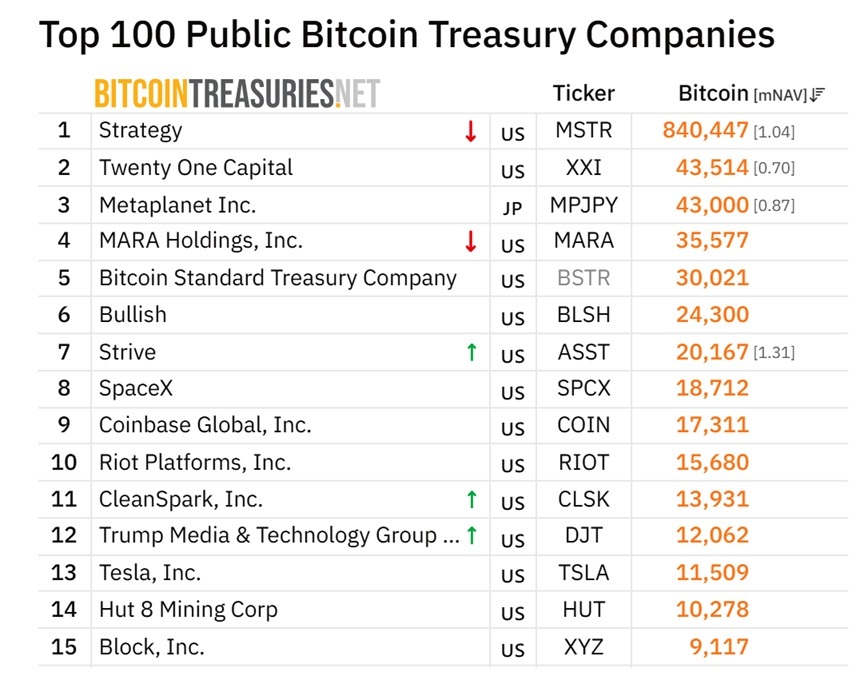
Image Source: Bitcointreasuries.net

Earlier in 2026, Hut8 refinanced a $200 million Bitcoin-backed credit facility in a new deal with FalconX, lowering the interest rate from 9% to 7% and freeing approximately 3,300 $BTC that were pledged as collateral. In its Q2 2026 results report, the company also reported having no debt with full recourse at the parent company level after converting the Coatue note, part of broader efforts to shift to non-dilutive project-level financing for expanding its data centers. This context serves as a reminder that not every movement in Hut8's wallet indicates a direct purchase.

Neither Metaplanet nor Hut8 has confirmed the destination of the withdrawn coins, and blockchain data alone cannot distinguish a transfer to cold storage from a trade being executed. Additionally, these withdrawals occurred during a period of Bitcoin price volatility, with the cryptocurrency trading just below $64,000 after being stuck below the $65,200 level reached earlier in the week.


Trending Cryptos

Related Questions

QHow many Bitcoins were withdrawn from exchanges by Metaplanet and Hut8 combined, and what is their approximate USD value?

AMetaplanet and Hut8 withdrew a combined total of 1,966 BTC, which is worth approximately $125 million.

QWhat are the two primary interpretations for why major holders like Metaplanet and Hut8 would withdraw Bitcoin from exchanges?

AThe withdrawals could represent a move to cold storage, a change in custodian, or routine financial management. However, such large-scale withdrawals from exchanges are typically interpreted as a bullish supply-side signal.

QWhat is Metaplanet's overall Bitcoin accumulation strategy, and how does this recent withdrawal fit into it?

AMetaplanet's strategy is based on long-term accumulation rather than trading. The pattern is to first purchase Bitcoin and then move the coins into long-term storage, which is consistent with this recent withdrawal from an exchange.

QHow does Hut8's relationship with Bitcoin differ from a pure accumulation company like Metaplanet?

AUnlike pure accumulation companies, Hut8 is a mining and digital infrastructure provider. It holds Bitcoin both as a treasury asset and as collateral for financing its operations and expansion.

QWhat significant financial move did Hut8 make earlier in 2026 related to its Bitcoin holdings?

AEarlier in 2026, Hut8 refinanced a $200 million Bitcoin-backed credit facility with FalconX. This deal lowered the interest rate from 9% to 7% and freed up approximately 3,300 BTC that had been used as collateral.

Related Reads

Stripe’s 16-Year Chronicle: From 7 Lines of Code to a $100 Billion Valuation

Stripe's 16-year journey began with a simple promise: "7 lines of code to accept payments." Founded by Patrick and John Collison, the company started by hiding the complexity of bank integrations and merchant accounts behind a clean API, initially targeting developers at startups. This early focus on user experience and technical simplicity fueled rapid adoption. A key early milestone was establishing vital bank partnerships, a challenge overcome by hiring Billy Alvarado, who brought crucial institutional relationship skills. From this foundation, Stripe systematically expanded its product boundaries. It launched Connect for platform payments, Atlas for company formation, Radar for fraud prevention, and Billing for subscriptions. This transformed Stripe from a payment processor into a broader financial infrastructure suite for internet businesses. The COVID-19 pandemic accelerated growth but also led to over-hiring. A 14% layoff in 2022 marked a period of organizational correction. Subsequently, Stripe shifted its growth strategy towards strategic acquisitions to enter new domains quickly. It acquired Bridge (stablecoin infrastructure), Privy (wallet infrastructure), Metronome (usage-based billing), and agreed to buy OpenRouter (AI model routing). These moves signal Stripe's ambition to build a "programmable money system" for the emerging AI and agent-based economy, managing not just currency flows but also the measurement and pricing of computational resources like AI tokens. Internally, Stripe leverages AI agents (like "Minions") to boost engineering productivity. Despite scaling to nearly 8,000 employees and processing $1.9 trillion in payment volume annually, the company remains private. A recent employee tender offer valued it at $159 billion. The core question for Stripe's future is whether it can successfully integrate its expanding product matrix—spanning payments, crypto, and AI infrastructure—into a cohesive platform, positioning itself as the foundational economic layer for autonomous software agents.

marsbit26m ago

Stripe’s 16-Year Chronicle: From 7 Lines of Code to a $100 Billion Valuation

marsbit26m ago

Treasury Secretary's Move to Suppress Treasury Yields Ignites 'Currency Debasement Trade'! Gold Hits Three-Month High, Bitcoin Surges Over 25% in a Single Week

US Treasury Secretary Besant's efforts to lower long-term Treasury yields by announcing expanded buybacks had only a brief market impact. However, this move fueled a "currency devaluation trade," weakening the US dollar while boosting both gold (to a three-month high) and Bitcoin (up over 25% for the week). Analysts attribute this reaction to deepening market concerns over the massive US fiscal deficit and structural pressures keeping long-term rates elevated, including fierce competition for capital from global government borrowing and massive AI sector financing. Despite the Treasury's actions, fundamental forces like growth, inflation, and capital demand are seen as limiting its ability to sustainably suppress yields. Bitcoin's strong positive correlation with gold has reinforced its narrative as a hedge against devaluation. While equity markets have shown resilience, some strategists warn that Treasury yields nearing 5% increase pressure on the dollar and high-leverage assets. Figures like Ray Dalio have advised reducing bond exposure in favor of gold and some Bitcoin, citing US debt risks. Market opinions are divided on the sustainability of the devaluation trade, with some noting the lack of a near-term catalyst for its next leg higher. The underlying tension between the Treasury's desire for lower borrowing costs and the Federal Reserve's focus on inflation and reducing market intervention remains a key theme. Upcoming events like Nvidia's earnings and the Jackson Hole symposium will test whether AI profits can continue supporting stocks and if the Fed aligns more with Washington's preference for easier financial conditions.

华尔街日报2h ago

Treasury Secretary's Move to Suppress Treasury Yields Ignites 'Currency Debasement Trade'! Gold Hits Three-Month High, Bitcoin Surges Over 25% in a Single Week

华尔街日报2h ago

Alexander Shokhin: Business Needs an Interest Rate Below 10% and the Dollar at 90-95 Rubles

Alexander Shokhin, head of the Russian Union of Industrialists and Entrepreneurs (RSPP), has advocated for potentially using "non-market" tools to keep the ruble within a target exchange rate corridor. This, he argues on August 21, would help avoid excessive volatility, though he called the topic a separate discussion. Shokhin had previously raised the idea of a currency corridor in late May, noting the ruble's current exchange rate is not fully market-driven due to a limited currency segment and reduced foreign currency demand. He stated that many business community colleagues propose fixing a corridor, even through non-market methods, to ensure predictability. The business community's key targets, as outlined by Shokhin in late December 2025, are a Central Bank key rate of 12%, inflation of 4–5%, and a US dollar exchange rate of 90–95 rubles by the end of 2026. A turning point for investment, he said, would be lowering the rate to 12% with 6% inflation, though truly comfortable business conditions would require a rate below 10%. He stressed the critical importance of currency predictability for corporate investment decisions. From a data analysis perspective, the idea of a ruble corridor is not new. A similar mechanism was used in Russia from 1995 to 1998, where the central bank held the dollar within fixed boundaries through regular interventions. This regime lasted three years before ending abruptly during the 1998 default, illustrating the fragility of rigid targets under external shocks. The macro-economic link is clear: stricter corridors require more reserves to defend against currency pressure. The key unresolved technical aspect is the specific sources and volume of such interventions given the current market's limited liquidity. Whether this discussion remains theoretical or leads to concrete corridor parameters will be seen in the coming months.

cryptonews.ru4h ago

Alexander Shokhin: Business Needs an Interest Rate Below 10% and the Dollar at 90-95 Rubles

cryptonews.ru4h ago

Trading

Spot

Hot Articles

What is $BITCOIN

DIGITAL GOLD ($BITCOIN): A Comprehensive Analysis Introduction to DIGITAL GOLD ($BITCOIN) DIGITAL GOLD ($BITCOIN) is a blockchain-based project operating on the Solana network, which aims to combine the characteristics of traditional precious metals with the innovation of decentralized technologies. While it shares a name with Bitcoin, often referred to as “digital gold” due to its perception as a store of value, DIGITAL GOLD is a separate token designed to create a unique ecosystem within the Web3 landscape. Its goal is to position itself as a viable alternative digital asset, although specifics regarding its applications and functionalities are still developing. What is DIGITAL GOLD ($BITCOIN)? DIGITAL GOLD ($BITCOIN) is a cryptocurrency token explicitly designed for use on the Solana blockchain. In contrast to Bitcoin, which provides a widely recognized value storage role, this token appears to focus on broader applications and characteristics. Notable aspects include: Blockchain Infrastructure: The token is built on the Solana blockchain, known for its capacity to handle high-speed and low-cost transactions. Supply Dynamics: DIGITAL GOLD has a maximum supply capped at 100 quadrillion tokens (100P $BITCOIN), although details regarding its circulating supply are currently undisclosed. Utility: While precise functionalities are not explicitly outlined, there are indications that the token could be utilized for various applications, potentially involving decentralized applications (dApps) or asset tokenization strategies. Who is the Creator of DIGITAL GOLD ($BITCOIN)? At present, the identity of the creators and development team behind DIGITAL GOLD ($BITCOIN) remains unknown. This situation is typical among many innovative projects within the blockchain space, particularly those aligning with decentralized finance and meme coin phenomena. While such anonymity may foster a community-driven culture, it intensifies concerns about governance and accountability. Who are the Investors of DIGITAL GOLD ($BITCOIN)? The available information indicates that DIGITAL GOLD ($BITCOIN) does not have any known institutional backers or prominent venture capital investments. The project seems to operate on a peer-to-peer model focused on community support and adoption rather than traditional funding routes. Its activity and liquidity are primarily situated on decentralized exchanges (DEXs), such as PumpSwap, rather than established centralized trading platforms, further highlighting its grassroots approach. How DIGITAL GOLD ($BITCOIN) Works The operational mechanics of DIGITAL GOLD ($BITCOIN) can be elaborated on based on its blockchain design and network attributes: Consensus Mechanism: By leveraging Solana’s unique proof-of-history (PoH) combined with a proof-of-stake (PoS) model, the project ensures efficient transaction validation contributing to the network's high performance. Tokenomics: While specific deflationary mechanisms have not been extensively detailed, the vast maximum token supply implies that it may cater to microtransactions or niche use cases that are still to be defined. Interoperability: There exists the potential for integration with Solana’s broader ecosystem, including various decentralized finance (DeFi) platforms. However, the details regarding specific integrations remain unspecified. Timeline of Key Events Here is a timeline that highlights significant milestones concerning DIGITAL GOLD ($BITCOIN): 2023: The initial deployment of the token occurs on the Solana blockchain, marked by its contract address. 2024: DIGITAL GOLD gains visibility as it becomes available for trading on decentralized exchanges like PumpSwap, allowing users to trade it against SOL. 2025: The project witnesses sporadic trading activity and potential interest in community-led engagements, although no noteworthy partnerships or technical advancements have been documented as of yet. Critical Analysis Strengths Scalability: The underlying Solana infrastructure supports high transaction volumes, which could enhance the utility of $BITCOIN in various transaction scenarios. Accessibility: The potential low trading price per token could attract retail investors, facilitating wider participation due to fractional ownership opportunities. Risks Lack of Transparency: The absence of publicly known backers, developers, or an audit process may yield skepticism regarding the project's sustainability and trustworthiness. Market Volatility: The trading activity is heavily reliant on speculative behavior, which can result in significant price volatility and uncertainty for investors. Conclusion DIGITAL GOLD ($BITCOIN) emerges as an intriguing yet ambiguous project within the rapidly evolving Solana ecosystem. While it attempts to leverage the “digital gold” narrative, its departure from Bitcoin's established role as a store of value underscores the need for a clearer differentiation of its intended utility and governance structure. Future acceptance and adoption will likely depend on addressing the current opacity and defining its operational and economic strategies more explicitly. Note: This report encompasses synthesised information available as of October 2023, and developments may have transpired beyond the research period.

2.0k Total ViewsPublished 2025.05.13Updated 2025.05.13

What is $BITCOIN

Discussions

Welcome to the HTX Community. Here, you can stay informed about the latest platform developments and gain access to professional market insights. Users' opinions on the price of BTC (BTC) are presented below.

活动图片