Meta is back to open source!
On Monday, the company with a market cap of approximately $1.5 trillion released the underlying parameters of its new open AI model, Muse Glimmer, which developers can directly download and modify.
Meta also stated that within the coming weeks, it will also open-source the model weights of its more powerful Muse Spark 1.2, Meta's latest foundation model.
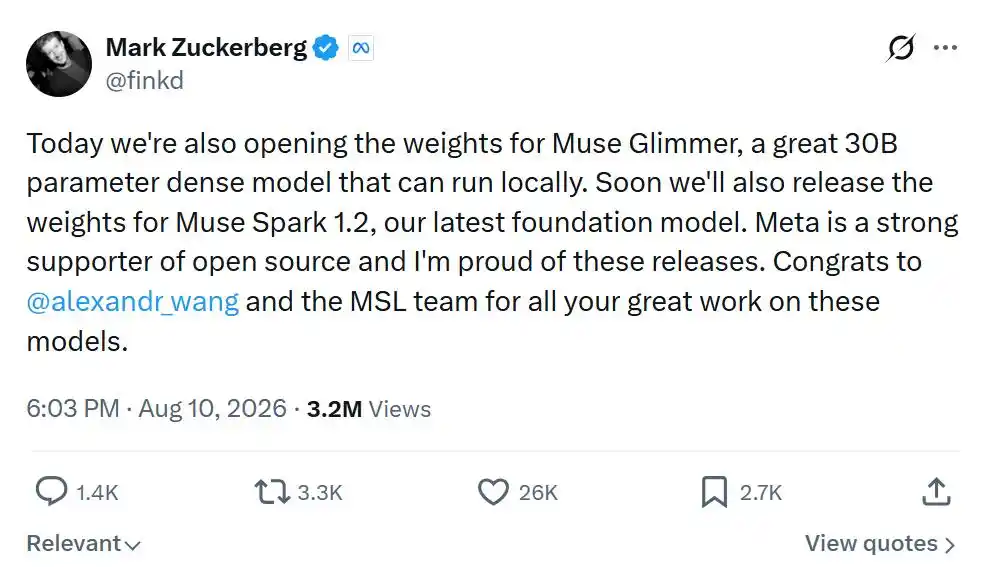
Regarding this, Mark Zuckerberg said: Meta has always been a strong supporter of open source, and he is very proud of these releases.
Zuckerberg also published an article on Meta's official website, proposing to provide free and highly capable AI to billions of people. He hopes this will empower individuals more and act as a counterbalance to the power of large institutions.
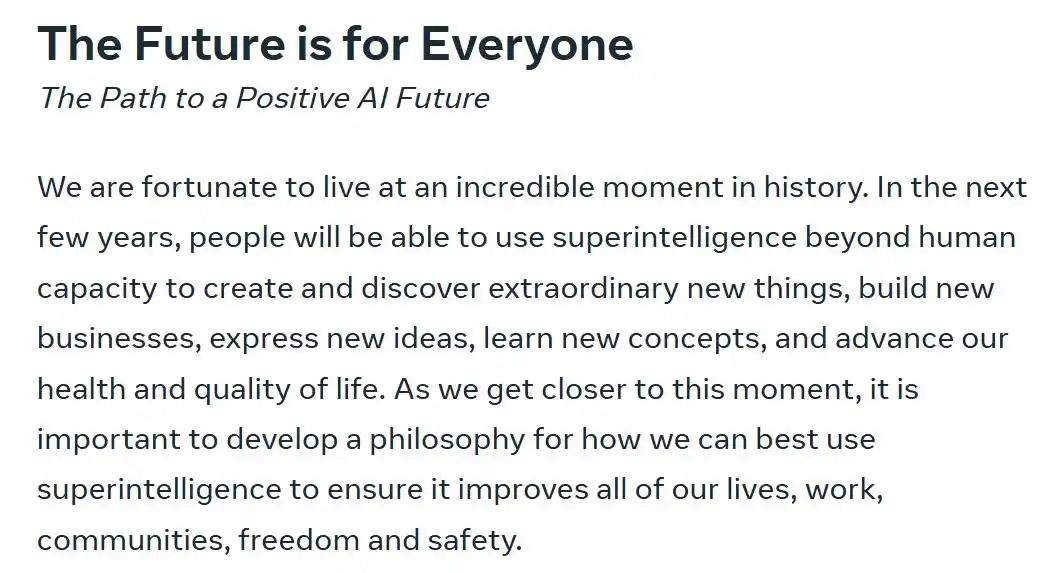
Article address: https://www.meta.com/thefutureisforeveryone/
In a statement that was clearly aimed at companies like Google, Anthropic, and OpenAI, he wrote: Most other labs are focused on building AI for businesses, governments, or other institutions. If these labs end up taking the lead, the balance of power will shift even more towards large institutions, rather than individuals.
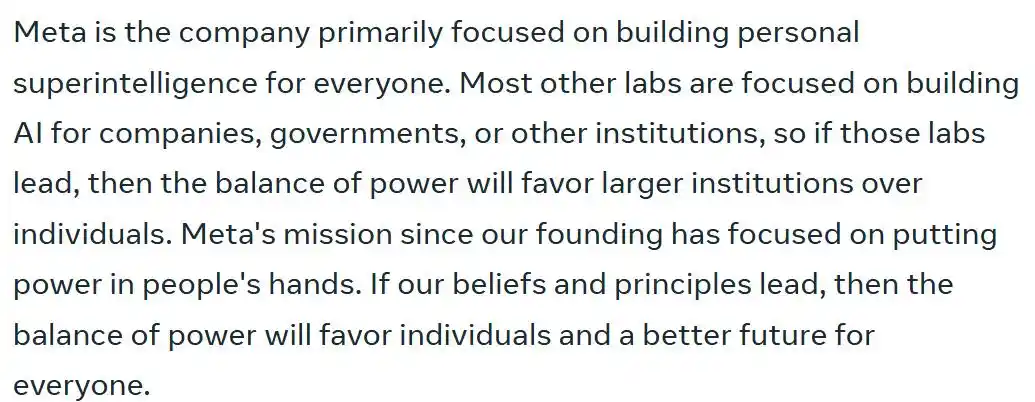
These commitments mean Meta is returning to its open AI path, which it previously used to differentiate itself from competitors.
Earlier this year, Meta had cited security concerns as a reason for not open-sourcing the underlying weights of Muse Spark. As competition among leading AI companies continues to intensify, a core question has also become: to what extent should the most powerful AI technologies be opened up.
Regardless, Zuckerberg's renewed embrace of the open approach has been met with almost universal applause in the comments section.
Yann LeCun gave his former employer a rare round of applause.

One netizen commented, "This move is spot on! Zuckerberg is really back in the game."

"We love open AI (tongue-in-cheek)"

Meta Replays the "Open Source Card"
Muse Glimmer is Meta's first open-weight model since Llama 4, and also the first model Meta has released under the Apache 2.0 license.
Previous Llama series used custom licenses with restrictions on certain commercial scenarios. Apache 2.0 is much more permissive; enterprises can deploy it directly, continue fine-tuning, develop derivative models, and integrate them into their own products.
Muse Glimmer is distilled from Muse Spark, with a total parameter count of approximately 29.6 billion, including a vision encoder with about 1.8 billion parameters. The model supports text and image input, has a 128K context length, and emphasizes multi-step reasoning, tool calling, and error recovery. It is positioned as the foundation for Agents on personal devices.
Traditional cloud-based Agents require continuous uploading of files, messages, and work context. The longer the task and the more calls made, the higher the token bill. When deployed locally, data can stay on the device, and latency and inference costs are easier to control.
Hardware barriers still exist. The BF16 weights of Muse Glimmer are nearly 60GB, making it difficult for ordinary computers to handle directly. Meta's provided 4-bit quantized version compresses the language model to under 20GB, allowing it to run in environments with 24GB or 32GB of VRAM.
The phrase "runnable on personal computers" more accurately means runnable on high-end Macs or PCs equipped with graphics cards like the RTX 5090.
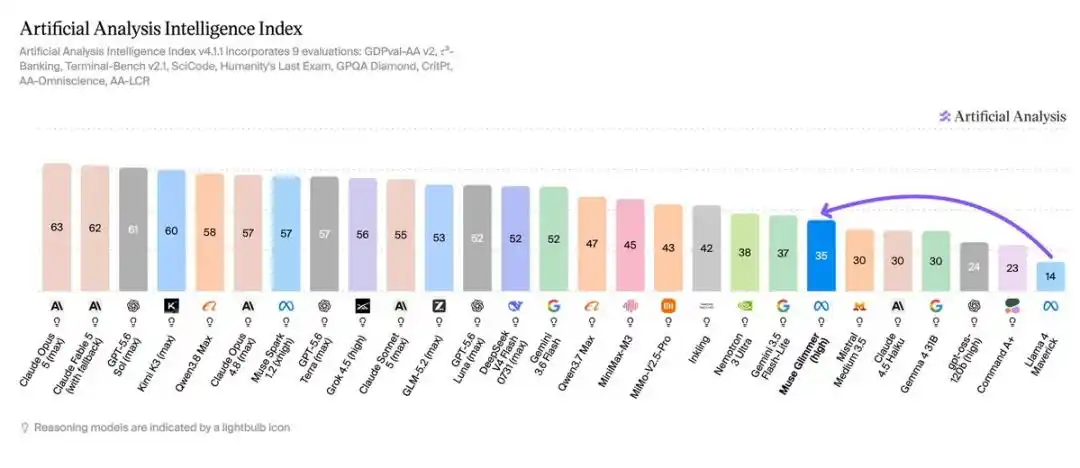
In terms of parameter efficiency, Muse Glimmer delivers respectable scores.
Artificial Analysis gave it an Intelligence Score of 35, 21 points higher than Llama 4 Maverick. It is close to Kimi K2.5's 36 points, slightly lower than the similarly sized Qwen3.6 27B and Ling 3.0 Flash, both at 38 points.
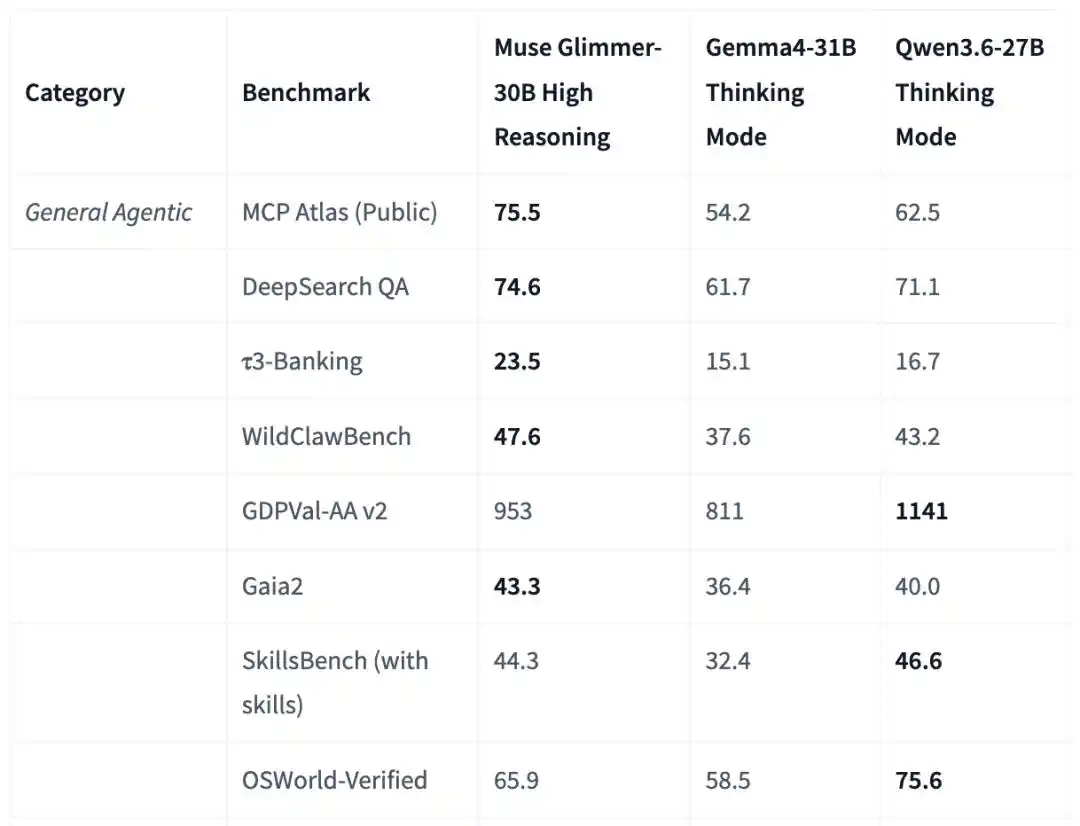
In Agent evaluations published by Meta, Muse Glimmer scored 75.5 on MCP Atlas, higher than Qwen3.6 27B's 62.5; DeepSearch QA was 74.6, also slightly higher than the latter's 71.1. On τ3-Banking, which tests tool usage, it scored 23.5, leading models in its tier.
Independent evaluations also exposed shortcomings. Muse Glimmer scored 953 Elo on GDPval-AA v2, below the human baseline of 1000 and trailing Qwen3.6 27B's 1141. Its hallucination rate on the AA-Omniscience evaluation was 82%, compared to 49% for Qwen3.6 27B. On Terminal-Bench 2.1, Muse Glimmer scored 52%, again lower than Qwen3.6 27B's 61%.
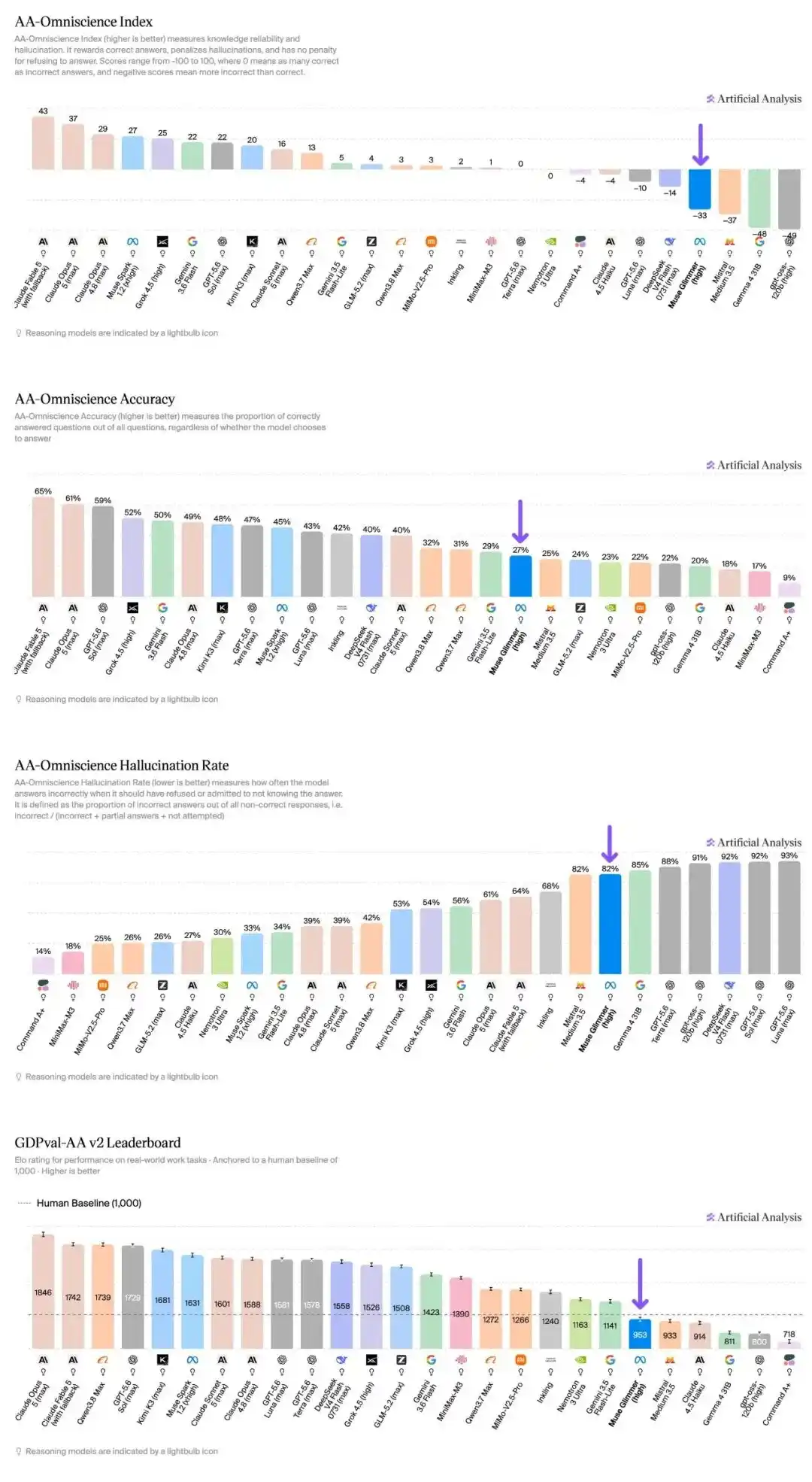
This indicates that Muse Glimmer is suitable for local tool calling and process execution. For high-accuracy knowledge tasks, it still requires retrieval and human verification.
Zuckerberg Vies for the AI Power Narrative
In Zuckerberg's view, the core of AI competition boils down to two questions: Who will achieve superintelligence, and what will people do with it.
He wants to deliver "personal superintelligence" to billions of users, allowing AI to participate in daily affairs like health, career, finance, interests, and relationships.
This proposition binds open models with personal autonomy and directly challenges the closed-source approach of companies like OpenAI and Anthropic.
Zuckerberg opposes using safety risks to justify centralization of capabilities.
He argues that placing the strongest AI under the control of a very few institutions itself creates new power risks. Open models can be examined by more developers, vulnerabilities are easier to expose and fix, and individuals can customize AI as needed.
He also defended model distillation.
OpenAI and Anthropic have recently repeatedly accused Chinese companies of using outputs from U.S. closed-source models to train their own models. Zuckerberg emphasized that people should preserve the principle of "learning from observable information." He also opposed restricting open models from overseas, advocating that U.S. open models should become the world's best through competition.
However, Meta is not sidestepping all safety concerns.
Zuckerberg proposed that Meta's independent directors be responsible for approving safety standards required for model releases; the company could also provide intermediate training checkpoints to governments to identify risks earlier.
Behind Open Source: Ecosystem and Compute Business
Meta's return to open weights at this time also comes with practical pressure.
Chinese open models are rapidly closing the gap with U.S. closed-source flagships. DeepSeek, Kimi, and Qwen continue to improve performance and expand influence through low pricing, customizability, and local deployment. If U.S. model companies continue to tighten access to weights, the global developer ecosystem may accelerate its shift to other providers.
Meta needs to recapture these developers. Muse Glimmer lowers the barrier for local deployment, while Muse Spark 1.2 is responsible for raising the capability ceiling. The two models can cover personal devices, enterprise private deployments, and cloud services.
Open sourcing can also create demand for Meta's compute investments. Meta plans to invest up to $145 billion this year in building AI infrastructure while preparing its cloud computing business. Model weights can be free, but inference, hosting, and development tools can still generate revenue. Openness expands the ecosystem, cloud services capture commercialization.
The $1 billion Data Center Community Fund announced the same day also serves this strategy. Meta needs to build more data centers while alleviating local community concerns about electricity, water resources, and land use. Technological openness, policy advocacy, and infrastructure expansion are thus linked.
Muse Glimmer alone is not enough to rewrite the model landscape. Its importance lies in the fact that Meta has returned to the open-weight camp and delivered a usable product aimed at local Agents.
If Meta opens Muse Spark 1.2 as planned, competition between open and closed-source approaches will escalate further.
Going forward, the industry must answer three questions: Which capabilities can be opened up, who bears the costs, and who sets the rules.
Reference links:
https://x.com/ArtificialAnlys/status/2086916150278111551
https://www.ft.com/content/4e3957f8-ea7c-4c46-a3de-cdce8e526878?syn-25a6b1a6=1
https://www.bloomberg.com/news/articles/2026-08-10/meta-releases-muse-glimmer-ai-model-people-can-run-on-their-laptop?srnd=phx-technology
This article is from the WeChat public account "Almost Human" (ID: almosthuman2014), author: Follows AI.