Meme Wrapped Contracts: Is alt.fun Real Innovation or Pseudo-Demand?

Odaily星球日报Published on 2026-05-18Last updated on 2026-05-18

Abstract

"Last week, the new Meme token launch platform alt.fun on Hyperliquid gained significant attention. Its flagship token ALT reached a peak market cap of $8.8 million. The platform's novelty lies in combining the mechanics of Pump.fun with leveraged trading on Hyperliquid. When a user creates a Meme token on alt.fun, they must also open a leveraged long/short position (2x, 3x, or 5x) on an underlying asset like HYPE. The platform then mints a corresponding leveraged token (LT) on BounceTech, which represents that perpetual contract position. Essentially, users are trading a tokenized derivative. This creates a dual price driver: the token's value is influenced both by market buying/selling via a bonding curve and by the performance of its underlying leveraged position. Hence the slogan: 'Your token pumps even when nobody's buying.' Tokens 'graduate' to a liquidity pool when their market cap (effectively the LT's value) reaches $9,000, achievable through either mechanism. However, this model faces key challenges. Gains are amplified only in strong, one-directional markets for the underlying asset. In volatile conditions, the mandatory 'rebalancing' of LTs leads to value decay. More fundamentally, alt.fun struggles to foster the community consensus vital for Meme tokens. Investment is driven primarily by price speculation on the underlying asset, not by narrative or cultural appeal. With limited underlying assets, token differentiation is low. The article concludes that while m...

Original | Odaily Planet Daily (@OdailyChina)

Author | Golem (@web3_golem)
Last week, a new Meme launch platform on the Hyperliquid ecosystem called alt.fun attracted significant attention from Meme players. Within just one week of launch, its leading token ALT reached a peak market cap of $8.8 million. Its price has since retraced, with the market cap currently hovering around $6.7 million.

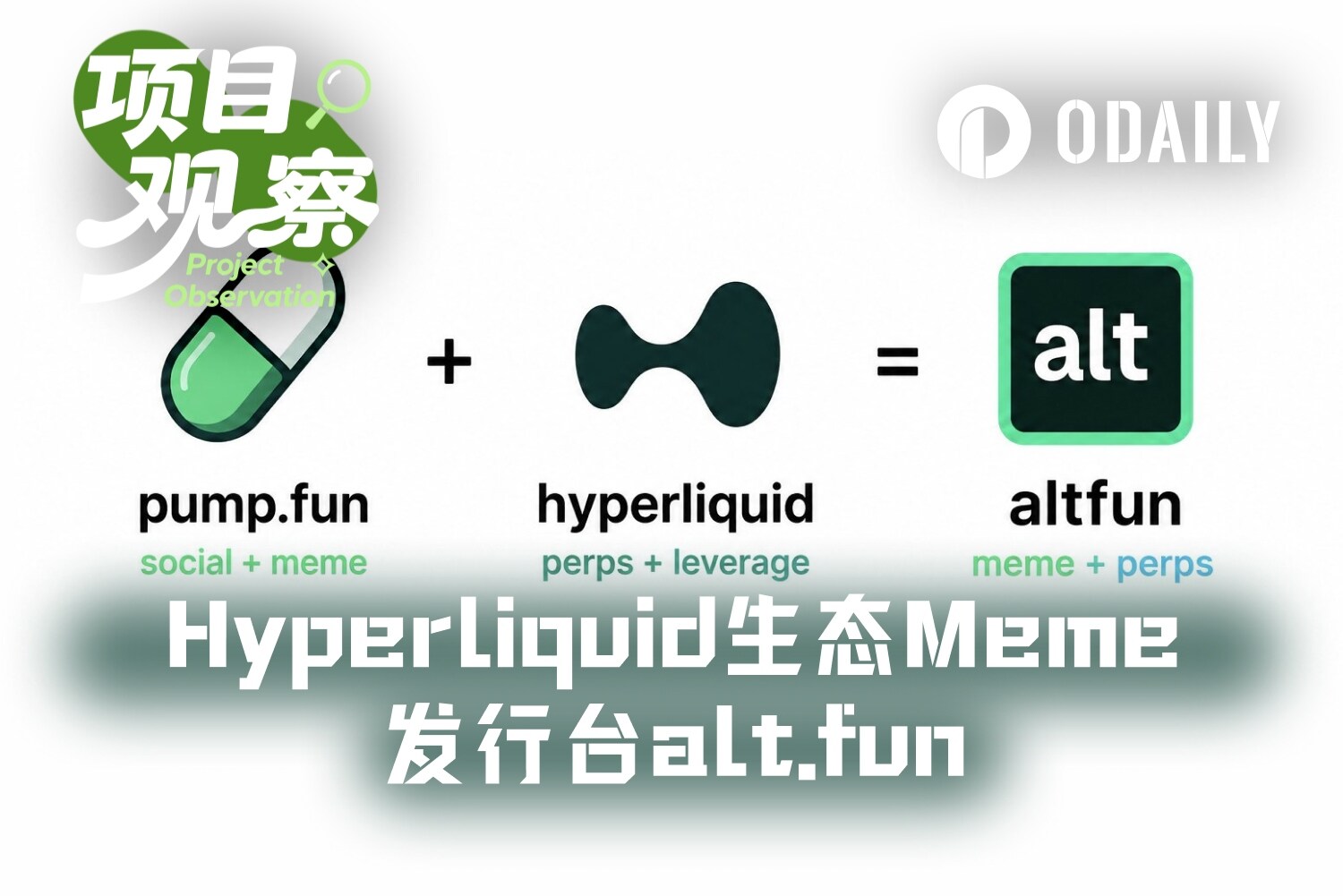
The novelty of alt.fun can be understood as a combination of Pump.fun and Hyperliquid, allowing users on this platform to experience the dual thrill of playing with Memes and opening leveraged contracts simultaneously.

Introduction to the alt.fun Platform Mechanism

Specifically, each Meme token launched on alt.fun has a corresponding contract position on Hyperliquid as its underlying asset.

Similar to Pump.fun, any user can launch a Meme coin on HyperEVM with one click via the alt.fun platform. The token price is still influenced by a bonding curve. The total supply of a created Meme coin is 1 billion tokens. When 75% of the tokens are sold, the token successfully "graduates" and is migrated to the HyperSwap V2 liquidity pool.

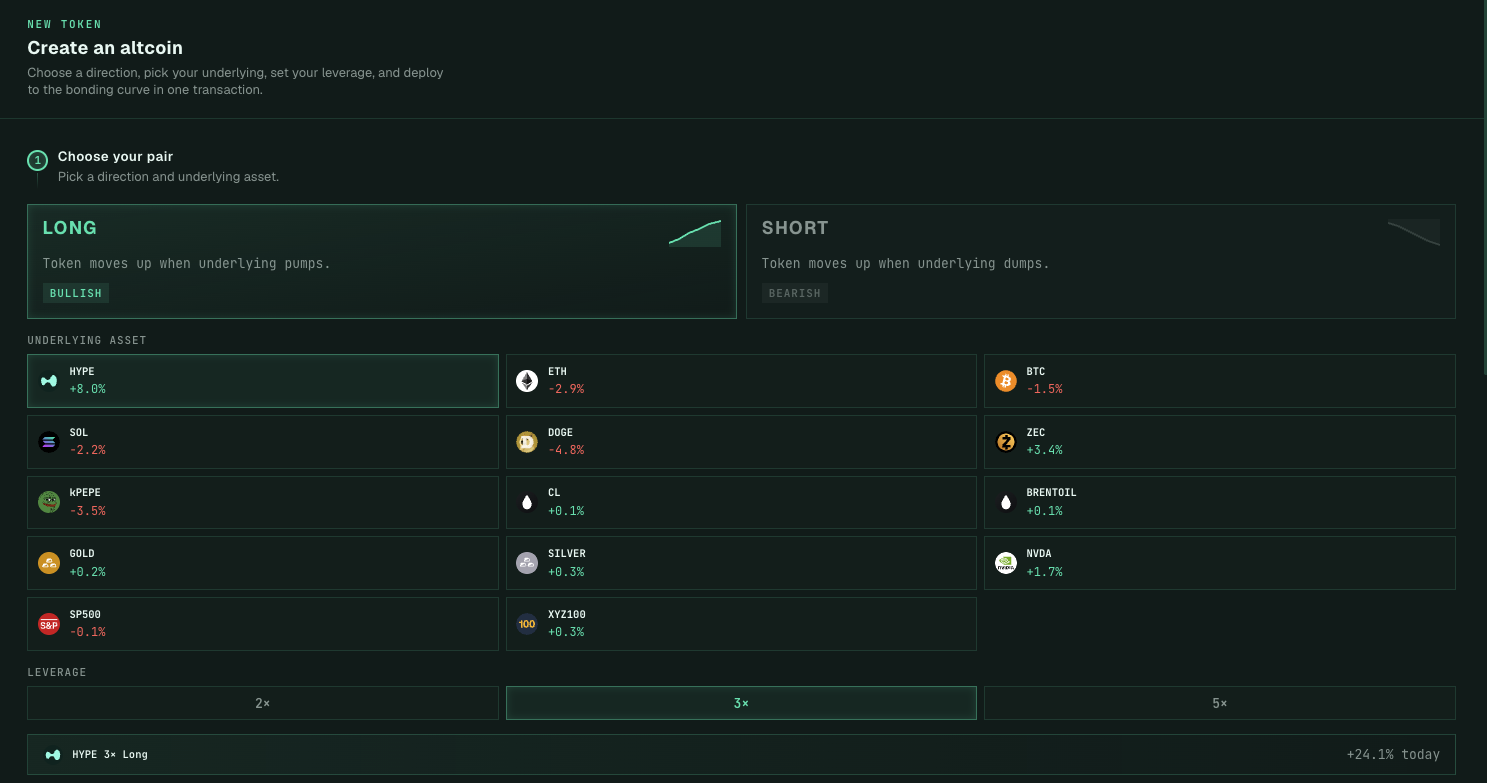
The difference from Pump.fun is that when creating a token on alt.fun, the user also needs to select an underlying asset and specify a leverage level (2x/3x/5x) for a short/long position. At the exact moment of token creation, the platform mints a corresponding amount of Leveraged Tokens (LT) on BounceTech(Odaily note: a permissionless leveraged token platform on Hyperliquid) and sends them to the user. These leveraged tokens represent perpetual contract positions on Hyperliquid. For example, if a user chooses to create a token based on a 3x long HYPE position, what they receive is essentially a leveraged token tracking the returns of a 3x long HYPE position.

As shown in the figure below, currently on alt.fun, users can choose from 14 underlying assets when creating a token. Similarly, when a player buys a Meme coin on this platform, the platform also mints the corresponding leveraged tokens on BounceTech. If a player sells, this process is reversed—the leveraged tokens are redeemed, and the user receives the corresponding USDC.
This model of packaging leveraged tokens as underlying assets and then selling them is similar to the securitization of specific risk exposures like futures and options in traditional finance, such as 3x short Nasdaq ETF, 5x short crude oil products, etc. In this process, the alt.fun platform acts as a role similar to an asset management company, managing the long-term positions behind the leveraged tokens for users.

The core price of such financial products follows the net asset value. However, because the token price on the alt.fun platform is also simultaneously influenced by the Meme coin bonding curve mechanism, the graduation model and price drivers for tokens on this platform are not singular.

Dual Graduation Modes and Price Driving Factors

This also means that token prices on the alt.fun platform are influenced by two factors: first, by market sentiment from buying and selling; second, by the performance of the underlying asset. So now you might understand the meaning of alt.fun's slogan, "Your token pumps even when nobody's buying."

For example, if a user creates a token based on a 3x long HYPE position with an initial investment of $20 (the platform's minimum buy-in size), and subsequently HYPE rises by 10%, then even if no one else buys the token, the user's holding value increases by 30% to $26.

Based on this dual price driver, the graduation model for tokens on the alt.fun platform is also not limited to one method. Specifically, the graduation condition for its tokens is reaching a market cap of $9,000. This essentially calculates the value of the leveraged token. Besides achieving graduation through token purchases, if the token's own value driven by the underlying asset's rise reaches a $9,000 market cap, it can also graduate smoothly. Therefore, whether a token reaches the graduation threshold is often a combined result of both price mechanisms.

Of course, ideally, the underlying asset's rise drives the leveraged token's increase, which, combined with the emotional catalyst from the Meme market, might cause the token's price to spiral upward rapidly. However, once the underlying asset falls, the leveraged token's value continues to shrink, potentially causing market panic and a sell-off, leading to the token's price crashing instantly.

Therefore, although alt.fun's mechanism can effectively leverage amplification effects, this only works in one-directional market trends and requires users to accurately catch the trend. If encountering volatile market conditions for the underlying asset, users must also bear the decay loss from leverage. This is because when the underlying asset price fluctuates, the platform needs to perform "rebalancing" to manage positions to avoid liquidation. This means that even if the underlying asset falls and then recovers to its original price, the leveraged token will suffer losses and gradually depreciate due to forced position reductions during the dip.

Furthermore, in cases of sudden price spikes or flash crashes, the platform might fail to react in time, potentially leading the leveraged token's value to zero.

Meme or not Meme

The alt.fun platform currently has a total of 41 graduated tokens. Only two have a market cap exceeding one million: ALT (based on 5x long HYPE) and STONKS (based on 5x long S&P 500). The total number of users is around just over 1,000. Although alt.fun is still in its early stages, we can already identify its current development bottlenecks.

First, the platform has too few underlying assets. With the current 14 underlying assets, there can be at most 84 different combinations of leveraged tokens. alt.fun has already seen leveraged tokens with the same leverage level (short/long) on the same underlying asset. For instance, the current top token ALT is based on 5x long HYPE, while another token, ATH, with a certain market cap, is also based on 5x long HYPE. Apart from the token name and creation time, there is no difference between them. In that case, why wouldn't an investor buy the lower-market-cap ATH?

Although alt.fun may support more underlying assets in the future, its core pain point is its inability to foster Meme coin community consensus.

The essential reason investors choose to buy leveraged tokens on the alt.fun platform instead of opening leveraged positions directly on Hyperliquid is to obtain greater price leverage and, because the platform manages position rebalancing on the backend, individual users can act as "hands-off managers," not worrying about individual liquidation risks.

But this is also the issue. Investors buying an alt.fun token are essentially doing so based on future price expectations for its underlying asset, not based on narrative, market games, attention—these "meaningless things" that ironically are the core value supporting Memes. A Meme's ability to rise or gain market recognition often isn't due to any actual value backing or financial design behind it; what's more important is its community propagation attribute.

As a Meme player, it's difficult for me to develop a love for a leveraged token similar to the passion for a particular Meme community's culture. If someone truly has faith in the underlying asset of a leveraged token, they might as well issue their own leveraged token rather than buying an existing one and bearing unnecessary premiums.

Therefore, the mechanism of the alt.fun platform appears novel, but in my view, it's merely a mechanical innovation. If alt.fun focuses on developing towards a DeFi platform in the future, there might be an opportunity. However, if it insists on forcing its way into the Meme launch platform track, it is destined to be a flash in the pan.


Related Questions

QAccording to the article, what is the core innovation of the alt.fun platform and which two platforms does it combine?

AThe core innovation of the alt.fun platform is that it packages leveraged tokens as underlying assets and sells them as meme coins, combining the meme coin launch mechanism of Pump.fun with the perpetual contract (leveraged trading) functionality of Hyperliquid.

QWhat are the two main factors that drive the price of a meme coin on the alt.fun platform?

AThe price of a meme coin on the alt.fun platform is driven by two main factors: 1) Market sentiment and buying/selling pressure on the meme coin itself (via the bonding curve). 2) The performance of the underlying asset that the coin's leveraged token is tracking (e.g., if the coin is based on a 5x long position on HYPE, its value is affected by HYPE's price movement).

QWhat is one of the key risks or disadvantages mentioned regarding the alt.fun leveraged token model, especially in volatile market conditions?

AA key risk is the potential for "leverage decay." In volatile or choppy market conditions where the underlying asset price fluctuates up and down, the platform must perform "rebalancing" to manage the leveraged position. This process can cause the leveraged token to slowly lose value over time, even if the underlying asset's price eventually returns to its original level.

QWhat is identified in the article as the core dilemma or fundamental weakness of alt.fun's approach to being a meme coin platform?

AThe core weakness is that alt.fun's model lacks the ability to build true meme coin community consensus. Investors buy these tokens primarily based on price expectations for the underlying financial asset, not for the narrative, cultural elements, or community hype that are essential to sustaining a successful meme coin. It's more of a packaged financial product than a true community-driven meme.

QWhat are the two conditions under which a meme coin on alt.fun can 'graduate' (be successfully launched into a liquidity pool)?

AA meme coin on alt.fun graduates when its market capitalization reaches $9,000. This can happen in two ways: 1) Through purchases on the bonding curve, which increases the token's price and market cap. 2) Through the increase in value of the underlying leveraged token itself, driven by favorable price movement of the underlying asset, even without new buyers on the bonding curve.

Related Reads

Claude Code Introduces Dynamic Workflows: Enabling AI to Form Teams and Collaborate

Claude Code introduces dynamic workflows, enabling AI to coordinate teams of specialized agents for complex tasks. This transforms Claude from a code assistant into a programmable workbench. Workflows address key limitations of single-agent systems: agentic laziness (premature task completion), self-preferential bias (favoring own outputs), and goal drift (losing sight of original objectives). The system allows Claude to dynamically create execution frameworks using JavaScript. It can split tasks, dispatch parallel agents for isolated work (e.g., in separate worktrees), implement adversarial validation, run tournaments, and synthesize results. This multi-agent approach is valuable for tasks requiring deep research, factual verification, code migration, root cause analysis, large-scale triage, and qualitative sorting. Key patterns include: classify-and-route, fan-out-and-synthesize, adversarial verification, generate-and-filter, tournaments, and loop-until-done. While token usage is higher, workflows excel where tasks resemble programming—needing problem decomposition, isolated context, hypothesis testing, and handling many details. They extend Claude Code's utility beyond technical work to areas like business plan review, resume screening, and naming brainstorm. The feature is not a universal solution but points to a future where AI tool competitiveness depends on organizing reliable, reusable, and auditable execution flows for complex goals.

marsbit35m ago

Claude Code Introduces Dynamic Workflows: Enabling AI to Form Teams and Collaborate

marsbit35m ago

Hyperliquid, Wall Street's 24/7 Trading Convenience Store

Hyperliquid: The 24/7 Trading "Convenience Store" for Wall Street Hyperliquid, a decentralized cryptocurrency exchange, has become a go-to platform for Wall Street traders seeking to trade around the clock, especially during traditional market closures. Founded by Jeff Yan, a former quantitative trader, after the FTX collapse, the platform emphasizes user self-custody of assets. It offers a wide range of perpetual contracts—leveraged derivatives with no expiry—on assets from Bitcoin and crude oil to the S&P 500 and even pre-IPO companies like SpaceX. A notable example involves a hedge fund trader who capitalized on geopolitical news over a weekend, securing a 243% return on oil derivatives before markets reopened. The platform, run by just 11 employees, generated approximately $800 million in revenue last year, and its native token HYPE has seen significant growth. Its rise highlights the merging of traditional finance and crypto. While U.S. users are currently restricted, recent CFTC rule changes could open access. The platform is known for its transparency, having processed $10 billion in liquidations during a market crash while competitors faltered. Regulators warn of the high risks and complexity of perpetual contracts for retail investors. Key to its appeal is a strong community culture, direct engagement with founders, and a simple interface. Despite rules against VPN use, it attracts global users with its permissionless approach. Hyperliquid plans to expand into prediction markets and options, aiming to eventually host all financial activity.

marsbit36m ago

Hyperliquid, Wall Street's 24/7 Trading Convenience Store

marsbit36m ago

Who Funds the Agents?

**Summary: Who Funds AI Agents?** OpenAI recently shut down a feature allowing AI agents to shop for users, highlighting the challenge of creating a secure and regulated environment for agent-driven transactions. While payment infrastructure exists, a crucial governance layer—defining spending limits, fraud detection, tax handling, and return policies—is largely missing. The potential is enormous: AI agents already processed $73M across 176M transactions last year, with McKinsey forecasting this could grow to $3-5T in global consumer commerce by 2030. The core competition isn't just about processing payments, which can be very cheap (especially with crypto-based settlement), but about controlling the rules that govern agent spending. Key players like Stripe and Coinbase are racing to dominate this governance layer. Stripe's acquisition of wallet provider Privy allows it to set spending policies, identity checks, and human-in-the-loop approvals directly at the wallet level. Similarly, Coinbase's stack, including its x402 protocol and AgentKit, embeds governance rules. This vertical integration across settlement, wallet, and governance layers is becoming the dominant strategy. Control over the governance layer is where significant future value lies. If agents handle trillions in transactions, even a small fee for managing compliance, fraud prevention, and policy enforcement could generate billions in annual revenue. The companies that successfully integrate across the payment stack will capture value from idle agent balances, transaction fees, and governance services, positioning themselves as the foundational banks of the AI agent economy.

marsbit1h ago

Who Funds the Agents?

marsbit1h ago

Trading

Spot
Futures

Hot Articles

Discussions

Welcome to the HTX Community. Here, you can stay informed about the latest platform developments and gain access to professional market insights. Users' opinions on the price of MEME (MEME) are presented below.

活动图片