Meme Watchlist: Who's Cultivating Real Fans, Who's Inflating Data

比推Published on 2026-03-06Last updated on 2026-03-06

Abstract

The article "Meme Watchlist: Who's Building Real Communities vs. Who's Inflating Metrics" analyzes the memecoin sector, arguing that memecoins have achieved product-market fit as a form of crypto "gaming" driven by speculation, social interaction, and risk-reward dynamics. The report focuses on five memecoins—BONK, PEPE, SPX6900, PENGU, and USELESS—selected based on criteria including liquidity, global audience, cultural relevance, historical volatility, transparent on-chain data, and high beta correlation to Bitcoin. Key on-chain metrics are analyzed to assess holder conviction and staying power: - **Total Holders:** BONK leads with 985.9K, followed by PENGU (534.1K) and PEPE (505.7K). - **Small Holders (<$100):** BONK, PENGU, and PEPE show mature bases, while SPX6900 has a smaller but more dedicated community. - **Larger Holders:** SPX6900 demonstrates superior holder retention. When analyzing wallets that held $1,000 or $100,000 worth of tokens at their all-time high (ATH), SPX6900 consistently showed the highest rate of holders retaining their full position (in token units, stripping out price volatility). - **Whale Retention:** A significant majority (80%) of SPX6900's whales (wallets that once held >$100k) still hold over 50% of their peak token amount, far exceeding the retention rates of the other coins. The analysis concludes that SPX6900, with its strong community ethos centered around "Flipping the stock market," exhibits the most resilient and committed holder ...

Source: The DeFi Report

Author: Michael Nadeau

Compiled and Edited by: BitpushNews


Whether you like it or not, we believe memecoins are here to stay. This article will share a macro perspective on the industry and delve into the meme coins we are closely monitoring.

Let's begin.

Why Focus on Memecoins

Our Methodology

Some people love memecoins, others despise them. We try to step outside this debate and simply observe the market. From our observations, memecoins have taken root. From a "Product-Market Fit (PMF)" perspective, they seem to be the ultimate crypto "game." People love trading, love gambling, love the social aspect, and love the risk-reward play. And we believe participants are very aware of the game they are playing.

After witnessing PEPE's success in the Ethereum ecosystem, we caught onto BONK and Solana in late 2023. This led us to research the space more deeply, including on-chain data and additional investments like GIGA, PEPE, and SPX6900. Our goal is to uncover unique properties in holder data that indicate a token's Staying Power and the conviction of its holders.

Why BONK, PEPE, SPX6900, PENGU, and USELESS?

  1. Liquidity: Each token has ample liquidity and is tradable on major exchanges and retail channels.

  2. Audience Reach: Each token has global audience interest (not limited to niche memes like specific politics).

  3. Leadership/Embedded Culture: Each token is supported by at least one of the following: 1) A highly influential leader/holder community; 2) An established internet meme/culture; or 3) An existing popular brand.

  4. Historical Performance: Each token has experienced multiple massive rallies followed by sharp pullbacks. This price action shows broad market interest and helps distribute the holder base, laying the foundation for the next expansion.

  5. No Unlocks, No VCs: Only transparent on-chain data.

  6. High Beta: Each token exhibits a high beta coefficient relative to BTC and the L1 assets of its ecosystem. With proper allocation (we target 3-5%), coin selection, and entry points, this can significantly enhance risk-adjusted returns.

Now, let's dive into the on-chain data to separate the wheat from the chaff.

Total Token Holders
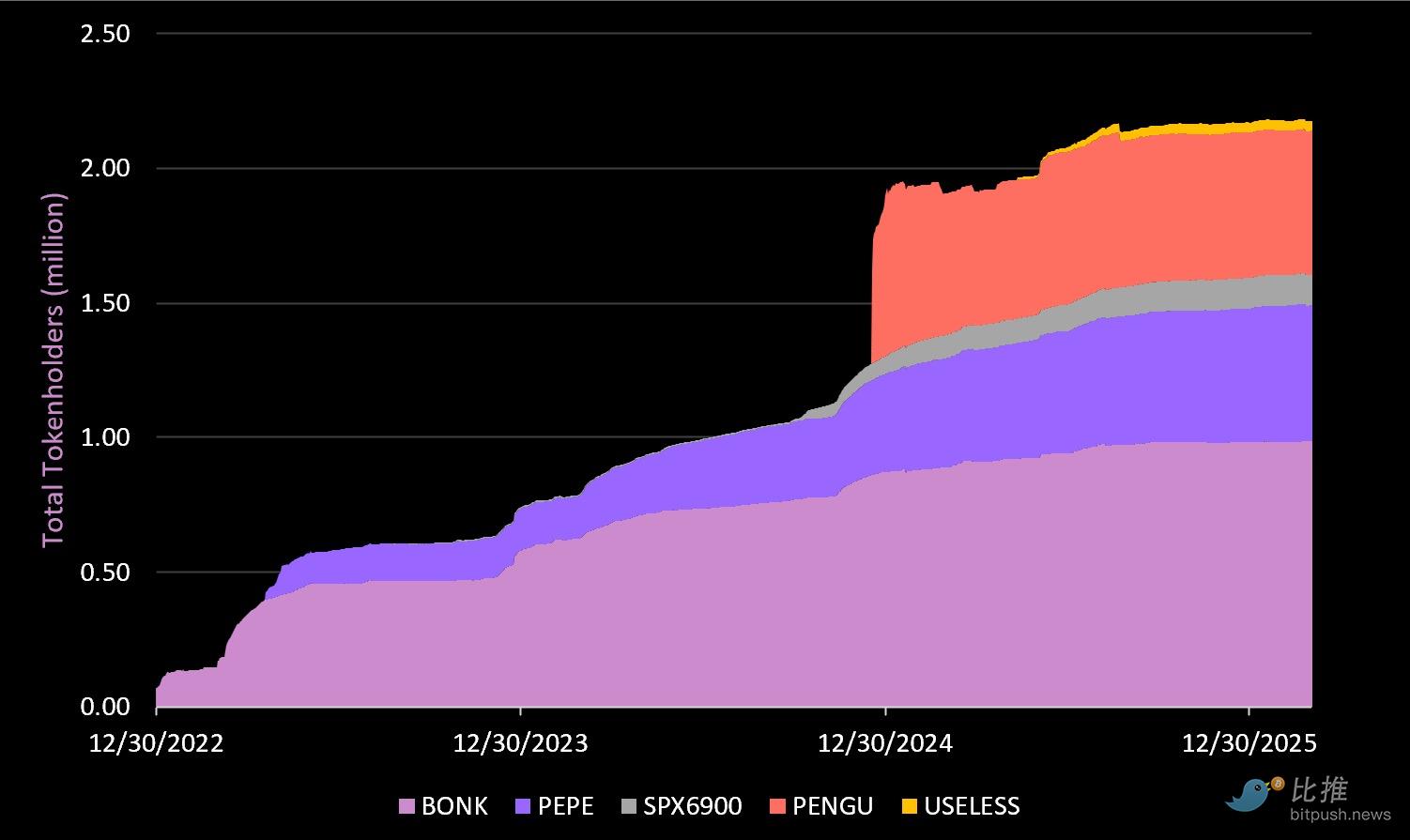
Data Source: The DeFi Report

  • BONK: 985.9K current holders (at an all-time high). BONK launched in Dec '22, is the largest memecoin in the Solana ecosystem, and is deeply integrated into various apps and wallets. Note: BONK executed a community-driven airdrop campaign, "seeding" a large number of wallets, which is reflected in the data in the table below.

  • PENGU: 534.1K holders (down 14% from peak). PENGU launched in Dec '24, representing social interest in the popular brand Pudgy Penguins. The total market cap of the Pudgy Penguins NFT collection today is ~$78.5M, while its memecoin market cap is $454M (5.7x the NFT collection, down from a $2.7B peak). We believe the value of the Pudgy Penguins brand (a strong crypto brand breaking into the mainstream) is likely to continue flowing to this memecoin.

  • PEPE: 505.7K current holders (down 1.51% from peak). PEPE launched in Apr '23. We believe PEPE is the purest expression of internet meme culture in crypto (especially on Ethereum). It's based on the globally recognized "Pepe the Frog," which has maintained a strong internet presence since the late 2010s.

  • SPX6900: 113K current holders (down 0.33% from peak). SPX6900 launched in Sep 2023, spawning a fervent internet community led by Murad, with the core ethos of "Flipping the stock market." The brand seems to combine financial satire with a "BTC-like" holder base that takes holding very seriously (as shown in the data below). We successfully traded SPX6900 in the last bull run and have been analyzing its community and on-chain data since Aug '24.

  • USELESS: 38.6K current holders (down 5.2% from peak). USELESS launched in May '25 as a satirical "Anti-utility" memecoin. It attracted a vertical and seemingly loyal community after its debut on LetsBONK (which took market share from Pump Fun at the time). Its current market cap is $44M with daily liquidity exceeding $10M (at bear market lows), and we believe USELESS could present interesting opportunities under the right market conditions.

Holders with Balances Under $100
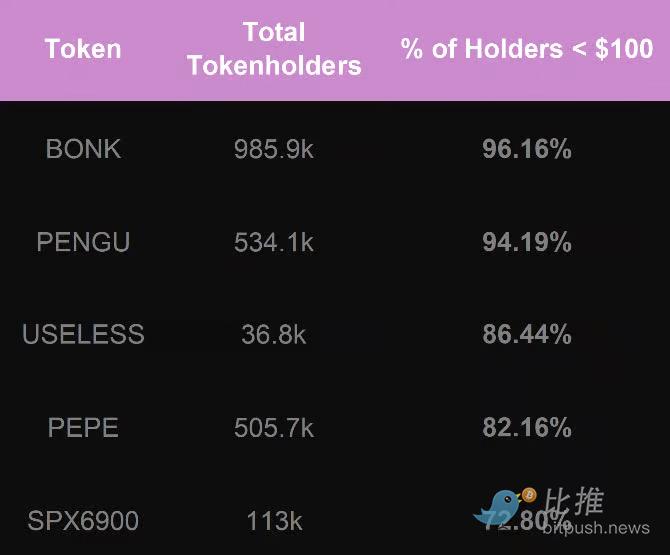
Conclusion:

BONK, PENGU, and PEPE already have very mature holder bases. SPX6900 shows a more resolute and loyal holder base (albeit smaller).

Holders with Balances Over $1,000
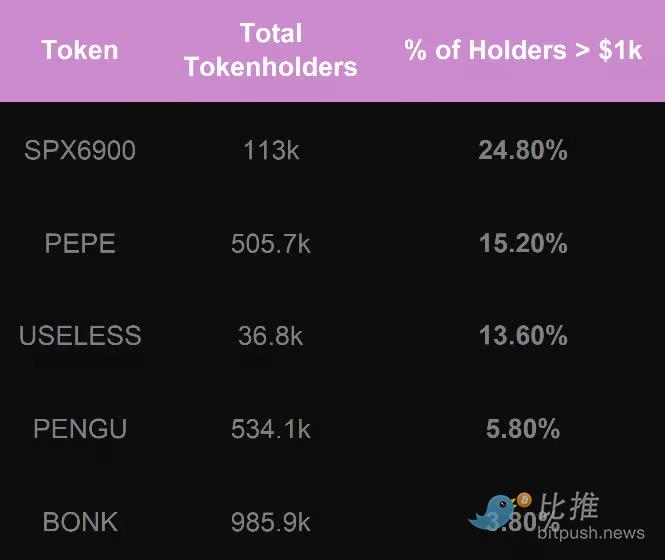
Note, $1,000 wallet classification: Split by the number of token units held at the token's All-Time High (ATH) price equivalent to $1,000.

Conclusion:

SPX6900 stands out here, as it consistently has since we started tracking this metric.

To better understand the retention of $1,000 holders, we normalized the ATH data for each token, calculating the number of token units required to be a "$1,000 holder" at that time.

Then, we tracked the holdings (number of units) of these wallets over time. This aims to strip out the noise of price fluctuations to more accurately gauge holder retention willingness.

Here are our findings:
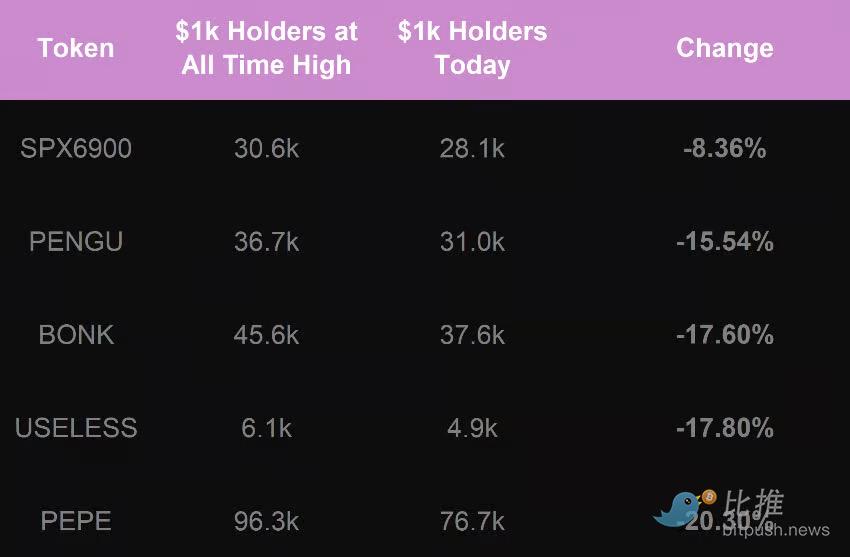
Conclusion:

In terms of "$1,000 holder" retention rate (measured in units to strip out price effects), SPX6900 seems to have separated itself from the pack.

Holders with Balances Over $100,000
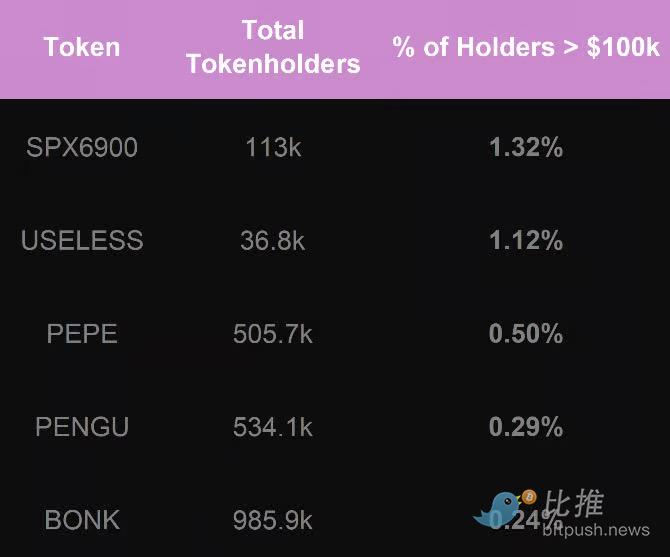
$100,000 wallet classification: Split by the number of token units held at the token's All-Time High (ATH) price equivalent to $100,000.

Retention Rate

Similar to the $1,000 holder data, we classified $100,000 wallets by their unit holdings at ATH.

Then, we tracked these wallets to determine the change in the total number of "$100,000 wallets" (by token units) over time.

Here are our findings:
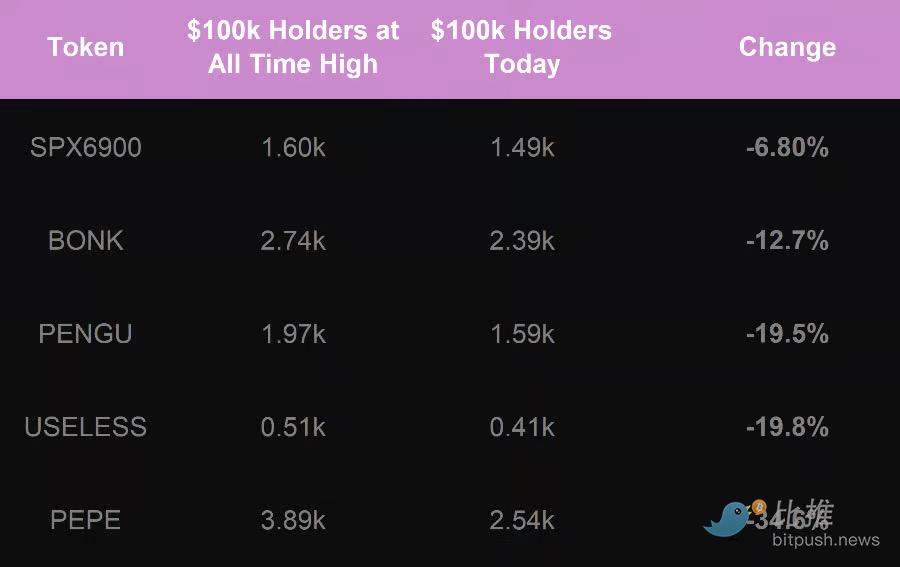
Conclusion:

Again, SPX6900 leads in the retention rate of holders at the $100,000 level.

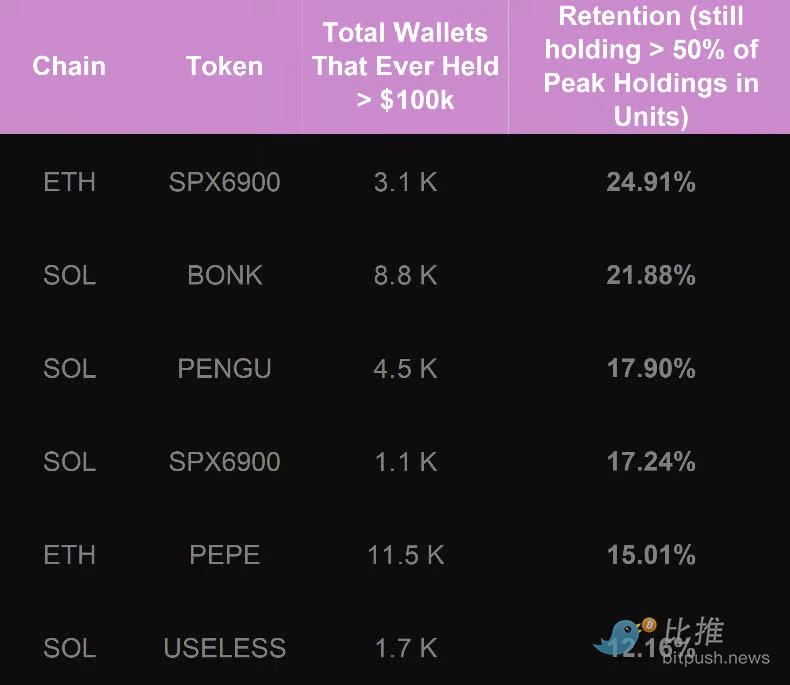
Whale Retention Rate

Another way to monitor whale retention is: Count all wallets that have ever held over $100,000 worth of the token and compare that to the number of wallets that still hold more than 50% of their peak holdings (in units).

Here are our findings:
Momentum & 50-Week Moving Average (WMA)

Relative Strength
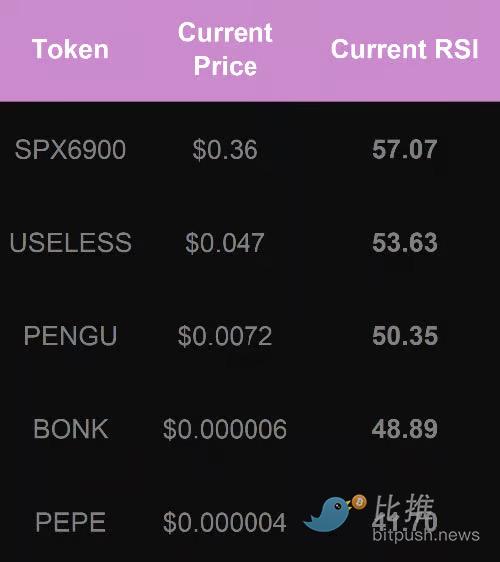
When we buy memecoins, we look for entry points where the 14-day RSI is at or near oversold territory (30).

50-Week Moving Average

  • SPX6900: Trading 64% below its 50 WMA.

  • BONK: Trading 62% below its 50 WMA.

  • PENGU: Trading 58% below its 50 WMA.

  • PEPE: Trading 57% below its 50 WMA.

Drawdown from All-Time High
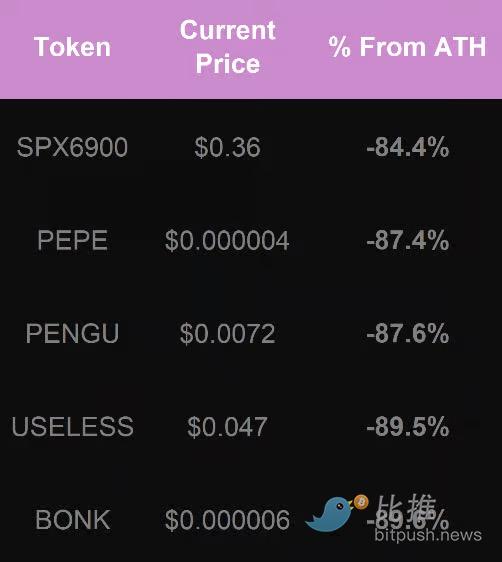
Given SPX6900's superior on-chain data, its relative resilience compared to the others is not surprising.

Conclusion

Given the industry's attention, we believe it is wise for crypto investors to pay attention to memecoins. We find them highly referential when monitoring broad risk-on/off sentiment and liquidity conditions in the crypto market.

Not to mention, with the right position sizing and entry points, the right assets can provide a "powerful catalyst" for a portfolio.

We successfully captured BONK and SPX6900 in the last bull run (exiting with a small portfolio allocation for 10x+ gains). We will look for similar entry opportunities in the future.


Twitter:https://twitter.com/BitpushNewsCN

Bitpush TG Discussion Group:https://t.me/BitPushCommunity

Bitpush TG Subscription: https://t.me/bitpush

Original link:https://www.bitpush.news/articles/7617562

Related Questions

QWhat is the main purpose of the article's analysis of memecoins like BONK, PEPE, SPX6900, PENGU, and USELESS?

AThe article aims to analyze on-chain data to identify unique attributes in holder data that indicate a token's staying power and the conviction of its holders, moving beyond the debate of whether memecoins are good or bad to observe their market presence and potential.

QWhich memecoin showed the highest retention rate among holders with over $1,000 and $100,000 investments when measured in token units to strip out price volatility?

ASPX6900 showed the highest retention rate among holders with over $1,000 and $100,000 investments when measured in token units to account for price volatility.

QWhat criteria did the authors use to select the memecoins BONK, PEPE, SPX6900, PENGU, and USELESS for analysis?

AThe selection criteria included liquidity (ample liquidity and tradable on major exchanges), audience reach (global interest beyond niche memes), leadership/embedded culture (supported by influential leaders, established internet memes, or existing hot brands), historical performance (experienced large rallies and drawdowns), no unlocks or VC backing (transparent on-chain data only), and high beta (high sensitivity to BTC and ecosystem L1 assets).

QHow does the article describe the current holder count and historical performance of PENGU compared to its associated NFT collection?

APENGU has 534,100 current holders (down 14% from its peak) and represents social interest in the Pudgy Penguin brand. The Pudgy Penguin NFT collection has a total market cap of about $78.5 million, while its memecoin has a market cap of $454 million (5.7 times that of the NFT collection, down from a peak of $2.7 billion).

QWhat trading strategy do the authors mention for entering memecoin positions based on technical indicators?

AThe authors look for entry points when the 14-day RSI is at or near oversold territory (30) and consider the token's position relative to its 50-week moving average (WMA) to identify potential buying opportunities.

Related Reads

The Era Has Arrived Where Human Writers Must Prove They Are Not Machines

The article describes an era where AI-generated content is flooding the market, forcing human authors to prove they are not machines. It begins with the example of dozens of AI-written, error-ridden biographies of Henry Kissinger appearing on Amazon within hours of his death, a pattern repeated for other deceased celebrities and even living experts who find fraudulent books under their names. This spam content has exploded, with monthly new book releases on platforms like Amazon reaching 300,000 by late 2025. The issue spans genres, from suspiciously high proportions of AI-written teen romance and self-help books to dangerous, AI-generated foraging guides containing lethal advice. The platforms' automated review systems, designed to catch plagiarism and banned words, are ill-equipped to detect AI-generated text that avoids these pitfalls while being nonsensical or fraudulent. The problem has infiltrated traditional publishing. A major publisher, Hachette, had to recall a bestselling horror novel after AI detection tools suggested 78% of its content was machine-generated. An acclaimed European philosophy book was later revealed to be entirely written by AI under a fake author persona. In response, authors are fighting back. At the 2026 London Book Fair, 10,000 writers published a blank book titled "Don't Steal This Book" containing only their signatures—using emptiness as a protest weapon in an age of AI overproduction. Initiatives like the "Human Author Certification" program have emerged, ironically placing the burden on humans to prove their work is not machine-made. The article warns of a vicious cycle: AI-generated low-quality books pollute the data used to train future AI models, leading to "model collapse" and an ever-worsening flood of digital waste, eroding trust in publishing and devaluing human creativity.

marsbit16m ago

The Era Has Arrived Where Human Writers Must Prove They Are Not Machines

marsbit16m ago

The King of Blind Date Attire in Korea: How SK Hynix Made a Comeback Against Samsung?

In South Korea's dating scene, SK Hynix employees are now highly sought after, a status shift fueled by the company's astronomical profits and employee bonuses, projected to reach up to 6.1 million RMB per person by 2027. This marks a dramatic reversal for the long-time second-place player in memory semiconductors, which has now surpassed its rival Samsung in annual operating profit. The turnaround story began in 2008 when a struggling Hynix, emerging from bankruptcy restructuring, took a risky bet by agreeing to develop High Bandwidth Memory (HBM) with AMD. At the time, HBM had no clear market beyond high-end graphics cards and was a costly, complex technology. Major players like Samsung, pursuing its own HMC technology, declined. For Hynix, with only memory as its core business, it was a gamble born of necessity. The pivotal moment came in 2012 when SK Group Chairman Chey Tae-won acquired Hynix. Defying industry downturns, he invested heavily in R&D and fabrication, sustaining the HBM project through over a decade of commercial uncertainty and internal challenges. A key break occurred around 2016-2017 when Samsung faced production issues supplying HBM2 for Google's TPU, allowing SK Hynix to gain a crucial foothold in the data center market. The AI explosion post-ChatGPT in 2022 was the catalyst, turning HBM into a critical bottleneck for AI accelerators like NVIDIA's GPUs. By 2025, SK Hynix captured 62% of the global HBM market, leaving Samsung at 17%. For the first time, its annual operating profit exceeded Samsung's. Analysts point to the "innovator's dilemma" to explain Samsung's miss: its vast, successful business portfolio made it risk-averse, preventing an all-in bet on the initially niche HBM technology. In contrast, SK Hynix, as a challenger with its back against the wall, had no choice but to commit fully. The story highlights how Korea's chaebol system allows for ultra-long-term bets beyond quarterly pressures. However, SK Hynix's lead isn't guaranteed. Samsung is aggressively catching up on HBM4, and challenges like customer concentration (heavy reliance on NVIDIA) and technical hurdles in advanced packaging remain. The narrative underscores a market truth: the greatest alpha often comes from betting on uncertain, long-term directions others dismiss, much like HBM in 2008.

marsbit56m ago

The King of Blind Date Attire in Korea: How SK Hynix Made a Comeback Against Samsung?

marsbit56m ago

Trading

Spot
Futures
活动图片





