Meme Coin Market Reaches $51B as PEPE-Centric Mine-to-Earn Project PepeNode Nears Presale End in 72 Hours

bitcoinistPublished on 2026-01-06Last updated on 2026-01-06

Abstract

The meme coin market has surpassed $51 billion in value, with PEPE leading the surge after a 64% gain. PepeNode, a mine-to-earn project, is closing its presale in 72 hours after raising over $2.5 million. The project allows users to mine meme coins like PEPE and FARTCOIN through a strategic game that combines elements of Zoo Tycoon and Factorio. Players build virtual mining operations, manage resources, and earn tokens. PepeNode emphasizes gameplay and sustainability, with 70% of tokens spent on upgrades permanently burned to reduce inflation. The presale price is $0.0012161, with tokens available via Best Wallet. The smart contract has been audited by Coinsult.

Monday, 5 January 2025 Meme coins have climbed past a $51 billion total market value, based on data from CoinGecko, while a project that allows players to mine leading meme tokens inside a virtual game environment is preparing to close its presale within the next 72 hours.

PepeNode (PEPENODE), the first mine-to-earn initiative in the crypto space, has already secured over $2.5 million in funding and is gearing up to release an innovative game that recreates real crypto mining through an entertaining and highly engaging gameplay model. The timing appears ideal, as renewed appetite for risk assets has driven fresh interest across the market, including in high-risk projects, during the opening days of 2026.

Through PepeNode, users can mine and earn major meme coins such as Pepe (PEPE), Fartcoin (FARTCOIN), and potentially additional tokens. Beyond simple value extraction, the project emphasizes entertainment, with gameplay designed to keep users engaged while the PEPENODE token sits at the center of the ecosystem, enabling long-term value capture.

With the game launch drawing closer, the chance to buy PEPENODE at a price of $0.0012161 is rapidly disappearing. Once the token becomes tradable, prices at this level may not be seen again.

PEPE Drives Meme Coin Revival with 64% Surge

The meme coin sector has risen by 4.1% over the past 24 hours, supported by a wider market rally. As Bitcoin strengthened its reputation as a “safe haven” asset amid rising geopolitical tensions following the U.S. detention of Venezuelan President Nicolás Maduro BTC moved from around $93,000 during early Asian trading to nearly $93,500 by the start of the U.S. session. After a subdued fourth quarter in 2025, the crypto market now appears positioned for a robust rebound in 2026.

This shift in sentiment is especially clear within higher-risk segments of the market. Meme coin market capitalization has recently moved beyond the $51 billion mark, rebounding strongly from earlier lows near $35 billion. The recovery highlights a renewed willingness among investors to take on risk, particularly as the first week of the year is on track to deliver a fifth straight day of gains. While dog-themed tokens led the broader upswing with a combined rally of 22.31%, individual asset performance paints an even bolder picture.

Dogecoin (DOGE) and Shiba Inu (SHIB) recorded respectable gains of 18.1% and 18% respectively, but both were outpaced by PEPE, which surged an impressive 64% over the same period. As the dominant force within the “Boy’s Club” and frog-themed meme coin niche, PEPE continues to command the spotlight among major influencers and market participants.
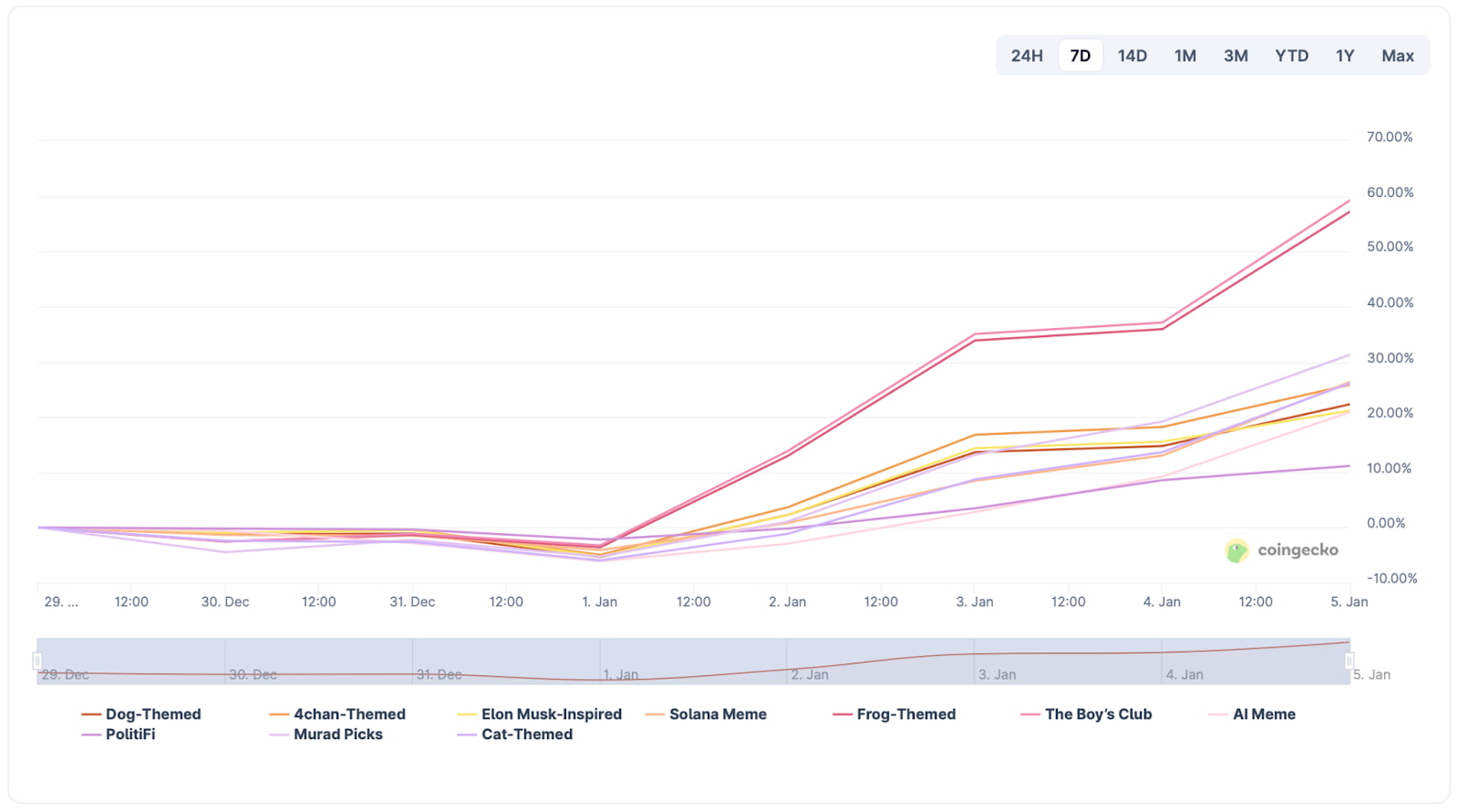
Notably, the well-known X personality Roaring Kitty recently told his 237,000 followers that past market cycles tend to be driven by a single standout meme coin that sparks wider momentum and in his view, that coin is PEPE.

Despite the strong rally, PEPE is still trading about 76% below its all-time high, leaving room for investors aiming to benefit from a potential full rebound. That said, participation is no longer confined to traditional spot purchases alone.

PepeNode connects speculation with entertainment by allowing players to earn PEPE through a virtual strategy-based game. Drawing on the engaging management style of Zoo Tycoon and the industrial depth of Factorio, the project gives users a new way to access a leading meme coin while delivering gameplay that appeals to crypto-native audiences and stands on its own as an enjoyable experience.

PepeNode: Powering the Next Phase of Meme Coin Mining

For newcomers, PepeNode is a virtual mining simulator that turns the technical challenges of crypto mining into an interactive, incentive-based experience. Rather than relying on the repetitive mechanics seen in older “clicker” titles, the game emphasizes strategic depth, where effective resource management directly influences the scale of token rewards players can earn.

At launch, each player begins with an empty server room, providing a blank slate to build a mining operation from the ground up. Presale participants gain an early advantage by being able to immediately use their discounted PEPENODE tokens to buy nodes, expand infrastructure, and unlock essential upgrades. The gameplay closely reflects real-world mining operations, requiring players to balance energy usage, optimize cooling solutions, and allocate capital wisely to keep their rigs operating at maximum efficiency.
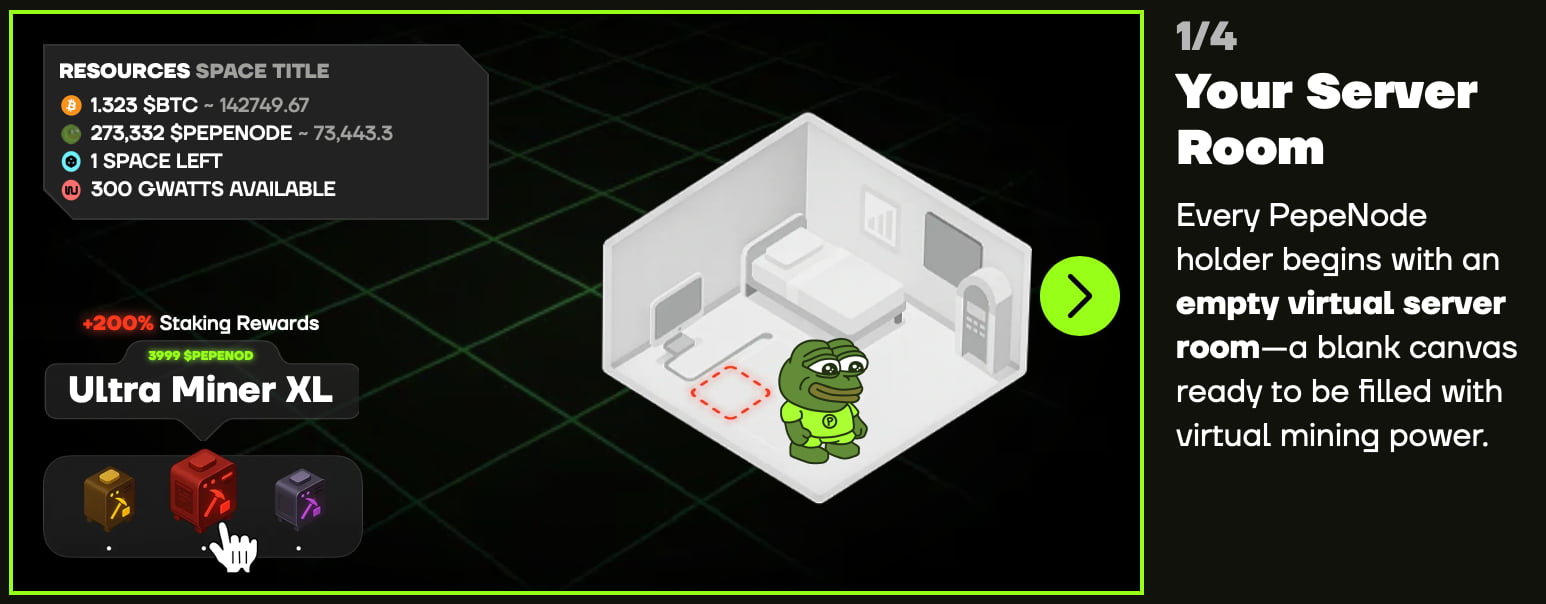
This strategy-driven design marks a clear break from the unsuccessful Play-to-Earn models of earlier cycles. Many of those games failed because they turned into tedious grinds, pushing players through repetitive actions purely to extract rewards. PepeNode takes a different path by targeting strategy enthusiasts and fans of industrial simulation games, putting real enjoyment and thoughtful gameplay ahead of monotonous labor.

Outside of gameplay, the project also tackles long-term sustainability through a carefully structured tokenomic model. To avoid the inflation issues that plagued earlier crypto games, PepeNode introduces a permanent burn mechanism: 70% of all tokens spent on in-game upgrades are removed from circulation forever. This substantial token sink is intended to create deflationary pressure over time, potentially supporting value growth as the player base expands.

Crucially, PepeNode is not built around the idea that cashing out is the sole objective. By offering high-tier rewards such as the ability to earn PEPE and FARTCOIN directly the game encourages players to keep their PEPENODE tokens within the ecosystem, reinvesting them to enhance mining efficiency and overall performance.

If PEPE is truly positioned to spearhead the 2026 bull run, mastering virtual mining through PepeNode may be one of the most effective ways to accumulate it.

Only 3 Days Left to Join the PepeNode Presale Here’s How

Participants can connect through their preferred wallet, including Best Wallet, which has received multiple reviews naming it among the leading crypto and Bitcoin wallets available. PepeNode is also featured on Best Wallet’s Upcoming Tokens discovery tool, allowing users to buy, monitor, and later claim their tokens once trading goes live.

For added reassurance, PepeNode’s smart contract has undergone an audit by Coinsult, providing early supporters with greater confidence in the project’s code security.

To stay informed about upcoming developments especially details surrounding the token generation event (TGE) users are encouraged to follow PepeNode on X and Telegram.

Visit PepeNode.

Trending Cryptos

Related Questions

QWhat is the total market value of meme coins as mentioned in the article, and which data provider is cited?

AThe total market value of meme coins is $51 billion, as cited by data from CoinGecko.

QWhat is the name of the first mine-to-earn initiative in the crypto space and how much funding has it secured?

AThe first mine-to-earn initiative is called PepeNode (PEPENODE), and it has secured over $2.5 million in funding.

QWhich meme coin experienced a 64% surge, and who is the influential X personality that endorsed it as the driver of the bull run?

APEPE experienced a 64% surge, and it was endorsed by the influential X personality Roaring Kitty.

QHow does PepeNode's tokenomic model address long-term sustainability, and what percentage of tokens spent on upgrades are burned?

APepeNode introduces a permanent burn mechanism where 70% of all tokens spent on in-game upgrades are removed from circulation forever to create deflationary pressure.

QWhat is the current presale price of PEPENODE and how much time is left before the presale ends?

AThe current presale price of PEPENODE is $0.0012161, and there are only 72 hours (3 days) left before the presale ends.

Related Reads

Agent Race Ends, Super Workbench Takes Over

The era of fragmented AI agents is ending. Over the past month, China's tech giants—Tencent, Alibaba, and ByteDance—have simultaneously shifted strategy: instead of launching new, standalone AI agents, they are consolidating their various agent projects into unified "super workbenches." Tencent integrated its QClaw teams into WorkBuddy, a strategic product hailed as a potential third flagship after QQ and WeChat. Alibaba is merging its QoderWork, Wukong, and MuleRun agents into a new "Qianwen Office" platform under DingTalk's leadership. ByteDance rebranded its TRAE SOLO coding agent to TRAE Work, signaling a broader focus on workflow collaboration. This convergence marks a pivotal industry consensus. The initial exploration phase, where companies rapidly built numerous overlapping agents for different scenarios, proved costly and inefficient. With open-source tools eroding technical barriers, competition has shifted from agent creation to resource consolidation and cost control. Historically, platform wars are won not by creating more products, but by simplifying them—as seen with browsers unifying web access and super-apps consolidating services. Now, the "super workbench" aims to become the unified AI entry point for work. This reflects a deeper market realization: the primary audience for AI is no longer just programmers (a market in the tens of millions) but all knowledge workers (a market of billions). The real opportunity lies in augmenting everyday tasks—managing emails, documents, data, and meetings—across the entire workday. The core battleground is becoming control over the primary AI entry point that employees use daily. Tencent's WorkBuddy leverages WeChat and Tencent Docs; Alibaba's Qianwen Office taps into DingTalk's organizational data; ByteDance's TRAE Work integrates with Feishu's workflows. Whoever owns this "super workbench" gains strategic control over orchestrating enterprise data and APIs. This shift is redefining enterprise software. Traditional SaaS applications, valued for their user interfaces, will recede into the background. Their core functionalities will be exposed as standardized "Skills" or APIs for the super workbench's agents to invoke. Software value will shift from selling user seats to charging based on API calls and outcomes delivered. The evolution of agents is moving through clear stages: first as novel standalone products, then as consolidated primary work entry points, and finally as pervasive, invisible capabilities embedded into the digital fabric. The recent moves by major tech firms signal the transition from the first stage into the second, accelerating toward the third. In the end, the most successful agent technology may become invisible—like electricity or the HTTP protocol—a fundamental, unnamed infrastructure powering work itself.

marsbit18m ago

Agent Race Ends, Super Workbench Takes Over

marsbit18m ago

Michael Saylor: 110 Reasons to Oppose BIP-110

Michael Saylor presents 110 arguments against Bitcoin Improvement Proposal (BIP) 110, a soft fork aimed at restricting certain non-monetary data storage uses (like inscriptions) on the Bitcoin blockchain. He acknowledges the proponents' valid concerns—such as node costs, fee pressure, and preserving Bitcoin's monetary focus—but fundamentally disagrees with the proposed solution. Saylor argues that BIP 110 represents a dangerous precedent of using consensus rules to enforce value judgments on transaction validity, moving away from Bitcoin's core principles of neutrality and permissionless innovation. His key objections are organized into eleven categories: 1) It violates neutrality and hard consensus by banning currently valid transactions. 2) It fails to meet the high burden of proof required for a consensus change, lacking concrete data on the alleged crisis. 3) Its seven bundled technical restrictions are overly broad, targeting generic script functionalities and blocking future upgrade paths. 4) It sacrifices compatibility and future optionality by closing off designed upgrade hooks. 5) Its temporary rules add significant complexity (grandfathering, expiry states) without sufficient justification. 6) The economic and security impacts, particularly on miner revenue and fee markets, are uncertain and unmodeled. 7) Superior, market-based tools (fee markets, relay/mining policies) already exist to manage blockchain load. 8) It stifles innovation by creating a chilling effect for developers. 9) Its modified activation mechanism (55% threshold, forced signaling) is aggressive and risks network splits. 10) The precedent it sets—using consensus to suppress disliked but legal uses—is more dangerous than the problem it aims to solve. 11) A better path exists: improving measurements, refining resource-based policies, and allowing market forces to work. Saylor concludes that Bitcoin's strength lies in its neutral rules, open markets, and hard consensus. Changing these foundational elements to target specific use cases is an unnecessary and risky "iatrogenic" intervention. He advocates for guarding Bitcoin's neutrality rather than acting as its redeemer.

marsbit34m ago

Michael Saylor: 110 Reasons to Oppose BIP-110

marsbit34m ago

Trading

Spot

Hot Articles

Discussions

Welcome to the HTX Community. Here, you can stay informed about the latest platform developments and gain access to professional market insights. Users' opinions on the price of MEME (MEME) are presented below.

活动图片