Luo Yonghao, Who Made 30 Times on Bitcoin: His Entangled Past with the Crypto World

marsbitPublished on 2026-05-20Last updated on 2026-05-20

Abstract

After a six-year hiatus, Luo Yonghao has returned to X (formerly Twitter) on a revived old account, wading back into the Web3 and crypto conversation hub. His return has quickly involved exchanges with crypto figures, including warnings against scams using his name. Luo has a long history with the space, stating he once earned over 30 times his initial investment on a 1 million RMB Bitcoin purchase during the 2017/18 bull run. He also co-founded a company with Bitcoin influencer Li Xiaolai, exiting his stake before the project suffered a major hack in 2023. Publicly, Luo has expressed belief in blockchain technology's potential and once claimed plans for a blockchain phone, while simultaneously distancing himself from ICOs and day trading. In 2019, during his company's financial troubles, he rejected public job offers from crypto entrepreneurs like Justin Sun and OKEx's Xu Kun, stating he had no plans to launch a token. Now back on X, Luo's renewed presence in the Web3-dominated platform hints at further inevitable engagement with the volatile crypto industry, raising questions about what new chapters his story might hold.

Author: Eric, Foresight News

Luo Yonghao returns to X after a 6-year hiatus.

At 13:00 Beijing Time on May 13, Luo Yonghao posted "Testing" simultaneously on both his old and new X accounts, announcing his comeback.

Updates on Luo Yonghao's new X account stopped in June 2020. This time, he is reviving his old account after "suddenly remembering the password in the middle of the night." The account's cover photo has been changed to the logo of his podcast "Luo Yonghao's Crossroads," and new tweets also feature some past podcast episodes.
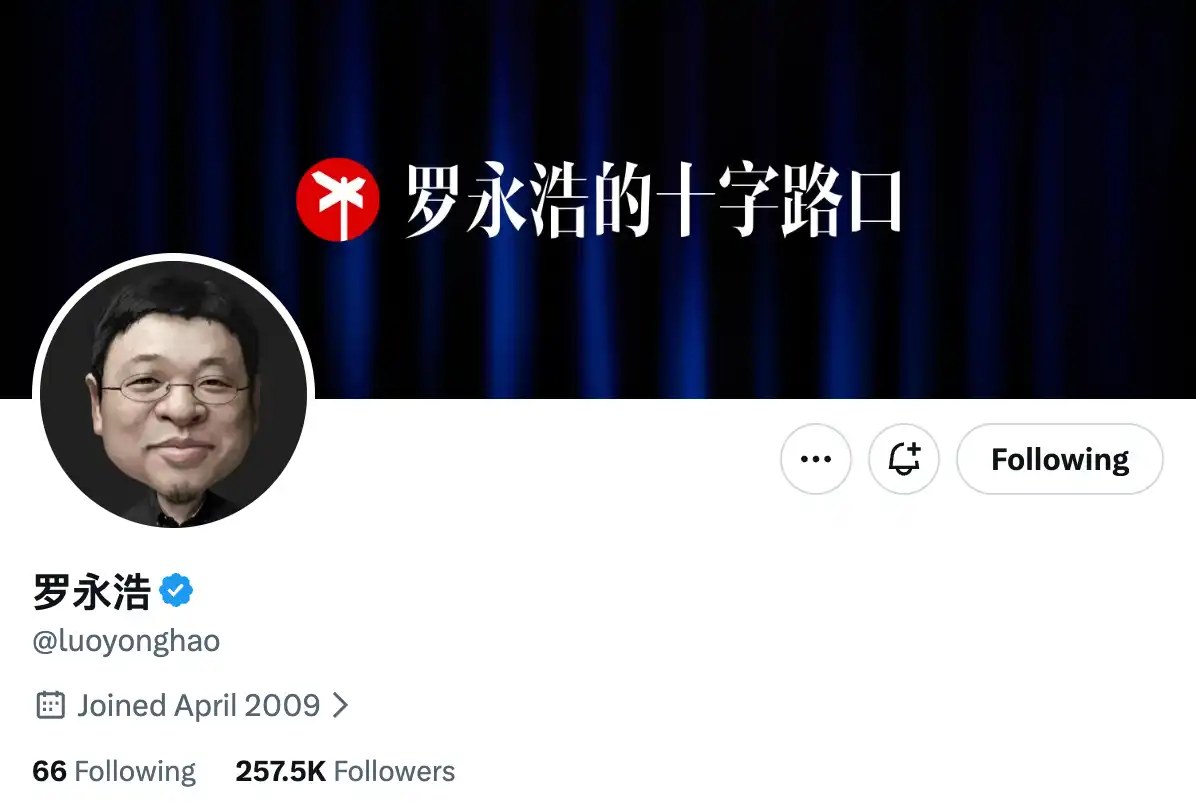
However, compared to podcasts, Luo Yonghao's own remarks are clearly more entertaining. Since the official operation of his new account, Luo has already exchanged numerous verbal jabs with "crypto folks." The pinned tweet on this account remains a reminder for everyone not to fall for cryptocurrency scams that falsely use his name.
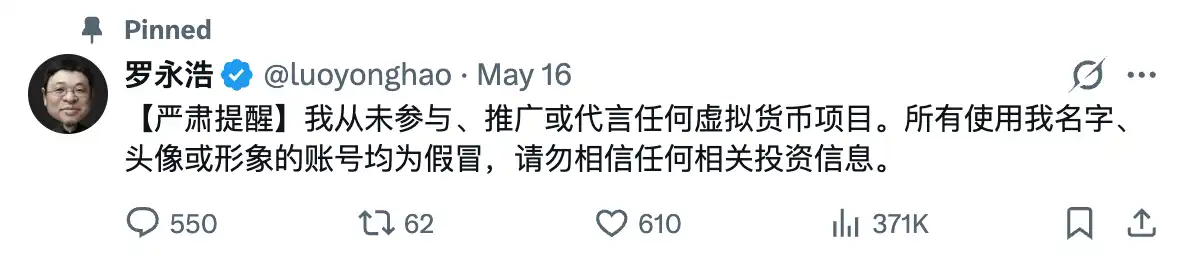
X is considered the "headquarters" of the Web3 industry, so Luo Yonghao's return inevitably involves sparring with active crypto participants. But if we talk about Luo Yonghao's connection with Web3, it might date back to 8 years ago.

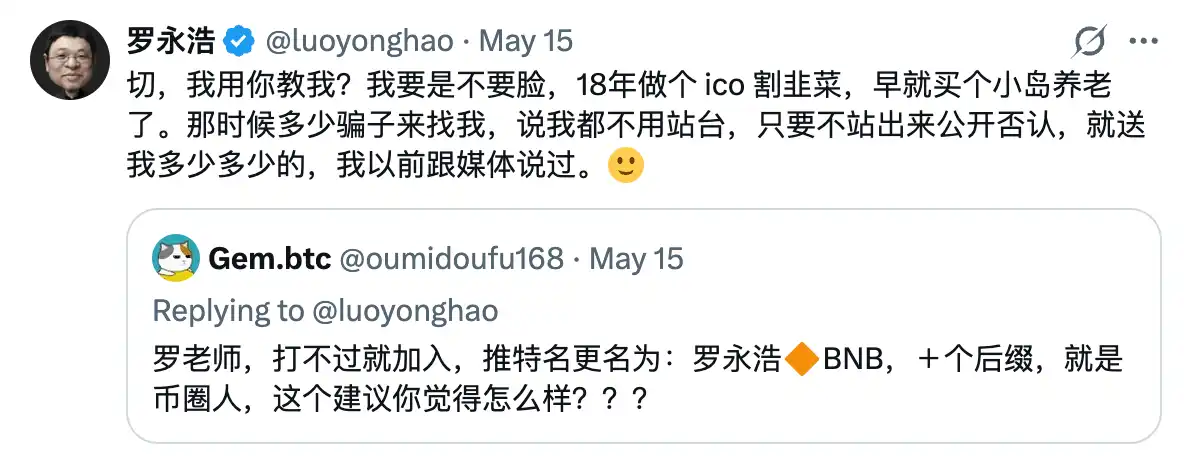
The years 2017 and 2018 were the height of the crypto "ICO frenzy" and widely recognized as the first wave of explosive wealth generation from tokens. Luo Yonghao also stated on X that if he had been shameless, the money he could have made back then would have been enough to buy an island. "How many scammers came to me back then, saying I didn't even need to endorse them, just not publicly deny it, and they would give me this much and that much."
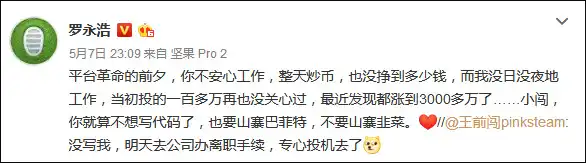
In May 2018, Luo Yonghao complained on Weibo about former front-line programmer Wang Qianchuang from Smartisan, saying he was "not focusing on work, trading cryptocurrencies all day, and hadn't made much money." Luo also mentioned that he had invested over 1 million yuan in Bitcoin earlier, which had grown to over 30 million yuan by the time of his post. According to Guancha.cn's report, Wang Qianchuang's obsession with crypto trading caused Luo Yonghao's dissatisfaction, leading to such remarks.
This was the first time Luo Yonghao publicly mentioned cryptocurrency-related content on social media, but his earliest public expression of views on blockchain was in late May 2018 during the "Wang Feng's Ten Questions" event.

During that event, Luo stated his firm belief that blockchain technology could change the world and that Smartisan had been actively researching and learning about related applications. When asked about blockchain phones, Luo Yonghao was even more direct: "A blockchain phone will definitely be made, but the details are not convenient to disclose yet."

Additionally, Luo Yonghao revealed that in the early days of Smartisan, he "followed friends' hype" and invested 1 million yuan in Bitcoin, which later grew to over 30 million. "I don't like speculative business, so I won't spend energy trading coins. Before the country's relevant policies are formally introduced, I won't consider doing an ICO either."

It is widely speculated that the "friend" Luo referred to is likely Li Xiaolai, who was also an English teacher at New Oriental early on alongside Luo and later became famous overnight in 2017 due to Bitcoin. According to public information, Luo Yonghao joined the shareholder lineup of Figerman (Beijing) Technology Co., Ltd., a company affiliated with Mixin, in 2016. Besides founder Feng Xiaodong, the other shareholder of this company was Luo's good friend Li Xiaolai.

In February 2023, Luo Yonghao withdrew from the shareholder lineup. In September of the same year, Mixin was hacked, with losses reaching $200 million. Achieving a 30x return on Bitcoin and exiting the project before it was attacked, Luo Yonghao's investment in the Web3 industry can be considered quite successful.

While successful in his Bitcoin investment, Luo Yonghao's company operations were less smooth. In the same year he participated in "Wang Feng's Ten Questions," Smartisan was reported to have a broken capital chain, owed supplier payments, and faced continuous layoffs and disputes. The situation did not improve the following year. In November 2019, Luo Yonghao posted on Weibo saying he had been placed on a court-ordered list of high-spending restrictions and published an article titled "A 'Deadbeat' CEO's Confession."

At that time, online discussions about Luo Yonghao were intense, and crypto influencers on Weibo were not about to let this wave of traffic pass.

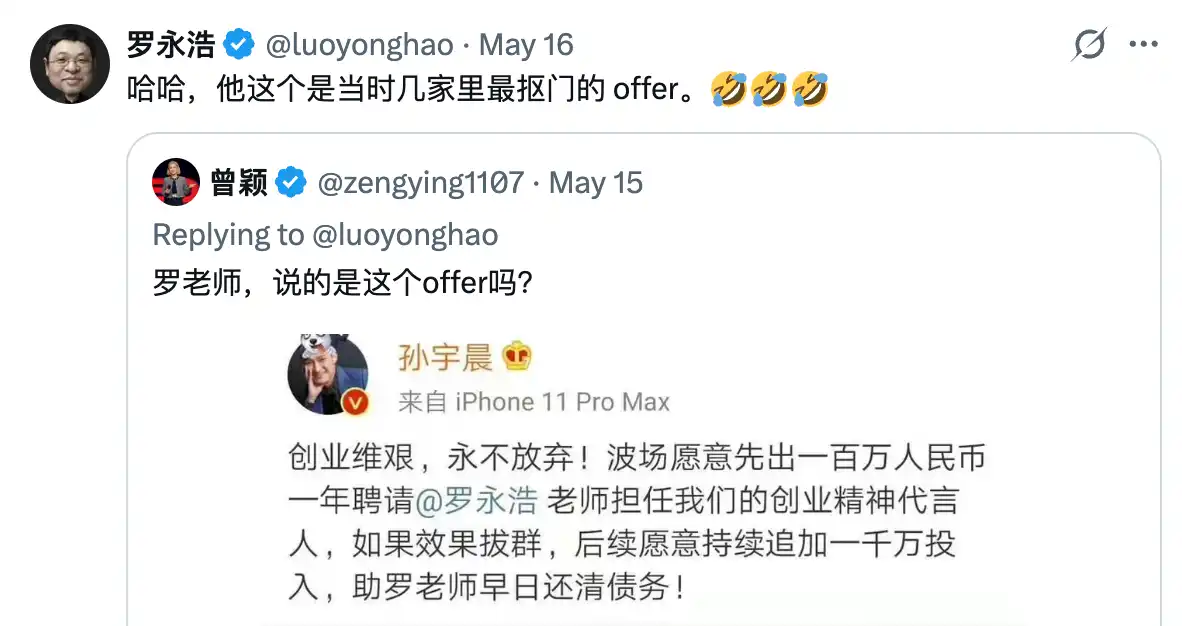
Sun Yuchen was the first to "strike," offering Luo Yonghao an annual salary of one million yuan to serve as the entrepreneurial spirit spokesperson for Tron, promising an additional investment of 10 million yuan if the effect was good. A few days ago, Luo Yonghao stated on X that among the several offers extended, Sun Yuchen's was the "most stingy."
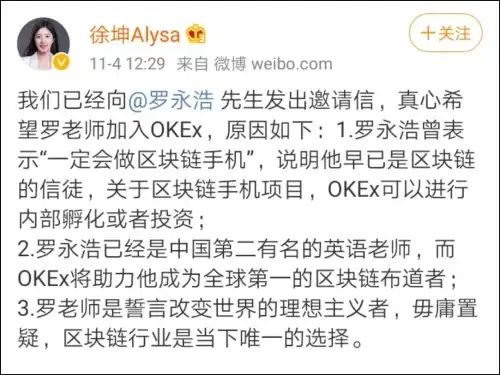
At that time, Xu Kun, Chief Strategy Officer of OKEx, also posted on Weibo expressing hope to invite Luo Yonghao to join OKEx.
Facing these invitations, Luo Yonghao responded in the early hours: "Thank you, friends in the crypto circle, for thinking highly of me, but I know how to issue tokens myself. I just don't plan to do it. Regardless, thank you for your kindness."

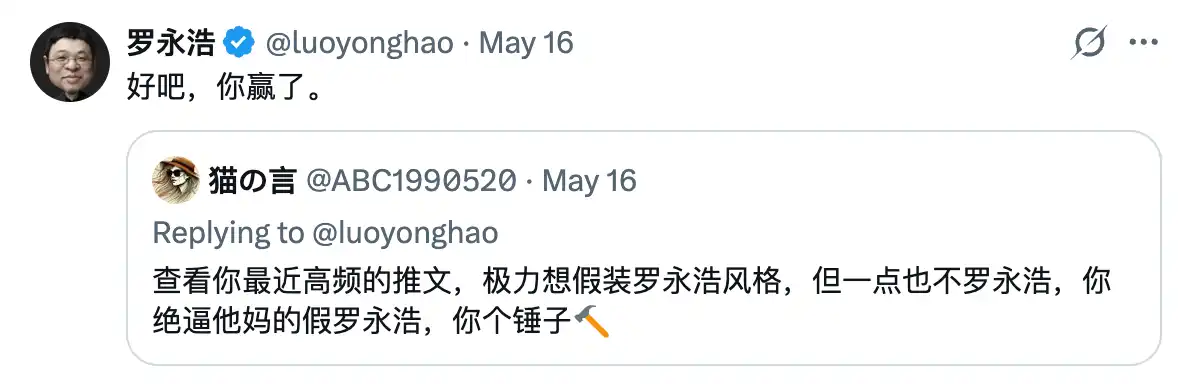
Over six years after his last "zero-distance contact" with the crypto world, our "Old Luo" has returned to the former Twitter. Faced with this familiar yet unfamiliar environment, his statements have even led many to suspect that the person behind this account is not Luo Yonghao himself. Many people's impression of Old Luo may still be of his former unrestrained and confrontational style, but perhaps time has tempered Luo Yonghao's demeanor somewhat. Just like the crypto world of 2017 and the Web3 of 2026, they are completely worlds apart.
Regardless, on the X platform, Luo Yonghao will inevitably face the surrealism of the crypto world in the future. How will the always fiercely principled Old Luo, after an absence from Web3 for nearly 7 years, create new stories with this industry he once had a love-hate relationship with? We can all look forward to it together.


Related Questions

QWhat is Luo Yonghao's past experience with cryptocurrency, specifically Bitcoin, according to the article?

AHe invested over 1 million RMB in Bitcoin early on, which grew to over 30 million RMB, representing a 30x return. He also co-founded a company connected to the Web3 project Mixin but exited before a major hack.

QWhy did Luo Yonghao recently return to X (formerly Twitter), and what is his initial activity there related to the crypto space?

AHe returned to his old X account after 6 years. His initial activity included warning his followers about cryptocurrency scams falsely using his name, which became his pinned post.

QWho is suggested in the article as the 'friend' likely behind Luo Yonghao's early Bitcoin investment?

AThe article suggests it was likely Li Xiaolai, a former English teacher colleague from New Oriental who became famous for Bitcoin and was a co-shareholder with Luo in a company linked to Mixin.

QWhat happened to Luo Yonghao's company, Smartisan, around the time of his public discussions about blockchain in 2018-2019?

ASmartisan faced severe financial difficulties, including a broken capital chain, unpaid supplier debts, layoffs, and legal disputes. By late 2019, Luo was placed on a court-ordered list of debtors restricting high consumption.

QHow did prominent figures in the crypto industry react when Luo Yonghao faced business troubles in 2019?

AFigures like Sun Yuchen (offering a spokesperson role for Tron) and Xu Kun from OKEx publicly extended job offers to Luo Yonghao, attempting to recruit him into the crypto industry during his company's crisis.

Related Reads

Anthropic Cries Wolf: Is the AGI Threat Real, or Just an IPO Story?

Anthropic has published an article titled "When AI builds itself," discussing the emerging concept of "recursive self-improvement," where AI begins to actively participate in designing, training, testing, and optimizing its own subsequent versions. The company presents internal data showing that by May 2026, over 80% of code merged into its codebase was written by Claude, its AI model. Claude's capabilities have expanded to handling complex, open-ended engineering tasks, achieving a 76% success rate in such areas, and even contributing to research processes, such as optimizing code performance and conducting AI safety experiments. Anthropic outlines an evolution from human-driven development to AI-assisted workflows, culminating in the current stage where AI agents can autonomously write, run, and delegate code. The company cautions that the path toward a "closed loop," where AI continuously improves itself, is becoming visible. It calls for coordinated global mechanisms to potentially slow or pause frontier AI development to allow safety research and societal structures to catch up. However, the timing of this warning coincides with Anthropic's preparations for an IPO, framing the narrative not just as a safety concern but also as a demonstration of Claude's advanced capabilities and its integral role in accelerating Anthropic's own R&D—creating a potential "flywheel" effect for competitive advantage. This contrasts with OpenAI's recent, more policy-oriented discussion of the same risks, highlighting the competitive dynamics in the AI industry as companies position themselves in both the technological and regulatory landscape.

marsbit21m ago

Anthropic Cries Wolf: Is the AGI Threat Real, or Just an IPO Story?

marsbit21m ago

BIT Research: ETF Purchases Have Slowed, Strategy (MicroStrategy) Has Slowed, What Else Can Drive Bitcoin's Rise?

Market Refocus on Inflation and Rate Expectations Weighs on Bitcoin Currently, the market is in a phase of macro-repricing dominated by inflation and interest rate expectations. Bitcoin, which previously benefited from easy liquidity and low inflation, is seeing its core bullish drivers weaken. These drivers were market expectations for interest rate cuts and strong inflows from Bitcoin ETFs and institutions like MicroStrategy (referred to as "Strategy" in the text). The logic has shifted. Recent high inflation data (e.g., CPI hitting 3.8% in a May 2026 report) has caused the market to sharply reduce its rate cut expectations for 2025 and even price in potential hikes. This is a key constraint for Bitcoin, as it lacks cash flows and is highly sensitive to rate expectations. Concurrently, institutional capital flows have slowed significantly. Following the hot CPI data, Bitcoin ETFs saw accelerated outflows, with around $4.3 billion leaving over a period. MicroStrategy's ability to keep adding substantial Bitcoin to its balance sheet is also diminishing. Together, ETF and MicroStrategy holdings total roughly $110 billion, but their momentum as growth engines is cooling. In summary, Bitcoin's current pressure stems not from its own fundamentals but from a changing macro environment. As long as inflation stays elevated, Bitcoin is likely to remain in a consolidating phase. However, historically, inflation eventually peaks. Once it recedes and rate cut expectations rebuild, institutional capital could return, potentially fueling a new and more robust recovery phase for Bitcoin.

marsbit28m ago

BIT Research: ETF Purchases Have Slowed, Strategy (MicroStrategy) Has Slowed, What Else Can Drive Bitcoin's Rise?

marsbit28m ago

Earning 1000 Trillion in Half a Year, 'Pocketing' 20 Million per Capita: This Round of Wealth Creation in the Korean Stock Market is Unprecedented in Scale

The South Korean stock market is experiencing an unprecedented wealth surge in 2026, with household equity and fund asset values soaring by over 1,000 trillion KRW (~$730bn) year-to-date. This translates to an average per capita wealth increase of roughly 20 million KRW, fueled by a historic 109% rally in the KOSPI index. The boom is driven by three converging forces: an AI-driven semiconductor supercycle boosting giants like Samsung and SK Hynix; the government's "Value-Up" market reforms addressing long-standing corporate governance issues; and aggressive real estate regulations that have locked capital within financial markets, preventing profits from flowing back into property. This has triggered a wealth effect, boosting high-end consumption significantly. However, the gains are highly concentrated. The two semiconductor behemoths account for over half the index's value, but retail investors own relatively low stakes in them, systematically missing the biggest rallies. Wealth and consumption benefits are skewed towards luxury goods and imported cars, bypassing mainstream retail. Further risks stem from excessive leverage, with high trading volume in leveraged ETFs, and a market sentiment heavily reliant on the AI sector's fortunes and speculative rumors. While this cycle marks a potential shift from real estate to equities as a primary wealth generator for Koreans, its sustainability, amid structural imbalances and leverage, remains a critical test.

marsbit33m ago

Earning 1000 Trillion in Half a Year, 'Pocketing' 20 Million per Capita: This Round of Wealth Creation in the Korean Stock Market is Unprecedented in Scale

marsbit33m ago

Trading

Spot
Futures

Hot Articles

What is $BITCOIN

DIGITAL GOLD ($BITCOIN): A Comprehensive Analysis Introduction to DIGITAL GOLD ($BITCOIN) DIGITAL GOLD ($BITCOIN) is a blockchain-based project operating on the Solana network, which aims to combine the characteristics of traditional precious metals with the innovation of decentralized technologies. While it shares a name with Bitcoin, often referred to as “digital gold” due to its perception as a store of value, DIGITAL GOLD is a separate token designed to create a unique ecosystem within the Web3 landscape. Its goal is to position itself as a viable alternative digital asset, although specifics regarding its applications and functionalities are still developing. What is DIGITAL GOLD ($BITCOIN)? DIGITAL GOLD ($BITCOIN) is a cryptocurrency token explicitly designed for use on the Solana blockchain. In contrast to Bitcoin, which provides a widely recognized value storage role, this token appears to focus on broader applications and characteristics. Notable aspects include: Blockchain Infrastructure: The token is built on the Solana blockchain, known for its capacity to handle high-speed and low-cost transactions. Supply Dynamics: DIGITAL GOLD has a maximum supply capped at 100 quadrillion tokens (100P $BITCOIN), although details regarding its circulating supply are currently undisclosed. Utility: While precise functionalities are not explicitly outlined, there are indications that the token could be utilized for various applications, potentially involving decentralized applications (dApps) or asset tokenization strategies. Who is the Creator of DIGITAL GOLD ($BITCOIN)? At present, the identity of the creators and development team behind DIGITAL GOLD ($BITCOIN) remains unknown. This situation is typical among many innovative projects within the blockchain space, particularly those aligning with decentralized finance and meme coin phenomena. While such anonymity may foster a community-driven culture, it intensifies concerns about governance and accountability. Who are the Investors of DIGITAL GOLD ($BITCOIN)? The available information indicates that DIGITAL GOLD ($BITCOIN) does not have any known institutional backers or prominent venture capital investments. The project seems to operate on a peer-to-peer model focused on community support and adoption rather than traditional funding routes. Its activity and liquidity are primarily situated on decentralized exchanges (DEXs), such as PumpSwap, rather than established centralized trading platforms, further highlighting its grassroots approach. How DIGITAL GOLD ($BITCOIN) Works The operational mechanics of DIGITAL GOLD ($BITCOIN) can be elaborated on based on its blockchain design and network attributes: Consensus Mechanism: By leveraging Solana’s unique proof-of-history (PoH) combined with a proof-of-stake (PoS) model, the project ensures efficient transaction validation contributing to the network's high performance. Tokenomics: While specific deflationary mechanisms have not been extensively detailed, the vast maximum token supply implies that it may cater to microtransactions or niche use cases that are still to be defined. Interoperability: There exists the potential for integration with Solana’s broader ecosystem, including various decentralized finance (DeFi) platforms. However, the details regarding specific integrations remain unspecified. Timeline of Key Events Here is a timeline that highlights significant milestones concerning DIGITAL GOLD ($BITCOIN): 2023: The initial deployment of the token occurs on the Solana blockchain, marked by its contract address. 2024: DIGITAL GOLD gains visibility as it becomes available for trading on decentralized exchanges like PumpSwap, allowing users to trade it against SOL. 2025: The project witnesses sporadic trading activity and potential interest in community-led engagements, although no noteworthy partnerships or technical advancements have been documented as of yet. Critical Analysis Strengths Scalability: The underlying Solana infrastructure supports high transaction volumes, which could enhance the utility of $BITCOIN in various transaction scenarios. Accessibility: The potential low trading price per token could attract retail investors, facilitating wider participation due to fractional ownership opportunities. Risks Lack of Transparency: The absence of publicly known backers, developers, or an audit process may yield skepticism regarding the project's sustainability and trustworthiness. Market Volatility: The trading activity is heavily reliant on speculative behavior, which can result in significant price volatility and uncertainty for investors. Conclusion DIGITAL GOLD ($BITCOIN) emerges as an intriguing yet ambiguous project within the rapidly evolving Solana ecosystem. While it attempts to leverage the “digital gold” narrative, its departure from Bitcoin's established role as a store of value underscores the need for a clearer differentiation of its intended utility and governance structure. Future acceptance and adoption will likely depend on addressing the current opacity and defining its operational and economic strategies more explicitly. Note: This report encompasses synthesised information available as of October 2023, and developments may have transpired beyond the research period.

363 Total ViewsPublished 2025.05.13Updated 2025.05.13

What is $BITCOIN

Discussions

Welcome to the HTX Community. Here, you can stay informed about the latest platform developments and gain access to professional market insights. Users' opinions on the price of BTC (BTC) are presented below.

活动图片














