Loss-Making XRP Supply Surges As Market Struggles To Find Support

bitcoinistPublished on 2026-03-11Last updated on 2026-03-11

Abstract

XRP is experiencing significant bearish pressure, with its price remaining below $2. A notable 60% of its circulating supply, approximately 36.8 billion XRP, is currently held at a loss—a higher percentage than during major past crises like the COVID period, the China ban, or the FTX collapse. This indicates weakened bullish activity and growing investor uncertainty. Despite this, exchange reserves of XRP have decreased by over 3 billion tokens, suggesting a potential supply squeeze. Technically, XRP is positioned between key liquidity clusters, and a decisive price move could trigger increased volatility and possible liquidations. The token traded at $1.39 at the time of reporting.

XRP briefly surged on Monday as the day drew to a close, but the leading altcoin is still heavily feeling the ongoing bearish pressure across the broader cryptocurrency market. During this highly volatile period, the level of supply sitting in a loss is growing rapidly, indicating a change in market dynamics.

XRP Share Of Supply In Loss Spikes

With the bearish side taking control of the market, XRP continues to face mounting pressure, keeping its price stuck below the $2 mark. A clear indication of the mounting pressure is the growing portion of XRP’s circulating supply slipping into the loss territory, which underscores the market strain on the altcoin.

Steph is Crypto, an investor and strategist, shared this development on X using data from Glassnode, a popular on-chain data analytics platform. After the expert’s examination of the chart, he reported that approximately 36.8 billion XRP are currently in loss amid recent price weakness.

This massive figure suggests that nearly 60% of the altcoin’s entire supply in circulation is underwater, demonstrating the lack of bullish activity. With more holders now sitting on notable unrealized losses, market sentiment is being shaped by broader uncertainty. Furthermore, this spike in loss-making supply typically indicates a pivotal stage in market cycles, when investor confidence is put to the test and volatility tends to rise.
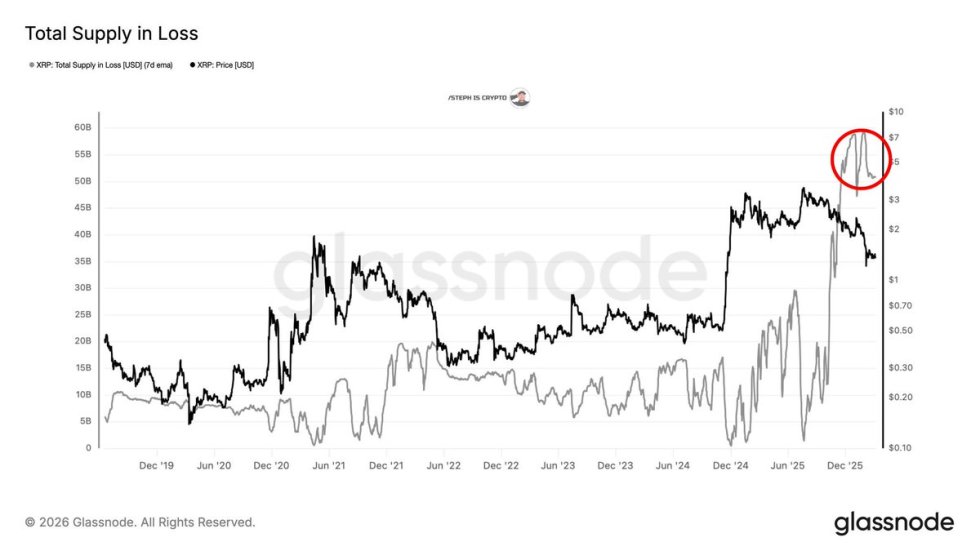
Source: Chart from Steph is Crypto on X

When compared to highly bearish periods in past market cycles, this percentage of supply in loss appears to be quite higher. According to the expert, the current figure is more than the one seen during the COVID period, the China Ban, and the collapse of the FTX cryptocurrency exchange in 2022.

Nonetheless, with XRP trying to stabilize while a larger portion of its supply is still underwater, the present situation might lead to additional downward pressure or pave the way for a possible recovery when market dynamics eventually change.

Despite XRP’s share of supply in loss spiking, investors’ activity on cryptocurrency exchanges is painting a different picture of the market. More tokens have been leaving these centralized trading platforms at a significant and rapid rate.

X Finance Bull highlighted that XRP’s reserves on exchanges are shrinking, as the total balance fell by over 3 billion XRP, underscoring a major supply shift. Prior data shows that shrinking exchanges’ supply often leads to the tightening of the market, especially if buyers step in.

Major Liquidity Clusters Are Appearing

After weeks of sideways performance, Xaif Crypto, a technical analyst, has delved into XRP’s liquidity heat map, revealing that the altcoin is at a crucial moment. Currently, the token is sitting between major liquidity clusters on both sides. At this point, the next decisive move could be triggered.

Xaif Crypto stated that a move into the upper zone might trigger liquidations and a fast parabolic squeeze. Volatility is growing because price action usually becomes highly sensitive to shifts in momentum as traders try to move the market toward one of the order books.

XRP trading at $1.39 on the 1D chart | Source: XRPUSDT on Tradingview.com

Trending Cryptos

Related Questions

QWhat percentage of XRP's circulating supply is currently in loss, according to the data from Glassnode?

AApproximately 60% of XRP's entire circulating supply is currently in loss.

QHow does the current level of XRP supply in loss compare to previous major bearish events like the COVID period or the FTX collapse?

AThe current percentage of XRP supply in loss is higher than the levels seen during the COVID period, the China Ban, and the collapse of the FTX exchange.

QWhat is the significance of XRP reserves on centralized exchanges, as highlighted by X Finance Bull?

AXRP reserves on exchanges are shrinking, with the total balance falling by over 3 billion XRP, which indicates a major supply shift and can lead to market tightening if buyers step in.

QAccording to the technical analyst Xaif Crypto, why is XRP at a crucial moment based on its liquidity heat map?

AXRP is sitting between major liquidity clusters on both sides, and the next decisive move could be triggered as price action becomes highly sensitive to shifts in momentum.

QWhat are the two potential outcomes for XRP's price as suggested by the article, given the current market dynamics?

AThe current situation might lead to additional downward pressure or pave the way for a possible recovery when market dynamics eventually change.

Related Reads

Annual Salary of Millions Competing for Electricians, Meta Rushes to Open Its Own Technical School

The AI boom is facing an unexpected bottleneck: a severe shortage of skilled construction workers and electricians. As tech giants like Meta, OpenAI, and Alphabet race to build massive data centers—such as OpenAI's $16 billion "Stargate" project—they are hitting a critical labor wall. The U.S. needs an estimated 130,000 more electricians, 240,000 construction workers, and 150,000 supervisors by 2030 for AI infrastructure alone, but tens of thousands of electrician jobs go unfilled each year. While AI companies offer high premiums, with electricians earning up to $280,000 annually, worker scarcity still causes massive losses—delays on a single project can cost $14.2 million per month. The complexity of building AI data centers, which require immense power (equivalent to powering hundreds of thousands of homes), sophisticated electrical systems, and advanced liquid cooling solutions, demands highly skilled technicians who are in short supply. To combat this, companies are investing heavily in training. Meta has committed $115 million to a free training school offering tuition, housing, and stipends, targeting 5,000 new workers. OpenAI is partnering with unions to secure skilled labor. These efforts are paying off, with a significant rise in Gen Z interest in trade schools over college. However, the power demands are staggering. AI data centers are driving a rapid surge in electricity consumption, projected to account for up to 12% of U.S. power use by 2028 and raising costs for consumers. Furthermore, the construction boom is project-based, leading to a potential future glut of trained workers once building peaks, which could depress wages industry-wide. The race for AI supremacy now depends as much on skilled hands as on advanced chips.

marsbit22m ago

Annual Salary of Millions Competing for Electricians, Meta Rushes to Open Its Own Technical School

marsbit22m ago

OpenAI No Longer Sells Its Most Expensive Model for Profit

OpenAI is shifting its business strategy away from promoting its most expensive, flagship models for every task. Recent price cuts—80% for GPT-5.6 Luna and 20% for Terra—signal a deeper change: the company now actively advises users that many tasks don't require the most powerful model. Instead, OpenAI recommends a tiered approach: use the high-end GPT-5.6 Sol for complex planning and analysis, then delegate execution to cheaper models like Luna. This mirrors moves by Anthropic, which recently launched Claude Opus 5 at half the price of its top model, Fable 5. Both companies are de-emphasizing flagship models as primary revenue drivers, using them instead for brand prestige and technological showcases. The industry is entering a "mass-market" phase, similar to automotive, where high-volume, cost-effective models handle daily operations and drive scale. OpenAI's price reductions are partly enabled by AI models themselves optimizing underlying code and infrastructure, creating a self-reinforcing cycle of efficiency gains and cost reduction. Competition is shifting from "who is smartest" to "who offers the best value." The goal is no longer selling individual models but fostering widespread API adoption and ecosystem lock-in. By making AI calls cheap and ubiquitous, companies like OpenAI aim to become the indispensable, utility-like infrastructure powering automated workflows—the "water and electricity" of software, quietly embedded everywhere.

marsbit22m ago

OpenAI No Longer Sells Its Most Expensive Model for Profit

marsbit22m ago

Will the Fed Definitely Raise Interest Rates in September? How Will Crypto and U.S. Stocks Withstand the Pressure?

The market's expectation for a September Fed rate hike surged dramatically in early August, jumping from under 50% to over 80% within a week. This shift followed a contentious July FOMC meeting, where a 9-3 vote to hold rates revealed growing dissent from hawkish members advocating for an immediate hike to combat persistent inflation. The primary catalyst for this repricing is rising oil prices, driven by renewed geopolitical tensions around the Strait of Hormuz, which threaten global supply. Energy costs directly influence inflation metrics, making the upcoming July CPI report (due August 12th) a critical data point. If it shows inflation reaccelerating, the probability of a September hike will solidify. For Bitcoin and crypto assets, this is typically bearish news. Bitcoin continues to behave as a high-beta, liquidity-sensitive risk asset. A rate hike raises the opportunity cost of holding non-yielding assets and could drive capital toward money markets, pressuring crypto prices in the short term. However, historical patterns suggest that if a hike is perceived as the end of a tightening cycle rather than the start, any negative price impact may be brief. U.S. stocks, particularly crypto-linked equities like Coinbase and growth-oriented tech stocks, are also vulnerable. Higher rates increase discount rates in valuation models, putting pressure on high-multiple companies. This coincides with a pivotal tech earnings season where investor focus has shifted from massive AI capital expenditure to tangible revenue and cash flow generation. Companies with negative cash flow and weak growth narratives could face heightened volatility if borrowing costs rise in September. In summary, a September Fed hike has evolved into a mainstream market scenario. Key factors to watch are oil prices, the July CPI report, and Fed communications, which will determine the final decision and its impact on volatile crypto and equity markets.

marsbit32m ago

Will the Fed Definitely Raise Interest Rates in September? How Will Crypto and U.S. Stocks Withstand the Pressure?

marsbit32m ago

Trading

Spot

Hot Articles

What is XRP 2.0

XRP 2.0: A New Frontier in the Cryptocurrency Landscape Introduction to XRP 2.0 In the ever-evolving realm of cryptocurrency, new projects continuously emerge, vying for attention and adoption. One such promising initiative is XRP 2.0, a novel cryptocurrency project designed to leverage advanced blockchain technology and robust encryption methodologies. While the name draws parallels with Ripple’s XRP, it’s crucial to note that XRP 2.0 operates independently, focusing on enhancing transaction security, privacy, and scalability. As the digital financial landscape increasingly embraces decentralized solutions, XRP 2.0 aims to contribute meaningfully to web3 and the overall expansion of crypto projects. What is XRP 2.0? At its core, XRP 2.0 is a cryptocurrency project that aims to create a secure and decentralized digital currency ecosystem. Its foundational technology integrates sophisticated blockchain principles with cutting-edge encryption techniques. The overarching goal of XRP 2.0 is to establish itself as a reliable and efficient platform enabling swift transaction execution while prioritizing enhanced privacy protections for its users. The project is promoted as a solution to many limitations faced by existing cryptocurrencies, proposing a system that can handle a higher volume of transactions with improved speed and privacy. This versatility positions XRP 2.0 as a significant contender in a marketplace riddled with various digital currencies. Who is the Creator of XRP 2.0? The identity of the creator behind XRP 2.0 has been flagged as ‘Wilbur.’ However, comprehensive details regarding Wilbur or their associated entity remain elusive. The anonymity of many cryptocurrency creators is not an uncommon phenomenon in the industry, often designed to maintain a degree of privacy and security. Who are the Investors of XRP 2.0? As of now, specific information related to the investment foundations or organizations supporting XRP 2.0 is not publicly available. In the cryptocurrency sector, the backing by reputed investors can significantly influence a project's credibility and success, yet the transparency regarding the financial supporters of XRP 2.0 has not been established. How Does XRP 2.0 Work? XRP 2.0 stands out by employing a combination of blockchain technology and advanced encryption algorithms that ensures secure and decentralized transactions. Its innovative structure includes unique features designed to foster user engagement and broaden functionalities beyond conventional cryptocurrency transactions. Among these features, XRP 2.0 incorporates AI-powered capabilities, such as text-to-image and text-to-speech functionalities. These additions are designed to enhance the interactive experience for users, promoting broader applicability across various sectors. By bridging technological advancements with user-centered design, XRP 2.0 aims to capture the attention of a diverse range of individuals and enterprises looking to integrate cryptocurrency solutions into their operational frameworks. Timeline of XRP 2.0 Understanding XRP 2.0 requires examining the milestones that have defined its journey thus far: July 23, 2023: XRP 2.0 is introduced as a novel cryptocurrency project, aiming to revolutionize secure and decentralized transaction capabilities in the blockchain domain. September 8, 2023: The launching of another project, XRP20, occurs, marking the emergence of an ERC-20 token on the Ethereum blockchain that remains unrelated to XRP 2.0. November 13, 2023: The XRP Ledger undergoes a significant update with the release of rippled server software version 2.0.0. It is essential to note that this development is disconnected from the XRP 2.0 cryptocurrency project. Key Points About XRP 2.0 To distill the essence of XRP 2.0, several critical factors emerge: Unique Features: The inclusion of features like AI-powered text-to-image and text-to-speech further diversifies the potential applications of XRP 2.0. Blockchain Technology: The framework utilizes advanced blockchain mechanisms and encryption protocols, ensuring a secure and decentralized environment for transactions. Scalability and Privacy: XRP 2.0 prioritizes enhanced privacy protections in transaction processes and the scalability necessary to accommodate a growing user base. No Affiliation with Ripple: Importantly, despite its name, XRP 2.0 does not have any allegiance or collaboration with Ripple’s XRP, distinguishing its operational framework and objectives within the cryptocurrency ecosystem. Conclusion XRP 2.0 represents an ambitious venture into the cryptocurrency sphere, aiming to offer a combination of security, privacy, and efficiency in digital transactions. By integrating sophisticated technologies and user-friendly features, the project sets out to broaden the horizons of what cryptocurrency can achieve in today's digital economy. While the anonymity of its creator and lack of disclosed investors might raise questions for some, XRP 2.0's focus on advanced functionalities and decentralisation enhances its appeal amidst an increasingly crowded crypto market. As the cryptocurrency landscape continues to evolve, XRP 2.0 may yet emerge as a pivotal player in the expansion of secure and scalable blockchain solutions.

1.3k Total ViewsPublished 2024.04.01Updated 2024.12.03

What is XRP 2.0

Discussions

Welcome to the HTX Community. Here, you can stay informed about the latest platform developments and gain access to professional market insights. Users' opinions on the price of XRP (XRP) are presented below.

活动图片















