‘Lean Ethereum’ will not compromise security for speed, says Vitalik Buterin – Here’s how

ambcryptoPublished on 2026-03-19Last updated on 2026-03-19

Abstract

Vitalik Buterin has reaffirmed his commitment to a "lean Ethereum" roadmap, aiming to simplify the network's design without compromising security for speed. This long-term strategy intends to merge the currently separate execution and beacon clients into a unified system, enabling faster transaction settlement and allowing smartphones to function as network nodes. Buterin argues this approach will allow Ethereum to achieve speeds comparable to chains like Solana while maintaining Bitcoin-level security. The Ethereum Foundation recently released a guiding document centered on the CROPS philosophy (censorship-resistant, open source, private, secure) to preserve user freedom and ensure the network's survival even without the Foundation. Opinions on the plan are divided, with supporters seeing it as reinforcing Ethereum's leadership in decentralization, while critics worry about potential security risks. Meanwhile, ETH's price action remains heavily influenced by Bitcoin's momentum. A recent Bitcoin price drop dragged ETH down approximately 6% from nearly $2,400 to $2,200, with analysis indicating potential further declines to support levels near $2,153.

Ethereum founder Vitalik Buterin has doubled down on his calls for a simpler, more secure network.

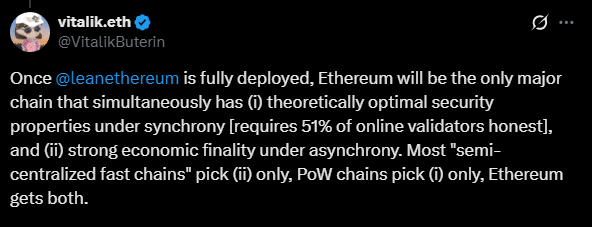
On Wednesday, the 18th of March, he reiterated that, through the ‘lean Ethereum’ plan, the chain will no longer be forced to trade between security and speed like other blockchains.

Most ‘semi-centralized fast chains’ pick (ii) only, PoW chains pick (i) only, Ethereum gets both.
Source: X/Buterin

The ‘lean Ethereum’ roadmap is an ambitious long-term strategy to simplify the network design, fast-track the settlement of transactions, and make it easier to run on simple devices like smartphones.

Eventually, Buterin wants smartphones to become the network’s new nodes.

This would mean merging the current, separately run execution and beacon clients that power the Ethereum network into a unified system. While critics had shown reservations about the vision and its inherent security risks, Buterin believes otherwise.

For him, that would be the only way to have a ‘faster’ chain like Solana while maintaining Bitcoin-like security.

But the plan goes beyond just a simplified system and advanced security.

Ethereum’s new ‘constitution’

Last week, the Ethereum Foundation unveiled a strategic document that it called ‘part manifesto, part constitution’ to guide its long-term vision and planning.

At the core of this roadmap is a new philosophy dubbed CROPS (censorship-resistant, open source, private, and secure) that will anchor all future plans and network upgrades.

The end goal is to ensure Ethereum preserves user freedom and can survive even if the Ethereum Foundation ceases to exist.

Like everything else, these updates have been met with divergent views. Supporters see it as a way to reinforce Ethereum as a leader in decentralized networks and a net positive for ETH. For critics, however, potential security risks and inconsistent roadmaps make it difficult to bet on ETH.

Only time will tell which side was right.

What’s next for ETH?

Meanwhile, Bitwise research analyst Max Shannon found that Bitcoin’s momentum drives ETH’s price moves far more than macro factors, treasury firms’ demand, or Spot ETH ETF flows.


Source: Bitwise

In fact, the recent 5% BTC price drop triggered by de-risking ahead of the Fed rate decision dragged ETH lower too.

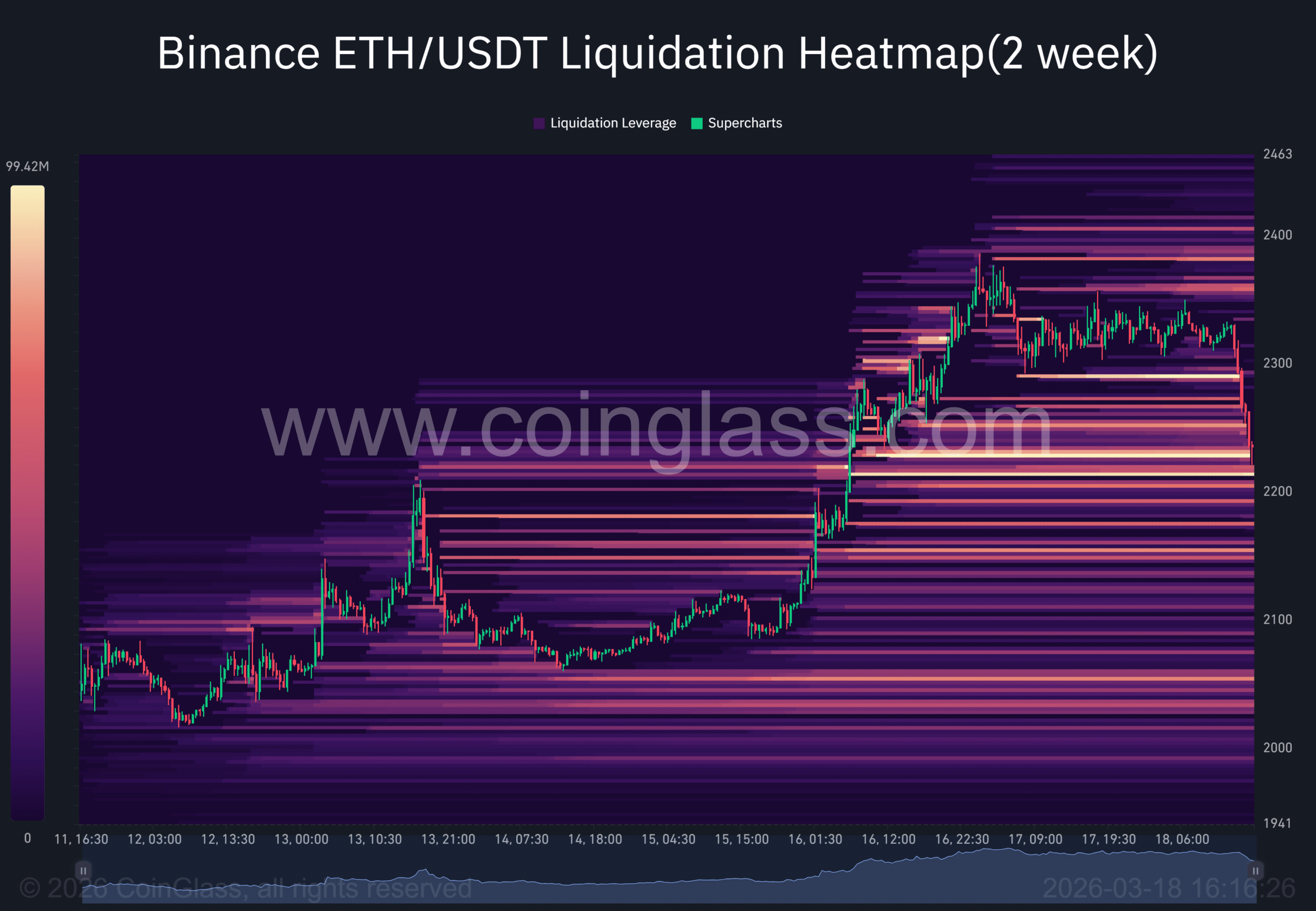
With most of the leveraged liquidity below price action, the long squeeze could drag ETH to $2213 or $2154, with a larger pool at $2053. At the time of writing, the altcoin dropped by 6% from nearly $2.4k to $2.2k.
Source: CoinGlass

Final Summary

  • Buterin now believes that a simplified, lean Ethereum could help it reach Solana-like speed while still offering Bitcoin-like security.
  • After a recent recovery to nearly $2400, ETH gave back some of the gains as traders de-risked ahead of the Fed rate decision.


Related Reads

a16z: AI's 'Amnesia', Can Continuous Learning Cure It?

The article "a16z: AI's 'Amnesia' – Can Continual Learning Cure It?" explores the limitations of current large language models (LLMs), which, like the protagonist in the film *Memento*, are trapped in a perpetual present—unable to form new memories after training. While methods like in-context learning (ICL), retrieval-augmented generation (RAG), and external scaffolding (e.g., chat history, prompts) provide temporary solutions, they fail to enable true internalization of new knowledge. The authors argue that compression—the core of learning during training—is halted at deployment, preventing models from generalizing, discovering novel solutions (e.g., mathematical proofs), or handling adversarial scenarios. The piece introduces *continual learning* as a critical research direction to address this, categorizing approaches into three paths: 1. **Context**: Scaling external memory via longer context windows, multi-agent systems, and smarter retrieval. 2. **Modules**: Using pluggable adapters or external memory layers for specialization without full retraining. 3. **Weights**: Enabling parameter updates through sparse training, test-time training, meta-learning, distillation, and reinforcement learning from feedback. Challenges include catastrophic forgetting, safety risks, and auditability, but overcoming these could unlock models that learn iteratively from experience. The conclusion emphasizes that while context-based methods are effective, true breakthroughs require models to compress new information into weights post-deployment, moving from mere retrieval to genuine learning.

marsbit2h ago

a16z: AI's 'Amnesia', Can Continuous Learning Cure It?

marsbit2h ago

Can a Hair Dryer Earn $34,000? Deciphering the Reflexivity Paradox in Prediction Markets

An individual manipulated a weather sensor at Paris Charles de Gaulle Airport with a portable heat source, causing a Polymarket weather market to settle at 22°C and earning $34,000. This incident highlights a fundamental issue in prediction markets: when a market aims to reflect reality, it also incentivizes participants to influence that reality. Prediction markets operate on two layers: platform rules (what outcome counts as a win) and data sources (what actually happened). While most focus on rules, the real vulnerability lies in the data source. If reality is recorded through a specific source, influencing that source directly affects market settlement. The article categorizes markets by their vulnerability: 1. **Single-point physical data sources** (e.g., weather stations): Easily manipulated through physical interference. 2. **Insider information markets** (e.g., MrBeast video details): Insiders like team members use non-public information to trade. Kalshi fined a剪辑师 $20,000 for insider trading. 3. **Actor-manipulated markets** (e.g., Andrew Tate’s tweet counts): The subject of the market can control the outcome. Evidence suggests Tate’sociated accounts coordinated to profit. 4. **Individual-action markets** (e.g., WNBA disruptions): A single person can execute an event to profit from their pre-placed bets. Kalshi and Polymarket handle these issues differently. Kalshi enforces strict KYC, publicly penalizes insider trading, and reports to regulators. Polymarket, with its anonymous wallet-based system, has historically been more permissive, arguing that insider information improves market accuracy. However, it cooperated with authorities in the "Van Dyke case," where a user traded on classified government information. The core paradox is reflexivity: prediction markets are designed to discover truth, but their financial incentives can distort reality. The more valuable a prediction becomes, the more likely participants are to influence the event itself. The market ceases to be a mirror of reality and instead shapes it.

marsbit3h ago

Can a Hair Dryer Earn $34,000? Deciphering the Reflexivity Paradox in Prediction Markets

marsbit3h ago

Trading

Spot
Futures

Hot Articles

Discussions

Welcome to the HTX Community. Here, you can stay informed about the latest platform developments and gain access to professional market insights. Users' opinions on the price of ETH (ETH) are presented below.

活动图片















