‘Keep Going’: Justin Sun Drives Massive TRX Buy-Up; Will MAXI Follow the Tron-Led Rally?

bitcoinistPublished on 2026-02-05Last updated on 2026-02-05

Abstract

Justin Sun's public endorsement of TRX buy-backs has triggered significant market activity, effectively decoupling TRX from Bitcoin’s volatility and signaling strong liquidity support. This defensive strategy often shifts investor appetite toward higher-risk, high-reward assets. One such beneficiary is Maxi Doge ($MAXI), a meme coin targeting leveraged trading culture. With a presale exceeding $4.5M and notable accumulations by large wallets, MAXI aims to engage traders through competitive features and staking rewards. The project positions itself as a speculative vehicle aligned with current market dynamics, appealing to those seeking outsized returns.

The crypto market is often dictated by subtle signals, but Justin Sun has never been one for subtlety.

When the Tron founder tweets ‘keep going’ regarding $TRX buy-backs, the market listens, not because of the sentiment, but because of the raw liquidity backing it. Recent on-chain movements suggest a coordinated effort to defend TRX price levels, effectively decoupling the asset from broader Bitcoin volatility.
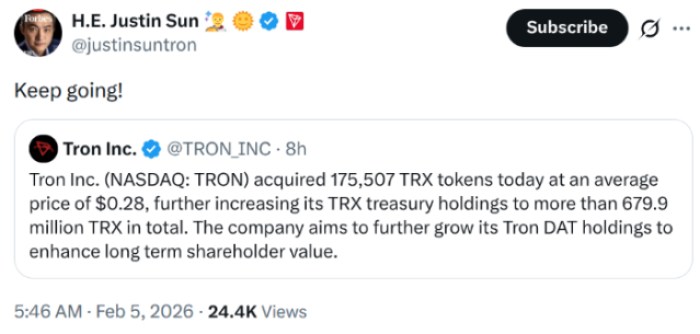
This isn’t just about price support; it’s a display of treasury dominance designed to signal strength in an otherwise choppy altcoin environment.

For traders, the implication is stark: liquidity is being artificially deepened. If history is any guide, when major ecosystem leaders like Tron stabilize, risk appetite doesn’t disappear; it rotates.

The capital preservation seen in large-cap alts often serves as a prelude to capital deployment in higher-beta sectors. Sun’s aggressive defense of the peg creates a safety net. And safety nets? They encourage speculators to look further out on the risk curve.

Usually, the beneficiary of this rotation is the meme coin sector, where ‘smart money’ moves to maximize the leverage effect of their gains. As liquidity cycles out of stabilized Layer-1s, it hunts for fresh narratives with explosive upside potential.

One such contender emerging from the noise is Maxi Doge ($MAXI), a project that explicitly targets the high-leverage trading culture that thrives in these exact market conditions. While Sun plays defense, MAXI is playing offense.

Maxi Doge Builds A ‘Leverage King’ Culture For ROI Hunters

While Tron focuses on infrastructural dominance, Maxi Doge is carving out a niche by addressing the psychological engine of the crypto market: the retail trader’s desire for outsized returns.

Most meme coins rely solely on viral imagery, but MAXI integrates the ‘gym-bro’ culture of ‘never skipping leg day’ with the high-stakes mentality of 1000x leverage trading. The project positions itself as a 240-lb canine juggernaut, a direct metaphor for the conviction required to hold through market volatility.
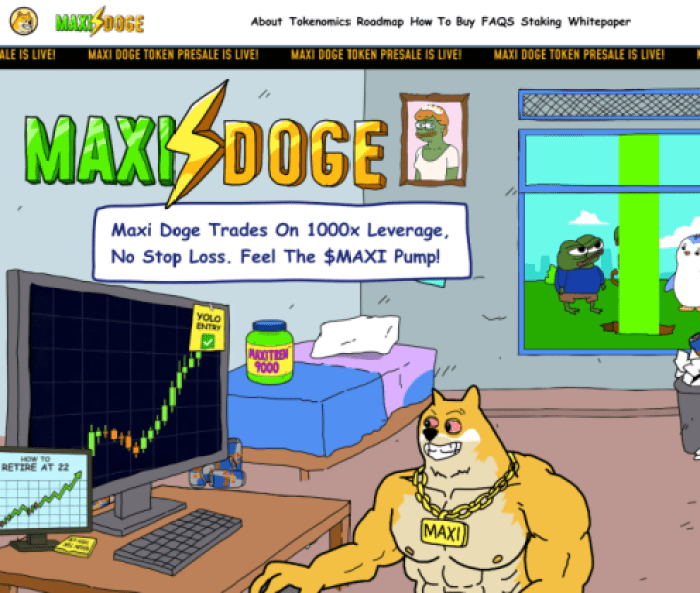

But can it actually deliver? This narrative is backed by functional utility designed to retain capital. The project plans to introduce holder-only trading competitions with leaderboard rewards, gamifying the trading experience in a way that static meme tokens can’t.

By creating a competition, Maxi Doge solves the issue of community engagement that plagues (and kills) many ERC-20 tokens post-launch. The ‘Maxi Fund’ treasury further supports this ecosystem, providing the liquidity needed for partnerships and future platform integrations.

The synergy here is notable. As established chains like Tron provide the rails for transaction volume, tokens like Maxi Doge provide the speculative vehicle that retail traders actually want to drive. The project’s ethos, ‘lift, trade, repeat,’ mirrors the grind of the current bull market, appealing to traders who find traditional spot trading too slow.

LEARN MORE ABOUT THE $MAXI PRESALE

Whales Accumulate $618K As MAXI Presale Breaches $4.5M

Smart money rarely waits for a project to launch on centralized exchanges before taking a position. Etherscan data reveals that two high-net-worth wallets recently accumulated 618K in Maxi Doge, with individual purchases of $314K and $314K.

This institutional-grade buying pressure has pushed the total funds raised to over $4.5M. It shows whales are positioning themselves before the token hits the open market liquidity pools.

The current presale price of $0.0002802 offers a specific entry point that these large holders seemingly view as undervalued relative to the project’s roadmap. Beyond the buy pressure, the tokenomics incentivize long-term alignment through a dynamic staking APY (current rewards sit at 68%.)

By allocating a dedicated pool of supply for daily automatic smart contract distribution, Maxi Doge encourages investors to lock their tokens rather than flip them immediately. This reduces circulating supply at launch, a critical factor for price appreciation in the volatile days following a Token Generation Event (TGE).

GET YOUR GAINZ WITH $MAXI

The content provided in this article is for informational purposes only and does not constitute financial advice. Cryptocurrency markets are highly volatile and carry significant risk. Always conduct your own due diligence before making any investment decisions.


Related Questions

QWhat action did Justin Sun take regarding TRX, and what was the market's reaction?

AJustin Sun tweeted 'keep going' regarding TRX buy-backs, and the market reacted due to the significant liquidity backing this move, with on-chain data suggesting a coordinated effort to defend TRX's price levels.

QAccording to the article, what is a common beneficiary when liquidity rotates out of stabilized Layer-1s like Tron?

AThe meme coin sector is often the beneficiary, as liquidity hunts for fresh narratives with explosive upside potential, such as projects like Maxi Doge ($MAXI).

QHow does Maxi Doge ($MAXI) aim to differentiate itself from typical meme coins?

AMaxi Doge integrates the 'gym-bro' culture with high-stakes leverage trading, plans holder-only trading competitions with rewards, and has a treasury (Maxi Fund) to support ecosystem growth, aiming for functional utility beyond just viral imagery.

QWhat evidence does the article provide to show institutional interest in Maxi Doge during its presale?

AEtherscan data shows two high-net-worth wallets accumulated $618K in MAXI (with individual purchases of $314K each), helping push the total presale funds raised to over $4.5M.

QWhat mechanism does Maxi Doge use to encourage long-term holding and reduce immediate selling pressure at launch?

AIt offers a dynamic staking APY (currently 68%) with daily automatic smart contract distributions, incentivizing investors to lock their tokens and reduce circulating supply post-launch.

Related Reads

When Doing Cryptocurrency Payment, the First Thing is Licenses, What is the Second?

When launching a crypto payment business, obtaining the necessary licenses is the crucial first step. However, the second, and arguably more critical, step is designing a comprehensive operational framework that forms a coherent business loop. This loop must be clearly understood and executable by all stakeholders: banks, payment partners, exchanges, on-chain analytics providers, regulators, and your internal team. Many projects mistakenly believe a single license permits all operations. Licenses merely grant entry; they don't define how the specific business functions. The real challenge lies in detailing every aspect of the workflow. This involves clarifying the customer base, the flow of fiat and crypto assets, the settlement process, and establishing clear lines of responsibility for risks like AML compliance, sanctions screening, chargebacks, and regulatory inquiries. A robust framework must answer seven core questions: Who are the clients and merchants? Who collects fiat and crypto? Who handles conversion and custody? And who is ultimately accountable for compliance and risk management? Projects often fail not from a lack of licensing, but during due diligence when they cannot convincingly explain these operational details. Therefore, beyond securing licenses, the priority must be constructing a closed-loop system. This system ensures the business model is transparent, risks are managed, responsibilities are delineated, contracts are aligned, and the entire process is comprehensible to partners and regulators. The true competitive edge in crypto payments lies not in acquiring a license quickly, but in integrating licensing, banking, compliance, and operations into a sustainable and executable whole.

marsbit33m ago

When Doing Cryptocurrency Payment, the First Thing is Licenses, What is the Second?

marsbit33m ago

Arthur Hayes Analysis: AI Bubble Nears Burst, Crypto Market Faces Short-Term Pressure

Arthur Hayes argues that the current AI market is a bubble poised to burst, which will exert downward pressure on the crypto market in the near term. The core trigger is rising oil prices due to the US-Iran conflict and a blockade of the Strait of Hormuz. Higher energy costs directly increase the operational expenses of AI data centers, squeezing profit margins for companies like Google, Anthropic, and OpenAI. Hayes predicts that persistent inflation from high oil prices will force Trump, in a bid to win the November election, to turn public sentiment against the AI industry. He may propose regulations and taxes on data centers and AI companies to appeal to voters concerned about costs and job displacement. Such political rhetoric could shatter market confidence. Furthermore, the market is unlikely to healthily absorb the massive concurrent IPOs of SpaceX, Anthropic, and OpenAI, which together seek valuations in the trillions. The combination of soaring energy costs, overwhelming equity supply, and negative political pressure will puncture the AI bubble. Hayes notes that nearly all new USD liquidity since 2022 has flowed into AI, leaving crypto like Bitcoin behind. When the AI bubble bursts, liquidity will contract sharply, pulling down all risk assets, including cryptocurrencies. In response, Hayes's fund, Maelstrom, has sold all AI-related stocks and non-core cryptocurrencies. It maintains core positions in Bitcoin and Ethereum while increasing exposure to energy sector equities, betting on rising oil and gas prices. He expects Bitcoin to bottom after the AI-led market decline, before rallying again with future monetary easing.

Foresight News47m ago

Arthur Hayes Analysis: AI Bubble Nears Burst, Crypto Market Faces Short-Term Pressure

Foresight News47m ago

To C, To B, and the Next Big Thing Called To A

After To C and To B, the Next Wave is To A: Serving AI Agents In a recent quarterly earnings call, Meituan's Wang Xing introduced a new concept: To A (To Agent), signifying that future business services will increasingly target AI Agents as primary clients, not just consumers or merchants. This shift implies that internet giants must now consider how to make their services more appealing for AI Agents to recommend, fundamentally altering traditional distribution logic. This "To A era" is prompting an unusual trend of alliances among major tech companies. Unlike previous competitive battles, firms like Meituan, Tencent, JD.com, Huawei, OPPO, and OpenAI are rapidly forming partnerships. The reason is strategic: as AI Agents become the primary user interface, handling tasks from a single command (e.g., "Book a Japanese restaurant for tomorrow"), the risk for platforms is being bypassed entirely. Companies are positioning themselves within this new value chain. Three primary strategies are emerging: 1. **Super-Entry Points + Service Providers:** Platforms like Tencent's Yuanbao, WeChat, and ChatGPT aim to be the first-stop Agent, integrating various services (food delivery, shopping, travel) from partners like Meituan and JD.com. 2. **Apps as Callable Services:** Companies like Meituan, JD.com, and Uber are ensuring their core services remain accessible and callable by external Agents, shifting from front-end apps to back-end capabilities. 3. **System-Level Agent Entry Points:** Smartphone makers (Huawei, Honor, OPPO) are leveraging their OS-level AI assistants to control the initial user command, redistributing it to relevant service apps. While alliances offer mutual benefit—entry points gain service capabilities, and service providers gain traffic—inherent conflicts of interest exist. A dominant Agent platform could eventually attempt to connect directly with suppliers (restaurants, hotels), bypassing current aggregators like Meituan or Ctrip. Other unresolved challenges include the potential for Agent recommendations to become a new form of paid ranking and unclear accountability for faulty recommendations. The current rush to form alliances is a defensive move by service providers to secure their position before the landscape solidifies. In this To A-driven restructuring, the greatest risk is not losing the race but failing to hear the starting gun.

marsbit56m ago

To C, To B, and the Next Big Thing Called To A

marsbit56m ago

The More Lifelike the Robot, the More Terrifying? Unveiling the 'Uncanny Valley Effect' in the Era of Humanoid Robots

As humanoid robots become increasingly lifelike, they confront a significant psychological barrier known as the "Uncanny Valley Effect," a concept proposed by Japanese roboticist Masahiro Mori in 1970. This phenomenon describes a dip in human comfort and acceptance when robots appear almost, but not perfectly, human. Minor imperfections in facial expressions, eye movements, or skin texture trigger a subconscious sense of unease, as the brain detects something trying, yet failing, to mimic a person. Examples range from the controversial human-like robot Sophia to animated characters in films like *The Polar Express*. The effect poses a key design challenge for robotics companies. Some, like Boston Dynamics, avoid it entirely by creating highly capable but visibly mechanical robots. Others, like Hanson Robotics, push for greater human likeness despite the risk. For consumer robots, especially in homes, most manufacturers opt for stylized or clearly mechanical designs to ensure broader acceptance. While the Uncanny Valley remains a powerful force, its impact may diminish over time through technological advancements that achieve near-perfect realism or through generational familiarity as people grow accustomed to interacting with humanoid machines. Ultimately, navigating this psychological frontier requires as much understanding of human perception as of robotics technology itself.

marsbit56m ago

The More Lifelike the Robot, the More Terrifying? Unveiling the 'Uncanny Valley Effect' in the Era of Humanoid Robots

marsbit56m ago

Trading

Spot
Futures

Hot Articles

How to Buy SUN

Welcome to HTX.com! We've made purchasing SUN (SUN) simple and convenient. Follow our step-by-step guide to embark on your crypto journey.Step 1: Create Your HTX AccountUse your email or phone number to sign up for a free account on HTX. Experience a hassle-free registration journey and unlock all features.Get My AccountStep 2: Go to Buy Crypto and Choose Your Payment MethodCredit/Debit Card: Use your Visa or Mastercard to buy SUN (SUN) instantly.Balance: Use funds from your HTX account balance to trade seamlessly.Third Parties: We've added popular payment methods such as Google Pay and Apple Pay to enhance convenience.P2P: Trade directly with other users on HTX.Over-the-Counter (OTC): We offer tailor-made services and competitive exchange rates for traders.Step 3: Store Your SUN (SUN)After purchasing your SUN (SUN), store it in your HTX account. Alternatively, you can send it elsewhere via blockchain transfer or use it to trade other cryptocurrencies.Step 4: Trade SUN (SUN)Easily trade SUN (SUN) on HTX's spot market. Simply access your account, select your trading pair, execute your trades, and monitor in real-time. We offer a user-friendly experience for both beginners and seasoned traders.

7.0k Total ViewsPublished 2024.03.29Updated 2026.06.02

How to Buy SUN

Discussions

Welcome to the HTX Community. Here, you can stay informed about the latest platform developments and gain access to professional market insights. Users' opinions on the price of SUN (SUN) are presented below.

活动图片












