Kalshi's Daily Stock Open Interest Hits Record High of $17.98 Million

cryptonews.ruPublished on 2026-08-14Last updated on 2026-08-14

Abstract

Kalshi's daily open interest for its perpetual futures product hit a record $17.98 million on August 12th, just over two months after its launch. The CFTC-approved platform, which began with Bitcoin and Ethereum contracts in early June, now lists 13 crypto assets. Open interest remained below $5 million initially, saw mid-June spikes to $13-14 million, stabilized around $6-7 million, and has steadily climbed since July, consistently holding above $12 million in recent weeks. This growth indicates sustained trader engagement on a platform that recently offered only short-term binary contracts. Despite this rapid growth, Kalshi's total crypto perpetuals portfolio is small in scale, representing about 0.15% of rival Hyperliquid's $11.7 billion daily open interest. The comparison is structurally limited: each Kalshi contract requires federal regulatory pre-approval, resulting in a small list, whereas permissionless platforms like Hyperliquid support hundreds of pairs. The concentrated open interest on Kalshi's few approved contracts signals strong demand within its specific niche. Analysts suggest Kalshi is not cannibalizing existing decentralized exchange volume but is tapping a previously underserved pool of U.S.-based traders who lacked a legal, leveraged crypto platform. The true size of this new user pool remains unknown. While a market downturn could disrupt the trend, the open interest chart has so far shown consistent upward momentum.

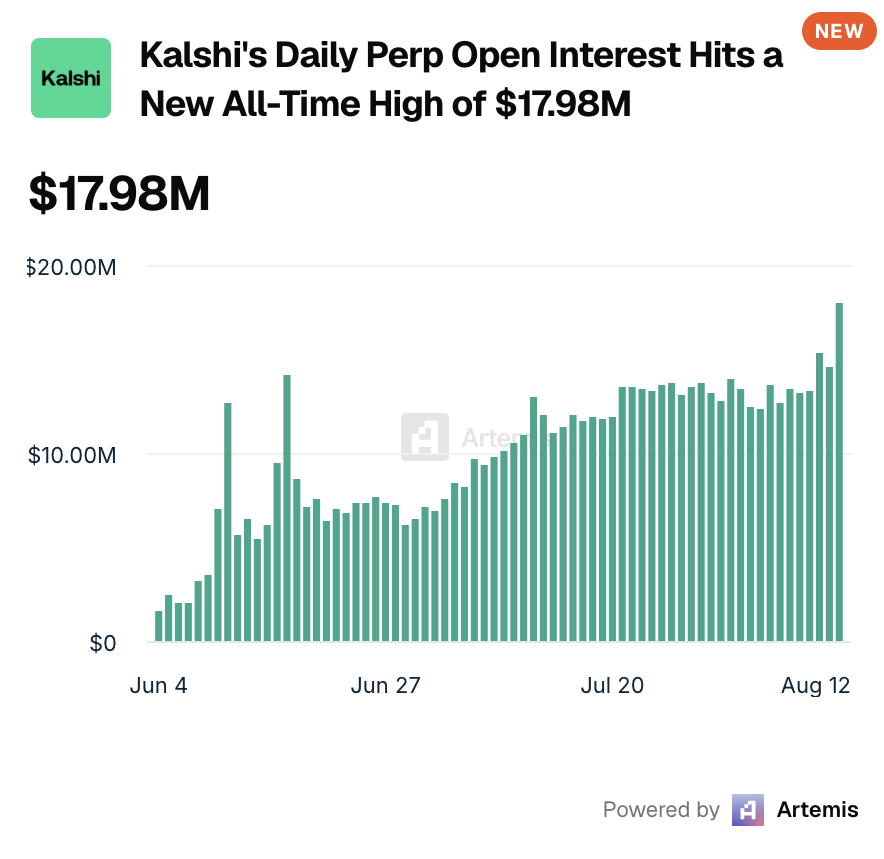
Kalshi's perpetual futures product launched on June 3rd, with BTCPERP becoming the first perpetual contract approved by the CFTC for traders from the US. Ether launched on June 4th, XRP on June 10th, and now the list covers 13 crypto assets. This week, on August 12th, daily open interest for perpetual futures closed at $17.98 million, a historic high for a product that didn't exist three months ago.
Source: Artemis

Open interest was under $5 million during the first week of June, with two peaks reaching $13 and $14 million mid-month, then dropped to the $6-7 million range where it stayed until the end of June. The following month, specifically in the second week of July, there was a jump as daily bars closed above $10 million, holding in the $12-14 million range for the last three weeks.

Interest Rate Hike More Important Than Election Results

A single large option on the new platform typically indicates several large positions that could have been closed over a few days. However, the chart doesn't show this. The lower bound of the range continues to rise, meaning traders are holding risk on a platform that just ten weeks ago only offered short-term binary contracts.

There is certainly demand for Kalshi's services, and another telling sign is sales volume. The notional value of Kalshi's services surpassed $1 billion within a week of launch. Compared to contracts on the events the platform built its reputation on, it took 40 months to reach that figure.

$17.98 Million Next to $11.7 Billion

Despite Kalshi Perps' impressive performance since launch, it's important to keep perspective. According to DefiLlama, Hyperliquid's 24-hour open interest is $11.7 billion with a daily trading volume of $7.17 billion. Kalshi's entire Perps portfolio is roughly 0.15% of that amount. Individual large players on Hyperliquid have positions exceeding Kalshi's total open interest across all its crypto markets combined.

The difference isn't just size. CoinGecko states Hyperliquid offers 377 perpetual trading pairs. Its HIP-3 segment, covering non-crypto markets created by a single developer, has over $4 billion in open interest. This is just one segment of one developer's markets and is more than 200 times larger than Kalshi's total markets.

Every New Stock Listing on Kalshi Starts with an Application

Kalshi's small contract list is for structural reasons. Every contract it lists must be vetted by a federal regulator before a single trade can be made. Hyperliquid deploys markets permissionlessly, so it can support 377 pairs and add new ones at a user's whim.

This is also a fair assessment of the $17.98 million figure. This number isn't low due to lack of demand. It's low because there's almost nothing to trade, and what there is took months of work with regulators to get on the exchange. Concentrating this much open interest on so few contracts is a very different signal than spreading it across hundreds.

In any case, the comparison everyone makes is wrong. Kalshi isn't taking flow from Hyperliquid. It's taking flow from US traders who previously had no legal venue at all to use crypto leverage, and who were either offshore, using a VPN, or just sitting on the sidelines. This pool is separate, and no one knows how large it is.

A period of stagnant or falling prices through the end of August could disrupt this trend. So far, the chart hasn't shown it.

end-content

Trending Cryptos

Related Questions

QWhat is the significance of Kalshi's daily open interest reaching $17.98 million according to the article?

AThe $17.98 million daily open interest for Kalshi's perpetual futures is a historical high for a product that didn't exist three months prior. It signifies strong initial growth and sustained trader interest in the regulated platform.

QHow does Kalshi's open interest and volume compare to a platform like Hyperliquid?

AKalshi's entire perpetuals portfolio of approximately $17.98 million in open interest is about 0.15% of Hyperliquid's $11.7 billion 24-hour open interest. Individual large positions on Hyperliquid can exceed Kalshi's total crypto open interest.

QWhat key structural difference between Kalshi and platforms like Hyperliquid limits Kalshi's number of contracts?

AEach contract on Kalshi must be approved by federal regulators (CFTC) before trading can begin. In contrast, platforms like Hyperliquid deploy markets permissionlessly, allowing them to support hundreds of trading pairs.

QAccording to the article, where is Kalshi primarily drawing its trading volume from?

AKalshi is drawing volume primarily from US-based traders who previously had no legally compliant platform to use leverage for crypto trading. These traders were either trading overseas, using VPNs, or not trading at all.

QWhat does the article suggest about the nature of the open interest growth on Kalshi, based on the chart data?

AThe chart shows that the lower bound of the open interest range has been consistently rising. This indicates traders are maintaining risk positions over time, rather than the growth being driven by a few large, short-term option positions.

Related Reads

Altcoin Hacked, Leading to Sharp Price Drop! Also Listed on Major Exchanges!

The price of the NES token plummeted significantly following suspicious activity and large sell-offs detected on the network. Blockchain observers suggested that one wallet minted approximately $55 million worth of NES tokens and began selling them on decentralized exchanges. This selling pressure caused the price of NES to drop by up to 40%. According to the data, the address in question still holds around $18 million worth of NES, indicating that market sell-off pressure may continue. Prior to the incident, it was reported that about $12.35 million worth (62.9 million NES tokens) were transferred to the Ethereum mainnet in the morning (Turkish time), with claims that liquidity was withdrawn and tokens were sold on the market later that evening. However, data regarding the $55 million token mint and the transfer of 62.9 million NES tokens has not been independently confirmed. The NESA team confirmed in a statement that they detected malicious activity exploiting a vulnerability in their Layer 1 network originating from Cosmos EVM. They stated they are working to contain the impact, responded promptly, and will restore services after implementing a software patch and additional measures to ensure secure network operation. Nesa also notified all cryptocurrency exchanges and stated deposit operations will resume after necessary work is completed. The article includes a chart showing the NES price decline following the exploit and concludes with a standard disclaimer that this is not investment advice.

cryptonews.ru2h ago

Altcoin Hacked, Leading to Sharp Price Drop! Also Listed on Major Exchanges!

cryptonews.ru2h ago

PeaqOS and World ID Integrate ZK Proofs into Autonomous Robots

The integration of PeaqOS and World ID now allows autonomous machines to verify they are interacting with real, unique individuals without collecting names, photos, or other personal data. This update, available via robotic.sh, enables connected devices to directly request and verify World ID proofs. The system leverages zero-knowledge technology, letting a person prove they are human while maintaining the privacy of their identity. This addresses a key challenge for operators of delivery robots, shared machines, and autonomous systems: how to authenticate a user as genuine without relying on insecure PINs, pickup codes, or traditional identity checks that require personal data collection. Instead of obtaining identifying information, a device receives a cryptographic proof that the user is a real person. PeaqOS acts as a coordination layer, allowing devices to utilize World ID via decentralized identifiers and a device marketplace. A robot can request verification, receive a zero-knowledge proof, and register an auditable record of the interaction—all without exposing underlying personal data. The system also supports uniqueness verification, enabling machines to enforce rules like "one item per person" without maintaining user identity databases. A demonstrated use case involves autonomous medicine delivery: a patient verifies via the World App when placing an order, a pharmacist verifies before loading the medication, and the patient verifies again upon delivery so the robot can confirm the recipient is linked to the order before unlocking the compartment. Similarly, promotional robots could ensure one item per person, and shared vending machines could grant access to verified individuals without requiring accounts or personal data. This integration for PeaqOS-powered robots and devices minimizes the identity information collected or stored while allowing autonomous systems to confirm they are interacting with real humans.

cryptonews.ru3h ago

PeaqOS and World ID Integrate ZK Proofs into Autonomous Robots

cryptonews.ru3h ago

Trading

Spot

Hot Articles

How to Buy T

Welcome to HTX.com! We've made purchasing Threshold Network Token (T) simple and convenient. Follow our step-by-step guide to embark on your crypto journey.Step 1: Create Your HTX AccountUse your email or phone number to sign up for a free account on HTX. Experience a hassle-free registration journey and unlock all features.Get My AccountStep 2: Go to Buy Crypto and Choose Your Payment MethodCredit/Debit Card: Use your Visa or Mastercard to buy Threshold Network Token (T) instantly.Balance: Use funds from your HTX account balance to trade seamlessly.Third Parties: We've added popular payment methods such as Google Pay and Apple Pay to enhance convenience.P2P: Trade directly with other users on HTX.Over-the-Counter (OTC): We offer tailor-made services and competitive exchange rates for traders.Step 3: Store Your Threshold Network Token (T)After purchasing your Threshold Network Token (T), store it in your HTX account. Alternatively, you can send it elsewhere via blockchain transfer or use it to trade other cryptocurrencies.Step 4: Trade Threshold Network Token (T)Easily trade Threshold Network Token (T) on HTX's spot market. Simply access your account, select your trading pair, execute your trades, and monitor in real-time. We offer a user-friendly experience for both beginners and seasoned traders.

13.1k Total ViewsPublished 2024.03.29Updated 2026.06.02

How to Buy T

Discussions

Welcome to the HTX Community. Here, you can stay informed about the latest platform developments and gain access to professional market insights. Users' opinions on the price of T (T) are presented below.

活动图片