JPMorgan launches its first tokenized money market fund on Ethereum

cointelegraphPublished on 2025-12-15Last updated on 2025-12-15

Abstract

JPMorgan has launched its first tokenized money market fund, called the My OnChain Net Yield Fund (MONY), on the Ethereum blockchain through its proprietary tokenization platform, Kinexys Digital Assets. The fund, available to qualified investors via the Morgan Money platform, invests in U.S. Treasury securities and repurchase agreements, allowing investors to earn yield and hold tokens directly on-chain. It offers daily dividend reinvestment and supports subscriptions and redemptions using both cash and stablecoins. The move represents a major step by a global systemically important bank into tokenized finance, enhancing transaction efficiency, transparency, and collateral utility within the blockchain ecosystem.

JPMorgan, one of the world’s largest banks, is advancing its presence in tokenized finance by launching its first money market fund through its $4 trillion asset management arm.

The fund, My OnChain Net Yield Fund, will trade under the ticker MONY and is now available on the public Ethereum blockchain, JPMorgan said in an announcement shared with Cointelegraph on Monday.

Launched via Kinexys Digital Assets, JPMorgan’s proprietary tokenization platform, MONY is a 506(c) private placement fund providing qualified investors the opportunity to earn US dollar yields by subscribing through its institutional trading platform Morgan Money.

“With Morgan Money, tokenization can fundamentally change the speed and efficiency of transactions, adding new capabilities to traditional products,” said John Donohue, head of global liquidity at JPMorgan Asset Management.

MONY investors can receive tokens at their blockchain addresses

By launching MONY, JPMorgan has become the largest global systemically important bank to introduce a tokenized money market fund (MMF) on a public blockchain, the bank said in the announcement.

The fund’s tokenization provides increased transparency, peer-to-peer transferability and the potential for broader collateral usage within the blockchain ecosystem, it said.
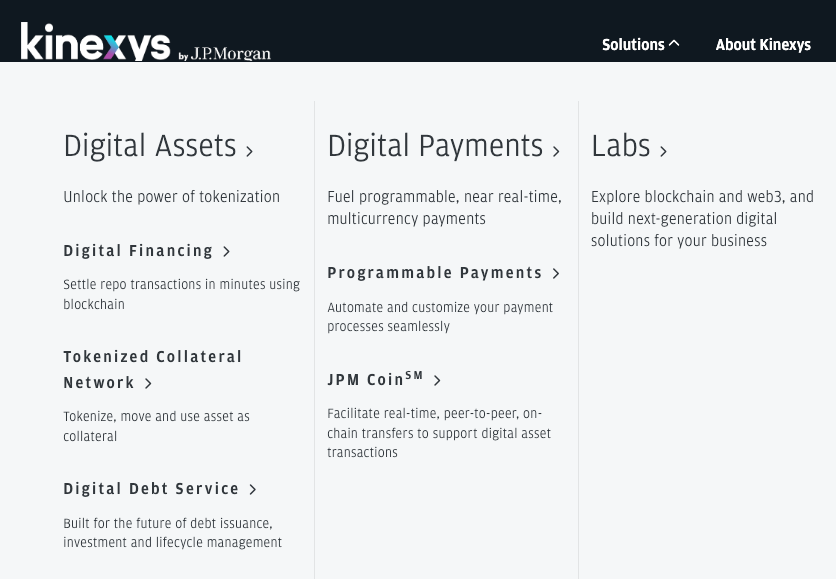
JPMorgan Asset Management’s My OnChain Net Yield Fund (MONY) is issued through Kinexys Digital Assets and is available to investors via Morgan Money. Source: JPMorgan

“This marks a significant step forward in how assets will be traded in the future,” Donohue said, highlighting the role of Morgan Money, where qualified investors can access the fund and receive tokens at their blockchain addresses.

Launched in 2019, Morgan Money provides a real-time investment dashboard and a single access point for operations, allowing investors to build stronger liquidity strategies.

“Morgan Money is the first institutional liquidity trading platform to integrate traditional and on-chain assets offering investors access to a full-range of money market products,” JPMorgan said.

Subscriptions and redemption in cash or stablecoins

According to the announcement, MONY will invest only in traditional US Treasury securities and repurchase agreements fully collateralized by US Treasury securities, allowing qualified investors to earn yield while holding the token on the blockchain.

It also offers daily dividend reinvestment, enabling investors to subscribe and redeem using cash or stablecoins through the Morgan Money platform.

Cointelegraph asked JPMorgan which stablecoins would be supported within the offering, but had not received a response at the time of publication.

Related: ‘Grow up... We debank Democrats, we debank Republicans:’ JPMorgan CEO

JPMorgan’s MONY launch marks another milestone in the race among traditional financial institutions to introduce regulated tokenized products. The news came weeks after the company initiated the first transaction via its upcoming fund tokenization platform, Kinexys Fund Flow, which is expected to roll out in 2026.

On Thursday, JPMorgan also announced the issuance of a US commercial paper for Galaxy Digital Holdings on the Solana blockchain, marking one of the earliest debt issuances ever executed on a public blockchain.


Trending Cryptos

Related Reads

Bitcoin Withdrawals Continue: 8 Years of Storage in a Coldcard Cold Wallet Ended in Zero

Coldcard Hardware Wallet Hacked: Losses Mount Due to Vulnerable Seed Generation A critical vulnerability in Coldcard hardware wallets has led to a continued wave of fund thefts. According to Galaxy Research, the total stolen has reached 1,367.05 BTC (approx. $88.6 million) from 4,585 addresses, a significant increase from the initial 594.5 BTC reported on July 30, 2026. Most of the stolen funds remain on the attackers' addresses. The issue is not with the current firmware, which Coinkite has updated, but with seed phrases generated on vulnerable devices between March 2021 and the release of fixed firmware versions. Due to a programmer error, devices switched from using a hardware random number generator to the software-based Yasmarang generator, which was initialized with publicly accessible data like the chip's serial number. This made the seed phrases predictable through offline brute-force attacks, meaning wallets remain at risk until funds are moved to a new wallet generated with the patched firmware. Affected devices include Mk2/Mk3 with firmware 4.0.1–4.1.9 (and up to 5.0.3), Mk4/Mk5 up to version 5.6.0, and Q models up to 1.5.0Q. The only exceptions are seeds created with a high-entropy method like at least 50 independent dice rolls or a strong unique BIP-39 passphrase. All other owners must generate a new seed on the fixed firmware and transfer their assets. A case highlighting the human impact involves a 39-year-old long-term investor who lost 2 BTC (approx. $130,000) in minutes. He had accumulated the Bitcoin over eight years through physical labor, viewing it as a financial lifeline and a retirement plan in a country suffering from hyperinflation. His story underscores that even conservative "buy and hold in cold storage" strategies can be compromised by such underlying technical flaws. From a technical perspective, this incident echoes historical failures where weak random number generators undermined cryptographic security, challenging the assumption that offline storage is automatically foolproof.

cryptonews.ru4h ago

Bitcoin Withdrawals Continue: 8 Years of Storage in a Coldcard Cold Wallet Ended in Zero

cryptonews.ru4h ago

Trading

Spot

Hot Articles

Discussions

Welcome to the HTX Community. Here, you can stay informed about the latest platform developments and gain access to professional market insights. Users' opinions on the price of ETH (ETH) are presented below.

活动图片














