JP Morgan: 89% of Family Offices Still Sideline Crypto While LiquidChain ($LIQUID) Targets Infrastructure Gaps

bitcoinistPublished on 2026-02-03Last updated on 2026-02-03

Abstract

A recent JP Morgan report reveals that 89% of family offices still have no cryptocurrency exposure, despite the asset class's strong performance. The primary barriers are operational complexity and security risks, not price volatility. Institutional capital is hindered by fragmented liquidity across chains like Bitcoin, Ethereum, and Solana, making cross-chain interactions a compliance and execution challenge. This highlights a critical infrastructure gap rather than bearish sentiment. LiquidChain ($LIQUID) is emerging as a potential solution, targeting these institutional concerns. As a Layer 3 protocol, it aims to unify liquidity from major blockchains into a single execution environment, eliminating the need for wrapped assets and complex bridging. By simplifying cross-chain interactions and reducing security risks, LiquidChain seeks to provide the streamlined infrastructure necessary for large-scale, risk-averse capital to enter the crypto space.

The number stops you in your tracks: 89%.

According to a recent report from JP Morgan Private Bank, the vast majority of family offices, those quiet giants managing the fortunes of ultra-high-net-worth individuals, still have zero exposure to cryptocurrency. Given that the asset class has outperformed almost every traditional index over the last decade, this hesitation looks paradoxical.

Dig a little deeper, though. The reluctance isn’t just about volatility or fear of the dark. The ‘Global Family Office Report’ highlights that while 11% of these firms are active, the sidelined majority cite specific roadblocks: operational complexity and security risks.

The current market structure, fragmented across incompatible blockchains like Bitcoin, Ethereum, and Solana, is a compliance nightmare for institutional capital. They aren’t waiting for higher prices. They’re waiting for better plumbing.

This data point matters. Not because it implies bearish sentiment, but because it predicts a massive capital rotation once those barriers fall. Smart money is watching the infrastructure layer right now, specifically projects that abstract away the chaotic user experience of cross-chain interaction. As the gap between institutional interest and execution capabilities widens, new Layer 3 (L3) solutions are stepping in.

This is where LiquidChain ($LIQUID) enters the picture, gaining traction for its promise to fuse the liquidity of the industry’s biggest chains into a single execution environment.

Buy $LIQUID here.

The ‘Uninvestable’ Nature of Fragmented Liquidity

JP Morgan’s report illuminates a critical disconnect. While retail traders might be comfortable bridging assets through sketchy protocols or juggling five seed phrases for five different chains, family offices can’t operate with that level of friction.

Right now, liquidity is trapped in silos. A billion dollars on Ethereum can’t easily talk to a billion dollars on Solana without complex bridging mechanisms that introduce ‘wrapped’ assets, derivative tokens that have historically been major failure points in DeFi hacks. Frankly, for a risk-averse family office, holding a ‘wrapped’ version of Bitcoin on a smart contract chain is a non-starter.

This suggests the next phase of the bull run won’t be driven by new assets, but by the unification of existing ones. The market is desperate for an interoperability standard that removes the technical debt of managing multi-chain portfolios. The 89% aren’t staying away because they hate returns; they’re staying away because the current infrastructure is too “noisy” for compliant, ten-figure execution.

Explore the LiquidChain ecosystem.

LiquidChain Unifies BTC, ETH, and SOL for Institutional Grade Execution

While legacy wealth waits for the dust to settle, LiquidChain is building the solution that directly addresses the fragmentation problem. Positioned as a Layer 3 infrastructure, LiquidChain does what previous bridging solutions couldn’t: it fuses Bitcoin, Ethereum, and Solana liquidity into a single, unified execution environment.

Here’s what most coverage misses about Layer 3 protocols: they aren’t just faster blockchains. They are application-specific environments designed to hide the messiness of the underlying layers. LiquidChain’s ‘Deploy-Once Architecture’ allows developers to build applications that access users and liquidity from all three major chains simultaneously.
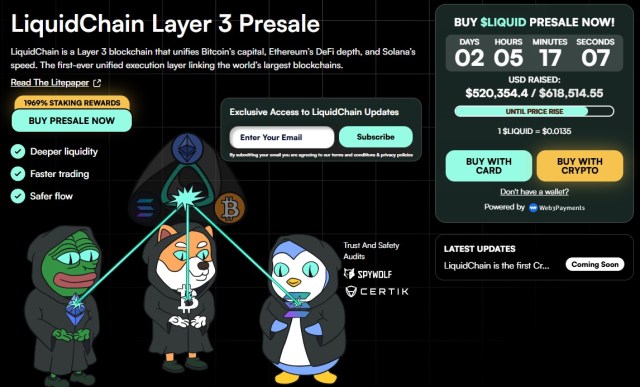
For the user, whether a DeFi native or a family office execution desk, this means single-step execution. There’s no need to manually bridge funds or wrap assets. The protocol handles the settlement verification across chains in the background.

By mitigating the risks associated with wrapped assets and unifying liquidity, LiquidChain presents the kind of streamlined, verifiable settlement layer that institutional capital requires to finally make the jump from the 89% to the 11%.

Learn more about LiquidChain here.

This article is for informational purposes only and does not constitute financial advice. Cryptocurrency investments, including presales and early-stage infrastructure projects, carry high risks. Always perform your own due diligence.


Trending Cryptos

Related Questions

QAccording to the JP Morgan report, what percentage of family offices have zero exposure to cryptocurrency, and what are the two main reasons cited for this?

A89% of family offices have zero exposure to cryptocurrency. The two main reasons cited are operational complexity and security risks.

QWhat specific problem in the current crypto market structure is described as a 'compliance nightmare' for institutional capital?

AThe current market structure, which is fragmented across incompatible blockchains like Bitcoin, Ethereum, and Solana, is described as a compliance nightmare for institutional capital.

QWhat is the primary promise of LiquidChain ($LIQUID) as presented in the article?

ALiquidChain's primary promise is to fuse the liquidity of the industry's biggest chains (like Bitcoin, Ethereum, and Solana) into a single execution environment.

QWhat does the article suggest is the major risk associated with 'wrapped' assets that prevents family offices from adopting them?

AThe major risk is that 'wrapped' assets, which are derivative tokens, have historically been major failure points in DeFi hacks, making them a non-starter for risk-averse institutions.

QHow does LiquidChain's 'Deploy-Once Architecture' aim to solve the problem of fragmented liquidity?

ALiquidChain's 'Deploy-Once Architecture' allows developers to build applications that can access users and liquidity from Bitcoin, Ethereum, and Solana simultaneously, creating a single execution environment that hides the underlying complexity.

Related Reads

Agent Race Ends, Super Workbench Takes Over

The era of fragmented AI agents is ending. Over the past month, China's tech giants—Tencent, Alibaba, and ByteDance—have simultaneously shifted strategy: instead of launching new, standalone AI agents, they are consolidating their various agent projects into unified "super workbenches." Tencent integrated its QClaw teams into WorkBuddy, a strategic product hailed as a potential third flagship after QQ and WeChat. Alibaba is merging its QoderWork, Wukong, and MuleRun agents into a new "Qianwen Office" platform under DingTalk's leadership. ByteDance rebranded its TRAE SOLO coding agent to TRAE Work, signaling a broader focus on workflow collaboration. This convergence marks a pivotal industry consensus. The initial exploration phase, where companies rapidly built numerous overlapping agents for different scenarios, proved costly and inefficient. With open-source tools eroding technical barriers, competition has shifted from agent creation to resource consolidation and cost control. Historically, platform wars are won not by creating more products, but by simplifying them—as seen with browsers unifying web access and super-apps consolidating services. Now, the "super workbench" aims to become the unified AI entry point for work. This reflects a deeper market realization: the primary audience for AI is no longer just programmers (a market in the tens of millions) but all knowledge workers (a market of billions). The real opportunity lies in augmenting everyday tasks—managing emails, documents, data, and meetings—across the entire workday. The core battleground is becoming control over the primary AI entry point that employees use daily. Tencent's WorkBuddy leverages WeChat and Tencent Docs; Alibaba's Qianwen Office taps into DingTalk's organizational data; ByteDance's TRAE Work integrates with Feishu's workflows. Whoever owns this "super workbench" gains strategic control over orchestrating enterprise data and APIs. This shift is redefining enterprise software. Traditional SaaS applications, valued for their user interfaces, will recede into the background. Their core functionalities will be exposed as standardized "Skills" or APIs for the super workbench's agents to invoke. Software value will shift from selling user seats to charging based on API calls and outcomes delivered. The evolution of agents is moving through clear stages: first as novel standalone products, then as consolidated primary work entry points, and finally as pervasive, invisible capabilities embedded into the digital fabric. The recent moves by major tech firms signal the transition from the first stage into the second, accelerating toward the third. In the end, the most successful agent technology may become invisible—like electricity or the HTTP protocol—a fundamental, unnamed infrastructure powering work itself.

marsbit19m ago

Agent Race Ends, Super Workbench Takes Over

marsbit19m ago

Michael Saylor: 110 Reasons to Oppose BIP-110

Michael Saylor presents 110 arguments against Bitcoin Improvement Proposal (BIP) 110, a soft fork aimed at restricting certain non-monetary data storage uses (like inscriptions) on the Bitcoin blockchain. He acknowledges the proponents' valid concerns—such as node costs, fee pressure, and preserving Bitcoin's monetary focus—but fundamentally disagrees with the proposed solution. Saylor argues that BIP 110 represents a dangerous precedent of using consensus rules to enforce value judgments on transaction validity, moving away from Bitcoin's core principles of neutrality and permissionless innovation. His key objections are organized into eleven categories: 1) It violates neutrality and hard consensus by banning currently valid transactions. 2) It fails to meet the high burden of proof required for a consensus change, lacking concrete data on the alleged crisis. 3) Its seven bundled technical restrictions are overly broad, targeting generic script functionalities and blocking future upgrade paths. 4) It sacrifices compatibility and future optionality by closing off designed upgrade hooks. 5) Its temporary rules add significant complexity (grandfathering, expiry states) without sufficient justification. 6) The economic and security impacts, particularly on miner revenue and fee markets, are uncertain and unmodeled. 7) Superior, market-based tools (fee markets, relay/mining policies) already exist to manage blockchain load. 8) It stifles innovation by creating a chilling effect for developers. 9) Its modified activation mechanism (55% threshold, forced signaling) is aggressive and risks network splits. 10) The precedent it sets—using consensus to suppress disliked but legal uses—is more dangerous than the problem it aims to solve. 11) A better path exists: improving measurements, refining resource-based policies, and allowing market forces to work. Saylor concludes that Bitcoin's strength lies in its neutral rules, open markets, and hard consensus. Changing these foundational elements to target specific use cases is an unnecessary and risky "iatrogenic" intervention. He advocates for guarding Bitcoin's neutrality rather than acting as its redeemer.

marsbit34m ago

Michael Saylor: 110 Reasons to Oppose BIP-110

marsbit34m ago

Trading

Spot

Hot Articles

What is DOGE M

Doge Matrix ($doge m): The New Breed of Community-Driven Cryptocurrency Introduction In the ever-evolving landscape of cryptocurrency, new projects constantly emerge, each aiming to capture the interest of investors and enthusiasts alike. One of the latest entrants to this domain is Doge Matrix, represented by the ticker symbol $doge m. This project has attracted attention thanks to its roots in the popular meme culture surrounding Dogecoin, establishing its place within the web3 space. This article aims to provide a comprehensive analysis of Doge Matrix, covering its overview, creator, investors, functionality, timeline, and notable aspects. What is Doge Matrix ($doge m)? Doge Matrix is a community-driven cryptocurrency project that seemingly builds upon the widespread appeal of Dogecoin, a digital currency known for its Shiba Inu mascot and its meme origins. While the overarching objectives of Doge Matrix are not extensively defined, it is characterised by a commitment to harnessing community involvement and support. Unlike traditional cryptocurrencies that often emphasise utility or intrinsic value through underlying technologies, Doge Matrix positions itself within a space that embraces the cultural phenomenon of cryptocurrencies, particularly appealing to those who resonate with the ethos of meme-based assets. Drawing on the strengths of the Dogecoin community, Doge Matrix operates as part of a broader ecosystem, inviting participation and engagement from users who share an interest in cryptocurrency and the digital landscape. Who is the Creator of Doge Matrix ($doge m)? The identity of the creator of Doge Matrix remains unknown. This lack of transparency is not an uncommon occurrence in the cryptocurrency space, where some projects are launched without revealing the identities of their founders. The absence of information regarding the founding team can raise questions among potential investors about the project’s accountability and direction. Who are the Investors of Doge Matrix ($doge m)? As it stands, there is no publicly available information detailing the investors or investment foundations that back Doge Matrix. The project appears to rely primarily on community support rather than institutional investment. This model aligns with the community-driven nature of the initiative, fostering an environment where the direction of the project is shaped by its participants rather than being dictated by a select few financial backers. How Does Doge Matrix ($doge m) Work? The specifics regarding the operational mechanisms of Doge Matrix are somewhat vague, reflecting a broader trend of projects in the meme coin space where innovative functionalities are not always clearly articulated. Nonetheless, Doge Matrix seems designed to tap into the existing cryptocurrency ecosystem by encouraging user participation while tapping into the familiar cultural references associated with Dogecoin. Its potentially unique characteristics derive from community interactions rather than technological advancements, emphasising shared experiences and collaboration among token holders. While the exact innovations have not been explicitly outlined, the project appears to create a space where community members can engage, share ideas, and propel the project's potential forward. Timeline of Doge Matrix ($doge m) Reflecting on the project’s timeline reveals notable events that have defined its journey thus far: November 25, 2024: Doge Matrix reached its all-time high value, marking a significant milestone in its early history. January 1, 2025: Conversely, Doge Matrix hit its all-time low value, illustrating the volatility often associated with cryptocurrencies, especially in the early stages of a project's lifecycle. Ongoing: The project continues to be actively traded and supported by its community, although specific future milestones or objectives have yet to be disclosed. Key Points About Doge Matrix ($doge m) Community Focus At the heart of Doge Matrix is a commitment to community engagement. The project thrives on the premise of collaboration and shared objectives among its members, emphasising the importance of collective effort. Unlike centralised projects that often have a defined leadership structure, Doge Matrix at present showcases a more fluid approach to governance, where every community member's voice matters. Volatility The cryptocurrency market is notorious for its volatility, and Doge Matrix is no exception. Its price history reflects significant fluctuations between high and low values, which is typical of many new cryptocurrencies but underscores the risks associated with investment in emerging tokens. Lack of Detailed Information One of the most striking features about Doge Matrix is the scarcity of detailed information regarding its technological underpinnings and operational mechanisms. This ambiguity necessitates that potential investors conduct thorough due diligence before engaging with the project. Conclusion In summary, Doge Matrix ($doge m) illustrates a new wave of cryptocurrency projects that lean heavily on community engagement and cultural relevance. While lacking in certain specifics—such as clear leadership, defined objectives, and detailed functionality—the project has managed to generate interest within the crypto community, leveraging the established appeal of meme culture. As with any investment in the cryptocurrency space, understanding the inherent risks and conducting comprehensive research is essential for potential participants. Doge Matrix stands as a reminder of the dynamic, sometimes unpredictable nature of the crypto industry, marked by constant evolution and enthusiasm for community-driven initiatives.

574 Total ViewsPublished 2025.02.03Updated 2025.02.03

What is DOGE M

What is $M

Understanding Mantis ($M): A New Era in Cross-Chain Interoperability In the continually evolving landscape of Web3 and cryptocurrency, new projects strive to offer innovative solutions aimed at enhancing the user experience and expanding functional possibilities within the decentralised financial ecosystem. One such project garnering attention is Mantis ($M), a pioneering protocol founded on the principles of cross-chain interoperability and intent-based settlements. This article delves into the essential aspects of Mantis, including its core functionality, creators, investment backing, innovative features, and critical milestones. What is Mantis ($M)? Mantis is described as a multi-domain intent settlement protocol that simplifies cross-chain interactions, enabling users to execute complex financial transactions across various blockchain platforms seamlessly. The protocol operates through three primary layers: Intent Expression: Users can articulate their transaction goals using natural language facilitated by the DISE LLM, an advanced AI language model. For instance, a user might express a desire to swap Ethereum (ETH) for Solana (SOL) with a specific slippage tolerance of 1%. Execution: This layer employs a network of solvers that compete to fulfil user intents. Transactions are executed using mechanisms such as Coincidence of Wants (CoWs) and Order Flow Auctions (OFAs), which ensure that user demands are met optimally. Settlement: Leveraging the Inter-Blockchain Communication (IBC) protocol, Mantis enables atomic cross-chain transactions, allowing users to operate across various supported chains, including Ethereum, Solana, and Cosmos. Mantis is engineered to introduce native yield generation for idle assets, employing cryptographic proofs to maintain the integrity of transactions throughout the entire process. Creators & Development Team Mantis was conceived by the Composable Foundation, a research-driven organisation notable for its emphasis on blockchain interoperability solutions. This foundation collaborates with esteemed academic institutions, including Harvard University and the University of Lisbon, contributing to extensive research and development efforts that inform Mantis's architecture and functionality. The Composable Foundation’s commitment to fostering innovation in the blockchain space positions Mantis as a robust solution for the growing demand for interoperability among multiple blockchain networks. Investors & Backing While specific details about individual investors have not been publicly disclosed, Mantis enjoys substantial backing from various entities, including: Ecosystem grants from IBC-enabled chains, which support the protocol's growth and integration within decentralised finance ecosystems. Strategic partnerships with infrastructure providers that enhance Mantis's network capabilities and deployment strategies. Funding through the Composable Foundation's treasury, ensuring sustained financial support for ongoing development and operational costs. These collaborative efforts reflect a consensus among stakeholders about the importance of enhancing cross-chain functionality and the potential utility of Mantis's infrastructural innovations. Key Innovations Mantis sets itself apart through several pioneering innovations that enhance its functionality and utility: Chain-Agnostic Intents: Users can initiate transactions from any supported chain while settling on another. This flexibility empowers users, driving increased interaction among different platforms. AI-Powered Interface: The integration of DISE LLM allows users to conduct complex DeFi operations using natural language, thereby simplifying interactions and making blockchain technology accessible to a broader audience. Cross-Domain MEV Capture: Mantis creates an internal market for maximal extractable value (MEV) through competitions among solvers. This innovative approach allows for greater efficiency and value extraction in complex transactions. Modular Settlement Layer: The protocol supports various verification methods, including zero-knowledge proofs and optimistic rollups, providing a versatile framework that can adapt to emerging blockchain technologies. Historical Timeline Mantis's development is marked by several critical milestones that chart its trajectory and growth: | Year | Milestone | |————|————————————————————————-| | 2022 | Initial concept development within the Composable Foundation's research division. | | Q3 2024 | Launch of the testnet with bridging capabilities between Solana and Ethereum. | | Q1 2025 | Anticipated Token Generation Event (TGE) alongside the mainnet launch. | | Q2 2025 | Expected integration of DISE LLM and expansion of cross-chain capabilities. | | 2025 H2 | Planned support for over 15 chains through further IBC upgrades. | This timeline outlines Mantis's evolution, from conceptual discussions to active implementation and future growth phases. Ecosystem Growth Strategy Mantis's strategy for ecosystem growth includes several initiatives designed to encourage user participation and developer engagement: Credits System: Users can earn protocol credits by providing liquidity and engaging in referral programmes. These credits are redeemable for incentives in the future, fostering a robust user community. Modular Software Development Kit (SDK): This toolkit empowers developers to create applications based on intent-driven models utilising Mantis's infrastructure, thus promoting innovation within its ecosystem. Governance Model: As the protocol matures, $M token holders will have a voice in protocol governance, allowing them to vote on proposed upgrades and changes, thereby enhancing community engagement and decentralisation. Mantis represents a significant advancement in the realm of cross-chain architecture. By seamlessly integrating advanced AI algorithms with a robust settlement framework, Mantis seeks to tackle the problems of fragmentation within multi-chain ecosystems. Its innovative approach prioritises improved user experiences while adhering to the foundational principles of decentralisation and security, setting a new standard for the future interoperability of blockchain technologies. As Mantis continues its journey of growth and implementation, it promises to be a project to watch closely in the competitive landscape of Web3 and decentralised finance. With its focus on crossing boundaries and elevating user engagement, Mantis is poised to be an integral part of the future developments in the cryptocurrency space.

93 Total ViewsPublished 2025.03.18Updated 2025.03.18

What is $M

Discussions

Welcome to the HTX Community. Here, you can stay informed about the latest platform developments and gain access to professional market insights. Users' opinions on the price of M (M) are presented below.

活动图片