Jito Foundation to return to US amid 'clearer rules' for digital assets

cointelegraphPublished on 2025-12-17Last updated on 2025-12-17

Abstract

The Jito Foundation, a nonprofit supporting the Solana-based MEV infrastructure platform Jito, has decided to return to the United States, citing clearer regulatory rules for digital assets. The organization had previously moved operations overseas due to debanking and regulatory hostility during what industry figures call "Operation Chokepoint 2.0." Jito Labs CEO Lucas Bruder stated that banks and vendors refused to work with them, creating significant legal risks. Recent developments, including the passage of the GENIUS stablecoin bill and progress on a crypto market structure bill, influenced the decision to return. Despite a more favorable regulatory environment under the new SEC leadership, some crypto industry executives report that debanking practices continue.

The Jito Foundation, the nonprofit organization facilitating the development of the Jito platform, said it will return to the United States, citing “clearer rules” for digital assets in the country.

Jito is a maximal extractable value (MEV) infrastructure builder for the Solana network. MEV refers to the profit that traders or validators can make by controlling the order, inclusion or exclusion of transactions in a blockchain block. By rearranging transactions before they are confirmed, MEV participants can capitalize on opportunities such as arbitrage or front-running to earn extra fees on transaction rewards.

The Jito Foundation was forced to operate overseas due to the debanking of the crypto industry during the so-called Operation Chokepoint 2.0, according to Lucas Bruder, co-founder and CEO of Jito Labs. Bruder, pseudonymously known as “buffalu,” said:

“Banks wouldn’t service us. Vendors wouldn’t contract with us. Every product decision carried real but unquantifiable legal risk from a hostile and capricious regulatory agency gone rogue.”
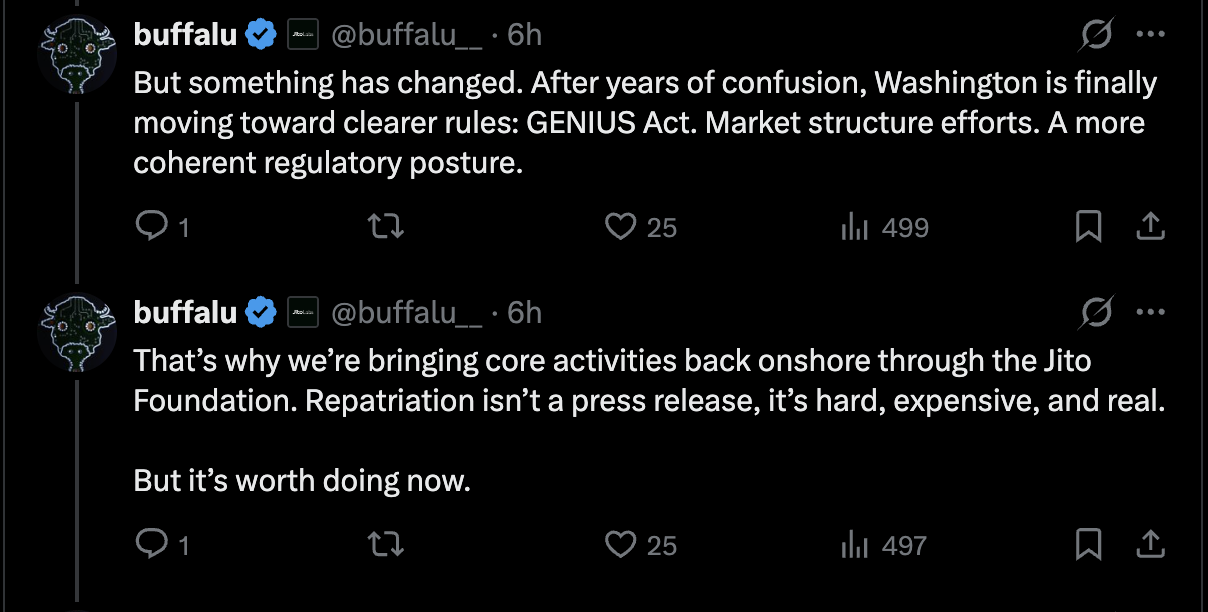
Source: buffalu

Bruder cited recent regulatory changes, including the passage of the GENIUS stablecoin bill and lawmakers working on a crypto market structure bill, as reasons for the Jito Foundation returning to the US.

The announcement reflects the regulatory sea change in the US, particularly at the Securities and Exchange Commission (SEC), following the 2024 presidential election and the appointment of Paul Atkins as SEC chair.

Related: ‘Grow up... We debank Democrats, we debank Republicans:’ JPMorgan CEO

Crypto industry executives say Operation Chokepoint 2.0 is ongoing in 2025

Even with a pro-crypto administration in the White House and at the SEC, crypto industry executives continue to report being victims of debanking.

In November, Jack Mallers, the CEO of Bitcoin Lightning Network payments company Strike, said JPMorgan Chase closed his personal bank account.

The financial services giant did not specify the reason for closing the account, Mallers said, adding that his father had been a private client for over 30 years.
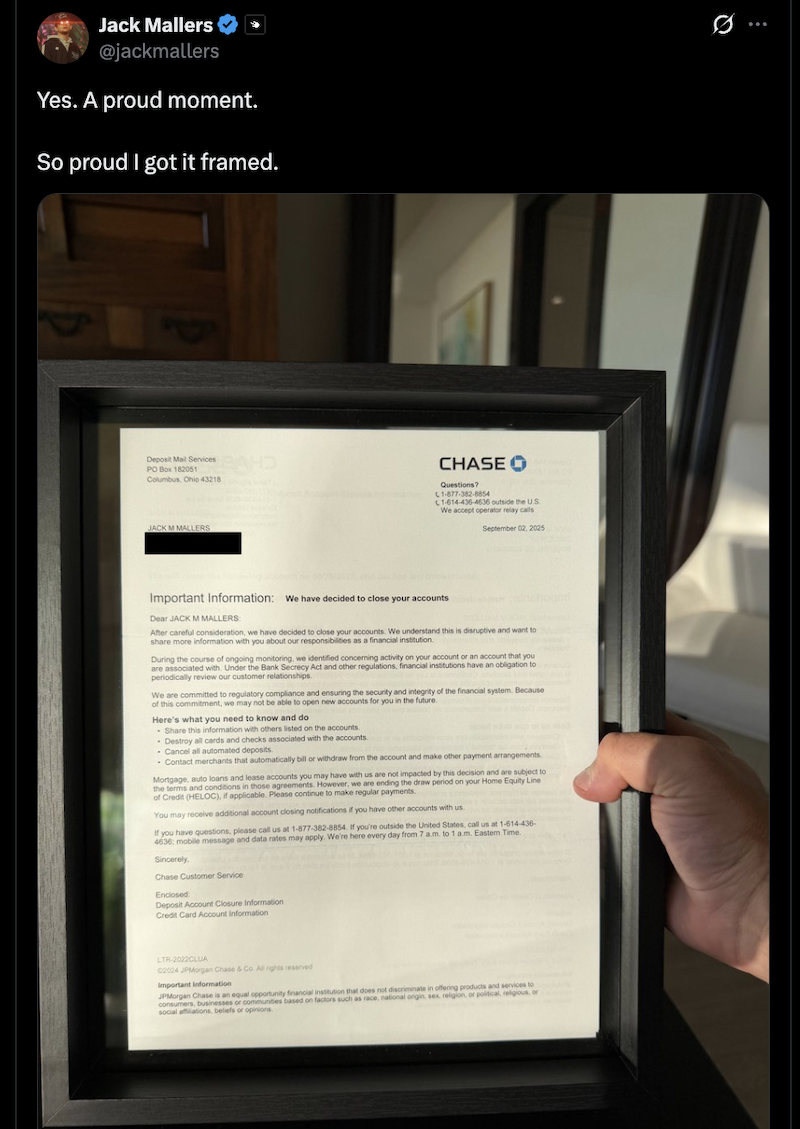
Jack Mallers shares a framed copy of the debanking letter he received from JPMorgan Chase. Source: Jack Mallers

In August, Alex Rampell, a general partner at venture capital firm Adreessen Horowitz, warned of the continuation of Operation Chokepoint by the banking industry through other tactics.

These tactics include banks charging excessive fees for clients moving crypto to wallets, centralized exchanges, Web3 applications and other digital asset service providers or outright blocking transfers to specific crypto platforms, Rampell said.

Magazine: Proton Mail exposing activists’ info showed the limits of encryption

Trending Cryptos

Related Reads

Refunds! Claude 4.8 Sees Overnight Major 'Dumb-Down', GPT-5.6's Computational Power Reportedly 'Halved'

The AI community is currently alarmed by widespread reports of significant performance degradation in two leading models. This article details a "mass self-testing frenzy" triggered by a mysterious prompt designed to detect a hidden "Juice" value, representing a model's reasoning compute budget. On OpenAI's side, users suspect a covert, limited test of a "GPT-5.6-sol" model is underway. When using a specific XML prompt on the Codex platform, a normal "gpt-5.5 xhigh" model reportedly returns a Juice value of 768. However, some users routed to the suspected GPT-5.6 test receive a drastically reduced value of 128—a six-fold decrease. This has sparked debate on whether it signifies a major efficiency leap or a "watered-down, low-cost version" achieved by slashing reasoning depth to save computational expenses. Simultaneously, Anthropic's Claude models, particularly the flagship Opus 4.8 Max, are facing intense user backlash for a perceived "physical brain cut." Users on platforms like Reddit report a dramatic decline in the model's once-impressive reasoning, with complaints of it becoming "absurdly" weakened, performing worse than older, lighter models like Haiku. Specific criticisms include: losing long-context memory, refusing to think deeply even in high-reasoning modes, providing instant incorrect answers, and engaging in unhelpful, argumentative, or "gaslighting" behavior where it contradicts users unnecessarily. The article speculates these "stealth downgrades" might be a calculated corporate strategy. Companies could initially release models with temporarily boosted compute to create an illusion of a major breakthrough, then silently scale back parameters later to manage unsustainable inference costs. A proposed underlying cause is a tightened funding environment, potentially exacerbated by SpaceX's massive IPO soaking up market liquidity, which could delay AI company IPOs and force cost-cutting measures like model "nerfing." The core issue highlighted is the asymmetry of information: subscribers pay for a service that can be silently and fundamentally altered without notification or explanation. The viral "Juice test" resonates because it represents users' desire for transparency about what they are actually paying for.

marsbit38m ago

Refunds! Claude 4.8 Sees Overnight Major 'Dumb-Down', GPT-5.6's Computational Power Reportedly 'Halved'

marsbit38m ago

Earning Six Figures and Still Struggling to Rent in San Francisco

A couple in San Francisco with a combined tech income over $360,000 struggled for months to find a one-bedroom apartment under $5,000 per month. Their story highlights how the AI wealth boom, driven by upcoming IPOs from companies like OpenAI and Anthropic, is dramatically escalating the city's cost of living. Even six-figure salaries are becoming insufficient for a comfortable lifestyle. The article details the financial reality for tech workers earning around $180,000 annually. After taxes, retirement contributions, and healthcare, take-home pay is roughly $7,000 per month. With average rents exceeding $3,800 and one-bedrooms often costing $4,500-$5,200, discretionary income shrinks to $1,500-$2,500. This contrasts sharply with reported median total compensations of $640,000 at OpenAI and $420,000 at Anthropic. The AI gold rush is identified as the primary driver. The scale of potential wealth from these IPOs, far surpassing previous tech booms, is flooding the housing market. Data shows San Francisco's average rent is now the highest in the U.S., with vacancy rates in desirable neighborhoods plummeting to around 3%. The overall cost of living is 65.6% above the national average. The piece features multiple professionals, including a 25-year-old with a $250,000 salary, facing housing instability, fierce competition for rentals, and a persistent, low-grade financial anxiety despite high earnings. It concludes that the rapid concentration of AI wealth is redefining what constitutes a "high salary" in San Francisco, pushing out mid-tier tech talent and creating a stark divide between those in the AI sector and everyone else.

marsbit2h ago

Earning Six Figures and Still Struggling to Rent in San Francisco

marsbit2h ago

Trading

Spot

Hot Articles

How to Buy US

Welcome to HTX.com! We've made purchasing Talus Network (US) simple and convenient. Follow our step-by-step guide to embark on your crypto journey.Step 1: Create Your HTX AccountUse your email or phone number to sign up for a free account on HTX. Experience a hassle-free registration journey and unlock all features.Get My AccountStep 2: Go to Buy Crypto and Choose Your Payment MethodCredit/Debit Card: Use your Visa or Mastercard to buy Talus Network (US) instantly.Balance: Use funds from your HTX account balance to trade seamlessly.Third Parties: We've added popular payment methods such as Google Pay and Apple Pay to enhance convenience.P2P: Trade directly with other users on HTX.Over-the-Counter (OTC): We offer tailor-made services and competitive exchange rates for traders.Step 3: Store Your Talus Network (US)After purchasing your Talus Network (US), store it in your HTX account. Alternatively, you can send it elsewhere via blockchain transfer or use it to trade other cryptocurrencies.Step 4: Trade Talus Network (US)Easily trade Talus Network (US) on HTX's spot market. Simply access your account, select your trading pair, execute your trades, and monitor in real-time. We offer a user-friendly experience for both beginners and seasoned traders.

5.0k Total ViewsPublished 2025.12.11Updated 2026.06.02

How to Buy US

Discussions

Welcome to the HTX Community. Here, you can stay informed about the latest platform developments and gain access to professional market insights. Users' opinions on the price of US (US) are presented below.

活动图片