Is There Really a "World Cup Curse" in the Market?

marsbitPublished on 2026-06-15Last updated on 2026-06-15

Abstract

Is there really a "World Cup Curse" affecting markets? Historical data shows global equity markets often underperform during the tournament. The S&P 500 has averaged negative returns of -1.5% to -2.11% across 19 World Cups since 1950, with declines in 58% of events. China's Shanghai Composite fell in 71% of tournaments since 1994. Studies confirm reduced trading activity during matches, with volumes dropping significantly, especially when a home nation plays. A team's loss can also lead to negative sentiment and selling pressure in its domestic market the next day. However, the "curse" may be partly attributed to seasonal weakness. Many tournaments are held in June-July, a historically weaker period for stocks ("Sell in May and go away"). The 2022 Qatar World Cup, held in November-December, saw a smaller drop in trading volume compared to summer events, suggesting timing plays a role. The cryptocurrency market's performance during World Cups has been mixed and largely driven by its own major catalysts (e.g., Mt. Gox hack, FTX collapse, halving cycles) rather than the tournament. Investment opportunities have shifted over time. Traditional beneficiaries like TV manufacturers have seen fading returns as streaming platforms become the core viewing channel. Classic consumer plays like beer and sportswear face challenges from changing consumption trends. Newer digital assets, like fractionalized collectible player cards on blockchain, have seen explosive growth. While gambling i...

The 2026 FIFA World Cup is set to kick off on June 11th. For a long time, a theory known as the "World Cup Curse" has circulated in the market, suggesting that during World Cup tournaments, major global stock markets often perform weakly, with trading volume significantly shrinking.

Whether you're ready with beer and peanuts to enjoy the matches or plan to trade in the market while watching, we can examine whether the "World Cup Curse" is a real phenomenon. What lies behind the data, and what are the reasons for this observed phenomenon?

Examining the "World Cup Curse" Through Data

Looking at historical data, the performance of major global stock markets during World Cup periods has generally been poor. Taking the US S&P 500 Index as an example, during the 19 World Cup tournaments from 1950 to 2022, the S&P 500's average expected return during the events was approximately -1.5% to -2.11%.
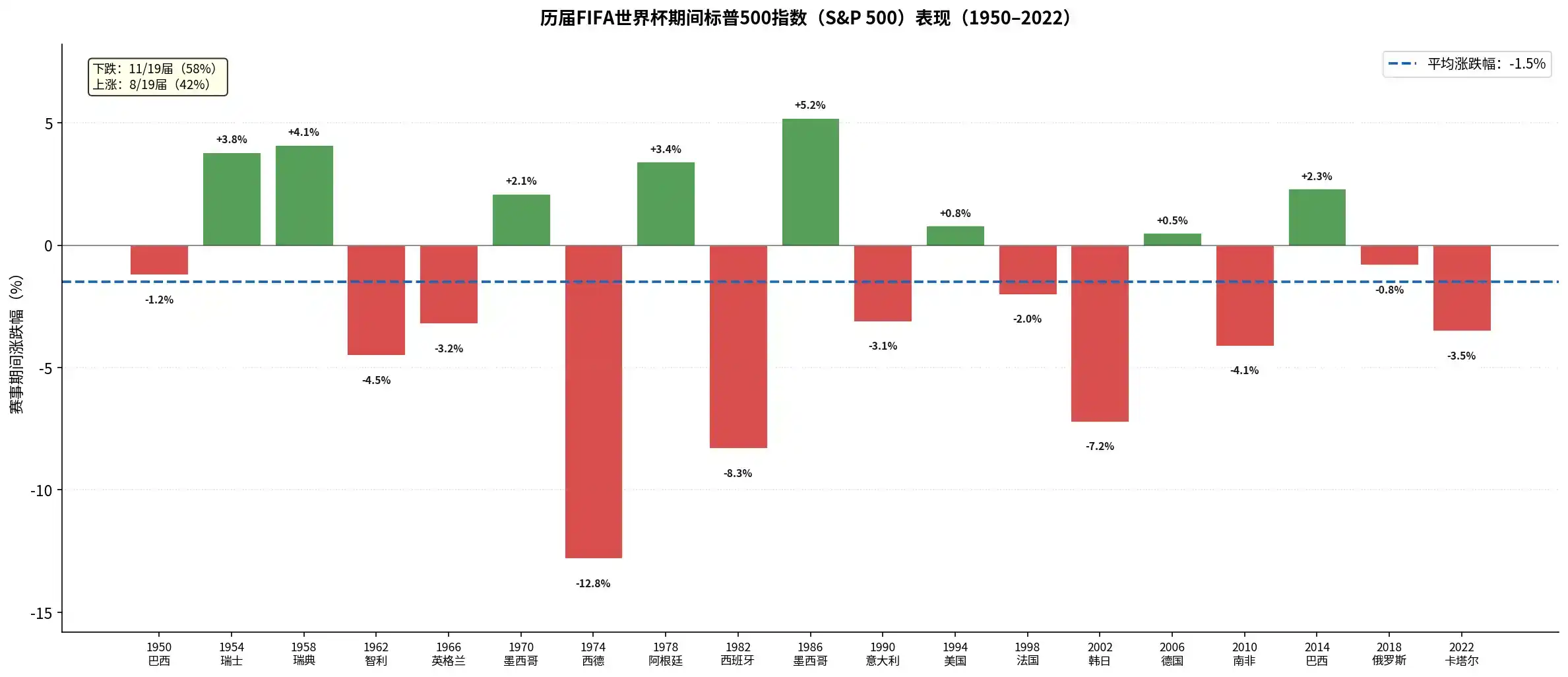
As shown in the chart above, the S&P 500 recorded negative returns in 11 out of the past 19 World Cups (a 58% rate). Notably, in recent years, US stocks declined during the 2010 South Africa World Cup (-4.1%), the 2018 Russia World Cup (-0.8%), and the 2022 Qatar World Cup (-3.5%).

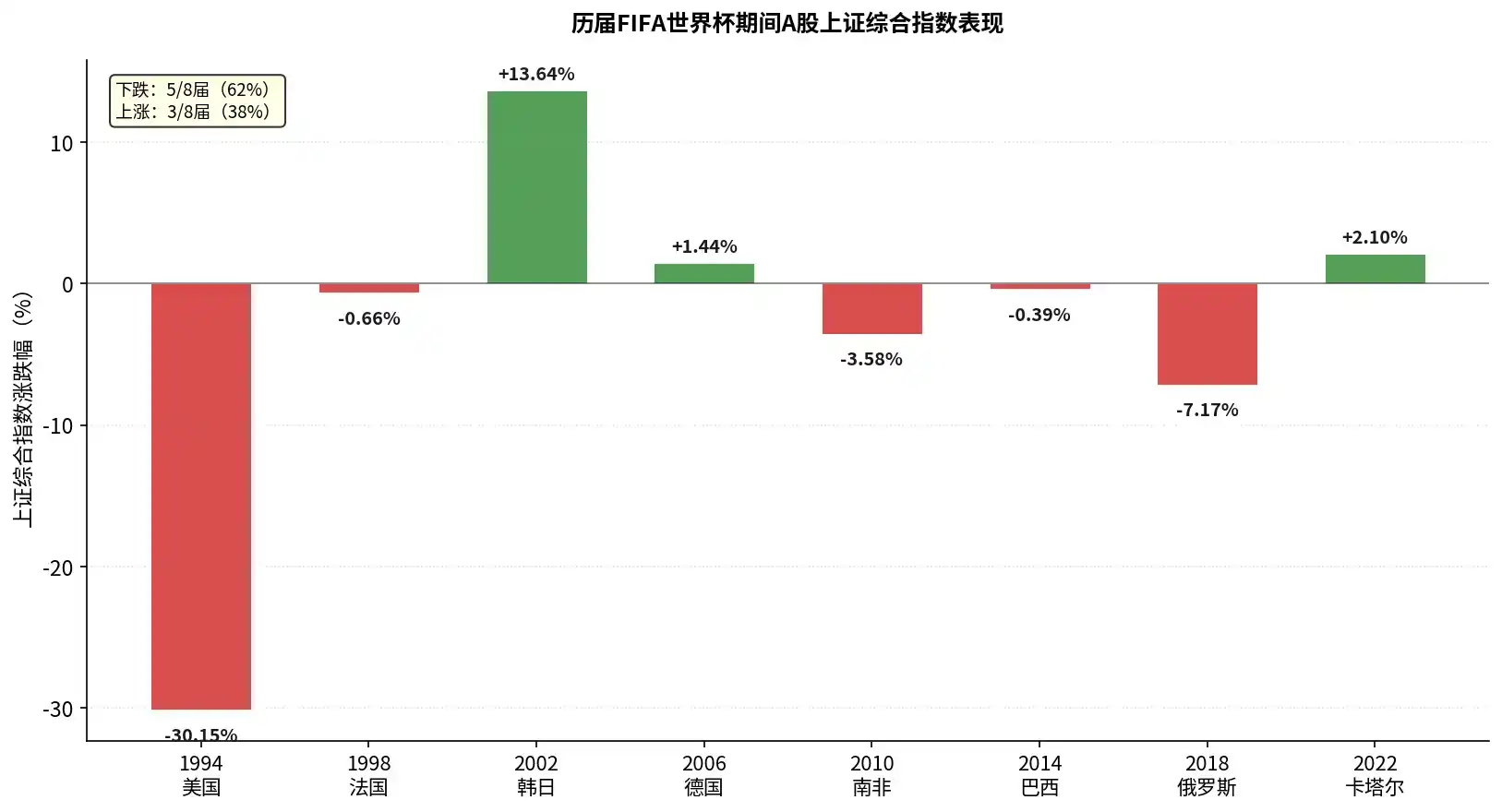
The A-share market has not been spared either. Statistics show that in the 7 World Cup periods since 1994, the Shanghai Composite Index fell 5 times, a decline probability as high as 71%. Among them, the index plunged 30.15% during the 1994 US World Cup and fell 7.17% during the 2018 Russia World Cup. It only posted gains during the 2002 World Cup (stimulated by favorable policies) and the 2006 World Cup (during a super bull market).
Now let's look at the cryptocurrency market:

- 2010 South Africa World Cup period: rose about 15%

- 2014 Brazil World Cup period: fell about 7.1%

- 2018 Russia World Cup period: fell about 16.5%

- 2022 Qatar World Cup period: rose about 4.3%

With the data presented, let's analyze the reasons.

Causes of the "World Cup Curse"

Does the World Cup really have a significant impact on market performance? It has an impact, but not a major one.

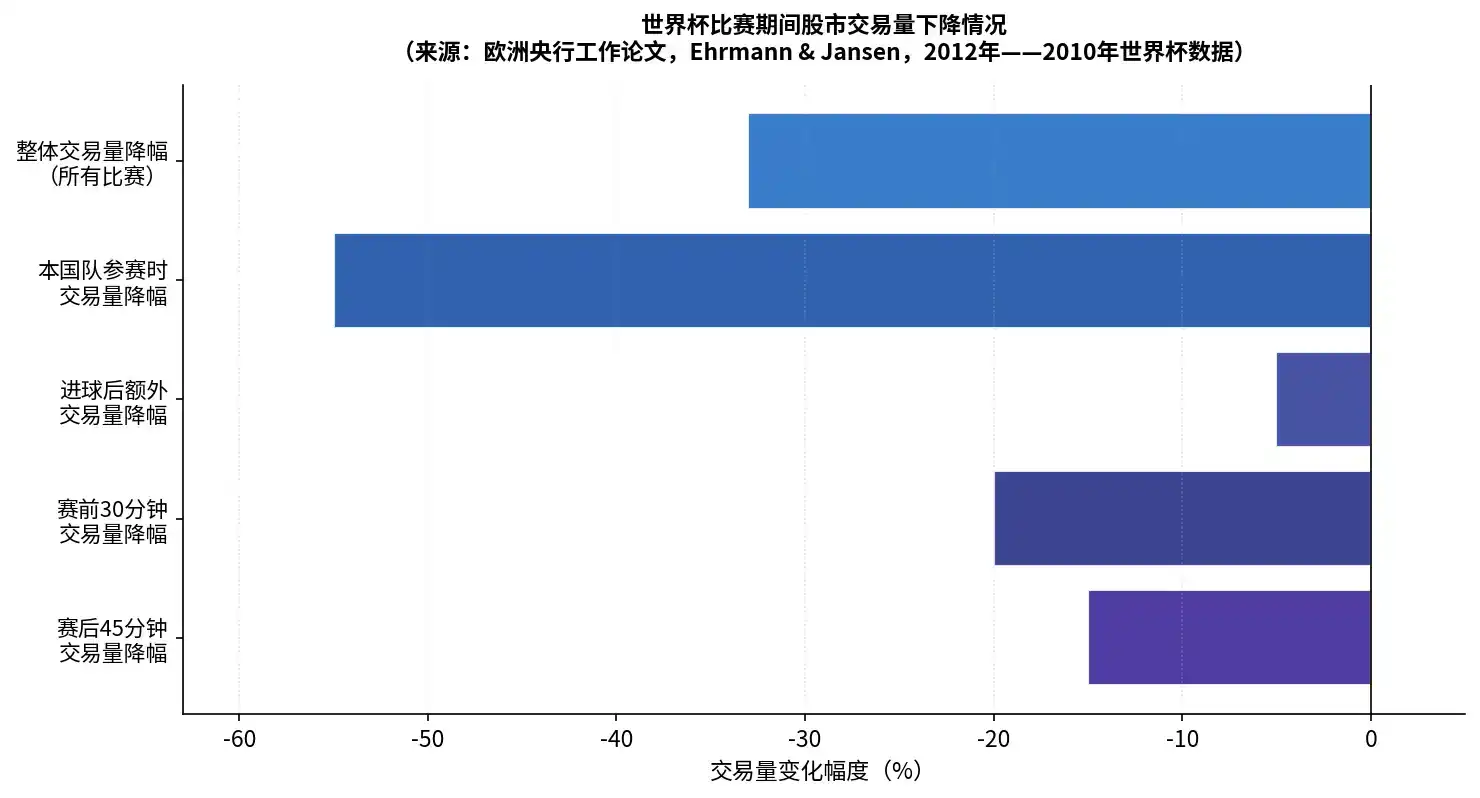
First, looking at the impactful part. A paper from the European Central Bank (ECB) analyzed minute-level trading data from 15 international stock exchanges during the 2010 World Cup. The study found that stock market trading activity indeed decreased during World Cup matches:

- Overall trading volume dropped by about 33% compared to normal levels.

- When the home country's national team was playing, trading volume plummeted by 55%, and the number of trades fell by 45%.

- Key events in matches (like goals) led to a further 5% drop in trading volume.
Match results also affect the mood of fans in various countries. Research found that when a country's national team lost a World Cup match, that country's stock market often showed significant negative abnormal returns on the next trading day (up to 49 basis points). This negative sentiment from a match loss does spill over into investment decisions, leading to market sell-offs.

But why is the impact considered not major? Wall Street has an old adage, "Sell in May and go away." The stock market itself exhibits seasonal patterns, with May through October typically being the weakest performance period of the year (especially June-August). Traditional summer World Cups (June-July) happen to fall within this seasonal lull window.
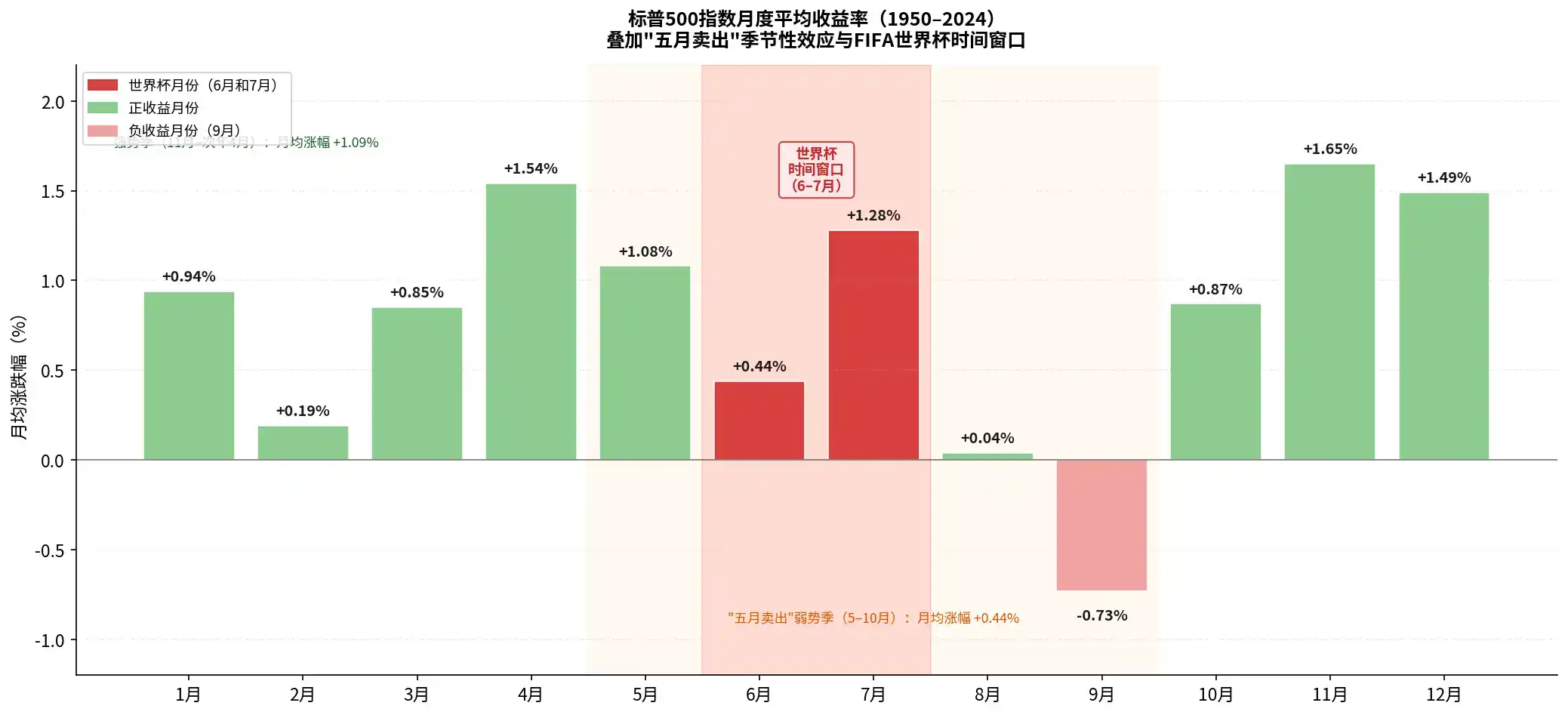
As shown in the chart above, among the average monthly returns throughout the year, June (+0.44%) and August-September are often the most lackluster or even negative months. This means traditional summer World Cups (typically held from mid-June to mid-July) coincide with the window in the year when the stock market has the least upward momentum.

The 2022 Qatar World Cup was the first World Cup historically held in the Northern Hemisphere winter (November-December). This unique timing provides a "controlled experiment" to test the above theory.
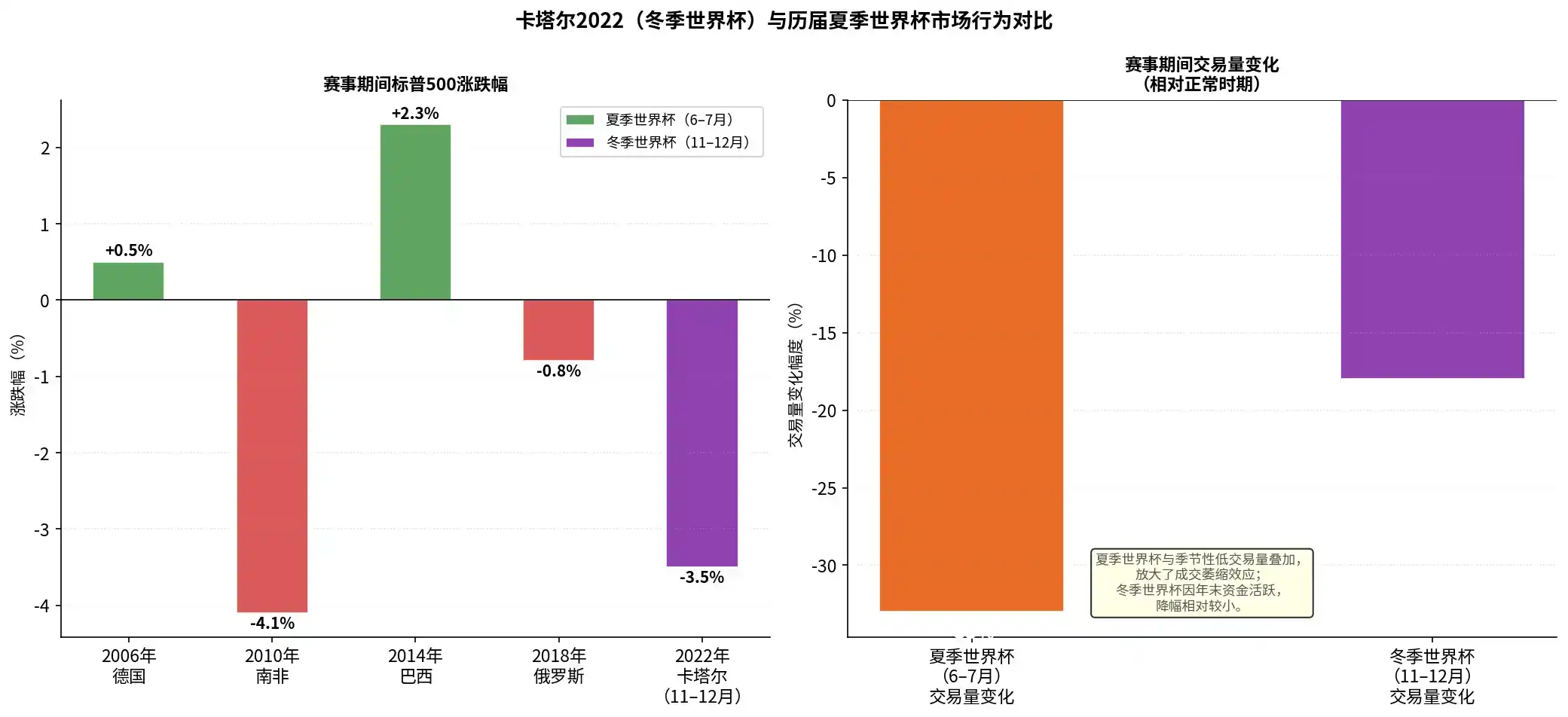
Although the S&P 500 still fell 3.5% during the Qatar World Cup (mainly driven by the Fed's aggressive rate hikes), looking at trading activity, the decline in trading volume during the winter World Cup (about -18%) was significantly smaller than during traditional summer World Cups (-33%). This suggests that when the World Cup is detached from the summer lull, its liquidity-draining effect on the market weakens. This also indicates that a significant portion of the "World Cup Curse" should be attributed to the seasonal low of June-July itself.

Compared to the stock market, the cryptocurrency market better proves that the World Cup's influence on markets isn't significant. From Bitcoin's inception to now, during the 4 World Cups, its price movements can actually be traced to more direct catalysts:

- 2010 South Africa World Cup: On May 22, 2010, a story we're all familiar with happened—programmer Laszlo Hanyecz used 10,000 bitcoins to buy two pizzas, completing Bitcoin's first real-world goods transaction, giving it initial real-world value consensus. Three days after the World Cup closing ceremony (July 17, 2010), the famous Mt.Gox exchange officially launched, marking Bitcoin's entry into the era of organized trading.

- 2014 Brazil World Cup period: Bitcoin was in a bear market following the burst of the 2013 bull market (which peaked above $1,100). In February 2014, Mt.Gox, then the world's largest Bitcoin exchange, declared bankruptcy after losing hundreds of thousands of bitcoins to a hack, dealing a devastating blow to the entire industry. During the World Cup, market sentiment remained fragile. Additionally, on June 27, the US Department of Justice auctioned nearly 30,000 bitcoins seized from the "Silk Road," further increasing selling pressure and uncertainty in the market.

- 2018 Russia World Cup period: A bear market adjustment following the end of the 2017 bull run. The ICO bubble had burst, and global regulation was tightening comprehensively. During the World Cup, the crypto market faced continuous negative news. On June 22, the major Korean exchange Bithumb was hacked, losing $30 million. In early July, the US SEC again delayed/rejected multiple Bitcoin ETF applications.

- 2022 Qatar World Cup period: In early November 2022 (the week before the World Cup opening), FTX collapsed. Meanwhile, the Fed announced a 50-basis-point rate hike on December 13, with continued tightening of macro liquidity, adding insult to injury.

It's also important to consider that Bitcoin, as an asset traded 24/7 globally, is less affected by traditional seasonal holiday patterns. Its own 4-year "halving cycle" is very pronounced. In the face of macro liquidity and its own cyclicality, the World Cup effect is essentially negligible.

Investment Opportunities During the World Cup

With technological advancement and changes in consumption habits, the landscape of World Cup beneficiary industries has changed over the past two decades (2006-2026).

In the past, we all watched the World Cup on TV. During the 2006 and 2010 World Cups, traditional TV and set-top box manufacturers often achieved significant excess returns.

But by the 2018 Russia World Cup, although traditional TV broadcasting rights revenue still accounted for a large portion, the excess returns for TV manufacturers had dropped to 0. By 2022, domestic TV sales during the World Cup decreased rather than increased, with the industry seeing both volume and price declines. Related listed companies' stock prices also underperformed the broader market.
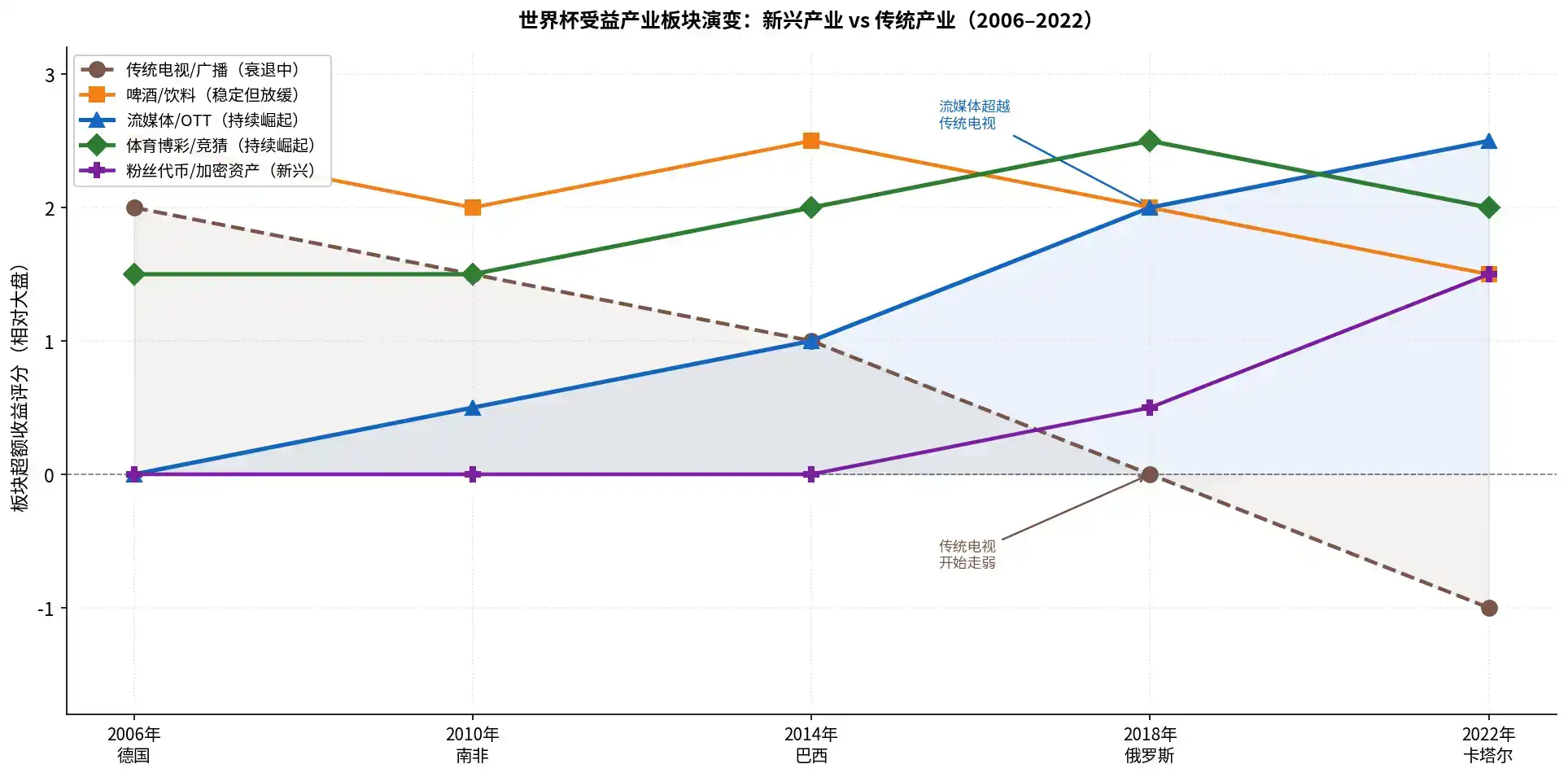
Streaming has officially replaced traditional TV as the core channel for watching the World Cup. The 2022 Qatar World Cup set a new record for streaming viewership. If you're bullish on World Cup viewership, perhaps more attention should be paid to streaming companies with exclusive broadcasting rights that can convert viewership into revenue.

Beer and sporting goods (like Nike, Adidas) are classic World Cup consumer categories, and their sector performance has been stable across past World Cups, but they also face slowing growth challenges in recent years.

Data from investment bank Jefferies shows that global beer sales grew by 3.6% during both the 2006 and 2010 World Cups. However, data from IWSR indicates that from 2014 to 2024, global overall beer consumption actually fell by 3%, with younger generations leaning more towards low-alcohol or alcohol-free beverages.

This means stocks like Budweiser and Tsingtao aren't hopeless, but new beverage stocks, new-style bars popular with young people, etc., might also perform well.

And compared to buying jerseys and shoes, young people might prefer trading cards, which can highlight advantages on-chain. For example, on the Base chain's fractionalized card platform Grail, the token price for Cristiano Ronaldo cards has surged nearly a hundredfold since May 5, and the token price for Kylian Mbappé cards has risen nearly 300-fold since May 5.

Sports betting is also a classic World Cup beneficiary sector, but the growth of prediction markets has been very rapid as well, though there aren't very good investment vehicles for prediction markets yet.

Conclusion

For a good World Cup viewing experience, stepping away from the market to relax is actually a good choice.

Israeli economists Guy Kaplanski and Haim Levy published a paper in the *Journal of Financial and Quantitative Analysis* in 2010 (cited over 261 times), which stated:

"The average return of the US stock market during World Cup periods is -2.58%, while the average return for all trading days in the same periods is +1.21%. The most natural investment strategy is to short stocks before the World Cup kicks off, which would further reinforce the stock price decline effect."

Although there's no famous instance of directly liquidating positions due to the World Cup, the World Cup window is indeed a period of poor liquidity. Regardless of the specific reasons for market movements being directly related to the World Cup, enjoying the World Cup itself might be the best defensive posture for facing a period of weaker market liquidity.

Related Questions

QWhat is the 'World Cup Curse' in financial markets, and what does historical data show about its effect on major stock indices?

AThe 'World Cup Curse' refers to the observed phenomenon where global major stock markets tend to underperform and experience a significant drop in trading volume during the FIFA World Cup tournament. Historical data shows that during the 19 World Cups from 1950 to 2022, the S&P 500 index had an average expected return of approximately -1.5% to -2.11%, with negative returns recorded in 11 out of 19 instances (58%).

QAccording to the article, what are the two main reasons discussed for the existence of the 'World Cup Curse'?

AThe article discusses two main reasons: 1) Direct impact: Reduced market activity as investor attention shifts to matches. Studies show trading volume drops significantly, especially during games involving the home country. Also, negative investor sentiment following a national team's loss can lead to selling pressure. 2) Seasonal factors: Traditional summer World Cups (June-July) coincide with a historically weak seasonal period for stock markets, such as the 'Sell in May and go away' pattern, which naturally depresses performance.

QHow did the 2022 Qatar Winter World Cup serve as a 'controlled variable experiment' regarding the curse?

AThe 2022 Qatar World Cup, held in November-December, served as a 'controlled variable experiment' because it was the first World Cup not held in the traditional summer period. While the S&P 500 still fell 3.5% (primarily due to aggressive Fed rate hikes), the decline in trading volume (about -18%) was significantly smaller than the average drop seen during summer World Cups (-33%). This suggests the seasonal market weakness in summer is a major contributing factor to the curse.

QWhat shift in beneficiary industries for the World Cup has occurred over the past two decades, as mentioned in the article?

AOver the past two decades (2006-2026), the beneficiary industry landscape has shifted from traditional TV and television set manufacturers to streaming media platforms. While traditional TV sponsorships were key in 2006-2010, by 2022, streaming platforms with exclusive broadcasting rights became the core channel for viewership. Traditional sectors like beer and sportswear remain stable but face growth challenges, while new trends like tokenized digital collectibles (e.g., crypto-based player cards) have emerged.

QWhat investment strategy is suggested by the research from Guy Kaplanski and Haim Levy, and what is the article's concluding advice for investors during the World Cup?

AThe research by Kaplanski and Levy suggests a natural investment strategy of shorting stocks before the World Cup begins, based on the historically negative average returns during the tournament. The article's concluding advice is that, regardless of the direct causal link to the World Cup, the period is characterized by lower liquidity. Therefore, disengaging from the market to enjoy the World Cup itself might be the best defensive stance for investors.

Related Reads

Do Robots Also Need Encrypted Wallets? Stablecoin Giant Tether Bets on German Company NEURA Robotics

Do Robots Need Crypto Wallets? Stablecoin Giant Tether Bets on German Firm NEURA Robotics German robotics company NEURA Robotics has secured up to $1.4 billion in what is claimed to be the largest-ever funding round in the full-stack robotics industry, valuing the company at $7 billion. The Series C round attracted major investors like Tether, Qualcomm, Amazon, NVIDIA, Bosch, and the European Investment Bank. NEURA, founded in 2019, initially focused on AI-powered collaborative robots (cobots) for industrial automation, later expanding to autonomous mobile robots, service robots, and humanoid robots. Its core strategy is evolving from a hardware manufacturer to the operator of "Neuraverse," a platform designed to enable different robots to share learned experiences and data, creating network effects. A key, crypto-focused aspect of this investment is Tether's involvement. Tether plans to integrate its open-source Wallet Development Kit (WDK) into NEURA's robot platforms. This would embed self-custody wallet functionality, allowing robots to autonomously handle payments and settlements for tasks under pre-set rules—envisioning use cases in logistics or Robotics-as-a-Service (RaaS) models. This move could position stablecoins and crypto wallets as potential "machine payment infrastructure." Additionally, the partnership will see Tether's QVAC (QuantumVerse Automatic Computer) edge-AI framework tested and deployed within Neuraverse. This aims to enable low-latency, offline-capable AI decision-making directly on robots, reducing reliance on cloud computing for critical, time-sensitive operations. The investment underscores Tether's broader ambition to expand beyond being just a stablecoin issuer into AI, energy, and digital infrastructure, with NEURA's robotics network serving as a testbed for merging crypto-based financial layers with edge-based intelligence for the future of automation.

marsbit15m ago

Do Robots Also Need Encrypted Wallets? Stablecoin Giant Tether Bets on German Company NEURA Robotics

marsbit15m ago

AMD Launches Compact AI Host, Directly Challenging NVIDIA DGX Spark

In June 2026, AMD announced the Ryzen AI Halo, a compact AI developer desktop to rival NVIDIA's DGX Spark. Both feature 128GB unified memory for running 200B+ parameter models locally. Priced from $2,949 to $3,999, AMD undercuts NVIDIA's $3,999+ DGX Spark. The core divergence lies in architecture and philosophy. Ryzen AI Halo uses an x86-based Ryzen AI Max+ 395 APU (CPU+GPU+NPU), runs standard Windows/Linux, and emphasizes general-purpose PC flexibility. DGX Spark uses an ARM-based Grace Blackwell Superchip, runs a custom DGX OS, and includes a high-speed ConnectX-7 NIC for cluster prototyping, anchoring it to NVIDIA's full-stack CUDA ecosystem. AMD's ROCm software has improved, with simpler installation and support for major frameworks, but still lags behind CUDA's 17-year maturity in community support and cutting-edge library availability. AMD's broader strategy focuses on becoming a viable second-source supplier. Key moves include acquiring design capabilities via ZT Systems (while outsourcing manufacturing) and securing two major 6GW GPU supply deals with OpenAI and Meta in late 2025/early 2026. These contracts validate AMD's role in diversifying the AI supply chain, rather than outright beating NVIDIA. NVIDIA counters with a tightly integrated stack from desktop (DGX Spark) to data center, emphasizing seamless scalability and enterprise software subscriptions (AI Enterprise). In summary, Ryzen AI Halo represents AMD's pragmatic path: offering a cost-effective, open-ecosystem alternative for developers wary of vendor lock-in, while its large data center contracts aim to capture share from customers seeking a second GPU supplier. The choice boils down to a familiar, flexible PC environment with potential software gaps (AMD) versus a premium, optimized, but locked-in ecosystem (NVIDIA).

marsbit15m ago

AMD Launches Compact AI Host, Directly Challenging NVIDIA DGX Spark

marsbit15m ago

Sharplink CEO: One Million Ethereum Developers, Who Can Compete?

Etherean Ecosystem: One Million Developers and a Formidable Moat The Ethereum network has surpassed a significant milestone: over one million unique lifetime developers, with approximately 232,000 active in the past year. This vast and growing talent pool is Ethereum's core advantage, far more critical than transient metrics like speed or transaction fees. The central question is not which blockchain is fastest, but where the best builders choose to build long-term. Ethereum's answer lies in a decade-long accumulation of infrastructure, standards, tools, liquidity, and collaborative culture that is exceptionally difficult to replicate. It has become the default operating system for programmable finance. This massive developer base is actively working on complex, high-risk challenges that deepen Ethereum's strategic moat: * **Glamsterdam Upgrade (2026):** Focused on core protocol scalability (ePBS, parallel execution) while preserving core values like credible neutrality. * **Synchronous Composability:** Aims to make numerous Rollups interoperate like a single chain, directly addressing fragmentation concerns. * **Quantum Resistance:** Ethereum leads mainstream ecosystems in coordinated preparation for post-quantum cryptography, with a targeted migration plan around 2029. This developer advantage is self-reinforcing, fueled by: * **Deep Composability:** Applications interact like interoperable financial Lego bricks via shared standards (e.g., EVM, Solidity). * **Credible Neutrality:** Secured by over 900,000 validators, making it trusted by major institutions. * **Modularity:** Rollups (Base, Arbitrium, etc.) expand, rather than fracture, the ecosystem into a tightly connected modular internet economy. * **Culture:** Attracts top-tier researchers and standard-setters who guide the entire industry. In essence, while other chains generate activity, Ethereum is consolidating as the trusted, long-term coordination layer for internet-native finance. Its future is being built now by the architects of the next-generation financial infrastructure.

Odaily星球日报1h ago

Sharplink CEO: One Million Ethereum Developers, Who Can Compete?

Odaily星球日报1h ago

Ethereum Reaches the Milestone of One Million Developers, Sharplink CEO Delves Deep into Ethereum's Future Possibilities

Ethereum Surpasses One Million Developers Milestone: A Look at Its Unshakeable Dominance and Future Joseph Chalom, CEO of Sharplink, reflects on his recent Asia trip where he engaged deeply with Ethereum developers and ecosystem leaders. The most striking takeaway was not just the industry's vibrancy, but the rigorous, long-term vision of local builders. This context brings to life a pivotal statistic: Ethereum has now surpassed one million cumulative developers (1,012,824), with approximately 232,000 remaining active in the past year—a talent pool unmatched by any other crypto ecosystem. The critical question isn't which blockchain is fastest, but where top developers choose to build long-term. Ethereum's answer is unequivocal. Its decade-long lead stems from a unique convergence of technology, institutional culture, economic systems, and composability, cementing its role as the foundational operating system for programmable finance. This massive developer base is tackling the industry's hardest problems, continuously strengthening Ethereum's moat. Key initiatives include: * **The Glamsterdam Upgrade (planned 2026):** Introducing ePBS and Block-level Access Lists for parallel execution and higher throughput while preserving core values like credible neutrality and fair MEV distribution. * **Synchronous Composability:** Projects are working to enable atomic transactions across dozens of Rollups, making them function as one unified chain and eliminating ecosystem fragmentation. * **Post-Quantum Security:** Ethereum is far ahead in preparing for quantum computing threats, with a dedicated foundation working group and testnets targeting a full migration by ~2029—a crucial factor for institutional adoption. Beyond developers, Ethereum's core network effects are its unparalleled composability and unified standards (like EVM and Solidity), which create a powerful flywheel: more developers → better tools → greater liquidity → more institutional participation. Its other decisive advantages include credible neutrality (over 900k validators), a secure modular architecture with interconnected Rollups, and a deeply entrenched culture shaped by top-tier researchers. Ultimately, there's a vast difference between generating short-term activity and becoming the trusted, long-term coordination layer for global native finance. Major institutions prioritize security, trust, and liquidity—areas where Ethereum holds dominant mindshare. The industry's trajectory shows resources consolidating around unified standards, deep liquidity, and developer consensus. After meeting the builders in Seoul and Hong Kong, Chalom is more convinced than ever: Ethereum's unshakeable future is being built right now.

Foresight News1h ago

Ethereum Reaches the Milestone of One Million Developers, Sharplink CEO Delves Deep into Ethereum's Future Possibilities

Foresight News1h ago

Saylor's Latest Long Read: Bitcoin is Not Money, It's Digital Capital, and Money is Built Upon It

Michael Saylor presents his "Digital Asset Stack" theory, positioning Bitcoin as the foundational layer of digital capital. He argues Bitcoin itself should remain unchanged—no staking, inflation, or protocol alterations. Instead, a five-layer financial architecture should be built atop it: Digital Capital (BTC), Digital Credit (e.g., yield instruments like STRC), Digital Currency (stable, yield-bearing instruments pegged to fiat), Digital Yield (leveraged/structured products), and Digital Equity (e.g., MSTR stock, absorbing residual volatility). Saylor asserts this stack transforms Bitcoin's high-volatility, high-energy capital into tailored products: stable currencies for payments/savings, yield instruments for income seekers, and equity for growth investors. This approach meets diverse needs—corporate treasuries, banks, retirees, emerging market users—without compromising Bitcoin's core properties (scarcity, decentralization). The "killer use case" is rebuilding global money, credit, and capital markets on Bitcoin, bridging the fiat world with a superior digital asset foundation. The system leverages traditional finance principles (risk layering, structured products) while using Bitcoin as the ultimate collateral. This expands Bitcoin's utility, drives adoption, and offers a better monetary experience: digital, yield-bearing, stable-value tools for everyday use.

marsbit1h ago

Saylor's Latest Long Read: Bitcoin is Not Money, It's Digital Capital, and Money is Built Upon It

marsbit1h ago

Trading

Spot
Futures
活动图片